


Oct 4, 2025 5:00 PM
Femicide is not merely a crime but a profound socio-political crisis. Its eradication requires dismantling gender inequality, enforcing protective laws, and challenging misogynistic cultural norms.
Femicide, the killing of women because of their gender, represents one of the most extreme forms of gender-based violence. Rooted in entrenched patriarchal and misogynistic structures, it reflects a system in which women’s lives are devalued, control over them is normalized, and violence is legitimized when they resist social norms. Femicide is not an isolated act but the fatal culmination of systemic inequalities and cycles of violence.
Global Context
Patriarchal norms that position women as subordinate or as men’s property remain the primary drivers of femicide. Economic dependence further traps women in violent relationships and exposes them to fatal risk. Cultural practices such as “honor killings” and dowry-related murders reinforce these dynamics. Legal gaps, impunity, and weak enforcement exacerbate the crisis. In many states femicide is not recognized as a distinct crime, and even where laws exist, enforcement is inconsistent. Latin America, despite progressive legal frameworks, continues to witness widespread impunity, with women killed symbolically and systematically, often in connection with organized crime and militarized conflict.
Insufficient data and misclassification of cases (e.g., labeling femicides as suicides) obscure the true scope of the phenomenon and weaken accountability mechanisms. Still, available statistics are alarming: according to the UN, in 2023 approximately 85,000 women were intentionally killed. While slightly fewer than 2022, intimate partner and family-related femicides increased, confirming that for many women the home remains the most dangerous place.
Regional Trends
Femicide rates vary across regions. Latin America and the Caribbean record the highest incidence globally. In Mexico, female killings rose by 135% between 2015 and 2021, a trend linked both to worsening violence and to feminist advocacy that increased visibility of the issue. The “Ni Una Menos” movement gained momentum after COVID-19, which itself intensified femicide by confining women with abusers and cutting off support services. In Europe, Spain’s rate escalated from one per week to one every three days in 2021; Italy reported a 16% annual increase. In the Middle East, hundreds of women are killed annually in “honor killings”; in Iran, estimates range from 375 to 450 cases per year.
Related stories
Typologies of Femicide
Scholarly and institutional research now categorizes femicide into several forms:
- Intimate partner femicide: killings by current or former partners, often following coercive control or separation attempts.
- Family femicide: killings by non-partner relatives, including “honor killings,” dowry-related murders, and inheritance disputes.
- Non-family femicide: killings by acquaintances or strangers, often involving sexual violence, jealousy, or retaliatory motives.
- Culturally justified femicide: killings framed as socially sanctioned, including honor crimes, dowry deaths, and female infanticide.
- State-related femicide: killings by security forces or deaths resulting from state negligence, impunity, or systemic failure.
- Identity-based femicide: killings of lesbian, bisexual, or transgender women (transfemicide).
- Conflict-related femicide: killings during wars or armed conflicts, including genocidal sexual violence (e.g., Yazidi women under ISIS).
- Organized-crime femicide: killings linked to gangs, drug trafficking, or human trafficking, particularly in Latin America.
According to UNODC (2022), over 55% of female homicide victims were killed by intimate partners or family members, compared to only 11% of male victims.
Strategies for Prevention
Effective prevention requires structural, legal, and cultural change. Key strategies include:
- Explicit criminalization of femicide and gender-based violence.
- Stronger enforcement of protective laws and survivor-centered justice.
- Standardized national definitions aligned with international norms.
- Early intervention in domestic violence cases, including risk assessments and safety planning.
- Expansion of shelters, protective services, and economic support for at-risk women.
- Legal, psychological, and financial aid for survivors.
- Public education to challenge patriarchal norms and gender stereotypes.
- Engagement of men and boys in prevention efforts.
- Systematic data collection, monitoring, and establishment of femicide observatories.
- International cooperation to develop shared standards.
- Coordination between governments, law enforcement, health systems, education, and civil society.
- Increased funding and political will to empower women and reduce violence.
Femicide is not merely a crime but a profound socio-political crisis. Its eradication requires dismantling gender inequality, enforcing protective laws, and challenging misogynistic cultural norms. Without structural and cultural transformation, femicide will persist as a global human rights emergency.
Femicide in Iran
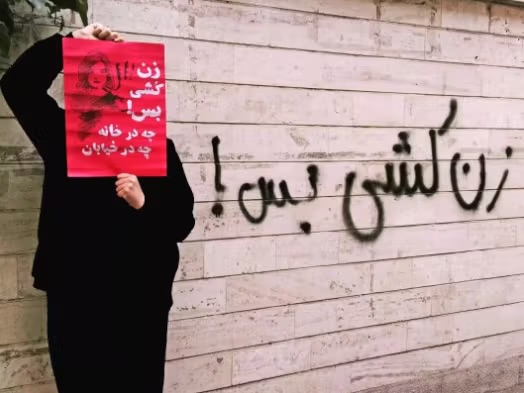
Among the various forms of femicide in Iran, so-called “honor killings” remain the most prevalent. In addition, the execution of women places Iran at the top of some international rankings. Other forms of femicide observed globally are less common in the Iranian context.
Honor killings in Iran typically combine intimate partner femicide and family femicide. Husbands often kill their wives, or fathers and brothers murder daughters and sisters under the pretext of preserving family “honor.” Another dimension of this phenomenon involves coerced or induced suicides, where women are driven to take their own lives under family and social pressure. These deaths are in effect hidden forms of honor killing, yet official records frequently categorize them as “suicides,” thereby obscuring domestic violence and the patriarchal structures that sustain it. Thus, honor killings in Iran are not isolated family tragedies but manifestations of structural femicide rooted in discriminatory laws, patriarchal traditions, and the state’s role in reproducing violence. This pattern reveals femicide in Iran as a social, legal, and political crisis closely tied to power and governance.
The weak media coverage and lack of transparent data on honor killings in Iran directly stem from the misogynistic structures of the Islamic Republic and its policies of censorship. Several interrelated factors drive this dynamic:
- Media censorship and control: State-controlled media avoid reporting cases that reflect negatively on the legal system or governance. Honor killings, particularly those involving husbands or male relatives, rarely appear in national outlets and are confined to local news or social media.
- Discriminatory laws legitimizing violence: The penal code (e.g., Article 630) allows a husband to kill his wife and her partner if caught in adultery, exempting him from retribution under certain conditions. In many honor killings, fathers or brothers, as the “guardians of blood,” waive retribution, reducing sentences to minimal penalties. Such legal loopholes facilitate recurrence, while authorities resist reform.
- Patriarchal ideology and the proprietary view of women: In official discourse, women are framed not as autonomous citizens but as family “honor” and instruments of “social control.” Publicizing honor killings risks undermining this ideological framework, so the state prefers to downplay them as “private” or “domestic” matters.
- Fear of public backlash: Highly publicized cases such as those of Romina Ashrafi and Mona Heydari provoked widespread outrage, transforming individual tragedies into critiques of the legal and cultural order. The state seeks to prevent such mobilization.
- Erasure of the problem: Discrepancies between official statistics and independent reports (e.g., sudden unexplained drops in monthly figures) reveal systematic efforts to minimize or conceal the scope of the crisis.
As a result, femicide in Iran is not framed as a matter of family violence alone but as a political–social crisis that mirrors the power relations and ideology of the state. While official statistics remain opaque, scattered reports suggest that dozens, if not hundreds, of women are killed annually in honor-related or domestic violence. Women’s rights activists reported alarming increases in 2024, yet the cases reaching public attention represent only the tip of the iceberg, as many killings remain hidden. Reports further indicate that husbands are responsible for the majority of these murders.
From the beginning of 2025 to mid-September alone, at least 108 cases of femicide have been documented. Independent reports estimate even higher figures—127 cases—contrasted with an official July statistic of only 40, illustrating state censorship and lack of transparency. Historical research places annual femicides between 375–450 cases before 2021, with provinces such as Kurdistan, Khuzestan, Ilam, and Sistan-Baluchestan reporting the highest prevalence. The names of victims such as Romina Ashrafi and Mona Heydari have become lasting symbols of a profound social crisis.
In contemporary Iran and parts of West and South Asia, femicide cannot be explained solely as patriarchal family violence; it also reflects widening generational divides. Younger women and girls, increasingly connected to global conversations on dignity, gender equality, and freedom through digital platforms, challenge rigid family and state controls that treat them as bearers of “honor” rather than as independent individuals. This generational and digital gap fuels conflict within families: urban youth with access to smartphones and online communities envision alternative lives, while traditional households—often lacking comparable digital literacy—respond with heightened surveillance and control. In such contexts, violence is justified as a defense of “cultural authenticity.” The state’s repressive, patriarchal policies intensify these tensions, criminalizing autonomy while legitimizing violence through law and practice.
The Iranian legal system exemplifies what feminist scholar Kate Manne calls “himpathy”—legal and cultural sympathy directed toward male perpetrators rather than female victims. Concepts such as “honor” and “ghayrat” are institutionalized in law, effectively naturalizing violence against women in the name of protecting family dignity. By embedding this gendered leniency in judicial structures, the state sustains the cycle of femicide.
In sum, femicide in Iran is not reducible to family or cultural traditions; it is a systemic phenomenon situated at the intersection of authoritarian governance, patriarchal ideology, and generational change. A smartphone in a girl’s hand or a social media post becomes more than personal expression—it is construed as a threat to both familial authority and state ideology. When both family and state cling to regressive patriarchal authority, the deepening digital and generational divides can have deadly consequences. Addressing femicide thus requires not only legal reform and protective policies but also recognition that digital freedoms and intergenerational dialogue are essential tools for dismantling the structures enabling gender-based killings.
Comments

Powered by RoundtableAn AI/DeFi-powered Enterprise Media Operating System. Learn more at Roundtable.io.© Roundtable 2026. By using this site you agree to the Terms of Use and Privacy Policy