


May 23, 2024 4:33 PM
Updated May 28, 2024 6:03 PM
The hallowed tradition of freedom of speech on university campuses is being challenged across the nation. Why?
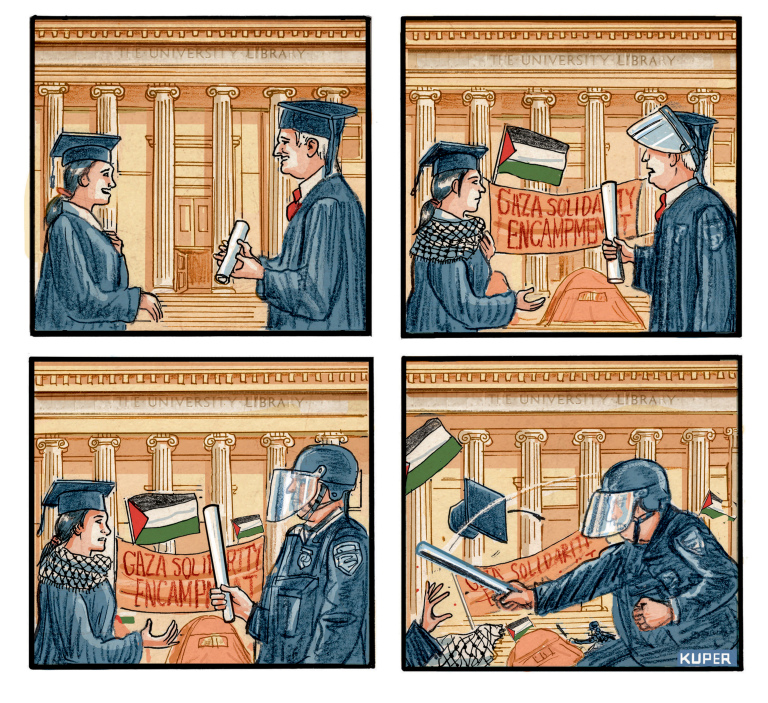
What happened at Columbia University and later at other universities around the nation started as a peaceful demonstration on the part of Columbia’s students protesting the killing in Gaza of over 34,000 innocent Palestinians, many of whom were women and children.
It goes without saying that these students felt morally outraged and justified in expressing their deepest abhorrence at what was unfolding in that part of the world. Moreover, they wanted to wake up our country to this horror to bring pressure to bear on our government to prevail upon Israel to stop the carnage. What they were doing was a profoundly moral act that took courage and speaks volumes about the idealism of youth, and America is deeply in their debt.
However, what was Columbia’s response? To call in the New York City Police Dept., whose officers arrested over one hundred of these students for doing what they believed was both morally right and in keeping with the hallowed tradition of freedom of speech on a university campus.
Nor was it in any way an antisemitic protest against the Jewish people, as some would have us believe, but a protest against the political leaders of Israel at the needless slaughter they had unleashed. In fact, there were even large segments of the Jewish people in Israel who were themselves protesting the slaughter, as well as American Jews who were also raising their voices in protest against what Israel was doing.
Related stories
What many in our country and the world don’t understand is why President Biden, a good and decent man, has been aiding and abetting Israel’s slaughter of Palestinian civilians by providing additional arms to Israel instead of bringing strong political pressure to bear on Prime Minister Netanjahu to stop the massacre.
So incensed were they at what they saw as President Biden’s complicity in this genocide that many refuse to vote for him in the coming election, which, though understandable, would be terribly short-shorted since it might hand the upcoming presidential election to Trump, which would be utterly catastrophic for both our country and the world.
What politicians of both our major political parties don’t seem to grasp is that millions of young American voters today are so profoundly disgusted with every form of injustice in our country that they refuse to tolerate it any longer by voting those who hold such views out of office.
As to Columbia University President Minouche Shafick’s calling the New York City Police, either she was unaccountably unaware of the tradition at American universities to permit peaceful demonstrations about issues that deeply matter to their students or, worse, chose to ignore that tradition due to political pressure, thereby losing the trust of both students and faculty.
Colleges and universities serve many purposes, but their very soul is being temples of reason where every viewpoint is welcomed in a spirit of tolerance and open-mindedness, but those viewpoints must prove themselves by evidence in the cauldron of debate.
Politics, ideology, party loyalty, prejudice, tradition, Groupthink, and philanthropy (as a Trojan horse for controlling curriculum or silencing future criticism) have no place within these hallowed precincts.
This ideal has always been the pride of these sanctuaries of learning, which ensure that free and open discussion can thrive both in and out of the classroom when, for example, guest speakers are invited to address issues of the day.
These invitations do not, of course, imply that these institutions necessarily agree with these speakers, but only that they take seriously their obligation to expose their students to a diversity of opinion.
And why do they do this? Because being open to every viewpoint is the only way to truth, unless, of course, one already possesses the truth, which is itself a dangerous viewpoint, since it conjures up the shade of Dostoevsky’s iniquitous Grand Inquisitor.
Not that students should accept or reject what these guest speakers are saying, but that they only give them a fair hearing for two reasons: to show respect to these speakers as human beings and guests of the university, and to uphold the right of freedom of speech not only for the ideas we accept, but also, and much more importantly, for those we reject.
This right of freedom of speech is the principle that every viewpoint has the right to be heard and given a chance to make its case rather than being censored or silenced, a view that received its classic formulation and defense in John Stuart Mill’s celebrated work On Liberty.
We do this for our own protection, for if we silence ideas we find offensive, there may come a time when we, too, may be silenced for our beliefs, and so to protect ourselves in advance against this intolerance, we extend the same tolerance we would wish for ourselves to those whose beliefs we don’t accept.
As Voltaire said about the French philosopher Helvetius, although he disapproved of what he had written, he would defend to the death his right to say it. No matter whether this story be apocryphal or not, the principle still holds — no idea should be denied a hearing, no matter how offensive, not because we agree with it, but because those who do, have the right to express it.
Freedom of speech, then, is not only for our ideas, but for all ideas. It is for everyone or no one, and includes both the ideas we approve, as well as those we abhor. This is the crux of the matter that some college and university students and even university presidents today don’t understand.
University presidents who protest against their students holding a peaceful demonstration about an issue they feel is deeply immoral don’t seem to grasp this elementary principle that all points of view must be allowed to take place. If they presume to deny students this right, they censor free speech and set themselves up as Inquisitors who deny them this right.
They become the enemy of reason and free speech itself by denying those with whom they disagree the chance to state, explain, and defend their views. Unless one understands and accepts this principle, one can turn a college or university into an Inquisition Chamber where no ideas are safe except one’s own, an alarming event at any institution of higher learning in a democracy.
However, this especially applies to university presidents themselves because they should know better. By what right do these presidents silence the free speech or the peaceful demonstrations of their students?
One could understand that some members of the community within which a university is situated might misunderstand the purpose of such peaceful demonstrations, but that a university president herself should call in the police to end such a demonstration is an extraordinary commentary on such a president. It would mean that she herself doesn’t understand what the life of the mind is about or the purpose of an institution of higher learning in a free and open society.
And should violence then occur from such police intervention, the blame would lie solely with the police themselves and the ill-advised decision by that university president.
The issue here is freedom of speech, which an institution of higher learning should be celebrating and proud of having such students of moral integrity, not castigating them and calling the police to arrest them.
Comments

Powered by RoundtableAn AI/DeFi-powered Enterprise Media Operating System. Learn more at Roundtable.io.© Roundtable 2026. By using this site you agree to the Terms of Use and Privacy Policy