


Jul 28, 2026 8:44 PM
Updated Jul 28, 2026 8:55 PM
The island’s corruption scandals and institutional failures cannot be separated from its unequal and undemocratic relationship with the United States.
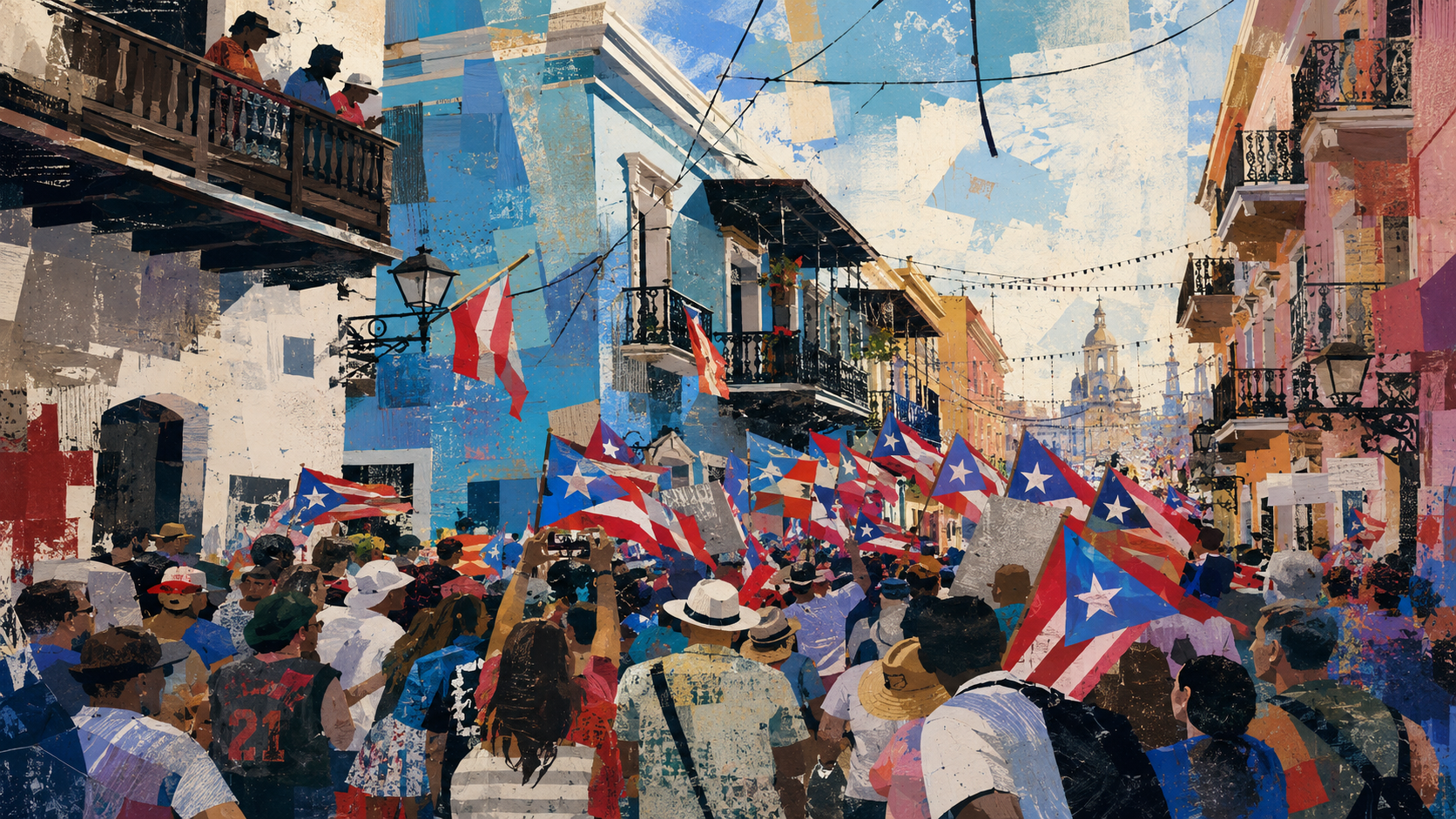
The streets of Old San Juan are once more alive with Puerto Rican flags, chants protesting corruption, and public outrage aimed at the colonial political leadership that governs the island under U.S. authority.
On May 30th and 31st, thousands of Puerto Ricans protested across Puerto Rico, and many marched to La Fortaleza, the governor’s mansion in San Juan, in one of the largest anti-colonial protests since the Summer of 2019, which led to former Governor Ricardo Rosselló's resignation. What started years ago as frustration over corruption and poor governance has grown into a broader anti-colonial movement driven by economic hardship, institutional failure, and a significant disillusionment with Puerto Rico’s political system.
The protests mainly targeted Governor Jenniffer González-Colón's administration and her pro-statehood New Progressive Party (PNP), which has faced scandals, resignations, and accusations of electoral fraud and corruption. Demonstrators highlighted issues such as increasing poverty, unemployment, gentrification, deteriorating public services, and what many see as a colonial government maintained through patronage, fear, and political immunity. The Democracy Perception Index 2026, a report compiled by the Alliance of Democracies, shows that Puerto Rico has the lowest perception globally of government transparency and ranks near the bottom for optimism about the country's future. For Puerto Ricans, this is no surprise.
Recent investigative reports about alleged electoral misconduct in Puerto Rico have particularly angered its people. A major investigation by ProPublica claimed that federal investigators found a “drugs-for-votes” scheme within Puerto Rico’s prison system, involving gang leaders and prison staff who supposedly distributed narcotics to inmates in exchange for votes backing González-Colón’s candidacy. The report states that investigators believed they had strong evidence and were ready to pursue wider charges, but the investigation was discontinued after the 2024 election.
Related stories
The consequences are severely damaging to public trust. Puerto Ricans operate within an antiquated territorial system where they cannot vote for president, lack voting representation in Congress, and are under federal jurisdiction without sovereignty over local matters. When allegations arise of possible manipulation in local elections through criminal networks and political interference - especially when authorities seem to avoid investigating - trust in democratic governance erodes even further.
The outrage grew after more leaked chats and recordings spread through Puerto Rican media, supposedly involving PNP figures discussing electoral manipulation and celebrating the 2024 election results. Puerto Rican journalist Sandra Rodríguez Cotto reported on leaked materials that many Puerto Ricans saw as proof of systemic political corruption and arrogance within parts of the ruling party.
Meanwhile, González-Colón’s administration has faced numerous cabinet controversies, resignations, corruption probes involving her Chief of Staff, Francisco Domenech, and accusations of incompetence (particularly her appointment of a loyal yet failed wedding planner with no experience as the head of economic development) at a recent hearing by the Senate Committee on Energy and Natural Resources led by Sen. Mike Lee. At the same time, Puerto Rico’s economy continues to deteriorate for ordinary citizens. Despite official claims of recovery and investment, many Puerto Ricans are struggling with rising living costs, stagnant wages, daily blackouts, water shortages, worsening housing affordability, and faster displacement from their communities caused by aggressive gentrification, speculative real estate activities, and the austerity policies of the detested Fiscal Control Board, established by PROMESA in 2016.
The ongoing water shortages, reminiscent of conflicts in war-torn nations, stem from colonial corruption, incompetence, and mismanagement by the PNP and PPD. These shortages, affecting hundreds of thousands of Puerto Ricans, could persist until December 2026. They threaten to harm residents’ health, disrupt tourism, harm the economy, and discourage investments.
Meanwhile, the Popular Democratic Party (PPD), the island's other colonialist party, has not succeeded in gaining the trust of an increasing segment of the population. Its most prominent representative in Washington, Resident Commissioner Pablo José Hernández Rivera, is seen by critics as a weak political heir of a fading colonial establishment that nostalgically longs to return to the 1950s. Critics argue that he is either unable or unwilling to acknowledge Puerto Rico’s colonial status and, reminiscent of Marie Antoinette, is disconnected from actual Puerto Rican issues, suffering, and realities. His recent announcement of a status bill that includes the current colonial commonwealth status was met with evisceration and ridicule by not only Puerto Rican leaders and communities in Puerto Rico and the diaspora, but also members of Congress. Critics ask: How can more colonialism be the solution to colonialism?
For many younger Puerto Ricans, especially, the traditional PNP-versus-PPD political divide increasingly feels obsolete. One faction promises statehood with more food stamps and welfare dependence while presiding over recurring corruption scandals and institutional decay. The other ludicrously defends a decrepit territorial “commonwealth” arrangement that federal courts, U.S. senators, and U.S. officials have repeatedly clarified is unconstitutional and ultimately subject to congressional authority - yes, colonial.
As frustration deepens, pro-sovereignty, nationalist, and patriotic sentiments in Puerto Rico continue to grow. This was evident in recent protests, where only Puerto Rican flags were seen. Public acts of patriotism, like RaiNao singing the original nationalist lyrics of La Borinqueña (Puerto Rico’s national anthem) during a basketball game, drew the ire of the colonial administration and the applause of the crowd. The discourse on decolonization, sovereignty, freedom, and self-determination is increasingly shifting from political margins into mainstream public conversations. Currently, over 43 percent of Puerto Ricans (and the number is increasing) and more than 60 percent of young people support options such as independence and free association.
This trend is increasing and is expected to become more evident during the upcoming March for Independence on July 18 in San Juan, where organizers anticipate a high turnout given the current political situation.
Washington must recognize that these issues are not just isolated incidents of unrest or partisan anger. Puerto Rico’s crisis is fundamentally structural. For many years, the island-nation has been stuck in a state of political and colonial limbo, neither fully independent nor an integral state. This ambiguous status has fostered corruption, dependency, poor accountability, the rise of political narco-colonialism, and institutional failures.
As the “administrative power”, the United States is responsible for this situation. Over 128 years after the Spanish-American War, Puerto Rico still remains an unincorporated territory (colony) under U.S. control. Federal officials hold supreme authority over Puerto Rico’s political system, economy, trade, relations, and territorial status. Despite this, Washington frequently views Puerto Rico’s democratic decline, poverty, and economic hardship as merely faraway local issues, rather than outcomes of colonial rule.
Puerto Ricans are increasingly showing their frustration with corruption disguised as democracy. They are wary of colonial political machines that rely on patronage, poverty, dependence, and fear. They are fed up with investigations vanishing, scandals increasing, and ordinary people enduring extreme hardship while politically connected elites prosper and benefit from Puerto Rico’s colonial status.
Many are now starting to believe that genuine democratic accountability, freedom, and economic prosperity might never be fully realized under the island’s current territorial status or in the bleak scenario of annexation by a foreign country.
The Summer of 2019 never truly ended. It merely paused. Puerto Ricans are determined to turn their colonial damnation into their national salvation.
The streets of San Juan are roaring once more, causing concern and fear among the colonial elites.
Comments

Powered by RoundtableAn AI/DeFi-powered Enterprise Media Operating System. Learn more at Roundtable.io.© Roundtable 2026. By using this site you agree to the Terms of Use and Privacy Policy