


Jan 5, 2026 11:16 PM
Updated Jan 6, 2026 12:33 AM
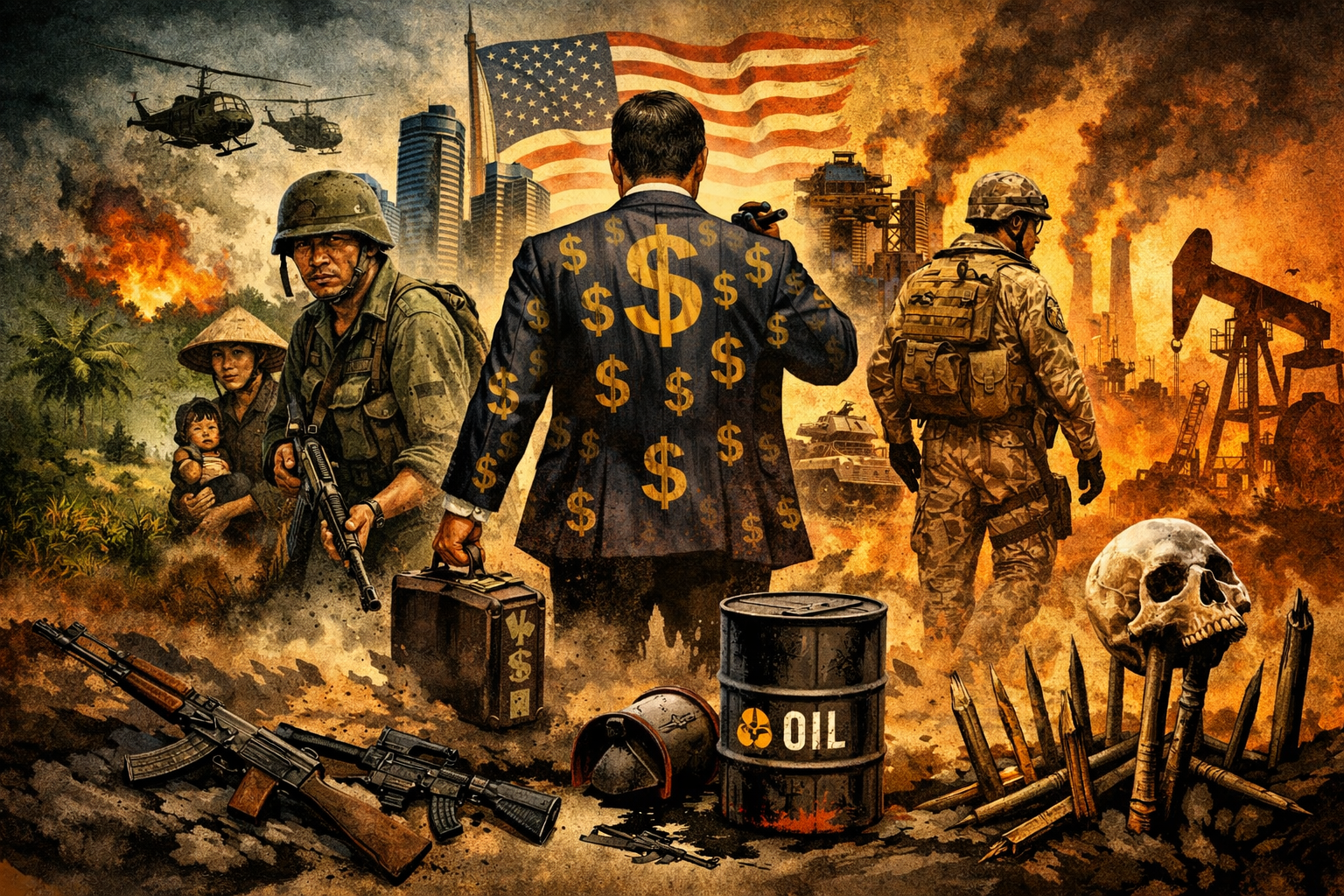
Same old, same old - From Eisenhower’s advisors in Vietnam to oil-driven interventions today, U.S. wars follow a predictable pattern: corporate profit, imperial overreach, indigenous resistance, eventual failure.
It Starts the Same: Advisors, “Assistance,” and Colonial Pretense
It starts the same. President Eisenhower sent a few advisors to Vietnam to help the French colonial administration as it tried to maintain power against an indigenous rebelliion. It evolves the same. The U.S. pays war profiteers vast amounts for war toys, sends thousands of U.S. young people to die while killing millions of resisting indigenous people. It ends the same. The world’s most expensive military gets thrown out of a place in which they caused vast damage.
Since the end of WW-II, the U.S. has been thrown out of Korea, Vietnam, Cuba, Latin America, Afghanistan, Iraq, etc. In that same time in the U.S. corporate welfare from government has steadily grown. And corporate power and welfare has evolved until most of government is controlled or heavily influenced by multinational corporations.
Multinational corporations have no national loyalty. They are driven by the desire for profits. Wars are profitable so corporations often encourage war. A pattern that is not unique to the United States has historically been that business encourages national war authorities to spend government money profligately, without meaningful oversight. Patrick O’Brien made a career of writing fact-based historical novels with a constant theme about the corruption that led to the decline of the British Navy in the late 18th and early 19th centuries.
General George Patton condemned the inadequacy of American made tanks when confronting German tanks. President Eisenhower, with decades of experience in the U.S. military establishment warned us what corporate influence peddling could lead to. Many journalists have built successful careers writing about corruption in the Pentagon, and in military equipment and provisioning dating back to the Revolutionary War. But we keep on bending to corporate needs for profit, and those needs keep weakening our military. To start out 2026, the Donald announced that he will continue historic patterns into the new year.
Related stories
But more of the same corporate colonialism means more of the same resistance. The disguised Bostonians who threw East India Corporate tea into Boston Harbor in 1773 followed a pattern of colonial resistance which itself followed repeated peasant uprisings across feudal Europe, and Portuguese and Spanish colonies far from Europe.
The “rude farmers” who stood beside the bridge in Concord, Massachusetts and hid behind trees and stone walls all the way back to Boston, on April 19, 1775, adopted tactics learned from Native Americans, designed to defeat the highly organized and better equipped British army. More recently Vietnamese people acquainted U.S. colonial soldiers with the Punji Stick first encountered by British troops in 19th century India and Southeast Asia.
Punji Sticks, Agent Orange, and the Cost of Arrogance
History is consistent. When power leads to oppression, oppression leads to resistance. Power is overwhelming force. Resistance encourages the innovation of new tactics and weapons with which to resist, often by rendering the overwhelming force either irrelevant or self-defeating. Consider Agent Orange and the devastating medical injuries it had on U.S. troops who were deploying fancy guns against a “primative” indigenous enemy.
The pattern is ubiquitous and universal. When Czar Vlad ordered columns of troops equipped with superior armaments to invade Ukraine and occupy Kyiv, Under-manned and under-equipped Ukrainians responded to organized columns of attacking vehicles by using the weather, ground conditions and simple, but innovative weapons to disrupt and disable their superior invaders.
The Ukrainians did what Afghanis had done to Russian invaders decades earlier, and to U.S. invaders earlier in this century. The Ukrainians did what the Vietnamese and Afghanis, and Iraqis had done to U.S. invaders.
U.S. style capitalism has left its own mark on this historical pattern. Corporate influence in late 20th century U.S. military spending models somewhat the British Navy’s spending in the late 18th century. Vast quantities of tax dollars were invested in the British Navy, with much of the money going to businesses for overpriced or insufficient (often both) equipment and supplies, guaranteeing profits for businessmen while also guaranteeing ships with fighting disadvantages.
Dick Cheney’s Secretary of Defense, Donald Rumsfeld, famously told complaining troops, and their worried families, that they had to fight with the tools they were given, not with the tools they wanted, like body and Humvee armor.
During the 50s and 60s we built a nuclear arsenal and missile systems designed to launch those weapons against our enemies. Also during the 60s and 70s electronics underwent a revolution. Transistors replaced tubes, then integrated circuits replaced transistors, making all sorts of control systems easier to build, easier to maintain, and less prone to failure. But transistors and integrated circuits are much less costly to make as well as being easier to maintain. Thus they are much less profitable than tube circuitry.
Why the Pentagon Keeps Failing Audits
During the Cheney/bush administrations wars on Afghanistan and Iraq, we learned things about our military “might.” While people were whining about Pentagon waste and the inability of any Pentagon department to ever pass any sort of audit, news leaked out that all of our vaunted “nuclear deterent” system continued to rely on 50s and 60s vintage tube circuitry and computer programs more primitive than those that allowed astronauts to land on the moon in 1969.
It was simply a matter of corporate profits. Maintaining decades old tube circuits and operating programs that no longer had any trained operators or even elderly people who could train new operators on obsolete equipment allowed war profiteering corporations to charge the Pentagon fabulous amounts for repair and maintenance.
This was simply a matter of corporate control over the Pentagon. Those familiar with the Vietnam War may recall that the “evil enemy” used AK-47 assault rifles which are usable in all sorts of conditions. To counter the AK-47, the Pentagon contracted for a new AR-15 assault rifle. Corporate suppliers were funded to supply the new guns and many soldiers died as the Pentagon learned that the new AR-15 jammed up in humid jungle conditions, leaving U.S. troops unable to fire back at Vietnamese troops. But the corporations got paid for the rifles. The AR-15, of course, did not detect or protect from Punji Sticks.
Cheney, Rumsfeld, and the Doctrine of Indifference
This was nothing new for the post-Cold War Pentagon. Dick Cheney’s Secretary of Defense, Donald Rumsfeld, told complaining troops, and their worried families, that they had to fight with the tools they were given, not with the tools they wanted, like body and Humvee armor. The desires of corporate suppliers was more important than the mere needs of the troops.
This was nothing new for the post-Cold War Pentagon. Dick Cheney’s Secretary of Defense, Donald Rumsfeld, told complaining troops, and their worried families, that they had to fight with the tools they were given, not with the tools they wanted, like body and Humvee armor. The desires of corporate suppliers was more important than the mere needs of the troops.
The Donald’s conquest of Venezuela is identical to Cheney’s attack on Iraq. There is a desire to take over the country and seize their oil. But there isn’t even a paragraph of any post-assault plan for administering a nation whose administration, courts and military will all be handed to ... [NOBODY identified before the invasion]. And the invasion started with attacks on civilian housing as well as infrastructure.
No doubt some Donald crony will become the new Paul Bremer, given $Billions to hand out to contractors and profiteers who contributed to the new White House ballroom or the Donald’s cryptocurrency scams. Or maybe to his 2028 campaign?
(For those who worry, or just wonder, Paul Bremer weathered all the criticisms and exposes and landed on his feet. He still “advises” corporations and sits on Boeing’s board of directors. Whether he tells passengers that they have to fly in the planes they’re given rather than planes that don’t drop doors and other parts from the sky, I don’t know.)
Guarding Oil Fields With Public Money
Watch as your tax dollars are used to equip and pay troops to guard oil fields being “rebuilt” by Exxon and Chevron, etc. We’ll be told that it would be unreasonable for capitalist corporations to shoulder the entire costs of developing an industry that they want to milk for profit. So our new Paul Bremer will see that our puppet “Venezuelan” government doen’t impose any environmental or health and safety, or fair wage and hour laws on oil corporations.
And if any foreign oil company wants to submit bids to share in the gravytrain, we’ll be told that capitalism means our corporations must be protected from foreign competition, even in a foreign land like Veneuela.
Comments

Powered by RoundtableAn AI/DeFi-powered Enterprise Media Operating System. Learn more at Roundtable.io.© Roundtable 2026. By using this site you agree to the Terms of Use and Privacy Policy