
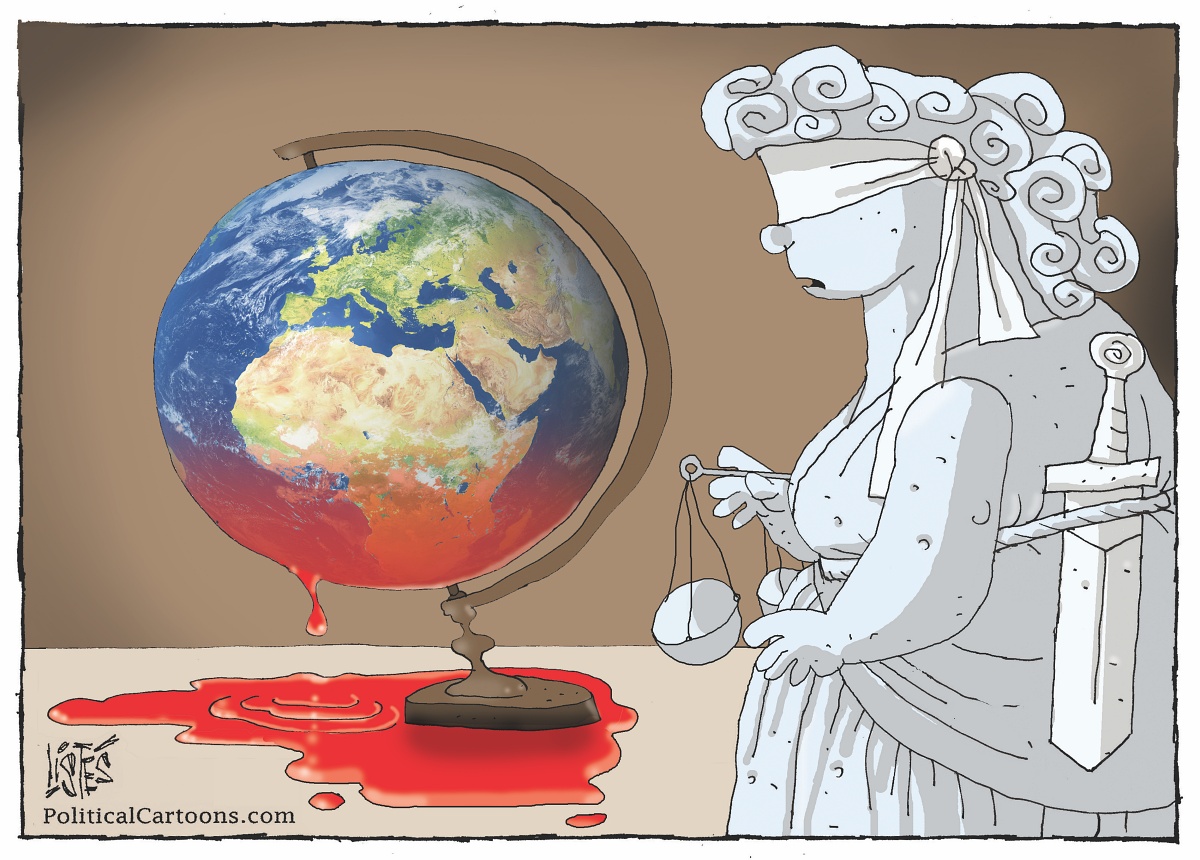


Ukrainian Peace Plan
Jul 14, 2024 3:01 PM
We should not be appeasers, but we should be creative and imaginative in working toward peace.
There is much on our minds these days. Israel and Gaza. President Biden’s debate performance. Real possibility of authoritarianism replacing democracy with another Trump presidency. Recent flooding and a still ongoing heat wave in some parts of our country as climate change continues its relentless advance. Plus the usual ongoing tragedies that have become so commonplace, that headlines ignore, that few people--except the afflicted--think of, for example, of civil war, famine, and hunger in Sudan.
Add to all of that, the just completed NATO summit in Washington, D.C., which pledged at least $43 billion in military aid to Ukraine over the coming year and declared it on an “irreversible path” to NATO membership. In total since the war started in early 2022, individual countries by early January 2024 had “committed nearly $118 billion in direct military assistance to Ukraine, in addition to financial and humanitarian help.”
Adding $43 billion and $118 billion we come up with $161 billion, but that doesn’t count from early January to early July 2024, nor does it include non-military aid. Besides, such large sums of money become almost meaningless to us, which is why I always liked the Carnegie Endowment for International Peace estimate of what could have been done with the $330 billion (direct and indirect) cost of WWI: Every family in the Great Britain, Belgium,Russia, Germany, the USA, Canada, and Australia could have been provided with a home of its own. In addition, all the property and wealth of Great Britain and France could have been purchased, and a considerable sum would still have remained.
Considering that the USA has been the biggest single contributor (more than 40 percent of the $118 billion mentioned above) of Ukrainian aid, we’re talking of a lot of U. S. dollars. Federal dollars that could have alleviated a lot of suffering in many different areas of U. S. life. (All of this material on the economic cost of the war is not suggesting Ukraine was not deserving of foreign aid, just that the cost is not meaningless and must be considered as one factor affecting our judgments about the war.)
Related stories
Since my 2014 essay “The Folly of War: Europe 1914, Ukraine 2014” I have often written of Ukrainian conflict with Russia. Of matters like the tragedy of it. The tremendous human toll of it. The environmental cost of it. The Russian motivation for it. And yes, even the responsibility for it. But it is time to put that all aside. Why? In the interest of peace, of ending all the innumerable suffering, which the British novelist Ian McEwan described so well about an earlier war in his novel Black Dogs.
About one of his characters, he wrote: “He was struck by the recently concluded war [World War II] not as a historical, geopolitical fact but as a multiplicity, a near-infinity of private sorrows, as a boundless grief minutely subdivided without diminishment among individuals who covered the continent like dust. . . . For the first time he sensed the scale of the catastrophe in terms of feeling; all those unique and solitary deaths, all that consequent sorrow, unique and solitary too, which had no place in conferences, headlines, history, and which had quietly retired to houses, kitchens, unshared beds, and anguished memories.”
A year ago in my "Don't Forget the Private Sorrows of Ukraine" I tried to remind readers of some of the numerous killings and grieving going on during the present war in Ukraine. And although at least one estimate of Ukrainian forces killed puts the number at a little under 50,000, deaths of the Russian military on Ukrainian soil (both estimates into early 2024) are listed as even higher--at a little over 57,000. Thus--and there is a wide consensus on this--over 100,000 total deaths. And we are reminded of McEwan’s writing of a “near-infinity of private sorrows”--and of their having “no place in conferences, headlines, history.”
Amid wars like the Ukrainian one and the present Israeli war in Gaza we are prone to forget all the benefits of peace. As I quoted in an earlier article on this publication: “Peace is ploughing and sowing and reaping and making things . . . and getting married and raising a family and dancing and singing.” And peace bestows “weddings, kindred, children, friends, / Wealth, health, wheat, wine and pleasure.”
Thus, considering all the human costs--like deaths, maimings, emigration, and tremendous property damage--and all the financial costs of the ongoing Ukrainian war, it seems worthwhile to seriously consider various peace plans. If we add environmental damage and risks of escalation to our calculations, our argument is even stronger. As John Kennedy said in mid 1963, in the most significant peace speech of his presidency, world peace is “the most important topic on earth,” and “we have no more urgent task.”
What we need to do to end the Ukrainian war is demonstrate more diplomatic creativity and imagination. (Stating this does not negate Vladimir Putin’s responsibility for attacking Ukraine beginning in late February 2022, or the necessity of getting his agreement to any peace terms, but the USA can only do so much.) Writer Wendell Berry often commented on our lack of imagination as one of the causes for involvement in unjust wars--e.g., “We have been led to our present shameful behavior in Vietnam by this failure of imagination, this failure to perceive a relation between our ideals and our lives.”
One area where we have not displayed much imagination is in considering Ukrainian NATO membership. We might see NATO as a defensive alliance, but Putin views it in a more offensive light, especially since former parts of the USSR (Estonia, Latvia, and Lithuania) are members, as are even more nations that were once part of the Soviet defensive organization, the Warsaw Pact.
Trying to understand Putin’s thinking is by no means the same as justifying it, as Zachary Shore’s A Sense of the Enemy: The High Stakes History of Reading Your Rival's Mind (2014) points out. “Understanding what truly drives others to act as they do is a necessary ingredient for resolving most conflicts where force is not desired. It is, in truth, an essential first step toward constructing a lasting peace.”
What I wrote about Putin in 2015 (in a “Surprising Consensus on What the Experts Say about Putin”) still seems true. He is a pragmatist, not an ideologue. He intends to restore Russia to major power status. He believes that Russia and many other countries require a strong state government and encourages patriotism to support it. He is deeply distrustful of Western-style democracy, the United States, and NATO and believes that Russia offers a unique civilizational model that differs from—but is equally valid to—that of the West. He is especially distrustful of any talk of bringing Ukraine into NATO, and he suspects major Western countries of trying to weaken him and Russia. His past experience as a KGB officer encourages his suspicious, conspiratorial views.
In 2014 U. S. historian of the USSR Stephen Cohen and Nation editor Katrina vanden Heuvel claimed that “twenty years of NATO’s eastward expansion has caused Russia to feel cornered.” With Finland and Sweden having more recently joined NATO, Putin undoubtedly feels even more “cornered.”
Nor were the two of them alone in such an assessment. Former ambassador to Russia Jack Matlock (named by President Reagan and serving from 1987 to 1991) once stated that he thought that NATO expansion and talk of bringing Ukraine into NATO has been “Putin’s main concern” and that such talk has been “irresponsible.” In 1998 George Kennan, the father of the U. S. Cold War’s containment policy, thought NATO’s eastward expansion was a “tragic mistake.” And in 2014, former Secretary of Defense (under both George W. Bush and Barack Obama) Robert Gates wrote, “Trying to bring Georgia and Ukraine into NATO was truly overreaching … NATO expansion was … recklessly ignoring what the Russians considered their own vital national interests.”
Yet the last decade has produced new Russian aggression against Ukraine, and it is reasonable to ask if Putin’s behavior has now made a stronger case for Ukraine’s NATO membership--as it has for the recent joiners, Finland and Sweden. Perhaps it has, but Putin’s fears and willingness to continue the Ukrainian war must also still be considered. And there is still a need for a more imaginative U. S. and NATO strategy for relating Ukraine and NATO.
Two years ago in LA Progressive--still in the early stages of the present war and many killings earlier--I mentioned a peace plan of two western experts on Russian-Ukrainian relations. According to it, Ukraine would not join NATO, but it would be able to negotiate “a wide variety of defensive military assistance and training from other countries, short of permanent foreign bases and weapons systems capable of striking Russian territory.” Also, Russia would pledge “that it will not object to European Union (EU) membership for Ukraine, opening the door to the multi-year assistance with investments and reforms that Ukraine will desperately need to recover.”
Another stipulation of the plan would have Russia withdraw from the Ukrainian areas seized in 2022 and “agree to hold a status referendum there under international supervision, some ten to twenty years from now.” To those areas where a “status referendum,” or plebiscite, would be held I would add Ukrainian territory (Crimea and the Donbas area) where Russia annexed or helped establish self-proclaimed republics. I would also be more flexible on when a referendum or plebiscite was held.
Such voting is often rigged, as Russia manipulated a Crimean vote in 2014, so the “under international supervision” stipulation is important. Successful, honest plebiscites can be held--for example, in 1920 in the former Duchy of Schleswig to determine the future border between Germany and Denmark. In a process monitored by a commission with representatives from the UK, France, Norway and Sweden, two plebiscites occurred. In the more northern region voters decided to become part of Denmark. In the other region, Germany was selected.
More recently, earlier this July, “A Better Path for Ukraine and NATO” appeared in Foreign Affairs magazine. It stated that regarding NATO membership, “there’s room for creativity . . . it doesn’t impose one-size-fits-all membership requirements.” The article cited a few examples. It mentioned that even though Norway, which shared a border with the USSR, joined NATO in 1949, it also “issued a unilateral declaration . . . stating that it would not ‘make available for the armed forces of foreign powers bases on Norwegian territory, as long as Norway is not attacked or subject to the threat of attack.’ It later added similar restrictions on nuclear weapons.”
Thus, to end the war various possibilities exist, but both Russia and Ukraine need to agree and compromises need to be made. It is simply unrealistic to expect peace to come without some give and take. Although the key decisions on terms will have to made by Ukraine and Russia, Western countries can have some influence--all the money and weapons they are providing guarantee that.
Provided honest plebiscites are held, Ukraine could get back all the territory it lost since the beginning of 2014. Even if it ended up not joining NATO, it could (according to the plan outlined above) negotiate “a wide variety of defensive military assistance and training from other countries.”
It is harder to see why Putin would accept any deal Ukraine would support. But we shouldn’t forget the cost of the present war to Russia and Putin--in all the Russian lives lost, in the young men who left Russia rather than be drafted, and in the drain on the Russian economy. Plus Putin is concerned with his legacy. If he becomes convinced that he can’t win the Ukrainian war on the battlefield or without escalating to using nuclear weapons, he might do something like Ronald Reagan did with Gorbachev--change from being his Cold-War’s greatest foe to someone who ended up signing peaceful agreements.
In short, we should not be appeasers, but we should be creative and imaginative in working toward peace--including heeding or ignoring any suggestions made here. The past, present, and possibly future of the Ukrainian war is simply too ghastly, too horrific, to allow it to drag on.
Comments

Powered by RoundtableAn AI/DeFi-powered Enterprise Media Operating System. Learn more at Roundtable.io.© Roundtable 2026. By using this site you agree to the Terms of Use and Privacy Policy