
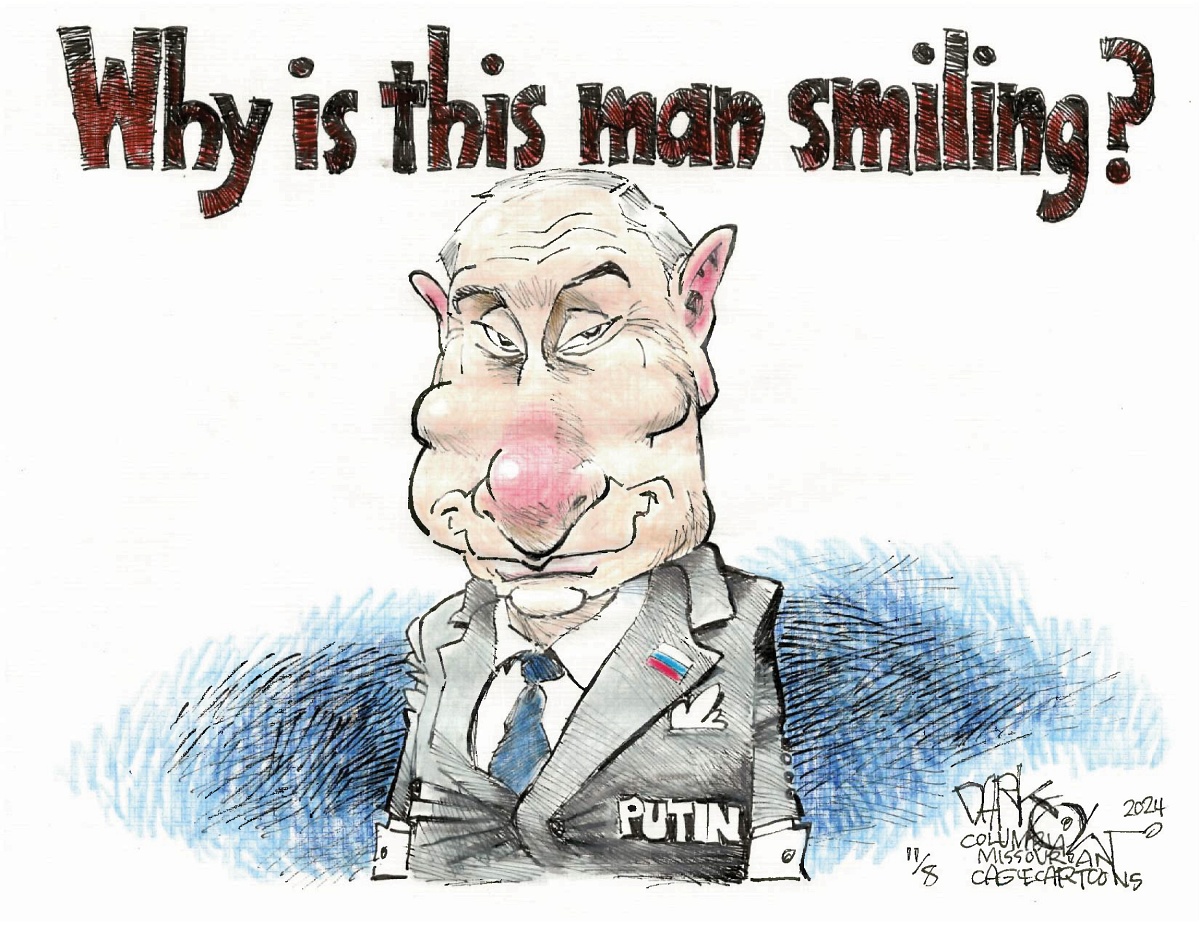


Ukraine Braces
Nov 11, 2024 4:44 PM
By advocating for reduced U.S. involvement, Trump is signaling a withdrawal from global responsibility at a critical moment in world history.
Trump’s policy of isolationism, draped in the rhetoric of disengagement from foreign entanglements and a return to the sanctity of domestic concerns, is not merely a retreat from the world stage. It is, in fact, a dangerous abdication of responsibility that leaves the world teetering on the edge of greater peril. In this dangerous moment, the absence of strong American leadership is not a reprieve, but an invitation for instability to surge.
By advocating for reduced U.S. involvement, whether through cutting military aid for Ukraine or disengaging from NATO’s collective security framework, Trump is signaling a withdrawal from global responsibility at a critical moment in world history. His stance threatens to undermine the very alliances and deterrents that have kept major powers in check for decades.
In the case of Ukraine, this retreat emboldens aggressors like Putin, who, seeing the erosion of Western resolve after a Trump victory, could press forward with his territorial ambitions, knowing that a fragmented or weakened international response will fail to challenge his expansion. Isolationism fosters instability, creating a vacuum that allows authoritarian regimes to thrive unchecked. In the long run, such a policy doesn’t protect America; it invites greater global insecurity, placing democracies, particularly those on Europe’s periphery, at the mercy of Russia’s unchecked imperialist aggression.
In a moment steeped in the shadow of impending violence, the United States president-elect's eldest son shared an Instagram clip posted by Sarah Palin that bore a message as sharp as it was callous: “POV [point of view]: You’re 38 days from losing your allowance.” The caption, splashed across a video of Ukrainian President Volodymyr Zelenskyy, echoed with chilling indifference. Palin’s post, flippant in its language, might have sounded like playground banter, yet beneath its casual facade lay an unforgiving edge. The words carried a brutal disdain—a casual dismissal of Ukraine's suffering as Russian fire tore through cities and families lived in constant dread.
Related stories
With a mocking tone, Donald Trump Jr.’s endorsement of the post betrayed an indifference as absolute as it was alarming. The anguish of a nation, its sovereignty violated and its people displaced, was reduced to a passing jest. And as North Korean and Russian forces gathered at Ukraine’s borders, poised for a new offensive, Trump Jr.’s post revealed a mind untouched by the cries of those in danger, a heart unmoved by their terror. His sneer exposed a willful ignorance of the profound stakes, a shrug toward the desperate resolve of a nation facing the storm alone.
Donald Trump Jr. has hardened his stance alongside his father, aligning himself with the Trump-Vance doctrine that pledges a sharp end to U.S. support for Ukraine’s defense against Russian aggression. His rhetoric mirrors the scorn of his father and Vice President-elect JD Vance, their criticisms leveled against the Biden administration's continued military aid as though it were a costly extravagance rather than a lifeline for a besieged ally.
In June, Trump’s words cut sharply beneath the surface of diplomacy as he dubbed Ukrainian President Volodymyr Zelenskyy “the greatest salesman of any politician that’s ever lived”—a remark wrapped in both praise and scorn. This backhanded compliment reduced Zelenskyy's urgent pleas for aid in Ukraine’s existential fight against Russian invasion to nothing more than a clever sales tactic. Trump's dismissal implied that Ukraine’s struggle was not one of survival, but of persuasion, a calculated campaign for resources rather than a battle for independence.
Trump’s remarks didn’t stop there; he went on to accuse Zelenskyy of casting “little nasty aspersions” toward him, transforming Ukraine’s appeals into a personal affront. His language reframed Ukraine’s resistance not as a moral imperative or a global crisis, but as a slight to his own standing. This personal grievance seemed to overshadow Ukraine’s anguish, reducing a nation's calls for solidarity to an imagined rivalry. In doing so, Trump shifted focus from the urgent realities facing Ukraine, recasting its leader as a mere player in a drama centered on himself.
This language, delivered with the precision of a dagger cloaked in mockery, underscores a growing disdain for Ukraine’s plight. It suggests a view of international aid not as a matter of principle, but as an impersonal transaction—one that Trump and his allies deem unworthy of further investment. For them, Kyiv’s appeals are dismissed as mere theatrics, and the fate of Ukraine’s people, caught in the crosshairs of Russian ambition, is treated as a distant inconvenience rather than a moral imperative. As the promise of American support wavers, their words cast a long shadow over the fragile hopes of a nation fighting for its survival.
Trump has repeatedly claimed that he could end the war launched by Vladimir Putin’s invasion of Ukraine in a single day, a boast that implies a swift, transactional peace.
Trump has repeatedly claimed that he could end the war launched by Vladimir Putin’s invasion of Ukraine in a single day, a boast that implies a swift, transactional peace. Yet the terms of such a "resolution" would very likely demand Ukraine’s acquiescence in ceding Crimea and large swathes of the Donbas, territories that symbolize both its sovereignty and its struggle for survival. Under this plan, Ukraine would be forced to surrender not only land but also the right to defend its borders and its independence.
Any blueprint Trump devises, weighted heavily in Russia’s favor, would do little to bring lasting peace and much to entrench Russian dominance. Such an arrangement would reward Moscow’s aggression, providing Putin the breathing room to regroup and strengthen his forces, ensuring that Ukraine’s sacrifice would pave the way not to peace, but to the consolidation of Russia's power. In this grim calculus, Ukraine’s sovereignty is the currency traded for a false calm, one that ultimately secures Russia’s strategic foothold at the expense of a nation's freedom and future.
Ideally, any plan for peace should honor Ukraine’s sovereignty and steadfastly reject the notion of surrendering territory seized by Russia during its brutal campaign. A durable solution must resist any notion of carving up Ukraine to placate Russian demands, for to concede these lands would be to reward aggression and undermine the principles of territorial integrity and self-determination. Such a plan should also be grounded in realism, wary of hollow assurances from Russian President Vladimir Putin, who has repeatedly demonstrated a willingness to renege on promises when it suits his strategic aims.
A meaningful resolution must be built on firm, enforceable commitments that prioritize Ukrainian autonomy, security, and the future stability of Eastern Europe. Anything less would not only fail Ukraine but also embolden similar acts of aggression, setting a dangerous precedent in global politics.
In a last effort to bolster Ukraine’s defenses against an uncertain future, the Biden administration is racing to deliver the final $6 billion in U.S. security aid to Kyiv before Trump’s January 20 inauguration. Biden, who has provided consistent support to Ukraine since Russia’s invasion, has nonetheless approached the conflict with a strategy of careful restraint. His focus on de-escalation has limited Ukraine's options, as he has largely restricted the use of U.S. weaponry to within Ukraine’s borders, save for a handful of exceptions.
While Biden’s strategy has been cautious, aiming to contain the conflict and avoid a broader confrontation with Moscow, it has also curbed Ukraine’s ability to strike directly at the sources of Russian aggression on Russian soil. For Ukraine, this restraint has been a double-edged sword—securing essential support while keeping critical tactical options just out of reach. Now, as the Biden administration accelerates its final shipments of aid, the urgency underscores a deep concern: the next administration may adopt a course that prioritizes Russian interests, leaving Ukraine to face a shifting tide in its struggle for survival.
Trump’s stance on Ukraine could have significant repercussions for European defense. If the U.S. reduces its commitment to NATO, Europe may be compelled to take on a much larger share of defense spending. In some ways, this could drive positive changes, prompting European nations to invest more in their own security, potentially strengthening their military capabilities and encouraging greater self-reliance within NATO.
However, a reduction in U.S. support—or, in the extreme case, a full U.S. withdrawal from NATO—could also severely undermine the alliance. Without the military and economic weight of the U.S., NATO’s capacity to deter Russian aggression could be compromised. This shift would put enormous pressure on European countries, especially those on NATO’s eastern flank, like Poland and the Baltic states, which have historically relied on U.S. backing as a critical counterbalance to Russian influence.
A weakened NATO could leave Europe more exposed if Russia, emboldened by gains in Ukraine, seeks to assert control or influence over neighboring states.
A weakened NATO could leave Europe more exposed if Russia, emboldened by gains in Ukraine, seeks to assert control or influence over neighboring states. While Europe would face the immediate burden of heightened defense spending, the broader consequence might be a more vulnerable NATO framework, potentially forcing European nations to prepare for greater security challenges on their own.
Putin’s concept of “historical Russia” casts an ominous pall over a vast and vulnerable stretch of territory, posing a latent threat to regions far beyond Ukraine’s borders. This vision frames nearly any area with historical ties to the Russian Empire as a potential target for Moscow’s ambitions, which could encompass Finland, Poland, the Baltic states, Belarus, Moldova, Georgia, Armenia, Azerbaijan, and the entire expanse of Central Asia. Even Alaska, once Russian territory, fits within this ominous lens of irredentist claims.
Such an expansive outlook is more than symbolic—it fuels a worldview that legitimizes conquest under the guise of restoring Russian heritage. This ideological stance destabilizes neighboring states and undermines their sovereignty, casting them as merely provisional territories awaiting "reclamation." As Putin’s ambitions appear to swell toward these historical claims, his vision introduces a precarious reality for Eastern Europe and beyond, stoking fears that aggression might not end with Ukraine but could, unchecked, spiral into a larger confrontation across continents.
For the safety and well-being of all humanity, we must call for diplomacy that is both resolute and nuanced, and for leaders who understand that our fates are intertwined across borders. We need those who place the bonds of global cooperation above the narrow grip of nationalistic isolation. We can only hope that Trump’s national security advisors are up to the task.
Comments

Powered by RoundtableAn AI/DeFi-powered Enterprise Media Operating System. Learn more at Roundtable.io.© Roundtable 2026. By using this site you agree to the Terms of Use and Privacy Policy