
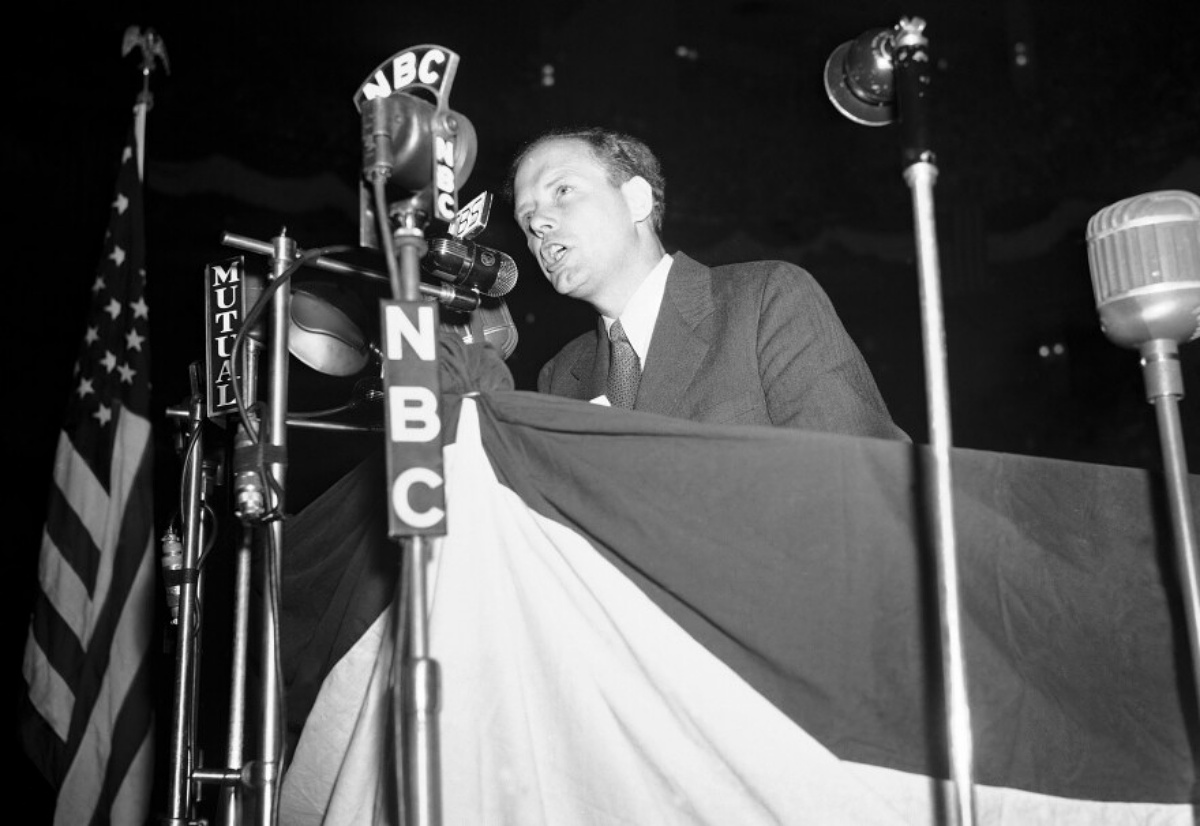
Charles Lindbergh speaks at a rally of the America First Committee at Madison Square Garden in New York, on May 23, 1941. Lindbergh was a leading voice of opposition to U.S. involvement in World War II up until the Japanese attack on Pearl Harbor.


Trumpian Isolationism
Feb 16, 2024 3:38 PM
Perhaps the strongest isolationist voices came from multi-newspaper and magazine owner William Randolph Hearst and famed aviator Charles Lindbergh.
At a recent 10 February rally in South Carolina, Donald Trump recounted that when he was president he once told a president of a big European NATO country that if it didn’t pay its fair share to NATO he would encourage Russia to “do whatever the hell they want” to that country.
As the president before Joe Biden, Donald Trump leaned toward isolationism. He didn’t pull the USA out of NATO, but he did pull us out of the 2015 Paris climate agreement. And he has always, as red “America First” signs being waved at his South Carolina rally and shouts of “USA” indicated, emphasized putting the USA first. Hardly surprising that an individual as egotistic as Trump would also promote national egoism.
But isolationism and “America First” are not original with Trump. We’ve had a long history of such. Let’s just look at the past century. Following World War I, when the Democrat Woodrow Wilson was still president, he had hoped that the USA would join the newly-created League of Nations, but Republican opposition in the Senate prevented that body from ratifying the treaty that would have accomplished that, and the U.S. never joined that organization. Senate opposition was mainly directed at Article X of the treaty, which would have obligated signers of the treaty to aid any country victimized by aggression.
In 1920, 1924, and 1928 U. S. citizens elected Republican presidents, and opposition to any mandatory commitments to aid countries attacked by aggressors continued. Although the Democrat Franklin D. Roosevelt (FDR) was elected in 1932 (and subsequently in 1936, 1940, and 1944) and he had originally supported Wilson’s desire for U. S. membership in the League, political considerations—namely the strong isolationist spirit in the U. S.—led him to downplay his internationalist inclinations. In his study of FDR’s foreign policy, Robert Dallek labels parts of his book accordingly. He begins with the Prologue, “An American Internationalist”; followed by Part One, “The Internationalist as Nationalist, 1932-1934”; and Part Two, “The Internationalist as Isolationist, 1935-1938.” It isn’t until Part Three, covering the years 1939-41, that FDR reveals more and more of his internationalist bent.
Related stories
In that latter period, however, he still faced strong isolationist sentiments. Perhaps the strongest isolationist voices came from multi-newspaper and magazine owner William Randolph Hearst and famed aviator Charles Lindbergh. In Philip Roth’s 2004 novel The Plot Against America he depicts a counter-factual history in which the antisemitic Lindbergh is elected president in 1940. (See here for comments on how the novel differs from real events.)
It was also in 1940 that the precursor to the Trump-rally “America First” signs was launched, when the America First Committee was formed.
It was also in 1940 that the precursor to the Trump-rally “America First” signs was launched, when the America First Committee was formed. Before it ended its brief existence just days after the December-1941 Japanese attack on Pearl Harbor, Lindbergh became its most prominent member. Its main mission was to keep the U.S. out of the European war Hitler had started by attacking Poland in September 1939.
According to historian Jill Lepore, Lindbergh “offered excuses for Nazi propaganda,” stating “In time of war, truth is always replaced by propaganda. I do not believe we should be too quick to criticize the actions of a belligerent nation. There is always the question of whether we, ourselves, would do better under similar circumstances.”Regarding what he considered U.S. anti-Nazi “propaganda,” however, he was not so lenient. At an America First rally in Iowa, he named three forces as responsible for spreading it: “The British, the Jewish and the Roosevelt administration.”
In general, Lepore believes that U. S. isolationism, such as Lindbergh’s, “emboldened Germany,” and she cites Hitler’s view that “Americans were too selfish to concern themselves with Europe.”
Although it is always difficult to predict the “what ifs” of the past, it seems likely that Lepore is correct, and that a more forceful involvement of the U.S. in resisting Hitlerite aggression in the late 1930s would have reduced, maybe even prevented, U.S. European casualties in the 1943-45 period.
From World War II until the last decade or so, most of the U.S.’s political leadership has been less isolationist than in the 1920s and 1930s. Foreign entanglements and interventions, however, have often turned out badly, as U.S. involvement in Vietnam, Iraq, and Afghanistan have indicated. But from the Truman Doctrine (1947) and the creation of NATO (1949) until the Trump candidacy and election in 2016, there has been pretty broad U.S. support for the backing of European democracies.
Not that some isolationist voices were still not heard. One of the most prominent was Robert A. Taft, a senator from Ohio from 1939 until his death in 1953. He opposed United States entry into the United Nations and later the creation of NATO. But as John Kennedy acknowledged in his Profiles in Courage, Taft was a principled man who earned his label as “Mr. Integrity.”
From 1974 to 2020, polling indicated that a fairly constant majority—a tad over two-thirds—of those polled agreed with the statement “it will be best for the future of the country if we take an active part in world affairs.” But then, over the next three years, that majority declined from 67 to 57 percent. The drop was largest among Republicans, with only about 47 percent of them still believing that the U.S. should be so involved in world affairs.
A similar trend was evident in support for Ukraine in its war against Russian aggression. According to an article by Thomas Edsall (who also furnished the above polling results), two recent polls indicate that between 2022 and late 2023 the share of U. S. voters who think the U. S. is furnishing “too much” aid to Ukraine has increased dramatically, especially among Republican voters, where according to one poll almost one half of Republicans think it’s too much, and according to another a whopping 62 percent so believe.
Edsall’s explanation for the heightened isolationism? He cites one expert who emailed him, stating, “The fundamental reason for the change in Republican attitudes on Ukraine, Russia, and indeed in their overall worldview, is simple: Donald Trump.”
Note the words, “fundamental reason.” Edsall does not suggest this is the only reason, and does not discount others, such as U. S. failures in Iraq and Afghanistan. And it is not just from Trump that criticism of past U. S. interventions are heard—nor just from the political Right. Leftist dissatisfaction with an activist U. S. foreign policy are not infrequent.
Nevertheless, Trump’s potential encouragement of Russia to “do whatever the hell they want” to any NATO country failing to pay its NATO fair share goes beyond mere isolationism. It is more in keeping with Trump’s frequent outrageous statements and the admiration he has previously expressed for “strong,” authoritarian rulers like Vladimir Putin. It is also in line with Trump’s recent discouragement of a spending bill debated by Congress that would provide aid to Ukraine and Israel, a bill supported in the Senate, where Republicans split with 26 senators opposing the bill, and only 22 supporting it. But chances for passage in the House, where Trump’s influence seems stronger, were not as good.
Regarding the 1930s, historian Lepore expressed the belief that U.S. isolationism such as Lindbergh’s “emboldened Germany.” Now it seems reasonable that a second-term presidency for Donald Trump would embolden Vladimir Putin—not only in its continuing war against Ukraine, but also in new aggression against one or more NATO countries, especially any that had formerly been part of the USSR. And if such aggression did occur, the cost to the USA—financially, and perhaps even in lives lost—could be much higher than the present cost of vigorously supporting NATO in Ukraine and elsewhere.
Comments

Powered by RoundtableAn AI/DeFi-powered Enterprise Media Operating System. Learn more at Roundtable.io.© Roundtable 2026. By using this site you agree to the Terms of Use and Privacy Policy