
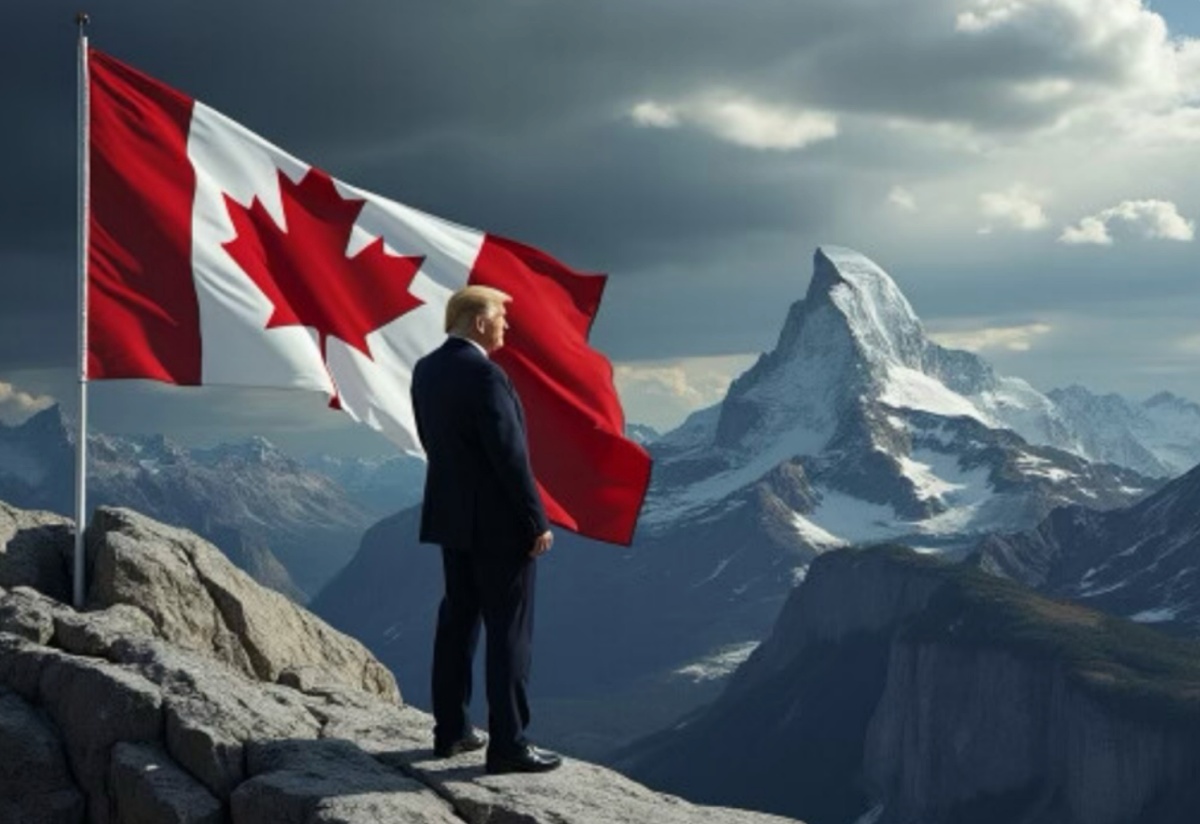


Trump Mocks Canada
Dec 13, 2024 6:13 PM
Someone needs to tell President-elect Donald Trump that the war of 1812 is over.
In the tempestuous summer of 1812, the young United States, emboldened by the fire of its revolutionary birth, cast its ambitions toward the north, then referred to as British North America. A prize of vast wilderness and strategic allure, it became the stage upon which American armies dreamed of swift conquest. Yet, in the shadow of towering pines and glinting waters, the land proved more steadfast than imagined, meeting the invaders with the icy resolve of British tenacity and indigenous defiance.
At Detroit, perched on the western edge of Lake Erie, General William Hull’s army crossed the border with the conviction of inevitability. Victory seemed assured—but confidence soon curdled into dread. The British, led by the audacious Isaac Brock and allied with Tecumseh’s warriors, wove a psychological net of deception. Brock’s calculated theatrics and Tecumseh’s unrelenting ferocity conjured an enemy that seemed larger than life. Hull, unnerved and overwhelmed, capitulated without a meaningful fight.
Farther east, at Queenston Heights, another American force sought to breach the Niagara frontier. Under the roar of the great river, they surged across, only to meet the steel and shot of a united foe. Brock, the stalwart defender of Canada, led a ferocious counterattack but fell in the storm of battle. Yet his loss lit a fire in his soldiers and allies, who rallied with unrelenting vigor. The Americans, their ranks broken and their spirit shattered, yielded to the British. By twilight, more than a thousand Americans were marched away as prisoners, their grand designs crushed underfoot.
The third prong of the invasion, marching tentatively north from New York, fared no better. Their advance was stymied not by a great battle, but by the grinding resistance of rugged terrain, logistical failure, and steadfast defenders. What began as a campaign of conquest dissolved into an ignoble retreat.
Related stories
These ill-fated invasions, imagined as the opening act of America’s dominion over what was to be renamed Canada, ended in bitter defeat. Instead of yielding spoils, the campaigns forged an iron unity among Canadians and etched into their memory a defiant legacy of resistance. For the United States, the war that had promised glory now stretched ahead as a long, grueling struggle. The visions of triumph faded, replaced by the harsh lessons of overreach, hubris, and the immutable strength of a determined foe.
According to Tristan Hopper, “The last serious U.S. attempt to annex parts of Canada actually predates Canada by just a few months. On the eve of Canada becoming an independent dominion in 1867, Republican congressman Nathaniel Banks introduced a bill calling for the various colonies of British North America to be admitted as a U.S. territory. But the bill fizzled out in committee just as the British North America Act was being approved by the British government. And Canada’s continued independence certainly isn’t due to any U.S. reluctance to use force. Since the 1860s, the United States has staged armed incursions into more than 100 countries, ranging from Germany to Vietnam to most of Central and South America. Rather, one of the main barriers to U.S. annexation is political. Turning 40 million Canadians into American citizens could result in a seismic leftwards shift to U.S. politics — with potentially devastating consequences for Republican politicians such as Trump.”
Since the War of 1812, a conflict marked by fiery ambition and bitter lessons, the United States has grown into the world's preeminent superpower, a colossus of industry, innovation, and influence. Across the shared expanse of forests, rivers, and prairies, Canada, once the embattled northern neighbor, has transformed into America’s closest friend and staunchest ally.
What was once a line of musket-fire dividing two young nations has become the longest undefended border in the world, a testament to trust forged not through conquest but through cooperation. From the fields of Normandy to the icy mountains of Afghanistan, Canadian and American soldiers have stood shoulder to shoulder, bound by shared values and a common vision for a freer, more stable world.
While the United States commands the global stage with its military might and economic power, Canada has proven itself a quiet but resolute partner, a nation whose voice resonates in diplomacy, peacekeeping, and the preservation of democratic ideals. Together, they form a partnership that exemplifies resilience—a bond unshaken by time, tested by history, and strengthened through mutual respect and collaboration. As a citizen of both countries, who has spent more time in my adopted country than in my native Canada, I feel comfortable crossing the Ambassador Bridge connecting Detroit and Windsor.
The echoes of the War of 1812 remind both nations of a time when their paths diverged in conflict. Yet today, those paths are intertwined, not as adversaries but as allies, shaping a future where their shared ideals illuminate the world stage.
Someone needs to tell President-elect Donald Trump that the war of 1812 is over.
Canada stands today as a great northern river, its currents flowing inexorably southward to nourish the vast plains and cities of its southern neighbor. From this river, the United States drinks deeply—77 percent of Canada’s lifeblood in goods and services streams across the border each day, carrying with it nearly 3.6 billion Canadian dollars (US $2.7 billion).
This lifeline delivers more than sustenance; it fuels America’s engines with 60 percent of its crude oil imports and lights its homes with 85 percent of its electricity needs.
Canada, a quiet titan, also fortifies the bones of America’s industry, providing steel, aluminum, and uranium in quantities unmatched by any other foreign land.
Beneath its soil lie 34 critical minerals and metals, shimmering like hidden veins of gold, their value recognized not only by miners but by the Pentagon itself, which views these treasures as essential to America’s national security.
In this intricate dance of dependency and power, Canada is both provider and partner—a steadfast presence in the great machine of continental prosperity, even as its contributions are sometimes overlooked or undervalued.
During Trump's first term, higher tariffs sparked retaliatory measures from affected countries. In 2018, Canada responded to U.S. taxes on its steel and aluminum exports by imposing billions of dollars in counter-tariffs.
Now in 2024, at the dawn of what could blossom into another chapter of historic economic prosperity between Canada and the United States instead cracked open again with the guttural roar of a man who speaks in ultimatums. In place of friendly deliberations were tariff threats, and instead of bridges of collaboration, there loomed walls of suspicion and alpha male bravado. The gilded setting of Mar-a-Lago, where power is paraded like a prize, became the unlikely stage for this fraught meeting of minds—a collision of Canada’s measured diplomacy and the thunderous cadence of Trump’s gruff transactional worldview.
It was a beginning weighed down by grievance and machismo, with Prime Minister Justin Trudeau stepping cautiously into the lion’s den. Days before, Trump had belted out his demands: a 25% tariff on imports from Canada and Mexico, cloaked in the language of border security and drug crises, but aimed squarely at forcing submission. For Trump, this was no ordinary negotiation—it was a contest, where compromise signaled weakness. The Canada-U.S. border is the longest undefended, unfortified border in the world, nearly 9,000 kilometers from Alaska to Maine, Yukon to New Brunswick – and no invasions since the War of 1812. Trump’s mockery was a step in erasing that proud history.
Donald Trump—victor and provocateur, king and tyrant—declared his intent to upend the delicate balance of North American trade, threatening to choke the lifeblood of economies bound to the United States by decades of cooperation and trust.
Donald Trump—victor and provocateur, king and tyrant—declared his intent to upend the delicate balance of North American trade, threatening to choke the lifeblood of economies bound to the United States by decades of cooperation and trust. In the gilded halls of Mar-a-Lago, where opulence meets political theater, President-elect Donald Trump and Prime Minister Justin Trudeau convened for what was officially billed as a “very productive meeting.” The Florida sun may have shone brightly outside, but inside, storm clouds of uncertainty loomed over their discussions. Trudeau’s journey south came mere days after Trump lobbed his latest rhetorical grenade.
On Truth Social, Trump offered his version of the meeting's agenda, one laden with his usual bravado. “We discussed many important topics that will require both countries to work together to address, like the fentanyl and drug crisis that has decimated so many lives as a result of illegal immigration, fair trade deals that do not jeopardize American workers, and the massive trade deficit the U.S. has with Canada,” he proclaimed.
Trump’s reasoning, characteristically blunt, tied the proposed tariffs to alleged failures by Canada and Mexico to curb illegal immigration and stem the flow of illicit drugs into the United States. Yet, beneath the veneer of diplomacy, Trump’s signature provocations sharpened to a point. "If tariffs would crush Canada’s economy,” he reportedly told Trudeau, “maybe it should become the 51st state.” What might have been dismissed as another offhand quip carried the unsettling gravity of intent, a reminder of Trump’s flair for testing norms and dismantling decorum.
This was, in no uncertain terms, a veiled threat. For Trudeau, the stakes were high. His government, navigating the delicate balance of standing firm against threats while preserving vital economic ties, found itself walking a tightrope. Flying to Mar-a-Lago—a move criticized by many as premature and conciliatory—placed Canada in a defensive posture, its prime minister staring down a leader known for his unpredictability, his insecurity and his cruelty.
As diplomatic as the statement “very productive meeting” might sound, the undercurrent of the Mar-a-Lago summit revealed a deeper truth: America’s new president-elect was all too eager to push boundaries—not only of international norms but of the very fabric of Canada-U.S. relations. Predictably, senior Canadian figures reacted with shock and concern. Who wouldn’t be concerned when you are dealing with a man known for his extreme narcissism, grift and penchant for lying.
To his credit, Trudeau did not sit still and sent a message to Trump that was both a warning and a clarion call to Americans, a message veiled in diplomacy but urgent in tone.
To his credit, Trudeau did not sit still and sent a message to Trump that was both a warning and a clarion call to Americans, a message veiled in diplomacy but urgent in tone: “Tariffs on Canadian goods would mean real hardship for Americans.” He detailed the quiet interdependence of the two nations—a delicate web of energy, resources, and trade. “65% of your crude oil comes from Canada,” he explained. “Your homes are lit and heated by our electricity and natural gas. Your factories are built on our steel and aluminum. Your dinner tables rely on our agriculture. All of this would become more expensive”. His words, measured but resolute, carried the weight of collaboration, a call to nurture the trade ties that had long been the lifeblood of both nations. He spoke not just of economics, but of human stakes—the countless lives intertwined with the ebb and flow of cross-border commerce, the families and communities whose futures rested on the fragile balance of partnership.
Yet his plea for unity crashed against Trump’s vision. For the American president, trade was no shared endeavor but a zero-sum contest, where the measure of success lay not in mutual growth but in the magnitude of America’s "win." His rhetoric bristled with the swagger of domination, a worldview that saw negotiation not as dialogue, but as conquest. And so, Trudeau’s steady cadence met the roaring winds of Trump’s unyielding ambition, two leaders charting paths destined to collide.
What could have been a stage of mutual opportunity instead simmered with tension, the promise of partnership overshadowed by a leader whose guttural roar signaled not peace, but a battlefield where even allies might find themselves treated as pawns. For Canada, the path forward seemed less a golden avenue of shared prosperity and more a gauntlet thrown at the feet of Canadians.
President-elect Trump, armed with a tried-and-true lexicon of insult worthy of Don Rickles, the iconic king of insult comedy, dubbed Prime Minister Justin Trudeau not as a leader of a sovereign nation and major U.S. ally, but as the "Governor" of the "Great State of Canada," a slap delivered with midnight relish on his Truth Social stage. Canadians stirred at the affront. “It sounds like we’re living in an episode of South Park,” quipped Immigration Minister Marc Miller.
The idea of Canada becoming a star on the American flag has long lingered like a shadow at the edge of a Canadian campfire—visible for a fleeting moment but destined to dissolve in the light of reason. Though the notion has occasionally danced into the periphery of political imagination, its steps have always faltered, its rhythm lost amidst the profound chasm of cultural, historical, and economic divergence.
Nathaniel Banks’ quixotic 1867 proposal to enfold British North America into the embrace of U.S. territory was a pipe dream, an aspiration undone not only by Canadian resistance but also by an American unwillingness to disrupt its own delicate balance. As Tristin Hopper aptly observes, the idea is fascinating to consider, yet impossible to embrace.
One of the most substantial barriers lies not in logistics or military capability, but in the political earthquake such a move would create within the United States itself. Canada’s population of nearly 40 million, which skews significantly to the left of the U.S. electorate on social, economic, and cultural issues, would fundamentally alter the balance of American politics. Canadian citizens, with their broad support for universal healthcare, gun control, and climate action, would likely align en masse with the Democratic Party, dealing a devastating blow to Republican ambitions.
Even in Canada’s most conservative corners—Alberta and Saskatchewan, those windswept bastions often likened to America’s Republican heartland—the political soil yields a crop far more progressive than anything sprouting south of the 49th parallel. Here, ideas that ignite fierce battles in the American landscape—reproductive rights, LGBTQ+ protections, universal healthcare—are not only accepted but embraced, woven into the bipartisan fabric of Canadian life. What passes for conservatism in Canada might seem, to U.S. eyes, like a tempered moderation or even a quiet liberalism.
What passes for conservatism in Canada might seem, to U.S. eyes, like a tempered moderation or even a quiet liberalism.
This divergence becomes starkly vivid when Canadians are asked to imagine U.S. presidential elections on their turf. Poll after poll reveals that Democratic candidates—figures polarizing in the U.S.—sweep across Canada like an unstoppable tide. Even Kamala Harris, vilified by the American right, commands the Prairies’ allegiance over Donald Trump. Nationally, the outcome is nothing short of a political landslide, a blue wave that would wash away any hope of Republican footholds.
For Trump and his Republican ilk, the idea of annexing Canada isn’t merely a political non-starter; it’s a poison pill. Absorbing Canada would mean surrendering not just millions of votes but also the ideological compass of their party. The new political geography would tilt Congress, the Electoral College, and the Supreme Court irrevocably to the left, cementing a Democratic supermajority for a generation.
And so, the dream of annexation collapses under its own contradictions, an impossible marriage of divergent values and irreconcilable realities. U.S.-Canada relations endure as a relationship of equals, each partner maintaining its distinct style.
Independence, then, is not just Canada’s identity; it is a cornerstone of survival for both nations—a mutual necessity born of divergent destinies.
Canada—a land that might have served as a refuge for Donald Trump during the Vietnam War, had his infamous "bone spurs" not provided a convenient shield—stands as far more than a northern neighbor defined by its snowbound winters and hockey prowess. It is a country whose heart beats to a rhythm of compassion and collective care, its universal healthcare system a testament to its belief in the dignity of every citizen. Unlike the patchwork system of its southern ally, Canada ensures that all its residents, regardless of wealth or status, have access to medically necessary care without facing financial ruin.
This is the Canada that turns out not only hockey players but also a vision of society admired worldwide for its equity and decency—a stark contrast to the transactional ethos that often defines American policy. It is the Canada that offered sanctuary to draft resisters during the Vietnam War, embodying a quiet defiance against a conflict many deemed unjust.
Canada is not a decaffeinated America. Canada's identity is shaped not by its proximity to American power but by its resolute independence and the values that set it apart: community over competition, shared welfare over individual gain. It is a nation admired for its poets, its thinkers, its ability to wrest harmony from diversity—and for its steadfast resilience in the shadow of a superpower whose roars often drown out quieter virtues.
Canada’s political landscape, distinct from the two-party duopoly of its southern neighbor, thrives in the vibrant tensions of a multiparty system. The three principal contenders on the federal stage—the Liberal Party, the Conservative Party, and the New Democratic Party (NDP)—weave a dynamic web of ideologies that reflect the country’s diverse populace.
While the Liberals and Conservatives alternate as the dominant players, it is the New Democratic Party, with its socialist-leaning roots, that often stands as the conscience of Canadian politics. Born from the labor movement and the ideals of social democracy, the NDP advocates for progressive policies that champion wealth redistribution, robust public healthcare, and environmental sustainability. Though federally their power has been limited, the NDP has found its strongest voice at the provincial level, where it has led governments in provinces such as British Columbia, Saskatchewan, and Alberta.
The NDP's victories at the provincial level underscore Canada’s capacity for political plurality, where ideas once considered fringe in other nations find fertile ground to flourish. It is through this interplay of ideologies—socialist aspirations balancing capitalist enterprise—that Canada has crafted a society celebrated for its universal healthcare, progressive labor laws, and social safety nets.
This multiparty system not only enriches Canadian democracy but also offers a blueprint for how differing visions of governance can coexist, challenge one another, and, at times, converge in the pursuit of a greater good. For all its struggles and imperfections, Canada’s political framework remains a testament to its collective resilience and its willingness to embrace the complexities of diverse representation.
Whereas Mexico’s President bristled and struck back in the press, denouncing Trump’s border demands as the hollow fantasies of a man unversed in the intricacies of policy, Trudeau took another path—a conciliatory pilgrimage to Mar-a-Lago, the gilded shrine of Trump’s empire. There, in the shadow of chandeliers and faux-gold leaf, he sought dialogue with a man waiting eagerly to be crowned King of the World.
It was here that Trump, ever the consummate showman, seized his advantage with his trademark blend of condescension and theatricality. "It was a pleasure to have dinner the other night with Governor Justin Trudeau of the Great State of Canada," he scrawled in his Truth Social account, his words dripping with derision. "I look forward to seeing the Governor again soon so that we may continue our in-depth talks on Tariffs and Trade, the results of which will be truly spectacular for all!".
The words dripped with calculated mockery and Trump’s signature “mine is bigger than yours” jocksniffery, a direct affront to Canada’s sovereignty. And if the insult of “Governor” weren’t enough, sources reported that during their meeting, Trump mocked Trudeau to his face, doubling down on his “51st state” rhetoric.
During their tête-à-tête, according to Fox News, Trump leaned into his "51st state" mockery with Trudeau seated a few feet away. The Prime Minister, ever measured, returned to Ottawa with both bruised pride and a warning: Trump’s tariffs would be a self-inflicted wound for America. "Life will grow far more expensive," Trudeau declared, “Americans import 65% of their crude oil from Canada, significant amounts of electricity. Just about all the natural gas exported from Canada goes to the United States. They rely on us for steel and aluminum. They rely on us for a range of agriculture imports. All of those things would get more expensive.”
Meanwhile, Donald Trump took his mockery to surreal heights. The showman-president-in-waiting, was immune to such realities. Instead, he turned to the theater of the absurd, promoting what seemed to be an AI-generated image of himself, a lone figure in a snowy expanse, staring out at a landscape he claimed to be Canada. But the jagged peaks weren’t Rockies—they were the Matterhorn, towering not over North America but the Alps of Switzerland and Italy. The photo, like the rhetoric surrounding it, was another fabricated flourish in Trump’s arsenal of political spectacle. The image was fittingly symbolic: a fiction cast as fact, a mountain far removed from reality.
Does this mean he wants to annex Italy and Switzerland, too? (If so, they can have Jordan Peterson, as far as I am concerned).
And so, the stage was set—a clash of wills between two leaders, one wielding bluster and bravado, the other armed with facts and measured warnings. The stakes stretched far beyond trade; they reached into the heart of North America’s shared destiny.
In Canada, pundits erupted in indignation, their commentary laced with sharp wit and pointed disdain. Across the border, U.S. commentators rolled their eyes and chuckled, dismissing the idea as yet another Trumpian fantasy untethered from political reality. But beneath the surface, the episode revealed a deeper truth about Trump’s modus operandi: his words were less a statement of intent than a spectacle designed to seize the spotlight, stoke division, and reinforce his image as the consummate disruptor, the master of chaos.
The idea of annexing Canada, ludicrous on its face, had served its purpose—not as policy, but as performance art in the theater of Trump.
The idea of annexing Canada, ludicrous on its face, had served its purpose—not as policy, but as performance art in the theater of Trump.
David Badash provides some of the backlash:
"Trump's 'great state of Canada' would have cast 20 Senate votes to convict him at his 2021 impeachment trial," wrote The Atlantic's David Frum, a former Bush 43 White House speechwriter who reportedly coined the term "axis of evil."
"Perhaps Trump doesn't realize that annexing Canada would be handing Democrats control of the House, Senate, and White House” observed The New Yorker's Susan Glasser.
"Disrespectful trolling of Canada and other countries around the world by Trump is a feature of who the man is, not a bug. The world is an unstable and dangerous enough place," warned Bruce Anderson, a Canadian pollster and political commentator.
Canadian pundit Laura Babcock also issued a warning, writing, "FFS this is EXACTLY what I warned about on radio: Trump has a proven process of signaling, mocking and normalizing preposterous ideas (Manifest Destiny in this case) so he can weaken resistance to them! It's how he destroys norms. We need to fight back early and often Canada."
Former Cabinet Minister and Deputy Premier of Alberta, Canada, Thomas Lukaszuk added, "Referring to Canada as US state and to our Prime Minister as Governor must concern us all. This arrogant passive aggressive language shows Trump has no respect for Canada’s sovereignty and the integrity of our borders. Such language is dangerous and can’t be tolerated."
Canadian journalist Geoffrey Johnston slammed "ignorant bully" Trump, writing, "Canada will never join USA. Time for Canadians to stop thinking of USA as a friend. Under Trump, USA is a threat to Canada’s economy & sovereignty. Most Canadians prefer our cooperative ways to American private medicine, gun violence, & imperialism."
Further criticisms published in Newsweek include the following:
"Being America's 'nice neighbor' won't get us anywhere in this situation," Candace Laing, president of the Canadian Chamber of Commerce, said in a statement given to Newsweek.
"President-elect Trump's intention to impose 25 percent tariffs signals that the U.S.-Canada trade relationship is no longer about mutual benefit. To him, it's about winners and losers—with Canada on the losing end.
"We're facing a significant shift in the relationship between long-standing allies. Canada's signature approach needs to evolve: we must be prepared to take a couple of punches if we're going to stake out our position. It's time to trade 'sorry' for 'sorry, not sorry'."
Canadian economist Trevor Tombe told Newsweek that a response from Canada to the tariffs was likely, but that it would require coordination with other countries.
Tombe, who published research during the election that indicated Trump's policy would result in American citizens losing an average of $800 each a year in income, said: "It is more likely than not that Canada would respond with its own trade policy measures, but this would be in close concert with other countries.
"It is unlikely that we would act alone. Historically, Canada does retaliate to U.S. tariffs such as the steel and aluminum tariffs recently, and the Smoot-Hawley broad-based tariffs nearly a century ago. But it is not a given. Canada did not retaliate to the across-the-board tariffs levied by Nixon in 1971, for example.
"If Canada acts alone with tariffs, then it would have little to no economic impact in the U.S. due to our small. But coordination with other countries can amplify the effect on U.S. producers and the broader U.S. economy, as seen with past trade disputes.
"The goal is to impose economic costs on U.S. producers, but to do that the importing country needs to be large relative to total U.S. production. Countries like Canada therefore find it more effective when working together with others since the collective market size is more meaningful."
The battle between fact and fiction, reason and bravado, seems to encapsulate the new era of U.S.-Canada relations—a turbulent tide whose outcome remains uncertain.
If Trump makes good on his threat to slap 25% tariffs on everything imported from Mexico and Canada, the price increases that could follow will collide with his campaign promise to give American families a break from inflation.
Economists say companies would have little choice but to pass along the added costs, dramatically raising prices for food, clothing, automobiles, alcohol and other goods.
The Produce Distributors Association, a Washington trade group, has said tariffs will raise prices for fresh fruit and vegetables and hurt U.S. farmers when the countries retaliate.
“We will of course, as we did eight years ago, respond to unfair tariffs,” Trudeau said.
Trudeau said his government is still mulling over “the right ways” to respond, referencing when Canada put billions of new duties in 2018 against the U.S. in a tit-for-tat response to new taxes on Canadian steel and aluminum.
Many of the U.S. products were chosen for their political rather than economic impact. For example, Canada imports just $3 million worth of yogurt from the U.S. annually and most of it comes from one plant in Wisconsin, the home state of then-Republican House Speaker Paul Ryan. That product was hit with a 10% duty.
“It was the fact that we put tariffs on bourbon and Harley-Davidsons and playing cards and Heinz ketchup and cherries and a number of other things that were very carefully targeted because they were politically impactful to the president’s party and colleagues,” Trudeau said.
Trudeau said when Trump says things he means them but they also know Trump is trying to insert uncertainty and “a bit of chaos” into democracies.
“One of the most important things for us to do is not freak out, not to panic,” Trudeau said.
For Trudeau, the challenge ahead is not only to defend Canada’s sovereignty but to navigate a neighbor consumed by the spectacle of his own ambition.
Comments

Powered by RoundtableAn AI/DeFi-powered Enterprise Media Operating System. Learn more at Roundtable.io.© Roundtable 2026. By using this site you agree to the Terms of Use and Privacy Policy