
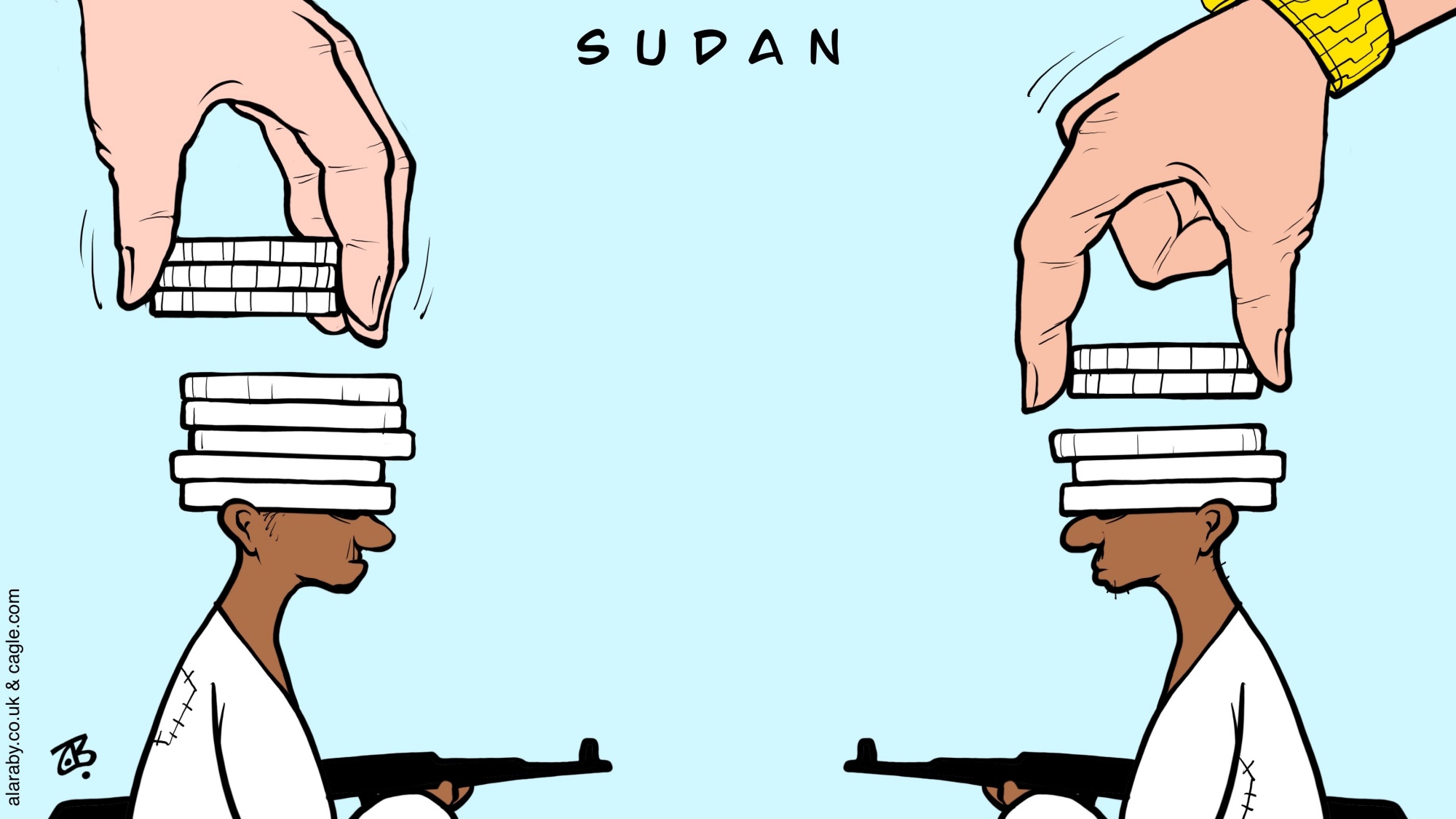


No doubt stopping this foolish war will be difficult. We simply cannot ignore such suffering--not if we want to consider ourselves decent, caring human beings.
Sep 5, 2024 8:05 PM
No doubt stopping this foolish war will be difficult. We simply cannot ignore such suffering--not if we want to consider ourselves decent, caring human beings.
With the Russian invasion of Ukraine for over two years now causing daily heartbreak for not only Ukrainians, but also the Russian troops killed or maimed; with many of the people in Gaza, often including women and children, being bombed, regularly displaced (if not killed), and facing shortages of food and drink; and with the USA approaching an election that could return an enemy of democracy to power, do we have room in our brains and hearts for one more serious problem?
I hope so. Because the present situation in Sudan (directly south of Egypt, with a population of about 50 million) is tragic and needs fixing. And, as Priti and Stan Cox emphasized a little over a month ago on the LA Progressive, quickly.
Here are a few of points stressed by the Coxes:
- “Almost 26 million people . . . could suffer from malnutrition by September.”
- “Eight and a half million of those human beings could face acute malnutrition."
- “If the war continues on its present path, millions will die of hunger and disease in just the coming months.”
- “More than a fifth of the population [have been displaced] from their homes, livelihoods, and farms.”
Related stories
In recent days the tragedy unfolding in Sudan has received more coverage. The Economist, a British newspaper/magazine that first appeared in 1843, featured Sudan on its cover at the end of August and provided several pieces about the ongoing tragedy there. And my favorite TV news source, the PBS News Hour, ran a series of reports (four from mid August through 3 September), featuring special correspondent Leila Molana-Allen, from within that war-torn country.
The Latest from The Economist
Sudan’s “capital city has been razed, perhaps 150,000 people have been slaughtered and bodies are piling up in makeshift cemeteries visible from space. . . . Some estimate that 2.5m [million] civilians could die by the end of the year. . . . It is the world’s worst humanitarian crisis.”
Molana-Allen’s PBS Reporting
It has been especially poignant and moving, partly because of the truth contained in the sentence “A picture is worth a thousand words.” To see numerous pictures of starving and ailing babies while Molana-Allen is compassionately interviewing their mothers is heart wrenching.
It makes us want to cry out, “Stop this tragedy.” “Stop this warfare that is causing such profound suffering to innocent children.”
“He was struck by the recently concluded war [World War II] not as a historical, geopolitical fact but as a multiplicity, a near-infinity of private sorrows, as a boundless grief minutely subdivided without diminishment among individuals who covered the continent like dust. . . . For the first time he sensed the scale of the catastrophe in terms of feeling; all those unique and solitary deaths, all that consequent sorrow, unique and solitary too, which had no place in conferences, headlines, history, and which had quietly retired to houses, kitchens, unshared beds, and anguished memories.”
Before interviewing mothers and other hungry Sudanese, Molana-Allen first sat down with Sudanese Vice President Malik Agar, and her talk with him became the first of her her three August reports. Before the interview, however, she presented some Sudanese background.
“Five years ago, elated Sudanese young and old danced in the streets after countrywide protests brought down Sudan's 30-year dictator and indicted war criminal Omar al-Bashir. Democracy had arrived. But just two years later, the Sudanese army and a rehabilitated militia, the Rapid Support Forces [RSF], united under Army Chief Abdel Fattah al-Burhan [and] took power in what Sudanese civil society calls a coup against the people.”
Agar, the man she interviewed, is not only vice president, but also “deputy head of the military junta that's ruled the country since 2021.” But Agar did not become vice president until last year, after his predecessor (a General Dagalo) broke away from the military junta, became leader of the Rapid Support Forces (RSF), and began fighting the Sudanese Armed Forces (SAF).
Molana-Allen did not provide any Sudanese history prior to the Omar al-Bashir 30-year dictatorship, but it is useful to know that like most of Africa, it was for many decades under Western (i.e. British) control, which was finally relinquished in 1956. And also like many African countries its ethnic and cultural makeup was determined more by imperialistic politics than by any internal cohesiveness.
In Sudan this led to substantial differences between its Islamic north and its Christian and animistic south. It also led to civil war, which finally ended in 2011, when South Sudan became an independent state. But even then, part of the new Republic of the Sudan (northern Sudan) had a very dissatisfied minority in a western region of the country know as Darfur, where the three-decade (1989-2019) long military dictatorship government committed numerous atrocities, including what some labeled “genocide.”
As for Molana-Allen’s interview with Gen. Agar, since it mainly deals with outside reaction to the crisis in Sudan, we’ll postpone consideration of their exchange until we come to section of this essay dealing with “What Should We Do?
Thus, instead we’ll first deal with her second and third News Hour programs, where she primarily interviews ordinary citizens caught up and suffering because of their country’s civil war.
First (in her second August segment on Sudan) she questions Sudanese in and around the capital, Khartoum, and nearby Omdurman, its second largest city. About Khartoum, she relates that in its “residential suburbs, once home to millions, . . . bullet-battered streets tell a story of hand-to-hand combat, craters from missiles fired at close range ripping through walls and rooftops every few yards, a century-old mosque scarred by hails of gunfire, the areas largest bank incinerated. Lifesaving hospitals gutted.”
Although government forces have managed to retake this area, “just across the Nile in Khartoum city, the Rapid Support Forces continue to shell, shoot and raid. Not a single street is unscathed by the violence. . . . All of Omdurman's hospitals have been hit multiple times by shelling and small-arms fire throughout the course of the war. Most of them aren't functioning anymore.”
But Molana-Allen talks to one doctor who is caring for a 10 month-old child with acute malnutrition--his lungs are failing and “he weighs just half what he should at this age.” Moreover, this hospital gets more than 100 such cases every month. She mentions another such case, “nine-month-old Ukrain, named for another bitter war of survival, has had so little nutrition in her early life that her organs are failing.”
Besides dealing with the Khartoum and Omdurman areas, Molana-Allen visits Qadarif, not far from the Ethiopian border. She mentions that RSF forces are closing in on it “in a pincer movement. An RSF victory here would be nothing short of catastrophic for the country's dwindling food supply. . . . Hundreds of thousands of the elderly, the injured, the desperate mothers and their weary children search in vain for a safe place to wait out this war and enough food to survive it.”
In her third August report from Sudan, Molana-Allen talks to refugees fleeing the “looting, killing, rape, at the hands” of the RSF, including in Sennar, a city and area southwest of Qadarif. She reports that the RSF's latest recent offensive has swept through Sennar, “sending its residents running for their lives.” Many of them have previously had to flee. One of the mothers, Salma, now in Qadarif, has six kids, four of them younger than 5 years old, and she tells the reporter that this is the fifth time they’ve been displaced.
In addition to her own children, Salma has a neighbor’s teenage daughters--the RSF attacks happened so fast in Sennar that the girls’ mother “was out trying to find work” and Salma says she “couldn't leave them behind.” So far, however, “there's no news” about the mother, “not even a phone call.” Salma adds that “the [ten-day] journey was long and rough, sleeping on a blanket on the roadside each night, fending off snakes and scorpions.”
Molana-Allen also talked to an older man who had diabetes, as did his wife. He told the reporter that people sent them medicine, but the RSF confiscated it. Some others “died because of the lack of treatment.” In their besieged territory shells “hit houses and people. The bullets were the worst because they were everywhere. There was no water, no electricity for 11 months.” In order to leave the area his “small family” had to pay the RSF a “hefty exit” bribe, nearly $1,000, which, unlike many others, he “was lucky to have.”
A woman from Omdurman tells Molana-Allen that seconds after a gunfight broke out, “her husband was dead and the RSF had kidnapped her. For six months, she was held captive, subjected to horrifying abuse.” She related that “there was beating, sexual assault and death. Everything was done to us.” Finally, she agreed to work for the RSF because, as she explained her “children were in their hands,”she “had no choice but to work with them.”
In the fourth series of interviews (aired on 3 September), it again becomes clear, as it had earlier, that the RSF is the main violator of human rights. One man from Sennar told Molana-Allen, “I saw death. There were rapes. The RSF were killing anyone they found in front of them. The situation in the country is getting worse.”
Not that the government forces (SAF) have been blameless, and interviews with Sudanese civilians express doubts about whether the SAF will really relinquish power to civilians, as VP Agar indicated it would, during his interview which aired in mid August. The Agar interview brings us to the outside responses to these horrors and to the question of “What should we [in the USA and elsewhere] do?”
What should we do?
After noting that “the world has responded to Sudan’s war with neglect and fatalism”; that “today American officials shrug that they are too busy dealing with China, Gaza and Ukraine”; that “the UN Security Council is split, its bureaucracy lumbering”; that “half-hearted ceasefire talks in Geneva have gone nowhere”; The Economist issue mentioned above has a few suggestions.
- “Public outrage can put pressure on democratic governments that care about human lives to do more.”
- “Get more aid in quickly, to reduce the death toll from starvation and disease. Lorries laden with food must pour across every possible border.” (Those wishing to aid the Sudanese can do so through various worthwhile charities.)
- “Put pressure on the cynical outside actors fuelling the conflict. If Sudan’s warlords had fewer weapons and less money to buy them, there would be less killing, and less war-induced starvation. America, Europe and other responsible powers should impose sanctions on any business or state official exploiting or enabling Sudan’s war—including those from allies such as the UAE [United Arab Emirates].”
The British journal concluded that,
“it is [still] possible to save millions of lives, and reduce the chance of calamitous geopolitical aftershocks [like the mass migration to Europe of refugees], if the world acts now. For too long Sudan has been the war almost everyone chose to ignore.”
Meanwhile, the civil war continues, and it seems to be innocent civilians - one thinks especially of the starving and malnourished children - who suffer the most. In Dostoevsky’s famous novel The Brothers Karamazov there is a scene in which one of the brothers, Ivan, says he cannot accept any God that allows the suffering of innocent children.
In his The Rebel (English trans., 1956) Albert Camus cites favorably these words. Later, in 1981, a Jewish rabbi, Harold Kushner, wrote a book, When Bad Things Happen to Good People, which tried to answer the same question with which Dostoevsky and Camus struggled—Why do innocent children suffer? There is no easy answer, but their suffering in Sudan (including many of their deaths) seems foolish indeed, as do most wars.
No doubt stopping this foolish war will be difficult. But other foolish conflicts have been ended before their carnage and suffering became even greater. One thinks, for example, of the 1998 Good Friday Agreement in Northern Ireland. When we witness what we have been seeing in Sudan, we simply cannot turn away and ignore such suffering--at least we can’t if we want to consider ourselves decent and caring human beings.
Comments

Powered by RoundtableAn AI/DeFi-powered Enterprise Media Operating System. Learn more at Roundtable.io.© Roundtable 2026. By using this site you agree to the Terms of Use and Privacy Policy