


Aug 29, 2026 6:58 PM
There is something encouraging in seeing Carney and Ford—politicians of markedly different temperaments and political traditions—standing together on this question.
There is something profoundly revealing about Donald Trump’s escalating campaign against Canada. What began ostensibly as a dispute over tariffs has increasingly assumed the character of something more disturbing: a politics of humiliation in which economic power is deployed not simply to secure commercial advantage but to demand submission.
Canada’s refusal to submit appears to have become the offense.
Prime Minister Mark Carney’s decision to walk away from trade negotiations with Washington was therefore consequential. The United States had introduced demands that Carney considered unacceptable, including restrictions affecting Canada’s ability to negotiate trade agreements with other countries and provisions threatening key Canadian industries and matters of national sovereignty.
His government chose to suspend the negotiations rather than accept a deal at any price.
Related stories
This was not anti-Americanism. It was an assertion of national self-respect.
Canada and the United States are neighbors whose economies, histories, families and cultures have been intertwined for generations. Millions of Canadians—including myself—have built lives in the United States. I arrived here in 1985 and became an American citizen in 2000. My criticism of Trump does not arise from hostility toward the United States. It arises precisely from an understanding that friendship between nations, like friendship between human beings, becomes meaningless when one party insists upon the subordination of the other.
Trump seems incapable of comprehending this distinction.
He has repeatedly referred to the Canadian prime minister as “Governor Carney,” as though Canada were already an American province awaiting formal annexation. He has described Ontario Premier Doug Ford as Carney’s “Flunky.” He has declared that Canada could not survive without the United States and instructed our northern neighbor to “fall in line.”
This is not the vocabulary of negotiation between sovereign democracies.
It is the grammar of domination.
Captain Canada
There is something encouraging in seeing Carney and Ford—politicians of markedly different temperaments and political traditions—standing together on this question.
Even Fox News has taken to describing Ford as “Captain Canada.” It is an unexpectedly appropriate sobriquet for a politician who has emerged as one of the most outspoken Canadian opponents of Trump’s trade threats.
Ford’s language has hardly been diplomatic. After Trump attacked him personally, the Ontario premier responded that the American president could “kiss my ass.”
Ford subsequently joked that, given his considerable girth, Trump would have plenty of “real estate” upon which to perform the requested maneuver.
Crude? Certainly.
But Ford’s profanity should not be confused with Trump’s politics of humiliation.
One is the language of exasperated resistance. The other emanates from the immense institutional power of the presidency of the United States.
Ford supplies the populist growl; Carney supplies the institutional restraint. Their rhetorical registers could scarcely be more different, yet at this historical moment they converge upon the same proposition:
Canada is not an American dependency awaiting instructions from Washington.
That is why the emerging “Team Canada” approach matters. It need not signify uncritical nationalism. Canadians can disagree profoundly among themselves about pipelines, energy, taxation, immigration, Indigenous sovereignty, social policy and a thousand other questions. Democracy requires such disagreement.
But democratic disagreement within a sovereign country is altogether different from allowing another country to determine the limits of that sovereignty.
As Carney has put it, Canada will set its own course.
The Best Deal—for Whom?
The Trump administration insists that Canada walked away from what U.S. Trade Representative Jamieson Greer described as “the best deal.”
But the phrase itself contains the paternalism of the entire encounter.
Best according to whom?
Best by what measure?
Best for American workers? Canadian workers? Multinational corporations? Ontario’s automobile industry? American consumers? Or the political fortunes of Donald Trump?
A powerful nation does not acquire the moral authority to define another nation’s interests simply by declaring the terms it has offered to be generous.
Carney’s refusal therefore assumes significance beyond the particular tariff schedules under dispute. It represents resistance to the proposition that proximity to American power requires obedience to American power.
Canada is entitled to negotiate with the United States.
It is not required to submit to it.
Fox News and the Ideology of Dependency
The ideological dimensions of this dispute are perhaps nowhere clearer than in the media ecosystem surrounding Trump.
Sean Hannity has treated Canada’s efforts to diversify its international economic relationships—particularly its dealings with China—as evidence of a dangerous political departure. Carney is situated within the familiar American culture-war vocabulary of the “left,” while figures around Trump portray Canadian economic independence as unrealistic because Canada supposedly depends upon the United States for its prosperity and security.
This is revealing.
The very possibility that Canada might diversify its trading relationships becomes suspect because MAGA ideology increasingly interprets independence from American power as hostility toward America.
The political spectrum has shifted so dramatically within MAGA discourse that policies once recognizable as ordinary social-democratic or liberal-democratic governance can be portrayed as evidence of radicalism. “Left-wing” becomes less a description than an accusation.
The implication is unmistakable: Canada may call itself sovereign, but its prosperity depends upon American markets, its security upon American military power, and therefore its political choices should remain within boundaries acceptable to Washington.
Vice President JD Vance made the underlying assumption even more explicit. At a Republican gathering, he referred to Canada as “a state,” quickly correcting himself and calling the remark a Freudian slip. Perhaps it was more revealing than he intended. Vance proceeded to attack Canada for underinvesting in its military while depending upon the United States for protection.
There, in miniature, is the grammar of domination.
Canada is simultaneously ridiculed for its supposed dependency and expected to be grateful for it. Its sovereignty is treated not as an inherent political fact but almost as a concession granted by American power. The implication is difficult to miss: we protect you, therefore you owe us deference.
But an alliance that demands political obedience in exchange for protection has ceased to understand itself as an alliance.
It has begun to imagine itself as a protectorate.
The Cartography of Resentment
Then came the lake.
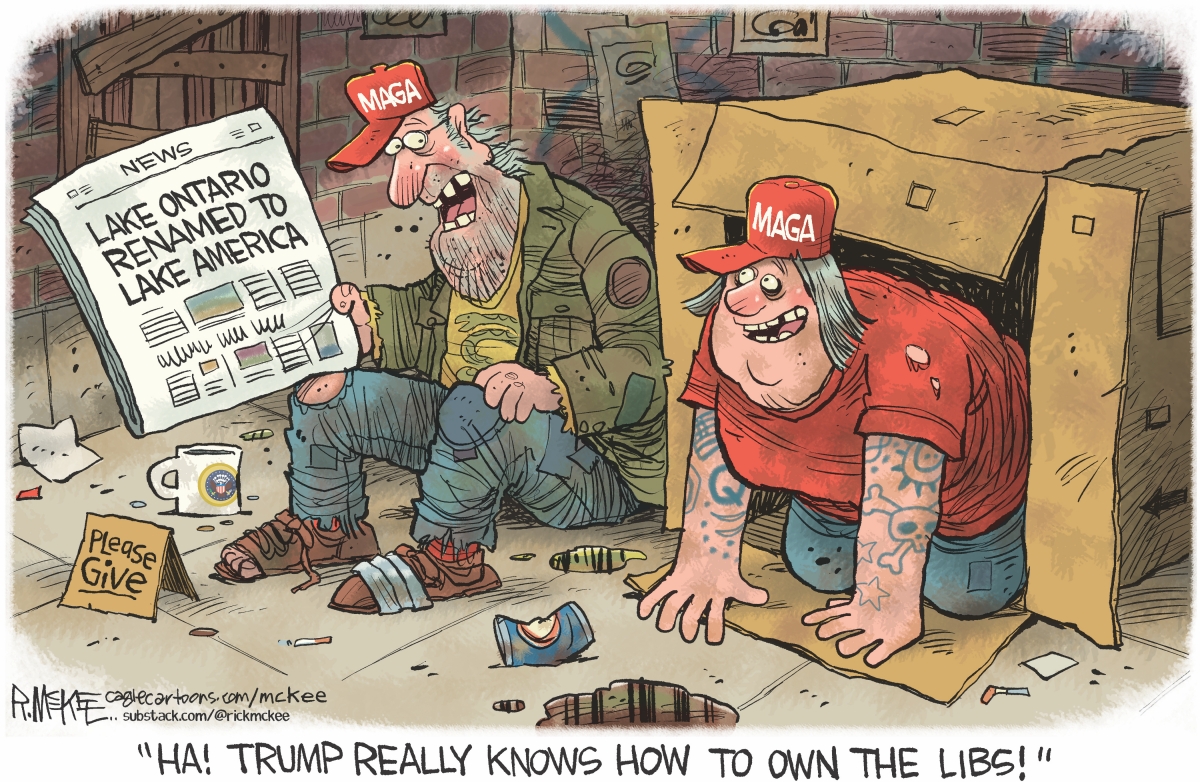
On August 27, Trump signed an executive order directing the United States government to rename Lake Ontario “Lake America.”
The spectacle initially invites laughter.
Trump’s renaming of Lake Ontario offers his audience little more than the slight bemusement of watching a reactionary man-child fist-pumping his emotions like a grade-schooler throwing a tantrum because another child refuses to surrender his lunch money.
But beneath the comedy lies something considerably darker.
This is the politics of narcissistic sovereignty: the fantasy that possessing power confers the authority to rename reality itself.
Unable to bully Canada into submission at the negotiating table, Trump turns instead to the cartography of resentment.
If Canada will not bend, its geography can at least be symbolically appropriated.
There is something almost comically imperial in the gesture. Trump could not make Canada the fifty-first state, so now he behaves as though he might annex it syllable by syllable, landmark by landmark, name by name.
Yet we should resist laughing too quickly.
Naming is a form of power.
Colonial history teaches us this repeatedly. Empires rename territories, rivers, mountains and peoples because the ability to name is inseparable from the ability to declare whose reality counts.
Trump’s executive order is therefore simultaneously farcical and revealing. It instructs American federal agencies to substitute “Lake America” for Lake Ontario and justifies the change partly through assertions about American economic investment, commerce, security and defense.
The logic is extraordinary: because the United States contributes to the protection and economic vitality of a shared body of water, the American president assumes the symbolic authority to rename it.
That is narcissistic sovereignty translated into geography.
Carney’s response was devastating precisely because it refused Trump’s theatrical register. He reminded Canadians that the name Ontario derives from the Wendat word Ontari’io and is more than four centuries old—older than both Canadian Confederation and the United States itself.
Canadians, Carney responded, will continue calling reality by its name:
Lake Ontario—then, now and always.
Trump can order American bureaucrats to alter federal maps.
He cannot order Canadians to surrender their history.
He cannot erase the Indigenous memory carried within the word Ontario.
And he cannot transform humiliation into victory merely by changing the label on a map.
Manufactured Martial Heroism
This struggle over symbols connects to something larger in Trumpism.
Trump has surrounded himself with an extraordinary iconography of military heroism: images presenting him as warrior, conqueror, defender and physically heroic embodiment of the nation.
It is manufactured martial heroism.
The distinction matters because political spectacle can counterfeit virtues that historically required sacrifice.
I have criticized Trump for avoiding military service during the Vietnam era. Yet intellectual honesty requires me to say immediately that I never served in the military either.
I came to the United States in 1985. I became a citizen in 2000. I have spent much of my life criticizing wars in which the United States and other imperial powers have participated.
So my criticism cannot be that every political leader must have worn a uniform before speaking about military affairs. That would be hypocritical.
The issue is something different.
I do not manufacture images of myself as a warrior.
I do not convert my absence from the battlefield into an elaborate iconography of battlefield courage.
There is a profound difference between never having served and constructing a political mythology in which one continuously performs the warrior one never was.
And here my thoughts inevitably return to Canada.
Juno Beach
Those who sneer at Canada’s military history might spend some time remembering June 6, 1944.
On D-Day, approximately 15,000 Canadians participated in the landing force at Juno Beach. Canadian infantry, armor, artillery, engineers, sailors and airmen confronted fortified German positions under murderous fire.
By evening, Canadian troops had advanced farther inland than any of the other Allied forces landing that day.
Three hundred and forty Canadians were killed.
Another 574 were wounded.
That is not manufactured martial heroism.
That is actual sacrifice.
My own father served with the Royal Canadian Engineers in Europe and fought through the campaign in the Netherlands. Like countless veterans of his generation, he did not need an artificially generated portrait depicting himself as a superhero. The evidence of courage was written into what he and his comrades had endured.
I have never claimed his courage as my own. Children do not inherit their fathers’ sacrifices as medals.
But we can inherit their memory.
And memory provides a useful defense against political counterfeit.
There is something obscene about watching military heroism converted into costume by political leaders who confuse aggression with courage, domination with strength and humiliation with victory.
The loudest performance of courage often begins precisely where the memory of actual courage ends.
What Strength Looks Like
Perhaps this is ultimately what the present conflict between Canada and the United States is about.
Not tariffs alone.
Not automobiles.
Not steel.
Not dairy products.
Not even Lake Ontario.
It concerns competing conceptions of strength.
Trumpian strength requires another person to kneel. Another country must “fall in line.” Another leader must become a governor. Another nation must acknowledge its dependency. Even geography must be made to speak the language of American supremacy.
That is not strength.
It is insecurity armed with power.
Canada need not answer it with a nationalism of its own.
It need not pretend to possess America’s economic or military power. Nor should Canadians romanticize their own history, which contains its own legacies of colonialism, Indigenous dispossession, racism and injustice.
A mature patriotism is capable of loving a country without inventing its innocence.
But a mature democracy must also know when to say no.
Carney’s refusal at the negotiating table and Ford’s considerably less elegant refusal outside it represent different versions of that word.
No.
No, Canada will not be treated as a subsidiary.
No, proximity does not entail subordination.
No, friendship does not require obedience.
No, economic power does not confer ownership over another nation’s political future.
And no, Lake Ontario does not become Lake America because Donald Trump commands it.
There is an important lesson here for Americans as well as Canadians.
A republic does not demonstrate its greatness by humiliating its friends.
An alliance is not proven by discovering how much pain the stronger partner can inflict upon the weaker one.
And patriotism is not measured by how loudly a leader beats his chest, how many heroic images of himself he circulates, or how many places he can rename.
The measure of democratic strength is the capacity to live alongside others who remain free enough to disagree with us.
Canada is disagreeing.
Canada is refusing humiliation.
And perhaps, in an age saturated with the manufactured iconography of strongmen, that quiet refusal reminds us what courage actually looks like.
Comments

Powered by RoundtableAn AI/DeFi-powered Enterprise Media Operating System. Learn more at Roundtable.io.© Roundtable 2026. By using this site you agree to the Terms of Use and Privacy Policy