
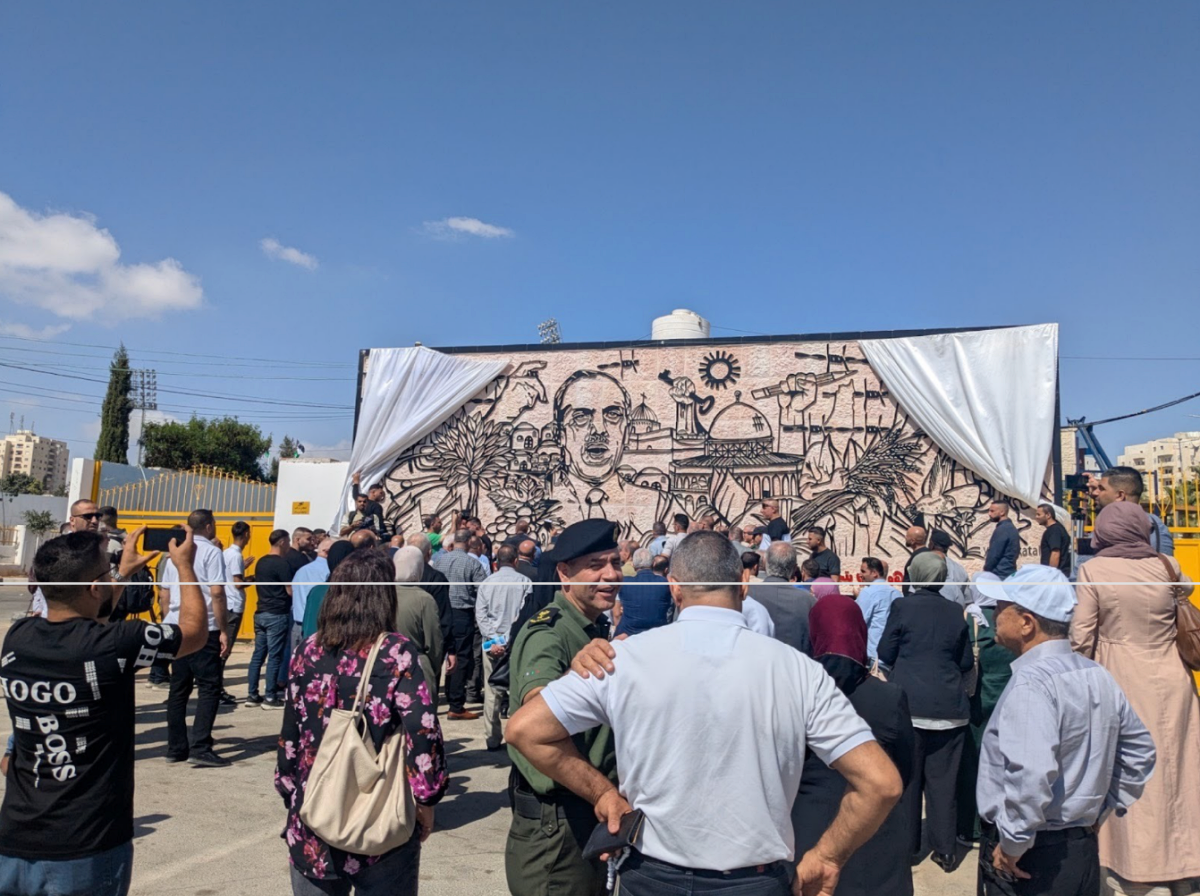
Saskia Hostetler Lippy in Dura, Hebron on October 5th, 2025.


Oct 24, 2025 5:48 PM
Updated Oct 26, 2025 3:45 AM
One answer to resisting occupation lies in organizing and codifying professional rights where none exist.
News from the West Bank is not far from my heart these days, having just returned as a solidarity activist to bear witness to the Occupation and the strength in the resistance to it of the Palestinian people. As Israel announced Tuesday the preliminary vote in the Knesset to apply sovereignty to the entirety of the West Bank (including Ma’Ale Adumim which required a 2nd vote), I was reminded of the recent October 5th event hosted by the Palestinian Authority.
As guests of our Palestinian comrade, we were told only that we were there to support the artist, Yousef Katalo, himself a political prisoner by the PA earlier in his life. Katalo created the mural being opened at the Dura Martyrs Cultural Center on October 5th in honor of Youssef Al-Khatib, poet, media figure and founder of the Palestinian Writers and Journalists Union who died in exile in Damascus in 2011.. Speeches by the mayor of Dura, governor of Hebron, minister of culture for the Palestinian Authority and head of the Palestinian writers association highlighted the following lessons in resistance from Khatib’s own life.
- Exile from one’s homeland is never the end of the political story. While Al-Khatib was exiled from his childhood home of Dura and the West Bank in the 1950’s he lived and created a storied career in exile in Damascus, Lebanon, and the Netherlands. His footprint touched the lives of many Palestinian writers and journalists including his groundbreaking 1968 publication of Diwan al-Watan al-Muhtall (“Diwan of the Occupied Homeland”), a collection of poetry including Mahmoud Darwish which was banned for decades in Arab countries.
- One answer to resisting occupation lies in organizing and codifying professional rights where none exist. Khatib’s career gives a roadmap for organizers today as founder of the following: Palestine Radio (1965) Palestine House for Culture, Media and Arts, Arab Writers Union in Syria (1966), Palestinian Writers and Journalists Union and the 1st audio story collection in 1983 entitled “The Crazy of Palestine”.
- Calls for unity will be met with fierce resistance. Called the “sword of Palestine”, Khatib called for the reunification of the Palestinian diaspora. For this he paid an enormous price. Banned in the Arab world, exiled from his homeland, the current head of the Palestinian Writers association, Murad Sudani acknowledged Khatib had spent parts of his life as a symbol of rejection. The historical quote attributed to Khatib is “There is no peace, the refugees today are enemies of peace! Until historical justice emerges from the point of sword…”. As a witness to the fragmentation within our own movements, solidarity activists can only hope to mend their own fences as they watch the Palestinian resistance seek to build unity-between the West Bank and Gaza, between the communities of the diaspora, between Jerusalem and Bethlehem etc. The stories of family separations and lives torn apart by the Occupation and its legal entanglements deserve a separate dispatch.
Related stories
- Lastly, communities can and do build solidarity through art. The murals of Yousef Katalo are scattered across Dura. This is not by accident. This is through community organizing and participation and by the people of Dura devoting themselves to the improvement of their town. The mayor highlighted their creativity in resistance in family councils, including women’s councils who help to make this essential work of resistance bear fruit.
The coming days will test us all, both in our country and abroad. As citizens of the wealthiest country on Earth, it is up to us not to be silent as we watch the current Israeli administrators of the Occupation reach for the end goal-the complete annexation of the West Bank. If you have any doubt about a just peace in Palestine, here’s a step you can take to conduct an action. Sign this. If our own political misfortunes have you down, remember and take courage from our Palestinian comrades like Youssef al-Khatib and Yousef Katalo who found a way (even through exile and death) to uplift the living.
Comments

Powered by RoundtableAn AI/DeFi-powered Enterprise Media Operating System. Learn more at Roundtable.io.© Roundtable 2026. By using this site you agree to the Terms of Use and Privacy Policy