


Jan 11, 2026 5:25 PM
Updated Jan 11, 2026 5:27 PM
Trump will define international law as he sees fit, and he will find nothing in it it that obliges him to respect the sovereignty of other states.
Among the twenty six executive orders issued by Donald Trump on his first day in offce is one titled, “Guaranteeing the States Protection against Invasion.” The “invasion” here is what most of us just call immigration, a phenomenon as old as our history, but one that the president apparently finds deeply threatening. Perhaps in an effort to show how serious the “invasion” is, the order begins with a definition of sovereignty: “An essential feature of any sovereign nation is the existence of territorial boundaries and the inherent authority to decide who and what may cross those boundaries.” It’s as if coming to this country in search of a better life, which people have been doing for centuries, places American sovereignty in jeopardy.
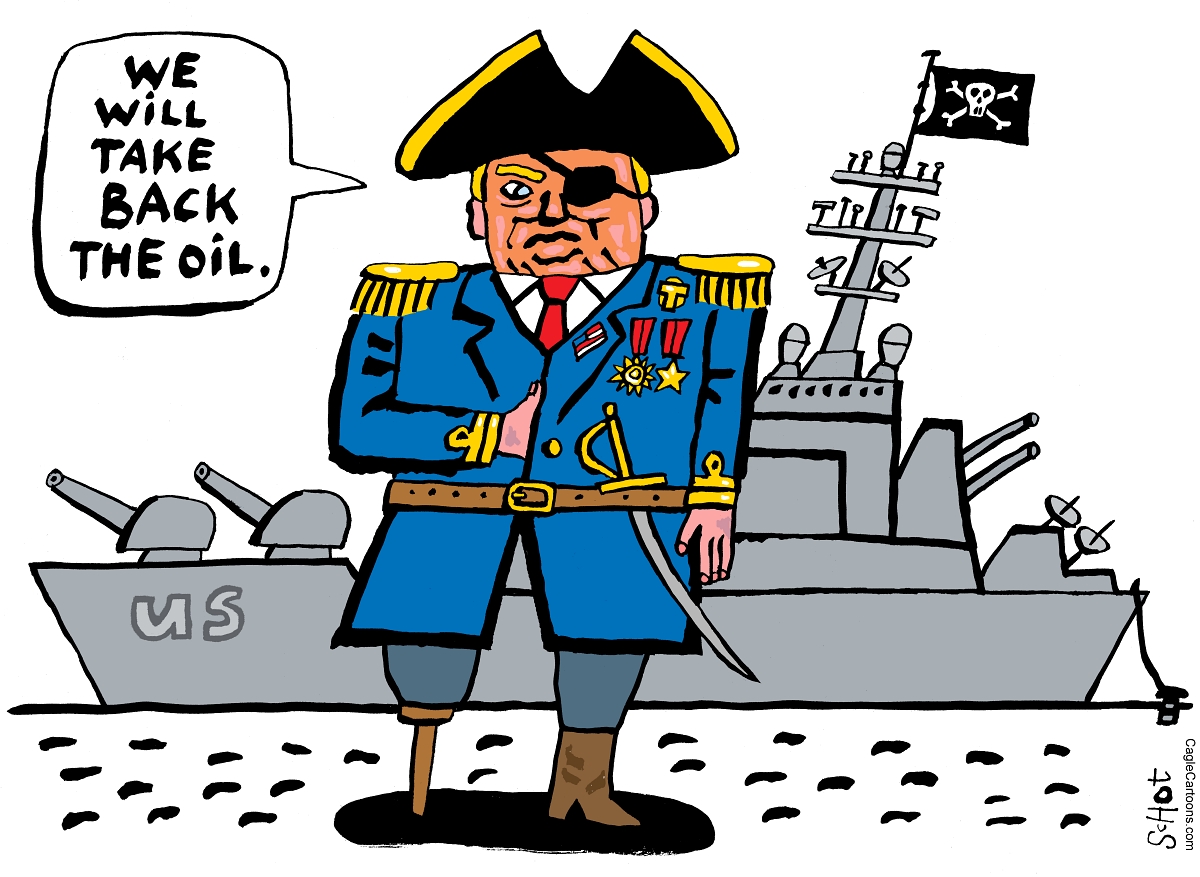
Scholars agree that sovereignty requires a territory with distinct borders and both the ability and the right to defend them. They also agree that when agents of one state—troops, for example—cross the border of another state without permission, that constitutes a violation of sovereignty. However, a year after Trump signed this order, with its unambiguous definition of sovereignty, US troops crossedVenezuela’s border and deposed its head of state. Our vice president explained: “The drug trafficking must stop, and the stolen oil must be returned to the United States.”
We may struggle to remember when Venezuela ever “stole” anything from the United States, let alone the oil that lies under its own territory. Most of us will remember, though, that in 1990 Saddam Hussein sent his troops across the border of Kuwait, deposed its leader, and took control of its oil, justifying the invasion with a claim that Kuwait had been stealing Iraqi oil. As Sam Sifton puts it in The New York Times, the attack on Venezuela raises the question of whether “a powerful nation has the right—or at least the ability—to command affairs in nearby, less powerful nations.” Trump and his advisors would not hesitate to answer with a yes.
Speaking to CNN’s Jake Tapper, senior Trump adviser Stephen Miller said, “The United States is using its military to secure our interests unapologetically in our hemisphere. We are a superpower, and under President Trump we are going to conduct ourselves as a superpower.” As if Miller’s “unapologetically” wasn’t clear enough, Trump himself said, “I don't need international law.” Then, promising to abide by it anyway, he added “it depends what your definition of international law is.”
Related stories
In other words, Trump will define international law as he sees fit, and he will find nothing in it it that obliges him to respect the sovereignty of other states. In effect, only the United States has any claim to the sovereignty he defined on his first day in office. Other states, presumably, have only the sovereignty he chooses to grant them. When interviewers asked him what might constrain him, he said, “My own morality. My own mind. It's the only thing that can stop me.”
When Saddam Hussein does it, it’s naked aggression, and the the United States replies with overwhelming violence followed by twelve years of sanctions that raise child mortality into the hundreds of thousands. When Donald Trump does it, it’s just America “unapologetically” protecting its interests, and whatever costs there are in human suffering are regrettable but unavoidable. As former secretary of state Madeleine Albright said of the widespread suffering and death in Iraq under American sanctions, “We think the price is worth it.”
But at least the president’s action is not without precedent, and he may find some validation in that. In 1637, colonists went to war against the Pequot nation for control of regional trade. Confining the Pequots inside their village, our ancestors set fire to the place and killed everyone who managed to escape, and then sold all of the survivors into slavery. Nearly all of our western states took form in territory seized from Mexico after the war of 1846-48. Hwaii became US territory after fruit growers there overthrew the hereditary monarchy. The Philippines became a US colony after American troops put down an independence movement there between 1899 and 1902—an “insurrection” in today’s military bureaucratese, and therefore illegitimate. And there are other precedents from much earlier.
In 419 BCE, nearly twenty five hundred years before Trump waged war on Venezuela, Athenian forces laid siege to the tiny island of Melos. At the time, Athens was the most powerful city state in the region. Melos was a Spartan colony, but the Athenians wanted them to shift their allegiance, and offered them a choice between Athenian protection and utter destruction. When the Melians appealed to the principle of right, the Athenians replied, “you know as well as we do that right, as the world goes, is only in question between equals in power, while the strong do what they can and the weak suffer what they must.”
In other words, we Athenians will decide what’s right, and you Melians will just have to live with it—or die with it. Or, to put that differently, “that depends on what your definition of right is.” Unable to resist, the Melians surrendered, and the Athenians proceeded to kill all of the adult men and sell the women and children into slavery.
If you’re wondering, yes, this is the same Athens we revere as the birthplace of our democratic traditions. Home to Plato and Aristotle, Spophocles and Aeschylus, Thucydides and Pericles, Athens was the birthplace of Western philosophy, theater, historiography, and the concepts of popular sovereignty and rule of law, the crown jewel of classical culture. But as the Melians would tell us, if only they could, Athens was also a ruthless aggressor, invading other sovereign states at will, and “unapologetically” taking whatever they desired.
It’s not just our proudest cultural and political traditions we owe to Athens.
From the Athenians at Melos to the Americans in Venezuela isn’t just a pattern. It looks like a tradition, one that Trump is honoring with his actions, even if he doesn’t realize it. The only problem is that the United States has always portrayed itself as a defender of weaker peoples facing oppression from stronger ones. It appears now that Donald Trump and his minions have decided that the United States is a predator nation, no longer a protector of the preyed upon. As Pogo the possum said many years ago, “We have met the enemy, and he is us.”
America’s talk has always been an inspiration for others, who’ve seen in us that city on a hill envisioned by John Winthrop nearly four hundred yaers ago and revived by Ronald Reagan, John Kennedy, and others in our lifetime. The harsh and unsparing realities of America’s walk, alas, bear less and less resemblance to the noble ideas conveyed in its talk. In the past, we always pretended that when we wrought havoc in another country, it was in the cause of peace and freedom—truth, justice, and the American way.
All pretense has now been dropped. We have become Athens at Melos, imposing our will on Venezuela “unapologetically.” Other sovereign states should be advised.
Comments

Powered by RoundtableAn AI/DeFi-powered Enterprise Media Operating System. Learn more at Roundtable.io.© Roundtable 2026. By using this site you agree to the Terms of Use and Privacy Policy