
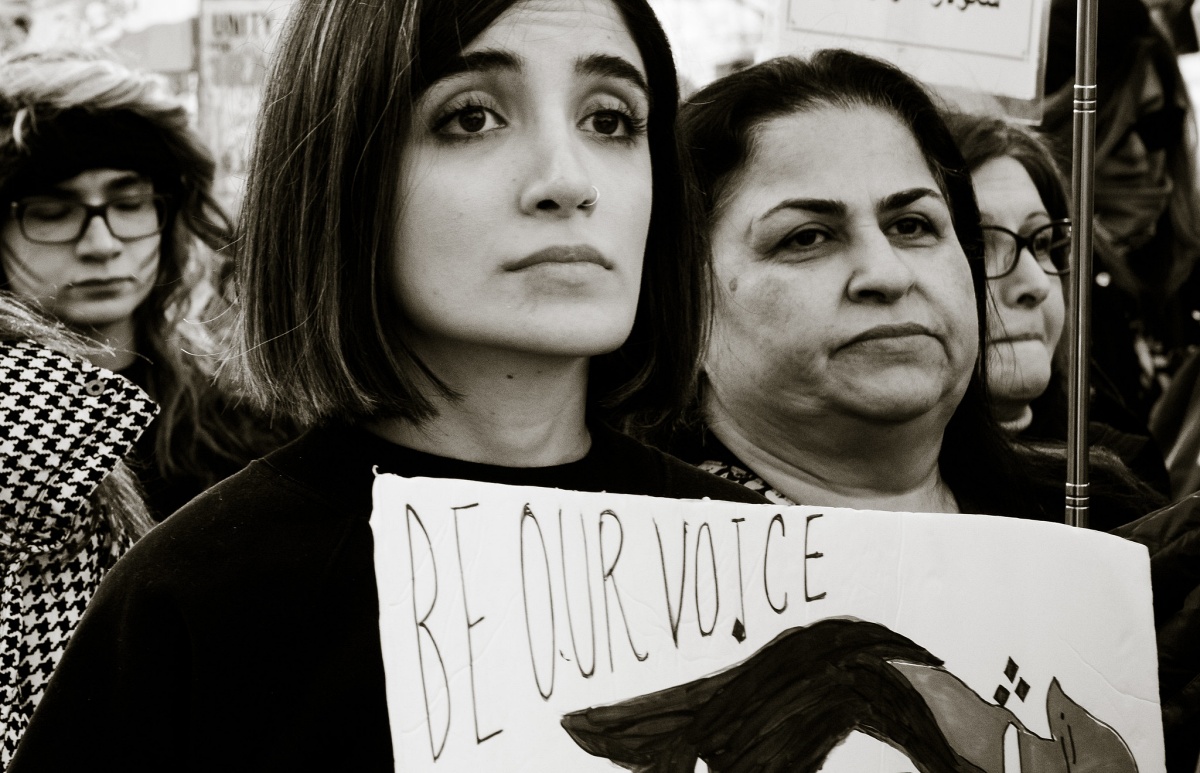
Victoria Pickering • Woman, Life, FreedomIranian protest, D.C. 1/28/23 • Attribution-NonCommercial-NoDerivs (CC BY-NC-ND 2.0) • Flickr


Jun 26, 2025 4:21 PM
The Iranian regime has long used external conflict as cover to consolidate power and punish dissent.
People are not nuclear enrichment. They are not a threat or a headline. Iranians are 91 million people—especially women and minorities—waking up each day, trying to hold on to dignity and protect their loved ones under impossible conditions.
Solidarity begins with clarity. Whenever we speak about Iran, we must ask a simple but urgent question: Are we referring to the Islamic Republic, or to the 91 million civilians forced to live under its rule? Without that distinction, public discourse becomes muddled, and those most impacted, especially women and minorities, are erased.
A ceasefire with Israel does not mean peace for Iranians. The regime has waged war on its own people for over four decades. Human rights organizations have documented a surge in arbitrary arrests and executions since the missile strikes began. That will likely increase as the defeated Islamic Republic projects power onto its most vulnerable citizens to compensate for international humiliation. As usual, repression intensifies just as media attention begins to drift.
The Iranian regime has long used external conflict as cover to consolidate power and punish dissent. And too often, when international focus fades, so does solidarity. But solidarity is not a fad, not a trending hashtag, and not saviorism. It is not about imposing solutions or equating bombs with democracy. True solidarity requires moral clarity and consistency, especially when it is inconvenient or unpopular.
Related stories
It also requires rejecting false binaries. One can oppose war and still condemn the Islamic Republic. One can decry atrocities in Gaza and still hold Iran’s regime accountable for its record of torture, censorship, and state violence. We must be capable of holding multiple truths at once, or we risk enabling erasure through oversimplification.
The Iranian people have risen up repeatedly, demanding dignity, justice, and a future worth living in. Each time, they have been met with brutal suppression. Yet the movement endures, not because of external pressure, but because of extraordinary internal courage. Women and minorities have not been symbols in this movement, they have been its leaders.
Some, like Nobel Peace Prize laureate Narges Mohammadi and political prisoner Sepideh Qolian, are known internationally. But there are thousands whose names cannot be spoken, because attention could put them in even greater danger. These activists are preserving truth, building resistance in whispers, and doing the unglamorous, essential work of grassroots transformation that rarely garners headlines.
I write not as a strategist or a spokesperson, but as a writer and lecturer in exile. I have lived and taught half of my life in Iran and the other half in North America. This dual perspective gives me both the clarity of distance and the intimacy of experience and academic insight. Exile removes you from your homeland, but sharpens your perception of it. It deepens both grief and responsibility.
When people in the West say they should not involve themselves in Iran’s internal affairs, I understand the hesitation. Foreign interventions have caused immense suffering across the region. But silence can be just as dangerous. No one is asking for bombs. What we need is space, support, protection for hospitals, asylum for those being hunted, and real solidarity with movements already growing from within.
Iran’s future will not be secured by removing one strongman and replacing him with a more Western-friendly version. It must come from dismantling the structures that sustain injustice: patriarchy, ethnic supremacy, and systemic inequality. That change cannot be imposed. It must emerge from within. What Iranians need most is for the world not to abandon them in their most dangerous hour.
Toni Morrison once wrote that evil has a blockbuster audience. Goodness, she said, lurks in the background. If we care about human rights, we must attune our attention to that quieter space—to the slow, courageous labor of justice—and refuse to look away when the spotlight dims.
Comments

Powered by RoundtableAn AI/DeFi-powered Enterprise Media Operating System. Learn more at Roundtable.io.© Roundtable 2026. By using this site you agree to the Terms of Use and Privacy Policy