
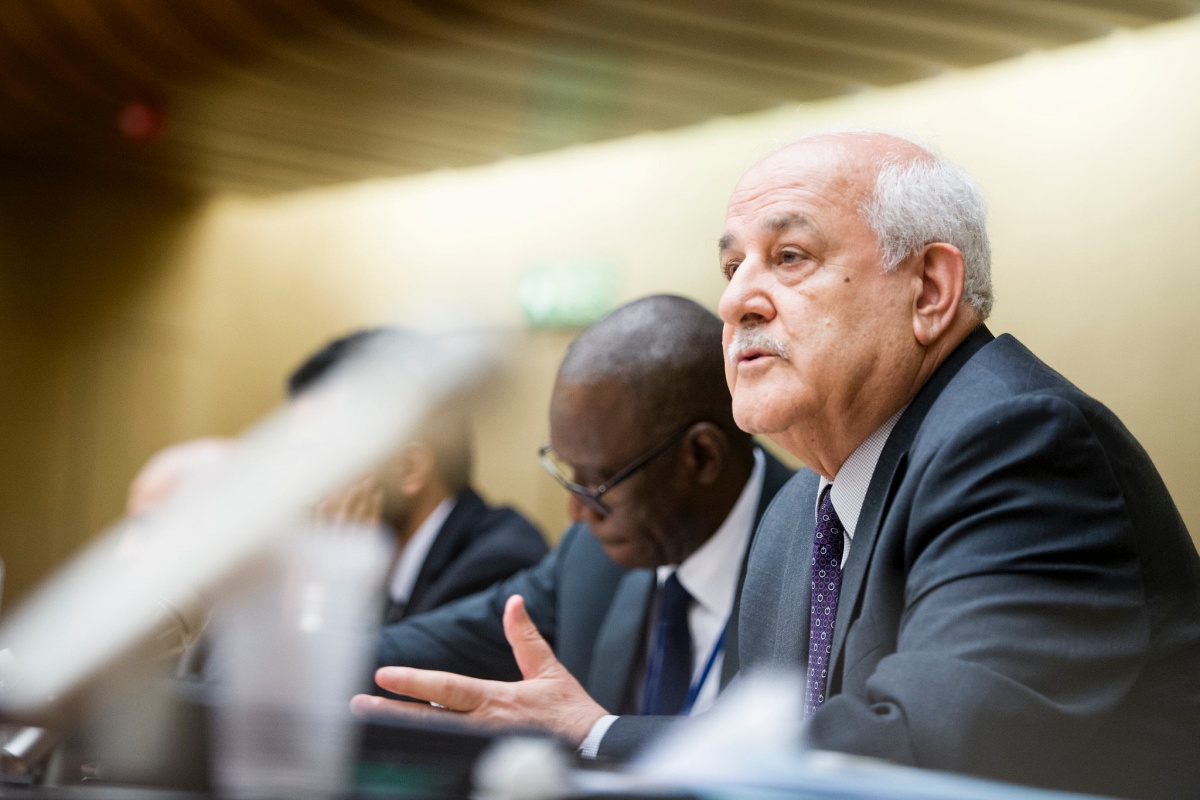
International Conference on the Question of Jerusalem • Attribution-NonCommercial-NoDerivs (CC BY-NC-ND 2.0) • Flickar

Riyad Mansour
Sep 23, 2024 8:24 PM
Interview with Riyad Mansour, the Palestinian Authority’s ambassador to the United Nations
The Washington Diplomat recently interviewed Ambassador Riyadh Mansour, the Palestinian ambassador to the United Nations.To describe the backdrop for this interview as a difficult one for Palestinians is at best a massive understatement. New revelations happen daily, a recent one is via a Human Rights Watch report detailing severe abuse of Palestinian medical workers—imprisonment, torture, even rape, and murder—who tried to alleviate suffering of the injured and wounded, many of them deliberately targeted children.
The continuing systematic crushing of culture and infrastructure is expanding to the West Bank, Israel's Violent Invasion of West Bank Parallels the Early Stages of War on Gaza: UN Rapporteur on Palestine, with military attacks greatly stepped up just prior to the interview, and the pattern of mass displacements starting to repeat there. That pattern began in Gaza after the tragic and brutal October 7th attack by Hamas that took 251 hostages and left 1,139 dead, including 695 Israeli civilians, 71 foreign nationals and 373 security forces. The fog of war makes precise counts challenging, including subsequent IDF revelations of a Hannibal Directive issued that terrible day. Israel believes approximately 100 hostages remain held by Hamas, an unknown number of them dead.
Prior to October 7, 2023, Israel held 5,200 Palestinian prisoners, including 170 children. By July, 2024, Israel held 9,623 Palestinians in incarceration, 4,781 of them in administrative detention for alleged security reasons. The conditions are grim. Arrests of Palestinians in the West Bank and East Jerusalem are skyrocketing. Though not yet a full member, on Sept. 9, 2024 Palestine was granted a seat at the UN General Assembly.Edited excepts from the interview follow below.
Sixty-nine journalists died in all of WWII, Israel killed over twice as many media workers in the first eight months after Oct, 7, 2023, and is one of the leading jailers of journalists as it seeks to curb witness. Mainstream western journalists largely stay clear of Gaza.
Related stories
So with the mainstream American press mostly not in attendance, Ambassador Mansour was asked about its coverage.
"For many months since the beginning of this catastrophe, the mainstream press was fixated only on the narrative of the Israeli side,” said Mansour. “They did not show sufficient objectivity to the plight of the Palestinian people. They covered the demonstrations and the movement of college students before the end of the academic year, but even that coverage was very much colored by the Israeli narrative.”
There has been a slight shift in covering the tragedy of the Palestinian people and the massive losses since Vice President Kamala Harris stressed the importance of a ceasefire, says Mansour, but it’s not sufficient, which is very unfortunate.
Asked about Harris still echoing Israel’s case, Mansour says that her mentioning self-determination, the two-state solution and living in freedom and dignity is a step in the right direction, calling for a ceasefire is a step in the right direction.
He is encouraged by the strong movement, including among members of Congress, expressing that you can not give a tremendous amount of weapons to Israel while at the same time calling for a ceasefire.
“Threatening not to arm Israel would be an effective tool to bring a quick ceasefire,” says Mansour.
Asked if he’s encouraged by international sentiment at the UN, Mansour said, “I appreciate immensely the massive support, the solidarity and empathy the international community demonstrated by demanding an immediate ceasefire and humanitarian assistance to scale, as proposed by the Secretary General, and the opposition to the crime against humanity of forced displacement and the threat of complete expulsion from Gaza.”
Partially underpinning this UN support, says Mansour, is that many countries, including in Latin America and the Caribbean, have gone through similar pain while struggling to end colonialism and acquire political and economic independence. He believes that though the US is moving slowly, this still affects it, while Europeans, impacted by the severity of the tragedy, are shifting position, led by nations including Spain, Ireland and Norway, recognizing the State of Palestine and voting to admit it to the UN. A similar shift is coming in Asia, says Mansour, as evidenced by Japan and South Korea voting in the National Security Council for UN admission.
As of the 10th of September, Palestine is going to have additional rights and privileges that would be almost that of full members, says Mansour, with the exceptions of voting and of running for a seat on the Security Council.
It was the United Nations that legislated a two state solution in 1947 when it adopted the Partition Plan, notes Mansour. "Let us complete the uncompleted part. Let the state of Palestine see its freedom and independence and become a full member at the United Nations. All these things are needed. We are not there yet. For those who talk about it, that is nice. We welcome it, but we need to move from the theoretical to the practical, from saying that you are committed to the two state solution to begin the process of implementation of the two state solution."
The Ambassador describes his working relationship with the US Ambassador to the UN, Linda Thomas-Greenfield, as generally professional and cordial. “We engage everyone,” says Mansour, "including all permanent members of the Security Council. There is one exception, Israel, because of its actions."
Mansour says that he operates on the reality that if the powerful US really uses all its available tools, it has the most influence on Israel. When negotiating resolutions, he also negotiates with the US, often succeeding in making minor changes, sometimes more than minor. “In the world of diplomacy, these are important signals,” says Mansour. “It’s not like take it or leave it.”
But the US has yet to be consistent in terms that will bring a ceasefire—no ifs or buts, says Mansour. He says that if the US keeps doing something to the contrary, Netanyahu senses the pressure is gentle. "Therefore he plays games, getting all this concrete support, while not stopping the war, which he wants to continue until he sees the US election results in November to determine his next moves."
Israel seeks to depopulate the 2.3 million from the Gaza Strip, says Mansour, a bigger tragedy than the 1948 Nakba, and to increase the appetite to depopulate the West Bank. "They want to actualize the dream that this land is only for the Jewish population from the River Jordan to the sea.” Israel encountered the barrier of Egypt not allowing the 1.5 million Palestinians who were overcrowding Rafa to burst in the direction of Sinai.
Mansour says this didn’t change the objective to make Gaza unlivable, with “destruction of hospitals, schools, universities, shelters, infrastructure, with no safe water, no safe zones, no electricity, no sewage system, and now diseases, with polio on the horizon. That’s the stage we are in, even if there is a ceasefire.”
One aim is to get people back to where they were, with enough tents and portable public housing so that people remain attached to the land, says Mansour. "When we get to the state of reconstruction of Gaza, we need forty to fifty billion dollars. Who is going to donate this?” he asks. “We want to stop the war because we want to save lives, we want people to go back to where they were forced to leave from, we don’t want the Israeli extremist government to succeed in depopulating Gaza."
The Ambassador notes actions such as by the International Court of Justice, also known as the World Court, an organ of the UN located in The Hague. "The ICJ asked nations and the UN not to contribute in any way, shape or form to prolong the life of this occupation and to do everything possible to shorten it, until the court can deal with the merit of the case of the genocide taking place."
It's a historic advisory opinion which dealt with all aspects of the question of Palestine from a legal perspective, says Mansour. “The court concluded that all these illegal policies and practices that Israel is doing is denying our people the right to self-determination.” Based on the ruling, he plans to go soon to the General assembly to legislate a resolution and to “operationalize it into practical paragraphs that demand what needs to be done.”
Over the years, proposed solutions have shifted in the face of difficulty and despair. Some began advocating a one state solution, with equal rights and protections for everyone regardless of background and status, instead of two separate states. However, Israel has passed laws stating self-determination is exclusive to the Jewish people, and Jewish-only settlements are in the national interest. Dozens of laws have ensured that Palestinians, even those who are citizens of Israel, will only have second class status.
Asked if there is any prospect for equality in a single state without apartheid, Mansour says establishing a two-state solution in which Palestinians determine their own future, with dismantlement of the illegal settlements in occupied territory, is now the only avenue. He notes that after two world wars that killed millions, France and Germany became two strongly united "pillars in the unique, remarkable experiment of building the European Union.”
“But we are not there now,” says Mansour. ”There is so much resentment and hatred on both sides, particularly because of the tragedy of what is happening in Gaza, we cannot be together in one state with democracy.” He says that if it’s just going back to business as usual, “it will be apartheid in its most vicious form, as if there is a lesser form. It is the ultimate crime against humans, against nations.”
“Therefore, separation and the two states equal, not in size but independent and sovereign, no domination of one over the the other, as is the case with the occupation, but a full member of the United Nations,” says Mansour. “Then perhaps we will enter a new phase of our life when things will start to change, particularly for the younger generations. It is amazing that the majority of young Jewish Americans, particularly students, are marching for justice for the Palestinians, going for ceasefire and the end of occupation."
In contrast, says Mansour, the behavior of the Israeli leaders shows no interest “in peace, in harmony, in understanding the pain of others, in stopping the wrong and illegal actions. Their representatives at the UN become more and more belligerent, attacking everyone, from the Secretary General to the Security Council to the General Assembly, to individual countries, even their strongest ally, the United States. They are rebelling against international law, against the global consensus, against the principles enshrined in the UN Charter for resolving complicated issues through peaceful means. They talk of nothing but Iran - Iran is the source of everything - and by doing that they think what they do to the Palestinian people is not relevant, not important, so they continue to oppress, to make them suffer."
Manipulations by those who were victims before and during WWII justifies making the Palestinians pay the price for the crimes committed by others, says Mansour. “Those responsible for the past should go and clean up their act, but not at our expense. Never again, never again by anyone. There is no one that should have a license to impose these atrocities against the Palestinian people because once upon a time they suffered. They should learn the lesson not to allow it to happen, not to them, not to others. We are the victims, the ones facing genocide, facing atrocities. We need humanity to stand by us, to put an end to these crimes. Nobody has immunity for committing genocide. No one.”
Comments

Powered by RoundtableAn AI/DeFi-powered Enterprise Media Operating System. Learn more at Roundtable.io.© Roundtable 2026. By using this site you agree to the Terms of Use and Privacy Policy