


Jul 20, 2025 4:52 PM
Updated Jul 20, 2025 4:54 PM
In the U.S., the Big Lie has metastasized into an article of faith for a disturbingly large segment of the population.
Former Brazilian President Jair Bolsonaro is currently on trial for allegedly orchestrating a coup attempt following his 2022 election defeat. The charges, stemming from his role in a failed bid to overturn democratic results, could result in his disqualification from holding political office until 2030. Bolsonaro, who has long flirted with authoritarian rhetoric, continues to court international allies and far-right sympathizers as his legal fate hangs in the balance.
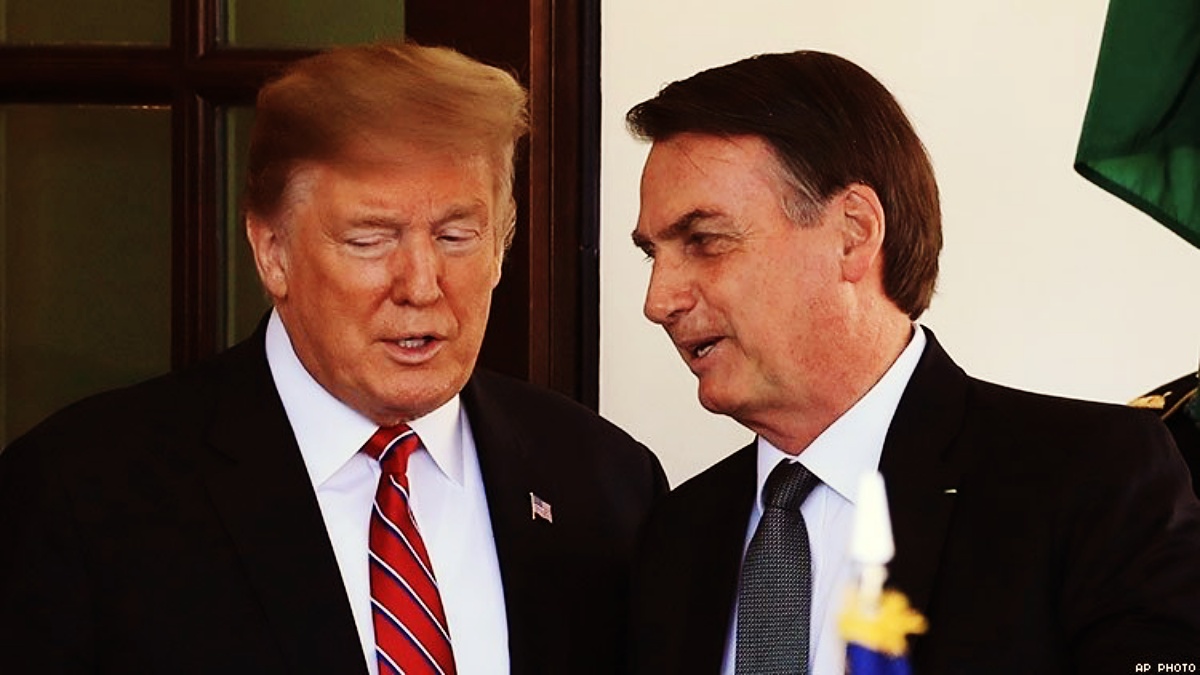
Among his most vocal defenders is Donald Trump, who has called the charges against Bolsonaro a "witch hunt." In a dramatic escalation, Trump announced sweeping 50% tariffs on Brazilian imports, set to take effect on August 1, 2025. He claims the move is a response to what he describes as political persecution by Brazil’s judiciary, as well as alleged infringements on "U.S. free speech" tied to rulings by Brazil's Supreme Court.
Trump has also launched a Section 301 trade investigation—typically used against countries accused of unfair trade practices—aiming it this time at Brazil’s treatment of speech and political expression. Analysts and observers widely view this as a politically motivated act intended to pressure President Luiz Inácio Lula da Silva and interfere in Brazil’s internal democratic processes.
This marks an unprecedented intervention by a U.S. president into the legal and democratic affairs of a sovereign ally—on behalf of a fellow strongman facing justice. It also deepens the emerging axis of far-right populism, with Bolsonaro and Trump reinforcing one another’s narratives of victimhood, grievance, and judicial persecution.
Related stories
In response, Lula has condemned the tariffs and reaffirmed the independence of Brazil’s judiciary. He has signaled a willingness to engage diplomatically but has also warned that Brazil will retaliate with reciprocal tariffs if necessary.
Let’s journey back to 2023. The lungs of planet earth are choking. The Amazon—cathedral of biodiversity, cradle of ancient memory, the pulsing green heart of South America—is being set alight before our very eyes. It is not a metaphor. It is flame, smoke, and ash. It is death with a chainsaw and a bulldozer.
And presiding over this funeral pyre is Jair Bolsonaro, the iron-jawed prophet of profit, the fascist steward of Brazil’s ruin, the self-styled “Trump of the Tropics.” He is a man who wages war on the educational conscience of his nation, branding its most luminous thinkers—Paulo Freire among them—as “cultural Marxists,” as if ideas were insurgents and liberation pedagogy a form of treason.
This is the man who tried to erase Freire’s name from Brazil’s pantheon and replace it with that of a long-dead Jesuit missionary, Saint Joseph of Anchieta—a figure conscripted not for faith, but for Bolsonaro’s theater of nationalistic nostalgia. Anchieta, plucked from the 16th century like a saintly mascot, was meant to sanctify the plunder. Freire, whose words taught the poor to read the world as text and the text as world, had become too dangerous for the regime’s liking.
This is the man who appeared in a resurfaced 2016 video bragging “I'd eat an Indian, no problem whatsoever," while discussing a visit to an Indigenous community where cannibalism was allegedly practiced.
In the video, Bolsonaro said that during a visit to the Yanomami people, a deceased member of the tribe was being cooked, and that if he had stayed longer, he would have been required to partake. However, Bolsonaro claimed his companions declined to participate, and he did not engage in cannibalism. However, Bolsonaro said in the interview, "I'd eat an Indian, no problem whatsoever," and added, "It's their culture!" The video's resurfacing sparked debate, especially during the 2022 Brazilian election, where it was used in political ads by Bolsonaro's opponent, and current president, Luiz Inácio Lula da Silva. Bolsonaro's lawyers argued he was showing deference to Indigenous culture, and an electoral court ordered the removal of ads linking Bolsonaro to cannibalism.
The Yanomami people denied ever practicing cannibalism and called Bolsonaro a compulsive liar. Despite the court's actions, the controversy became a significant talking point in the election, with social media being flooded with discussions and memes surrounding the topic.
The resurfacing of Jair Bolsonaro’s 2016 remarks about allegedly witnessing—and hypothetically participating in—cannibalism among the Yanomami people is not just a grotesque political gaffe; it is emblematic of the colonial arrogance and racist spectacle that have long haunted Brazil’s treatment of Indigenous peoples.
To say “I’d eat an Indian, no problem whatsoever,” and then cloak that statement in the guise of cultural relativism—“It’s their culture!”—is not an act of respect. It is a cynical performance. It is the disfiguring of Indigenous identity into a prop for political theater, a tool for self-aggrandizement wrapped in the false flag of cultural appreciation. Bolsonaro wasn’t showing deference to Indigenous tradition; he was commodifying it for shock value, reducing a people’s existence to a lurid anecdote, and then weaponizing the lie for his own machismo branding.
The Yanomami, who have long suffered under policies that permit illegal mining, mercury poisoning, and deforestation of their ancestral lands, were quick to respond: they denied the claim, called Bolsonaro a liar, and rightly saw the comment as a grotesque distortion of their lives and dignity. Their pushback should be understood as a form of counter-testimony, an assertion of truth against a propaganda machine skilled at mixing racism with spectacle.
In truth, this moment isn’t just about cannibalism—it is about symbolic cannibalization. Bolsonaro, like many authoritarian populists, feeds off Indigenous pain, off the forest’s destruction, off the vulnerability of marginalized communities. He devours memory, history, truth—chews it up and spits it out as ideology. He is the one who cannibalizes the state: its resources, its institutions, its dignity.
And yet, the power of the Yanomami’s refusal—that one small “no” from the forest—echoed across Brazil. Their insistence on truth disrupted the echo chamber of fake news and forced a reckoning, if only briefly, in the national discourse. The court’s order to remove Lula’s campaign ads might have stemmed the electoral utility of the scandal, but it could not stop the moral indictment.
The viral video, the social media memes, the grotesque fascination—these are the distractions Bolsonaro thrives on. But beneath the noise lies the real crisis: the destruction of Indigenous lives and ecosystems under his administration, and the broader decay of democratic ethics in the face of weaponized disinformation.
In the end, the question is not whether Bolsonaro “would eat an Indian,” but how much more of the Amazon, how many more Indigenous lives, languages, and lands must be consumed before the world realizes that the true cannibalism is being committed by the state—and that the feast is not cultural, but political, extractive, and ecocidal.
In 2023, the world scarcely caught its breath after watching, in real time, the Palacio do Planalto and the Congresso Nacional besieged by a rag tag militia of Bolsonaro loyalists—faces painted in jungle green, cell phones held aloft like torches of a digital inquisition.
The attack on 8 January 2023 marked one of the gravest assaults on Brazilian democracy in recent history. Following Jair Bolsonaro’s defeat in the 2022 presidential election and the peaceful inauguration of Luiz Inácio Lula da Silva, thousands of Bolsonaro supporters—fueled by weeks of disinformation, conspiracy theories, and false claims of electoral fraud—stormed the Praça dos Três Poderes (Three Powers Plaza) in Brasília, invading and vandalizing the National Congress, the Supreme Federal Court, and the Palácio do Planalto (the presidential office).
The attack bore eerie similarities to the January 6, 2021 insurrection at the U.S. Capitol, including the symbolic targeting of democratic institutions, the use of far-right digital networks to organize and incite the assault, and the presence of violent extremists emboldened by an ex-president who had refused to accept the legitimacy of his electoral loss.
Jack Nicas’ juxtaposition between the aftermaths of January 6th in the United States and January 8th in Brazil is both sobering and instructive. It lays bare not just the differences in political culture between the two countries, but the existential stakes of what democratic resilience—or its absence—looks like in an age of rising authoritarianism.
In the U.S., we witnessed the grotesque inversion of reality: a failed coup rebranded as patriotism, a would-be autocrat elevated as a martyr. Trump was able to shape a major political party in his image, turning his legal peril into political capital. His narrative has metastasized into a theology of grievance, reinforced by right-wing media and underwritten by a cultural machinery eager to erase or recast the violence of January 6 as mere protest.
In contrast, Brazil responded with a collective immune response. Its institutions, though not immune to strain, acted swiftly and decisively: the judiciary barred Bolsonaro from running, and key figures on the right distanced themselves from the insurrectionary fever dream. Perhaps most importantly, Brazilian civil society—journalists, educators, artists, and voters—treated January 8 not as a political Rorschach test but as a national trauma demanding accountability.
What we are seeing, then, is not merely a difference in judicial response or electoral laws. We are seeing the consequence of narrative control.
In the U.S., the Big Lie has metastasized into an article of faith for a disturbingly large segment of the population. In Brazil, Bolsonaro’s attempt to replicate Trump’s formula encountered limits—limits forged by Brazil’s memory of dictatorship which only ended in 1985, a judiciary willing to act, and a political elite that, despite its own fractures, did not fully capitulate to the anti-democratic spectacle.
Steven Levitsky’s observation is piercingly accurate: in Brazil, the right did something American Republicans refused to do—they accepted the outcome. They didn’t necessarily embrace Lula, but they acknowledged the rules of the game. In the U.S., a sizable faction of the Republican Party abandoned the rules altogether.
In Brazil, there is no myth of a stolen election gaining mainstream traction. In the U.S., that myth is being weaponized in real time to dismantle democratic safeguards.
We are, in the United States, living through a dangerous historical experiment—a lurching towards dictatorship—two nations, struck by similar blows, moving in opposite directions. If the U.S. is to reclaim its democratic bearings, it would do well to study Brazil—not because Brazil is immune to authoritarianism, but because it showed, at least this time, that democracy’s immune system can still fight back.
But resistance is dangerous in a world ruled by algorithms and avatars. We have now entered the age of spectral violence—disinformation that metastasizes like cancer, ideological contagions that leap across continents. Bolsonaro’s mob stormed Brazil’s democratic heart as if reenacting Trump’s Capitol riot in a different key, backed by the same digital puppetmasters.
What millions saw as shocking theater was, in fact, the logical endpoint of an algorithmic war long in the making. Platforms that promised connection—Facebook, TikTok, Telegram—became sluice gates for fascist fantasy, funneling “Stop the Steal 2.0” memes, coup manuals, and livestreamed incitement to every corner of Brazil’s infosphere. SumOfUs, the global watchdog, was blunt: the assault was “directly aided” by these corporate megaphones, whose recommendation engines kept shoveling tinder onto the pyre. Flora Rebello Arduini, the group’s campaign director, called the Brasília rampage a grim echo of January 6, 2021, in Washington, proof that the same digital scaffolding of lies now props up insurrections on multiple continents—a clone uprising born of the same algorithmic womb. Both insurrections were midwifed by digital leviathans, whose opaque and profit-hungry machines amplified the febrile delusions of the far-right, rendering conspiracy into catechism and rage into choreography.
Their pre election report showed Meta’s and TikTok’s feeds steering users toward calls for military intervention and claims of a rigged vote—content boosted not by human editors, but by profit seeking code.
What we are witnessing is the birth of a sovereign, nationalist tech stack—an electronic Iron Dome erected not to protect democracy, but to shell it. It is an ideological machine that harks back to the torture rooms of Brazil’s 1964–85 dictatorship, only now the cattle prods have been replaced by push notifications, the hooded interrogator by an irresistible swipe. As hate mutates “in rhizomatic fury,” to borrow Deleuze’s phrase, it grafts itself onto every open channel, turning the connective tissue of the internet into a pulsating nervous system of authoritarian desire.
For educators and citizens alike, the lesson is brutal but clear: the fascist coup has gone digital, and the classroom is part of the battlefield. If we fail to teach our students how to read not only the word but the algorithm, the next insurrection will not need bricks and broken glass; it will unfurl in the silence of a news feed, one dopamine hit at a time.
That this echo should arise in Brazil is no coincidence; Trump and Bolsonaro, two demagogues carved from the same idolatrous stone, have long traded in each other’s symbols. One lifts a Bible in front of a scorched church; the other lifts the Constitution like a cudgel before dissolving Congress in a venomous speech in which he proclaimed,
"I am in favor of a dictatorship…"We will never resolve serious national problems with this irresponsible democracy". Does Bolsonaro’s announcement echo Trump’s remarks that he will serve as a dictator, but only for the first day of his presidency?
Trump and Bolsonaro are bonded by a shared dream: to remake democracy in the image of an ancient tyranny dressed in modern drag. Within this nightmare architecture—this infernal cathedral of misinformation—new technologies have become sacred instruments of domination. Artificial intelligence whispers fascist lullabies through digital rosaries; content algorithms dance like spectral djinn around the campfires of conspiracy. We are witnessing the gospel of post-truth, coded in JavaScript, whispered through WhatsApp, written in the bloodless ink of metadata.
And if QAnon’s hallucinations of liberal cannibal cabals are the folk religion of the American right, then Bolsonaro is its Latin American high priest—a man who, in a moment of grotesque bravado, spoke of eating an Indigenous man not as metaphor, but as desire. Under the red-tinted lights of the internet’s infernal stage, Bolsonaro plays the role of inquisitor and executioner, laughing as he rewrites the blood-soaked script of Brazil’s military dictatorship.
He exhorts teenage students to read The Suffocated Truth, a rancid hagiography of Colonel Carlos Alberto Brilhante Ustra, the dictatorship’s most notorious torturer—a man whose legacy drips with the echoes of screams muffled by waterboards and the snap of electric cables. Pro-military Bolsonaro claims that his opponents don’t want Ustra's version of the left-wing armed struggle in Brazil during the military dictatorship to be known.
Clearly, we are living in this vestibule of the end times—not the mythic Armageddon of televangelists and stained-glass eschatologies, but something crueler and altogether more banal: the Armageddon of spreadsheets, deregulation, clickbait, and carbon. The apocalypse has arrived not as a flaming chariot from the heavens but as a quarterly earnings report from ExxonMobil.
For our students, these are no longer abstract lessons in civics or ethics; they are daily confrontations with a reality in which the past has claws, the truth wears chains, and history itself may be conscripted into fascism’s latest dream of empire.
Noam Chomsky, oracle of our rational conscience, has called today’s Republican Party the most dangerous organization in human history. Not because it is grotesque (though it is), nor because it is violent (though it is), but because it is actively dismantling the conditions for life on Earth with the giddy zeal of a child pulling the wings off a butterfly.
It is a party of extinction, of cheerfully greased guillotines, where climate denial is liturgy and fossil capital (the burning of fossil fuels related to climate change) is gospel. Under the reign of the “Cheeto Christ Stupid-Czar”—a man who styles himself as the Chosen One, the Second Coming, the Twitter Avatar of American decline—we have traded science for spectacle and salvation for brand management.
This is the Age of the Buffoon, and it is no laughing matter.
We live in a time when the abyss no longer looms on the horizon—it surrounds us. The mushroom cloud, once the singular icon of annihilation, has been joined by a thousand lesser dooms: the melting ice caps, the burning lungs of the Amazon, the silent extinction of species, the poisoned rivers, the algorithmic incitement to genocide, the normalization of mass surveillance, and the toxic fog of disinformation that corrodes the soul of democracy.
We are in the age of ambient apocalypse. Not the spectacular rupture of a single red button pressed in a fit of madness, but the slow, granular disintegration of everything that makes life breathable—literal and figurative. We are now confronted not only with the terror of instantaneous death, but with the agonizing possibility of ecological suffocation, of moral exhaustion, of political entropy.
And yet, instead of recoil, we see repetition. The same technologies that promised connection now generate isolation. The same democracies that once resisted fascism now do more than flirt with it—they embrace it. The same voices crying out in grief and protest are met with tear gas, deep fakes, or silence.
In this moment—between the cold calculations of deterrence and the hot chaos of collapse—we must ask not only what world we are destroying, but what kind of people we are becoming in the process.
This is the imperative that Paulo Freire, Leonardo Boff, and bell hooks ask of us. This is the cry of the Earth and the cry of the poor. Not just to survive—but to unlearn the violence that brought us here, and to invent, together, another way of being human.
We are, as Michael Peters warns, confronting anthropogenic extinction—a Sixth Mass Extinction whose architect is not a meteorite but capital itself.
What curriculum could be equal to this hour? What theology, what politics, what pedagogy? We must begin not with denial, but with grief—and then, from that grief, raise a cry that can be heard beyond the walls of every gated community, every think tank, every oligarch’s orbiting space bunker.
Leonardo Boff, whose liberation theology bends not just toward the liberation of the poor, but of Earth itself, tells us that
we must rise alongside the biosphere and noosphere. It is time to entwine our pedagogy with eco-spirituality—to imagine integral liberation not only for workers and peasants, but for forests and watersheds, for whales and glaciers, for ancestors and descendants alike.
For Boff, Earth is not scenery—it is a superorganism, a breathing, evolving sacrament of cosmic history. Humanity is not its master but its expression, a spark of consciousness within the vast fire of cosmogenesis. What we do to the rainforest we do to our lungs. What we do to the soil we do to our own flesh.
But instead of reverence, we remain ensepulchered in pestilent denials, sealed inside a mausoleum of economic orthodoxy. Capitalism’s high priests continue to chant the dead rites of accumulation while species vanish and waters rise. The poor, as ever, are made scapegoats—banished, caged, demonized. Immigrants are crucified at borders. Their children cry behind steel bars while white Christians sing psalms of prosperity and look the other way.
The victims become the mirrors. And when we finally look into their eyes, we realize with horror: we are the ones being led to slaughter.
The answer to the climate Armageddon is not to be found among the rapture-ready televangelists or the Armageddon speculators who turn the Book of Revelation into a board game for oil magnates. Nor will it come from the brackish mouth of Barnum-esque Christofascism, with its snake oil sermons and gold-plated crosses.
Those evangelists who cheer Trump as a new Cyrus and eagerly anticipate the Rapture—have bent scripture into a geopolitical playbook. They imagine God in the real estate maps of East Jerusalem and the Dome of the Rock. If only, they whisper, the Third Temple can rise, then Christ will descend through the sealed Gate of Mercy and smite the infidels in a pyrotechnic finale fit for the end of cable news.
But their theater of destruction is no myth. It is imperial policy. It is drone strikes and embassy relocations. It is white nationalism wrapped in prophecy and soaked in oil.
So where do we turn?
To the poets. To the forests. To the teachers. We turn to ecopedagogy—a pedagogy that sings in the language of rivers, that teaches photosynthesis as scripture, that makes compost of capitalism’s false gods. A pedagogy that prepares not just students but guardians of the future.
While the Brazilian Amazon was burning in 2022, the former president of Brazil, Jair Bolsonaro, was fiddling—no, he was tweeting. He postured, sulked, and snarled at perceived slights, turning down $20 million in G7 aid because President Macron bruised his vanity. One would think that the scale of ecological catastrophe might override a playground spat, but Bolsonaro governed with the logic of conquest and the manners of a colonel drunk on nostalgia and nationalist machismo. The forests fall because, in his eyes, they stand in the way of profit. Because the trees, like the Indigenous peoples who guard them, are expendable.
Not even the spectral hand of Chico Mendes—summoned through the mystic seances of Allan Kardec’s disciples—could halt this orgy of deforestation. The spirit world may weep, but it cannot compete with the sweetheart deals inked in smoky backrooms between government ministers and the titans of mining and logging.
This is not only a Brazilian tragedy. It is planetary. For every hectare of Amazon lost, the planet loses breath. With each fire, we inch closer to Michael Peters’ unflinching prophecy: anthropogenic extinction. His is no idle phrase. It is a tolling bell warning of a world imperiled by its own creations—nuclear arsenals, bioweapons, pandemics, algorithmic overlords, ecological collapse. And into this witches’ brew march the new barbarians, with Bolsonaro and Trump leading the parade—smiling as the air thickens, the rivers rot, and the forests fall. What is extinction if not policy written in the language of greed? What is collapse if not the predictable result of leaders who mistake plunder for patriotism?
Four million hectares of South American forest lost each year. Four million prayers unspoken. Four million acts of violence against the future. And still, our oligarchs speak of sovereignty—as if sovereignty is measured by how much destruction one can accomplish without interference.
It is our right as citizens to demand answers, and to demand them now. We cannot let this question—how shall we survive?—be postponed until the last tree falls or the last teacher gives up hope. It is a question that must be asked in every classroom, echoed in every student’s heart. Because if we do not answer it with urgency, clarity, and courage—then there may be no classrooms left. No students. No generations to come.
My earliest journeys to Brazil were not so much travels as they were awakenings. From the steaming veins of São Paulo to the ancestral soul of Bahia, from the port cities of Rio and Santos to the quiet towns of Santa Maria, Santa Cruz do Sul, Cachoeira, and Uberlândia, I walked among those who carried in their blood the pulse of history, resistance, and remembrance. It was here, amid conversations with Afro-Brazilian comrades of the Workers' Party—disciples in the gospel of Paulo Freire—that I began to see with new eyes: not just the brutality of colonization, but the architecture of racial capitalism itself.
And what do we see today? The heirs of empire—Trump and Bolsonaro—proclaiming a new gospel of "patriotic education," an orthodoxy carved in plastic, drenched in denial. They would teach our children a fable, not a history—a gauzy dreamscape in which America emerges immaculate and Brazil glistens without blood. It is a syllabus of forgetting. A curriculum of cowardice. A theology of amnesia drafted by those who fear the mirror and worship only the mask.
What they offer is not education but embalming—a mausolacracy of dead white men, where the air is thick with the dust of empire and the whisper of betrayal. It is a pedagogy fit for the Fox News parlor, where truth is taxed and white supremacy is served with morning coffee. These “curriculums” are nothing less than necromantic rituals—animated by dogma, sealed with propaganda, and sanctified by the golden calf of Trumpian casuistry.
In Brazil, the same ghosts howl. Bolsonaro, with his necrotic vision of the nation, sought to replace Paulo Freire as Patron of Brazilian Education with a missionary relic—Saint Joseph of Anchieta. But even here resistance blossomed. Jesuit leaders stood firmly for Freire, for truth, for the dispossessed. In this, they offered a lesson to us all: not all clergy bow to empire; some still walk with Christ among the poor.
Trump and Bolsonaro are not aberrations. They are symptoms of a larger disease—the weaponization of ignorance, the sacralization of the market, the gospel of fear. Trump tells his followers they are victims of diversity. Bolsonaro calls Paulo Freire’s work “Marxist rubbish.” One brags of strong genes; the other rehabilitates machismo. And both turn the state into a digital cudgel to strike at the the migrant, the teacher, the thinker.
This is the age of neurocapitalism, where the mind has become the last frontier of extraction. Here, the self is not merely surveilled but sculpted, the soul dissolved into data points. In this uncanny terrain, where Facebook and Neuralink build bridges into the sanctum of thought, who will defend the citadel of consciousness?
Shall we look to public advocacy groups to raise alarms while our inner lives are mapped, commodified, and weaponized? What neurorights must we now demand, as AI learns to scan not only our faces but our fatigue, our despair, our rage—as if to engineer obedience through preemptive detection? When the state can diagnose you before you act, when your melancholy becomes metadata, your agency becomes a ghost.
And what becomes of democracy when the soldier who now patrols our streets in search of undocumented migrants is no longer formed by conviction, but forged in the sterile furnaces of neurochemical obedience? When courage is no longer a moral act but a programmed reflex, when the trembling awe before the burden of killing is replaced with the click of a neural switch? Then democracy—fragile as breath on a mirror—begins to vanish.
They will call these soldiers “enhanced,” but in truth, they are edited: their memories curated, their doubts deleted, their empathy dimmed like lights in a war room. Fed intravenously with algorithms and nanodrugs, they no longer march—they are deployed, like drones made flesh. But their valor is synthetic. Their loyalty, leased.
And what happens when such men—machined into precision—are aimed not at foreign foes but at the unruly crowds in the streets of their own country? When the line between battlefield and boulevard dissolves like mist, and the citizen becomes the target?
There is no ballot box sturdy enough to contain a soldier whose mind is no longer his own.
So let us ask again—not what becomes of democracy, but whether democracy can survive the death of the human conscience inside the uniform. Whether liberty can endure when obedience is not chosen but engineered. Whether the soul, once outsourced, can ever be recalled.
What happens when emotion itself becomes programmable, when human volition bends to algorithmic nudges and neurochemical tuning? Are we not, then, standing on the precipice of a high-tech Armageddon, where nations of wired minds become laboratories of control—silos of synthetic passion, engineered conviction, and artificial awe?
Democracy, in such a world, becomes theatre. It wears the mask of the republic but speaks in the voice of command. It lives under curfew, policed not by consent but by circuitry. The demos—the people—are no longer sovereign but surveyed, no longer heard but handled.
Perhaps we should turn to neuroethicists to halt not only the theft of memory but the slow death of ecosystems. For even as the mind is colonized, the Earth is bleeding. The forests fall. The rivers slow. Moisture ceases to spiral through the trees, and the rainforest, once oracle of oxygen, degrades into savanna. Dieback, they call it—but it is no accident. It is murder by policy. A coup engineered by the mind of capital.
So then—shall we turn to cosmologists, geologists, nuclear physicists? Shall we trade our theologies for no-burn agriculture, drought-resistant crops, the sober calculus of climate engineering? Or is there still something to learn from the philosophers, those stubborn old keepers of paradox and mystery? Might Kierkegaard help us divide the objective from the subjective, the measurable from the meaningful? Might Hegel lead us into the self-moving labyrinth of spirit, that strange dialectic of freedom and fate, of God as process, not puppeteer? Spinoza saw God in the grain of matter, in the leaf and the lightning. Could his luminous pantheism bring us back from the brink? Or might Whitehead's "Creative Advance" remind us that even amidst planetary ruin, the cosmos longs for novelty, for emergence, for beauty? Teilhard de Chardin saw evolution as a fire spiraling upward—a cosmic Christ drawing all toward the Omega Point, not by force, but by desire. Thought, he argued, is matter interiorized; consciousness is the universe awakening to itself. If that is true, then the burning of the Amazon is no mere environmental crime—it is a psychic self-immolation. It is Gaia gnashing her teeth in the mirror.
We may no longer have the time to bicker over metaphysics. And yet, metaphysics may be the only thing that keeps our souls from disintegration. The sixth extinction is not just about species lost—it is about meanings lost, ways of being forgotten, silences that should have been sacred now sold to the highest bidder. The Holocene has become the Capitalocene, and like all epochs of conquest, it comes with priests in lab coats and scrolls written in code.
Still, we live in the time of paradox. The evolution of consciousness has become baroque, multidimensional, tangled in a lexicon of arcane genesis: neurogenesis, cosmogenesis, psychogenesis, systemogenesis. So many beginnings—but where is the direction? Where is the soul?
Platforms like Facebook, Telegram, TikTok—once praised for “connecting the world”—have become the arsenals of fascism, their code dripping with cruelty. We have seen it all before. The chants, the conspiracies, the thirst for blood. The QAnons who warn of democrats’ dreams of devouring children. The autocrats who speak openly of liberal cannibalisms. The old torturers resurrected as national heroes. History is no longer repeating—it is remixing, looping, mutating. We are watching, in real time, a pedagogy of barbarism unfold before the eyes of our children.
Bannon and Musk take to the airwaves like generals of a digital Pentecost, broadcasting not truth but tremors—each syllable a drumbeat for the faithful, each pause engineered for a viral echo. They do not debate; they incant. They do not speak; they summon. Their tongues flicker with algorithmic fire, and in their gaze is the cold gleam of men who know their empires are not built on reason but reaction.
Each man performs a theatre of dominance: Bannon, the necromancer of Old World decay, garbed in the vestments of eternal grievance, conjures visions of blood and soil, while Musk, the techno-jester turned Caesar, tweets prophecy from his floating throne, pretending that freedom is a codebase and democracy a user setting.
And the followers—ah, the followers. Not citizens but supplicants. They do not listen; they kneel. They don’t think; they repost. These are not communities—they are cults with comment sections, cathedrals of consent where the only liturgy is loyalty, and the only heresy is doubt.
Fascism, once a boot heel stamping on a human face, is now a livestream, a meme, a monetized mood. It wears a hoodie. It quotes Nietzsche without reading him. It sells supplements between segments of apocalypse.
So they soar on platforms not built to elevate truth but to enshrine spectacle, two prophets of the post-truth age offering salvation through domination—Bannon with his cigar-stained manifestos, Musk with his Martian myths—and always, always demanding one thing above all: submission.
They do not want followers.
They want believers.
And still, the question haunts us: is this the America in which we wish to live?
On June 14 of this year, 2025, it stirred the soul to see the streets alive again—with rhythm, with rage, with the radiance of multitudes. Young and old, Black and brown and white, standing shoulder to shoulder against the creeping fog of fascism that now drapes itself, serpent-like, over the globe. The faces of fascism change but the stench is the same—Trump in the North, Bolsonaro in the South—the twin grotesqueries of a new authoritarian age, each mouthing the same gospel of cruelty, each a carnival mask for the old demons of empire, greed, and fear.
June 14, 2025, was a day of reckoning for the far right—a No Kings Day, when golden calves were ground to dust, and the people remembered that liberty is not inherited from tyrants, but wrested back from their hands. But what of the tyrants?
Permit me, just for a moment, the liberty of fantasy in the transformative imaginary of Dickens’ A Christmas Carol. Imagine, if you will, a midnight ceremony in the heart of Bahia: a terreiro de Candomblé, lantern-lit and humming with ancestral drums. There, we seat these hollow men—Trump and Bolsonaro—before bowls of bitter Ayahuasca, the vine of souls. Let Exú, on orisha trickster and messenger of the crossroads, conduct them—yes, like Dickens’ ghosts—on a pilgrimage through the ruins of their making. Let them walk the smoldering forests they set ablaze for profit. Let them choke on the ash of extinct species and hear the wails of the youth whose futures they bartered for oil and applause. Maybe then—just maybe—they would awaken, not as tyrants, but as trembling men.
Let them behold a planet turned hospice, a generation rendered surplus. Let them kneel before the graves of the nameless poor who drowned beneath rising seas, or perished behind border walls built of paranoia and lies. And maybe then—just maybe—they would return to the world reborn, not as tyrants but as penitents, bearing the cross of an ecosocialist redemption.
But such a reckoning lacks a crucial ingredient: being graced with hope. Then imagine further, if you will, a grim, candle-lit chamber deep within the hollowed-out fortress of late capitalism—marble floors smeared with soot, digital ticker-tape streaming down the walls in blood-red code, and there, seated upon thrones fashioned from gold-plated grievances and algorithmic lies, sit Donald Trump and Jair Bolsonaro. Two men, twin tyrants, haunted by a single voice—small, clear, incorruptible—Tiny Tim, stepping gently into their shadowy lair with a crutch in one hand and a blessing in the other.
“God bless us, every one!” he says, eyes wide with mercy, not judgment.
And for a flicker of a moment, time slows.
Trump recoils, confused. “Is this kid part of Antifa? Soros-funded? Where’s his paperwork? Why’s he so small?” His lip trembles as if the phrase “bless us” might be code for socialism. He reaches instinctively for a smartphone to check his Truth Social feed.
Bolsonaro, sneering, scoffs in Portuguese, “Bless us? Him too? Even the poor? The disabled? Even the Amazon?” He laughs, but the laughter dies in his throat, choked by the echo of a rainforest still smoldering.
Tiny Tim, unshaken by bluster or blasphemy, waits patiently.
And it unmans them.
Because Tiny Tim's words are not merely sentiment—they are indictment. They strip bare the hollow theology of prosperity gospel and expose the death-cult gleam of their nationalism. “God bless us, every one” includes the migrant child in the cage, the trans woman in the favela, the favela itself. It includes the tree, the river, the jaguar, the trembling mother at a border checkpoint.
And perhaps, just perhaps, in the brittle silence between fake news and the truth, in the smoke between democracy and its burning halls, in the pause before the algorithm reloads—their hearts, long petrified by power, feel something ancient stirring. Not guilt, but the cold breath of accountability. "God bless us, every one"—the radical refrain of a child who walks with a crutch, yet is armed with hope sharper than any sword.
And it may be the voice that haunts them most of all.
For it is not the cry of sentimentality, but of solidarity.
A beatitude in disguise—
not for those seated in power, but for the crucified people of history.
Tiny Tim, like the child in Isaiah, leads them—not with force, but with the fierce gentleness that topples empires.
His blessing is not neutral; it sides with the poor.
It echoes the Gospel that says the mighty will be cast down, and the lowly lifted up.
It is a preferential option for the most vulnerable,
a liturgy of the margins,
a prophecy in a crutch.
And in that frail frame, the powers see the judgment of history:
that the kingdom belongs not to the triumphant, but to the torn.
Not to Caesar, but to the child. It is inclusive goodwill—offered not to the deserving, but to all.
Even to those who hoard wealth while children starve.
Even to those who crucify the prophets and pave the streets with empire’s gold.
Not because they merit it, but because grace refuses to be chained to merit.
Tiny Tim’s blessing is not naive; it is revolutionary.
It is the whisper of a kingdom not built by violence, but by armed love—
a phrase the theologians of liberation dare to use.
Love that does not excuse injustice,
but believes that even the jailer might one day drop the keys.
His “God bless us, every one” is not a lullaby—it is a summons.
A call to the rich to descend,
to the powerful to repent,
to the world to remember that mercy belongs first to the poor,
and only then, maybe, to those who learn to join them.
Comments

Powered by RoundtableAn AI/DeFi-powered Enterprise Media Operating System. Learn more at Roundtable.io.© Roundtable 2026. By using this site you agree to the Terms of Use and Privacy Policy