


Jan 14, 2026 8:36 PM
If recognition is desired more than the fruits of peace, then such a faulty desire can undercut peacekeeping.
If I am right that the main driver of President Trump’s policies, domestic and foreign, is his egotism, then we should not expect logical or ideological consistency. No, he is more like a child who wants all that he wants. As conservative George Conway recently said about him, “He believes in no principle, no rule, no law, no other human being, no restraint, no morality...He only believes in himself.”
Almost two years ago, I wrote that as president (2017-2021) he “leaned toward isolationism.” He pulled us out of the 2015 Paris climate agreement. And he emphasized putting the USA first. But now in his second term, his foreign policy has demonstrated some new emphases. As John Bolton, now a Trump enemy, but earlier a first-term national security adviser, insists, “There is no Trump Doctrine: No matter what he does, there is no grand conceptual framework; it’s whatever suits him at the moment.”
And what presently suits him are still tinges of isolationism—this month he “withdrew from the UN Framework Convention on Climate Change (UNFCCC), along with 65 other organizations, agencies and commissions, calling them ‘contrary to the interests of the United States.’” And he “shut down the U.S. Agency for International Development (USAID),” which, according to one Harvard source, “has resulted in hundreds of thousands of [global] deaths from infectious diseases and malnutrition,”
But there are also new, more noticeable priorities, and commenting on Trump’s current foreign policy one January 2026 Atlantic piece notes “that President Trump’s foreign-policy doctrine is not actually isolationist. Although he doesn’t care about defending allies or toppling dictatorships to spread democracy, he’s perfectly happy to intervene overseas to steal resources or simply to show other countries who’s boss.”
Related stories
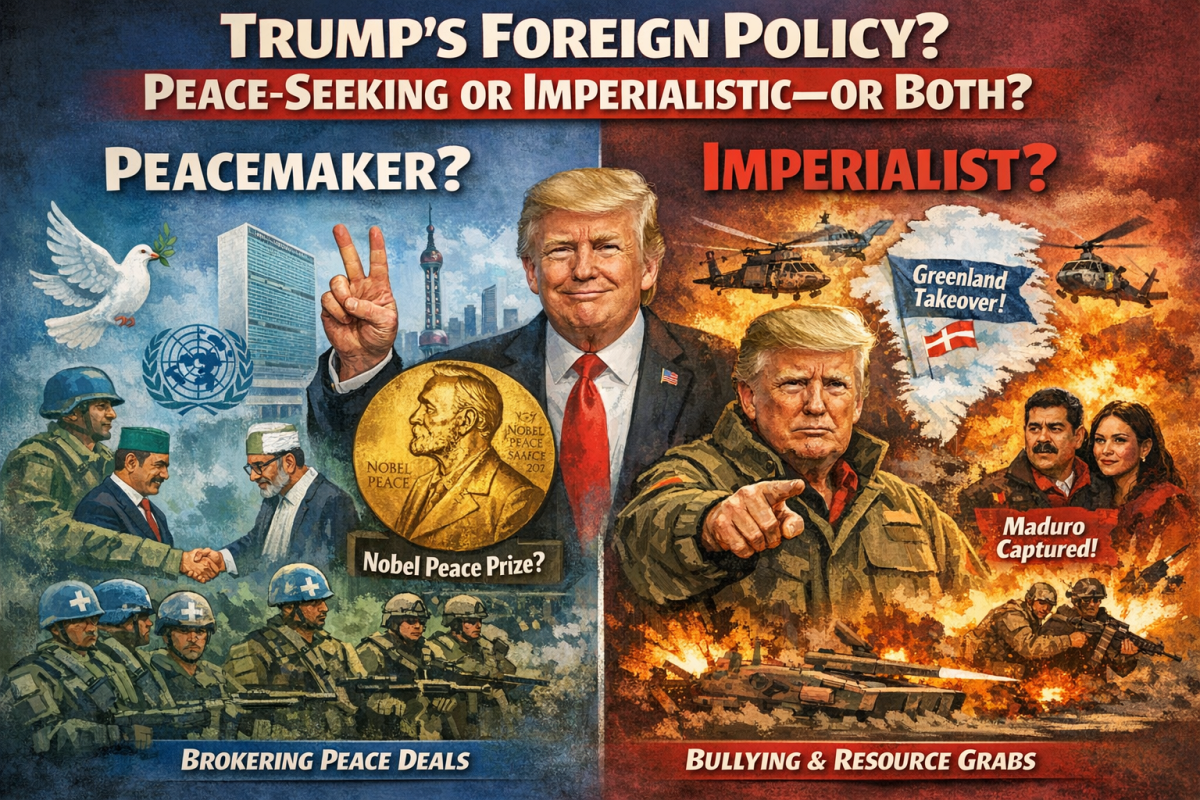
That last sentence seems to capture Trump’s foreign-policy fixations as we begin the new year (of 2026). It’s one where he has amped up his imperialistic tendencies, primarily by sending special op troops in to kidnap Venezuela’s Nicolás Maduro and his wife—and announcing his intention to manage Venezuelan oil. But also by indicating his intention to take over Greenland “either by buying the autonomous island territory or by using military force, calling it a matter of national security.” He also threatened to attack Iran “for cracking down on protesters.” As a recent magazine piece phrased it, “A desire to dominate—an eagerness to bully his counterparties into submission—is perhaps the essence of Trump’s character.”
At the same time, however, he wants to be recognized as a leader who furthers peace—and therefore deserves a Nobel Peace Prize. In a December 2025 interview with Politico, Trump, in his usual braggadocio style, said this, “I settled eight wars...I mean, I settled one...one that was going on for 36 years. Uh, I settled Pakistan and India. I settled so many wars. I’m very proud of it. And I do it pretty routinely, pretty easily. It’s not hard for me to do. It’s what I do. I make deals.”
Among the eight that he claims to have settled are those involving Cambodia and Thailand, Kosovo and Serbia, Democratic Republic of Congo and Rwanda, India and Pakistan, Israel and Iran, Egypt and Ethiopia, Azerbaijan and Armenia, and Israel and Hamas. He also insists that he’s working on a ninth peace deal. This time between Russia and Ukraine, but it’s a “tough” one because of the “hatred” between Putin and Zelensky.
Regarding the eight settlements that Trump claims to have achieved, there are mixed reactions to them (see, e. g., here) and some have noted his “obsession” with obtaining the Nobel Peace Prize.
All of which is not to say that making peace, regardless of motivation, is not better than making war. But if the right desire is absent, if recognition is desired more than the fruits of peace, then such a faulty desire can undercut peacekeeping. Plus, the seeking of such instant gratification can subvert any logical consistency. Thus, the answer to the question posed in this piece’s title is—“Both.” But peace-seeking only when it involves some other nations—not our own.
Blowing up Venezuelan boats in the Caribbean, the seizing of Maduro, threats to take over Greenland, and Trump “promises” to come to the military rescue of protesters in Iran do not suggest a Trumpian peace-seeking approach.
Comments

Powered by RoundtableAn AI/DeFi-powered Enterprise Media Operating System. Learn more at Roundtable.io.© Roundtable 2026. By using this site you agree to the Terms of Use and Privacy Policy