
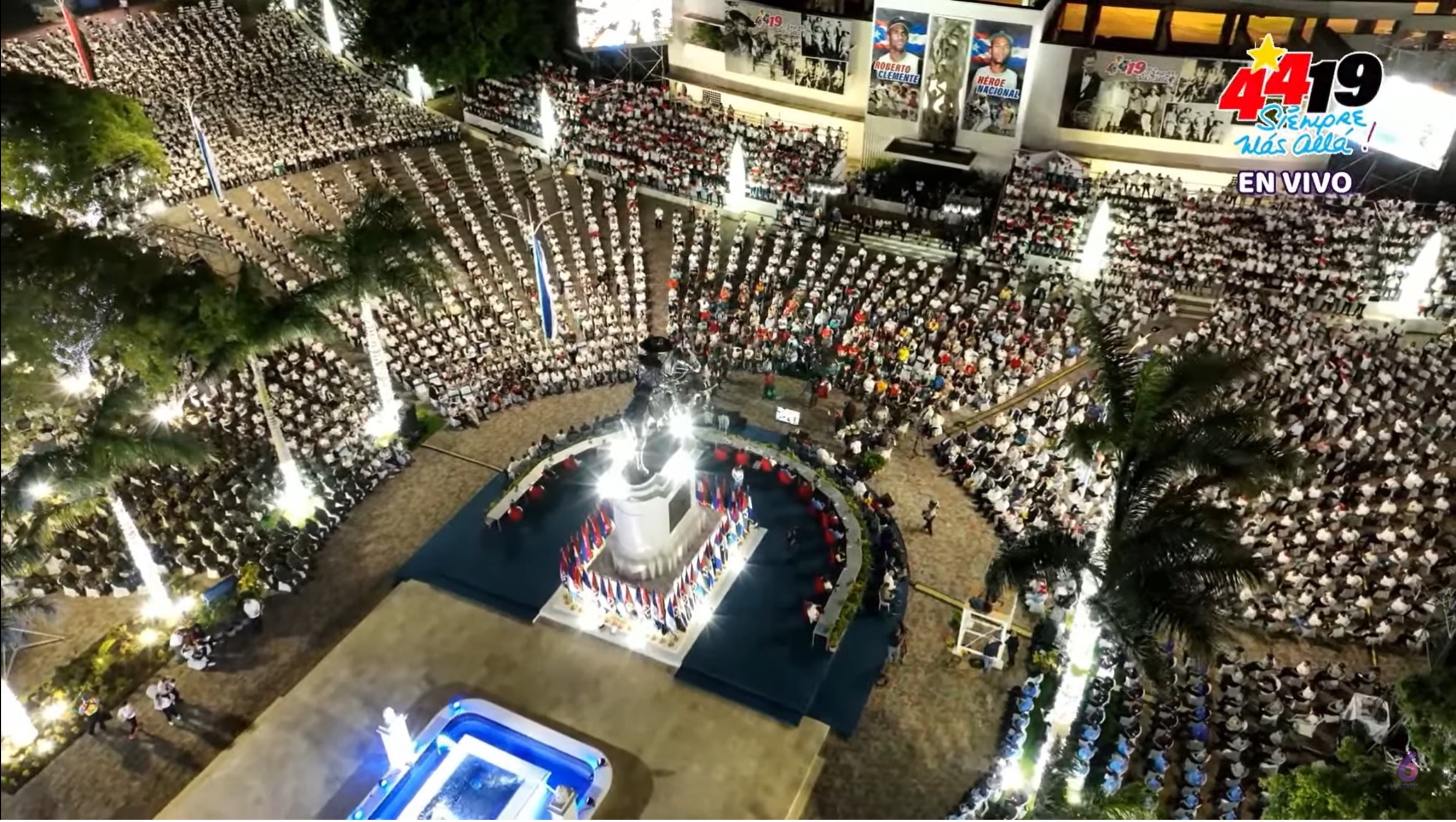
July 19, Revolution Plaza, Managua – Thousands celebrate 44th anniversary of the Sandinista Revolution, with Sandino watching over them. PHOTO: Managua Canal 6


Jul 25, 2023 1:00 PM
Today’s Nicaragua has joined a growing bloc of countries fighting for their self-determination against the colonists that have held them down for centuries.
Managua’s Revolution Plaza rang with music, song and thunderous fireworks this July 19th, as tens of thousands of Sandinistas and their supporters thronged the plaza to celebrate. Scores of invited solidarity activists joined dozens of diplomatic guests from across the globe for the event. Vice President Rosario Murillo Ortega said “It seems like yesterday that we arrived, enhanced by luminous journeys, with radiant backpack full of the heroism of a people who stood up, who fought, who armed themselves, who proved their right for history, and who won!”
I remember those “luminous journeys,” which seemed more like gritty slogs through rugged mountains back in the 1980s when the Sandinistas were fighting against Reagan’s contras. My first July 19 celebration was in 1987 in Matagalpa, the entry to Nicaragua’s mountains where most of the hard fighting took place. The same militant optimism that was felt back then flooded into Managua’s Revolution Plaza this time, along with large delegations of Sandinistas from every section of the country. They cheered and sang in response to Rosario’s poetic declaration that “standing, always firm, never on our knees, we are the love of loves, we are banners waving in the wind of all time. And we are chest and forehead and face and heart held high.”
There was a “people’s music festival” quality to the event. President Daniel Ortega called for “a big applause to these compañeras and compañeros, these young people, these artists, the fruit of the Sandinista Revolution.” The crowd sang along and danced to much of the music, proof of Daniel’s comment that “these groups have multiplied all over the country carrying the revolutionary message; through music, through singing, that enables the forging of consciousness in the youth.” It’s part of the Sandinistas’ secret of success, making it easy to embrace what Rosario declared was “so complex, so difficult, so hard, so stormy, but also so true and lasting every advance against hatred, against meanness, against evil.”
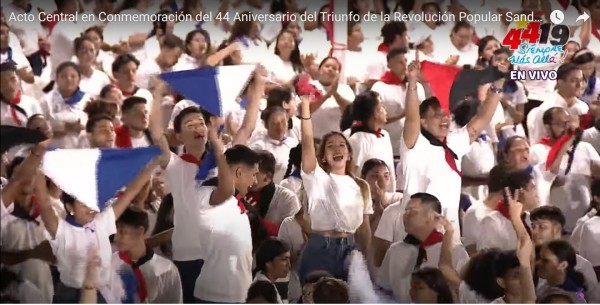
Solidarity from Africa, Euro-Asia and the Middle East
Vice President Murillo made it clear that Nicaragua is not alone, echoing China’s slogan of “together for a shared future.” Murillo declared, “All together we create a future, from the sun that illuminates us, that does not set, and that already announces all the new victories, we greet in that sun of triumphs our companions from the peoples and governments of Africa: Angola, Burkina Faso, Ghana, Mozambique, Nigeria... From Euro-Asia: Abkhazia, Belarus, Russian Federation, South Ossetia... From Asia and the Middle East: The Islamic Republic of Iran, the Democratic People's Republic of Korea, the Lao People's Democratic Republic, the sisters and brothers who represent the government, the state and the Palestinian people, always in struggle...! Our brothers and sisters from Cuba, victorious Cuba, revolutionary Cuba, so admired, so beloved...! From Honduras, from Mexico, and from Bolivarian Venezuela, with everyone united, everyone fighting, everyone victorious!”
Related stories
All these countries Murillo mentioned had representatives present. It was not a complete list. China, for example, did not get honorable mention, even though Nicaragua is now included in the Belt and Road Initiative, with major projects underway, including a new world-class port in Bluefields, on the Caribbean coast, and a major new highway connecting that Afro-Nican center to Managua and the denser western parts of the country.
Africans in general had a very high profile at the event, especially the late Thomas Sankara, the revolutionary leader of Burkina Faso. He had visited Nicaragua during the height of the contra war and forged strong personal ties with the Sandinistas on behalf of his country. President Ortega said of Sankara that “we want to honor a great friend, a compañero, a comrade, a brother of our Nicaragua. We met him here in Managua, where he arrived, simple, humble, and then we visited him in Ouagadougou, where we had the honor of sharing memorable hours with him and his people.” Daniel even read a poem Sankara wrote for Nicaragua:
From the depths of the scorched earth
the cries of a determined people rise
because every day is a day of struggle,
of combats that announce
to the enemy his fall.
And how heavy is the price that is paid!
Vice President Murillo had also invited the current Prime Minister of Burkina Faso to introduce Daniel’s speech. The Prime Minister of Burkina Faso said “Nicaragua is a great country, but the determination of its people is a hope and an example for others, they have a great spirit. In such a way, we have also kept that hope, even after the assassination of our President Thomas Sankara.”
Why does this matter? Today’s Nicaragua has joined a large and growing bloc of countries across the globe fighting for their self-determination against the colonists and imperialists that have held them down for centuries. Next month a large group of them, including Nicaragua, will meet for the BRICS summit in South Africa.
Recalling the war against US-backed contras in the 1980s, Ortega said “Reagan… came to say: I am a Contra. And he found our country, our people in arms, heart, soul, and conscience, in arms. We wanted peace, we fought against the tyranny imposed by the Yankees, because we wanted peace, we wanted our people to be freed from extreme poverty, illiteracy, which exceeded 60%.”
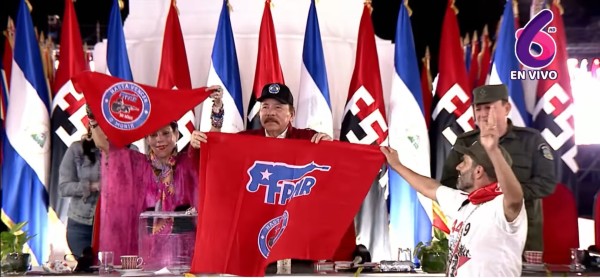
Economic success
Now poverty is much lower in Nicaragua, and illiteracy has been replaced by 98% literacy. Health care is universal and free. There are dozens of new hospitals. Nicaragua has also achieved food sovereignty. We visited a cooperative farm and a school for agricultural workers dedicated to training a new generation in sustainable farming methods. They told us of developing non-toxic inputs to replace chemical fertilizer. They create organic mulch locally, and have used it to increase harvest yields. They are also creating wine from the local fruits – pitahaya (dragon fruit) and pineapple – which they sell both in local markets and in the USA. Young students told of their university specialties in agronomy and agricultural engineering. Education is free from pre-school through university.
The country is now electrified by geothermal energy drawn from a volcano outside Managua, which provides over 90 percent of its energy needs. Partnerships with oil producers – Venezuela and Iran – provide the fossil fuels needed for transportation. The government has invested in improving roads and highways across the country, thus reducing the cost and time needed to bring food products to the cities from the countryside.
These policies and developments have helped Nicaragua reduce the impact of US efforts to strangle it through sanctions and the NICA and RENACER acts. Those laws target Nicaragua’s efforts to get development loans and access to regional trade through CAFTA. Cooperation with China, Russia, Venezuela, Iran and African countries have blunted the impact of these sanctions.
President Ortega highlighted how the US and NATO destroyed Libya, and murdered its leader Muamar Ghadafi. Libya was “one of the countries with the highest income, where Libyan families automatically received a percentage just from the sale of oil; that is, they studied, looked for work, but they received an income, because the oil income allowed justice to be done,” Ortega said. “I remember the boasting of the Secretary of State, Hilary Clinton, Bill Clinton's wife… Hilary Clinton gave statements, jumping up in rage thundering against Libya and against Gaddafi. And when Gaddafi was assassinated, that lady jumped for joy, toasting with champagne the assassination of Gaddafi.”
Ortega also denounced “the conspiracies that colonialists engage in across the African region… to promote terror and assassinations. Under those circumstances they murdered our Brother Thomas Sankara.”
He called attention to Roberto Clemente, the Puerto Rican baseball star who gave his life in an effort to bring a planeload of supplies to overcome the 1972 earthquake that devastated Managua. “There are thousands of young people there in Puerto Rico, and thousands of young people in the United States who love Puerto Rico and can be sure we accompany them in that struggle, that Puerto Rico will be free, it will be Independent.”
Ortega gave a history lesson on the many heroes, like Diriangén and Nicarao, who dealt the first defeat to the Spanish invaders. And those who defeated the expansionist troops of William Walker, who in 1855 “had imposed himself as President of Nicaragua, when the first law he had dictated was slavery. The people rebelled, and there the Yankee empire suffered its first defeat in combat after combat.” And “General Benjamín Zeledón, who had to face the Yankee troops in 1912, and then that occupation was prolonged, until the General of Free Women and Men, Augusto César Sandino, appeared, who confronted them, stood up to them, and defeated them.
Ortega told of how Sandino was killed when he went to Managua to negotiate. “The Yankees had already organized the plan with the head of the National Guard that they had organized and that was commanded by the Yankees, Somoza. And he murdered Sandino.” He added that “they murdered Sandino, but they couldn't destroy Sandino's Spirit, they couldn't destroy Sandino's soul. They couldn't destroy it! So, where is he? Where is Sandino? He is in the soul of the Nicaraguan people! He is in the heart of the Nicaraguan people!“
He also highlighted Carlos Fonseca, founder of the FSLN, “who knew how to link Sandino's thought to the historical moment that was being lived at that time in Nicaragua, because the guerrilla struggles against Somoza were continuing.”
At the end of his speech Ortega referred to a recent meeting between CELAC (the Community of Latin American and Caribbean States) and the European Union, where “the European Union thundered against us continuously, the European Parliament spoke barbarities against Nicaragua, and called for more sanctions against Nicaragua, also against Venezuela, even talking about preventing the arrival of President Nicolás Maduro to the meeting, under the threat that he would be put in prison.”
He said the EU representatives “wanted to bring the fascist, the Nazi President of Ukraine, to be there at the meeting. The Europeans pushed hard, but most of the CELAC countries did not accept, and they could not get the fascist President of Ukraine seated there. Then the Europeans insisted on blaming the Russian Federation for everything that is happening in Ukraine. Logically, we could not accept this.” He added that the Latin American countries tried to introduce a statement condemning US use of cluster bombs against Russia in the war in Ukraine. The EU representatives “simply vetoed that point,” he said, as they did also to a resolution calling to end the blockade of Cuba.
At the very end of his speech Ortega recalled “when I met Benjamin Linder, an American engineer who came here to the mountain areas in the north, to help the population make wells so that they would have water, and the mercenaries of Ronald Reagan's Government murdered him, just as they murdered Swiss brothers, brothers from other Countries too were murdered” in “the 80s when the war was hard.”
“That is to say, the solidarity of the peoples is firmly maintained even in the most difficult moments, and we see and feel it every day when you write and defend the truth of the peoples, the truth of the revolutions, the truth about Nicaragua. Thank you, brothers and sisters.
Transcription and translation of speeches credit: Stephen Selton, https://www.tortillaconsal.com/
‘
Comments

Powered by RoundtableAn AI/DeFi-powered Enterprise Media Operating System. Learn more at Roundtable.io.© Roundtable 2026. By using this site you agree to the Terms of Use and Privacy Policy