


Jun 23, 2023 12:00 PM
The opportunity to teach in Ethiopia came about after a racially-motivated send off by a university in Wisconsin.
I told Hewan, yes. I’ll go with her to church. I looked forward to it. The two of us. I was in my late forties then. I had relinquished my tether to the Catholic Church, religion altogether for that matter, by the end of my teen years. I was, however, near the end of my first semester of teaching English composition at Haramaya University, on the eastern boarder of Ethiopia, in the city of Haramaya, bordering Somalia. In a very short while, I would be on my way to teaching a graduate course in Black women’s literature at Addis Ababa University, where, to my surprise, I would find a bust of President John F. Kennedy at its library entrance. But that’s another history.
The opportunity to teach in Ethiopia came about after a racially-motivated send off by a university in Wisconsin, actively engaged in removing the few faculty of color, and leaving the campus “comfortable” for its predominately white student population. That May of 2002, I called the number I copied from an ad I noticed on the bulletin board of another university in Chicago. I held onto the number, even after this Visiting Professor position in Wisconsin became available. I had always wanted to teach in Africa, but I had no interest in doing so through a missionary.
I called the International Foundation for Education and Self-Help (IFESH), founded by Rev. Leon Sullivan, inquiring about the following year. Certainly May was too late for a position to begin in Fall. Maybe I could teach in Africa next year? I thought for sure I would be told to call back—later in the year.
But I was asked to send a CV and some other documents, I can’t recall now. Soon after, I received a call from another IFESH representative asking for more documents. In the meantime, a packet will arrive at my home. Please attend to it ASAP. A few days later, I stared at that USAID logo on one of the many pages I received. I stared at it for a long time. I remember thinking, once in Ethiopia, I would close my eyes to the idea that I had accepted this appointment through an organization I had been critical of for sometime. But I would be wide awake to living in a country where there would be, for the most part, Black people everywhere I looked.
Related stories
I signed all the forms requiring my signature, filled out black lines, wrote an essay, requested letters of recommendation. I did all that was asked of me. Then one day, I received material asking that I meet with an IFESH representative in Washington D. C.
That felt like a long time ago, in a far off land. Now, I was here. I would visit an Orthodox Church, and I would do so beside the woman who fetched the water for my food and bath, who cleaned and cooked the apartment, the “American’s” apartment—the woman who had taught me so much. I would walk through the community now, on African soil, dressed as an Ethiopian woman. And there would be no Western interference!
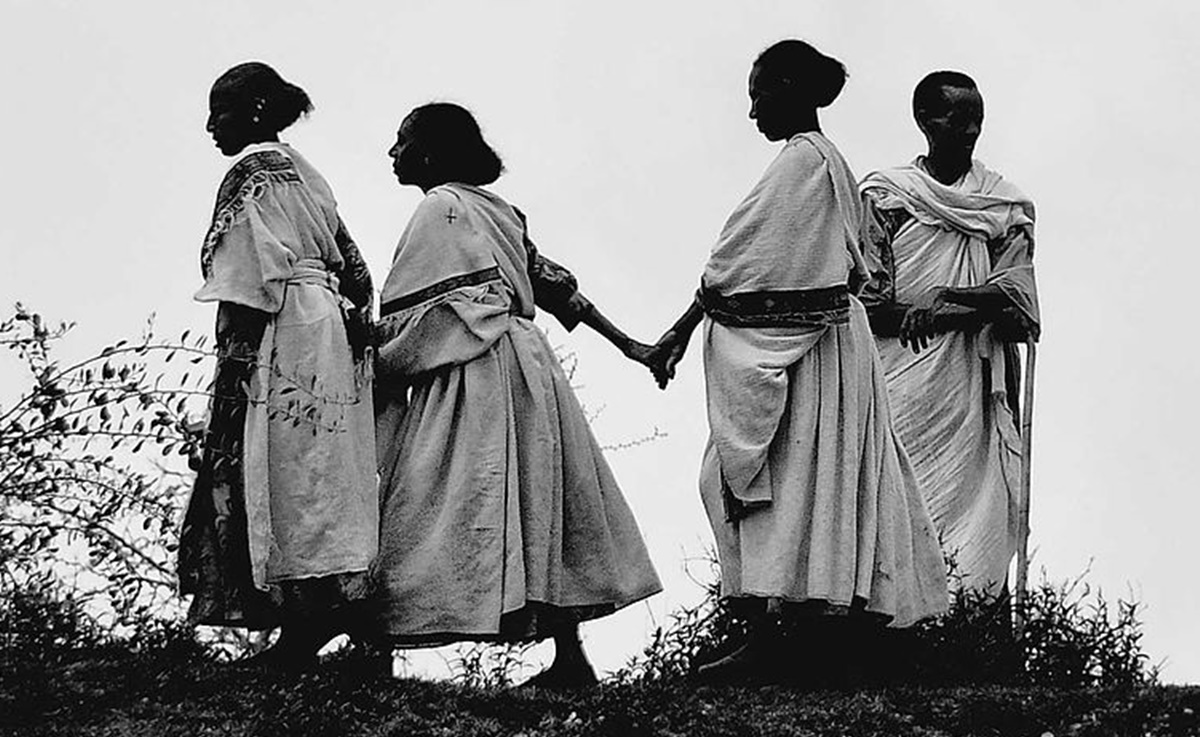
On the streets, women wore the white-colored dresses, symbolic of the Orthodox Christian religion. Muslim women, if not attired in a more colorful dress, wore brown or black-colored burkas. Priests, with dreads, walked among the people. For an American, it was impossible to avoid hearing the omnipresent chanting of the liturgical prayer in Ge’ez, a dead language spoken only by priests, from the Orthodox Churches and the reading of the Quran from the mosques. Some fellow expatriates were exasperated by what they thought of as a cacophony of noise. For me, it was Ethiopia.
The Cushitic Oromo made up the majority of the population surrounding the campus, but the Muslims were a close second. It wasn’t unusual to see Somalians at market or walking along a road or women, usually, sitting in groups with young children. Some were doing well enough, if they worked in some capacity for the university. If not, well, they simply waited. I wanted to see and so I caught the faces of the women. Big-bellied children…
My fellow colleagues in the English department were Christian, so was my chair, in theory, at least. He was managerial. A clever gatekeeper for Western donors who supplied the campus with a warehouse of laptops and other educational electronics. Only I noted professors as well as students using yellow legal pads to write essays and thesis and class lesson plans. He recognized in me trouble no less than his counterparts in the States. Students as well as professors spoke at least one dialect and at least two foreign languages, including English. Nonetheless, so many of the students wanted to come to America.
In terms of the managerial staff at higher education here, I found it difficult to see a difference from what I, as a Black person, experienced in the States. As usual, I felt sorry for the students, particularly these students, each who would have kept their heads down out of respect and scribbled on the yellow legal pad before them—my grocery list! They deserved better.
On the morning Hewan and I prepared to go to church, I thought back to my initial first weeks when I believed I could manage without hiring a Black woman as a servant. But anywhere on the planet, we all need water! Someone in Hewan’s “class,” depended on being hired to clean, shop, cook, and most important, fetch water in rural Ethiopia. Hewan already worked for the campus for at least two other Ethiopian faculty members.
Hewan confided in me that she saved most of her income to send to her son “up north,” attending a university, in another rural area. Her husband died in the “war,” and her only other child, a daughter was killed by “a Muslim.” She didn’t care for Muslims and had learned not to care for “dark-skinned” Blacks either. I learned of that when, one day, I invited an expatriate, a Nigerian co-worker, to lunch, and Hewan refused to place food before her. I ended up placing the food in front of my colleague. I didn’t want to start a war.
Otherwise, Hewan seemed to share the same sentiment against violence. Against war…
Well, I often found myself frustrated because I hadn’t learned enough Amharic to have a decent conversation with Hewan. We had to resort to gestures of the hand and nods or her heads. Sometimes when I was home, and she was cooking and both of us had to remain silent, I had to remember that we were two women. Two Black women. My ancestors were kidnapped from the western coast of Africa, but this was still Africa. Still Africa.
Hewan had no rights that men had to honor under the former PM Meles’ administration. If I didn’t push my way up to the counter at the bank, for example, I would be ignored. Men, one after another, came and stood in front of me as if I didn’t exist. And the women? I was always asked by women why I had come to Ethiopia without my husband. How was I allowed to do so? Where are my children? As if, at 49-years-old, I could conceive and give birth to a child. Immediately! Women learned the lessons of patriarchy and served as gatekeepers too making sure things ran smoothly—at the bottom of the ladder.
Hewan and I managed to plan this visit to the church a half a mile away. I could see that the idea brought her some joy. and not because she thought I would be “saved.” I needed a long white dress, a white scarf, a white shawl. My hair had to be covered behind the scarf because I wore dreads as I do now. Ethiopian women, not the young Western-influenced generation, wore braids. Priests wore dreads. Hewan pointed to my hair while she held the scarf in front of me. While she placed the scarf on my head, I recalled men laughing at me, pointing at my hair. Did I think I was a priest!
Some of the younger Ethiopians, however, thought I was Jamaican. When I went to the market in Harar, a city south of Haramaya, with the Nigerian colleague, she would have to speak for me. The US was determined to send “shock and awe” to Iraq. Ethiopian Muslims weren’t happy, and I didn’t want to “disappear” while in Ethiopia. In March, once the “shock and awe” was delivered, I was teaching in Addis Ababa, and I wasn’t surprised to hear younger guys calling out, “Jamaica!”
I wore a white dress, Ethiopia style, declaring I was Christian. Yet, another compromise. This dress Hewan suggested I wear was not one worn by the average women and girls I encountered on the streets or on the buses as I made my way to the campus. It was a white linen dress, trimmed with embroidered golden material, a shoulder sash and a veil to match—too much for the average woman because way too costly. A woman hauling slabs of cement or blocks of wood over her shoulders, others with large pails of water on their heads, holding on to small children at their sides, wouldn’t be able to afford this outfit for church.
Hewan, too, with her corrugated roof top home, was fortunate to have her job at the university and therefore a key to the padlock on her door. When I was fortunate to have been invited to Hewan’s one room home for dinner, I sat beside her on a mat on the floor with the large round platter of cabbage stew with injera between us. But, in the morning, here was Hewan in an embroidered linen dress! I had to try not to cry.
She turned me to face her, throwing one end of the head scarf thrown over one of my shoulders and the other end over my other shoulder. Again, Ethiopian style! Then she stepped back and looked at me. She smiled.
Walking in silence helps me to be more observant, allows me to think when it’s often a struggle to do so, living among those who receive their news from anything-goes-websites calling themselves news. Small talk is distracting. So walking in this ankle-length dress, I observed…
It should feel and look different, shouldn’t it?
Lots of Black people. Lots of suffering. A good number of poor people, mainly women with small children, clung to the fences and gates of homes and business. I remember seeing this as soon as I departed the airport. People, mainly women, calling out to anyone exiting the airport, clinging to the hope of maybe receiving food, maybe, money. Everywhere there were gray and ashen faces of children. And everywhere in the country, there was an organization supposedly serving the children. Often I would encounter women with children or a woman alone, sitting or walking, pleading for something to eat.
Once, in Addis Ababa, a woman in a worn and torn dress, standing outside of a bakery I was about to enter, motioned to me that she was in need of food for her child and herself. It’s a bakery rather than a grocery store. Nonetheless, I did the best I could do as a woman walking alone, an American, at that, walking alone. I came out of the bakery and handed her some biscuits and walked away quickly before I would be followed by more people asking for food or money.
But what good would this do? What good are prayers? Or these Western charities taking up large office space in some of the best buildings back in the city of Addis Ababa?
The crowd was beginning to swell around Hewan and I until we are surrounded on all sides. The men start to move in one direction until it’s only women. White linen veils steadily proceeding toward the steps of the church as if we were climbing a stairway to heaven. The chanting in Ge’ez is louder now.
Hewan is holding onto the small of my back, so I won’t become lost in this sea of white linen. When we reach the foot of the steps, our forward progress comes to a halt. Hewan nods at me to wait. Then I notice how we are slowly moving in one direction up the steps. She grabs my arm. We are no longer moving. On the other side of the women on the steps, I see the men moving forward, entering the main wooden church doors. Huge and welcoming. The men pass through. We, the women, are waiting.
I can’t remember how long was the wait, but finally we begin to move. But still slowly. I try to gesture to Hewan for an explanation. Why the wait, when the men are going through the church doors? Where are we going?
She gestures that she can’t hear. The chanting…
Finally, we have arrived at one of the entrances to the church. Hewan and I walk toward a small space where there are women sitting on a bench and women kneeling by a wall. They are praying. Standing on my toes, looking over the women standing just ahead of me and Hewan, I see what held the women’s attention.
It’s Jesus. And Mary’ s there too. Not the Palestinian Jesus and his mother. A blue-eyed Jesus and Mary is here! At least, colored “photos” of them is here in this space, in this Orthodox Christian church in Ethiopia. These photos, pasted to cardboard, lean against the wall opposite where we will sit. And pray. Or, rather where these women will pray.
I hear the chanting priest in the church proper just when I notice Hewan rise from her seat. She, too, kneels closer to Jesus and to Mary. From behind her, I sit, observing the woman who accompanied me to this church. Her head is bowed. She is no longer here.
I look at the blue-eyed Jesus again. I knew then that I had always been miles apart from Hewan.
Comments

Powered by RoundtableAn AI/DeFi-powered Enterprise Media Operating System. Learn more at Roundtable.io.© Roundtable 2026. By using this site you agree to the Terms of Use and Privacy Policy