


Mar 11, 2026 2:25 AM
Updated Mar 11, 2026 2:26 AM
The Kurdish story is not merely ethnographic; it is geopolitical dynamite buried beneath the region’s modern wars.
Prelude
The Kurds are a nation written not on parchment but on mountains.
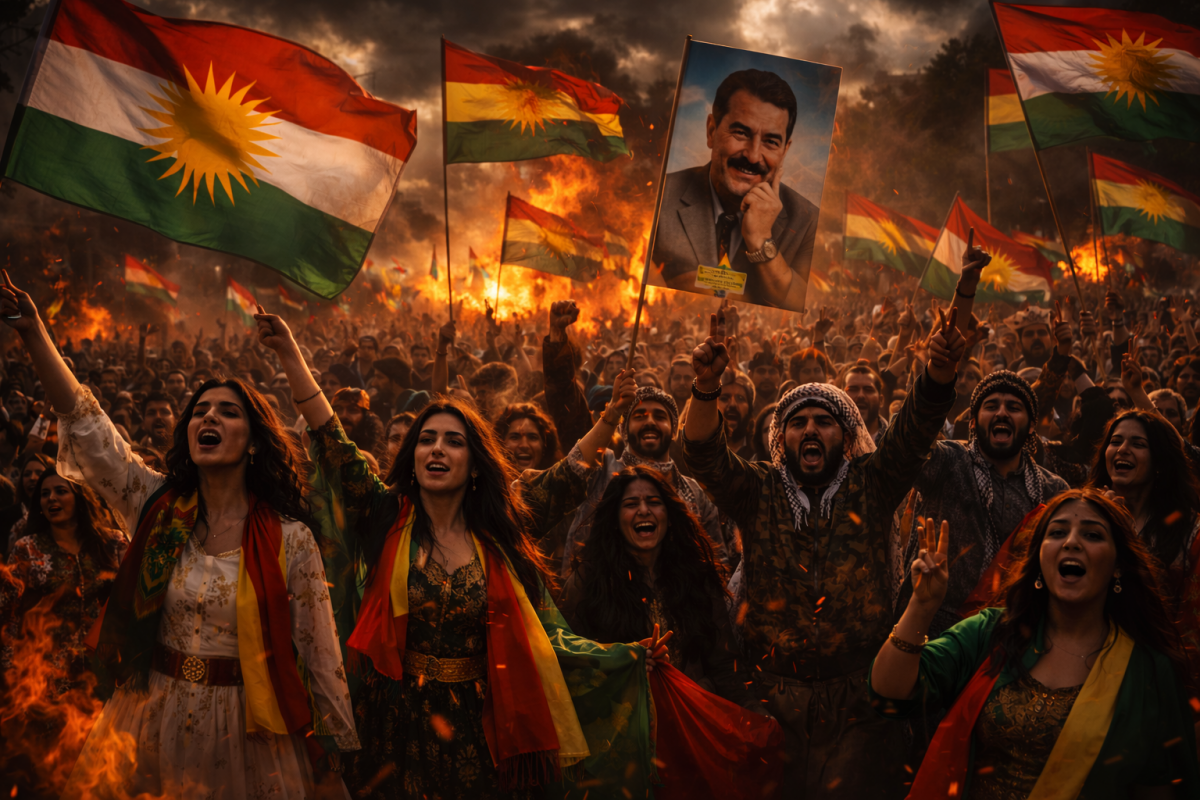
Across the broken spine of the Middle East—through the highlands where the Zagros and Taurus ranges fold into one another like the ribs of an ancient earth—lives a people who are everywhere and nowhere at once. Numbering perhaps 30 to 45 million, the Kurds are among the largest nations on earth without a sovereign state: an Iranic people scattered across the fault lines of empires, their homeland—Kurdistan—divided by the borders of Turkey, Iraq, Iran, Syria, and reaching even into Armenia.
If history were a map drawn by justice rather than power, Kurdistan might appear as a continuous highland republic. Instead, the Kurds exist as a nation interrupted—a language divided by checkpoints, a culture carried across frontiers by memory rather than passports.
They speak the Kurdish languages—Kurmanji, Sorani, and others—branches of the great Iranic linguistic tree. Most are Sunni Muslim, though Kurdish identity has always been broader than any single creed, shaped as much by tribal memory, poetry, and resistance as by theology. And yet despite their dispersion, the Kurds have maintained a remarkably durable sense of peoplehood, like a river that continues to flow even when buried beneath the desert.
Related stories
Nowhere is this more visible than in the autonomous Kurdish region of northern Iraq, where the Kurdistan Regional Government stands as a fragile political experiment—part sanctuary, part unfinished promise—while Kurdish diaspora communities in Europe carry the culture into cities far from the mountains where it was born.
But the Kurdish story is not merely ethnographic; it is geopolitical dynamite buried beneath the region’s modern wars.
For the Middle East was carved in the twentieth century by imperial rulers who treated mountains like lines on a chessboard. When the borders hardened after the First World War, the Kurds were quartered among rival states, each of which feared the centrifugal pull of Kurdish self-determination. A nation of millions became a cartographic remainder—the people left behind when empires drew their straight lines across the earth.
And now, as war once again ripples through Iran, the Kurdish question returns like a suppressed earthquake along an old geological fault.
Every new military intervention—whether by regional powers or global ones—rearranges the political landscape in ways that echo through Kurdistan’s mountains. The involvement of powers such as the United States and Israel in the shifting conflicts surrounding Iran does not merely reshape alliances; it reopens the ancient puzzle of Kurdish sovereignty. For the Kurds have often been both partners and pawns, valued for their strategic position yet rarely granted the political recognition their numbers might warrant.
Should conflict widen inside Iran, the implications would reverberate across the entire Kurdish world. The Kurdish regions of western Iran lie along the same mountainous corridor that binds Kurdish communities across the region. Instability there could awaken long-suppressed aspirations, unsettle existing borders, and redraw the political imagination of the Middle East. What begins as a war between states can quickly become a question of nations without states.
Thus the Kurdish people remain something like a wind moving across borders that refuse to acknowledge it.
They are a nation that exists in the tense grammar between already and not yet:
already a people, already a culture, already a political force—
yet not yet a state.
And so the mountains of Kurdistan continue to hold a paradox:
a homeland that exists physically, culturally, historically—
but politically only in fragments.
In the age of drones, shifting alliances, and unfinished wars, the Kurdish question still hangs over the region like a prophecy waiting to be interpreted:
that a nation long divided by maps may one day redraw them.
Interviews by Serkan Demirel
Prof. Peter McLaren: Peace is imprisoned together with Öcalan
“Wanting peace in today’s world is an act of rebellion,” said Prof. Peter McLaren, adding: “The Turkish state wants Öcalan’s ideas but not his will; it wants his words but not his existence. Peace itself has been imprisoned along with him.”
Interviewed by SERKAN DEMIREL
The “Peace and Democratic Society” process, developed under the leadership of Leader Apo (Abdullah Öcalan) , who has been held in severe isolation for 26 years in İmralı Island Prison, continues to gain increasing international support. This process has also enabled the democratic, ecological, and women’s libertarian paradigm advocated by Abdullah Öcalan and the Kurdish Freedom Movement to become more widely recognized and visible.
Many experts in various fields see these ideas, which revolve around the perspective of peace and a democratic society, as a hopeful alternative not only for the Kurdish people but also for the peoples of the Middle East and the world.
One of these figures is Prof. Peter McLaren, a leading theorist in the field of critical pedagogy, as well as a Canadian educator, writer, and academic. In a message he recently sent to the DEM Party, Prof. McLaren expressed his support for the ongoing process. We spoke with him about the peace process and the significance of Kurdish People’s Leader Abdullah Öcalan’s proposed paradigm.
We publish the first part of the interview Prof. McLaren gave to ANF.
Your message about the peace process in Turkey and Kurdistan drew attention not only as a political statement but also as a moral and human appeal. What motivated you to write it?
I grew up in the wide hush of Canada, where snow fell like the world’s soft refusal of war. There was no draft notice at my door, no uniform waiting on the bed—only the echoes of other men’s courage and fear. Yet the Second World War was the invisible companion of my childhood. My father carried its memory in his silences, the way some men carry scars. He had fought in the sodden trenches of Europe with the Royal Canadian Engineers, building bridges amid ruin. My uncle, Terry Goddard, flew with the Royal Navy’s 808 Squadron, a winged hunter pursuing the German Bismarck battleship across the gray Atlantic until the steel leviathan bled fire and sank beneath the cold, eternal sea.
They fought, so they said, that their sons might never have to. And so I grew up believing that peace was not a gift but an inheritance purchased dearly with the anguish of others.
When my time came, I chose another battlefield—the classroom, the street, the conscience. I stood against the wars of empire, against the delirium of nations mistaking domination for destiny. I marched, I spoke, I wrote. I went where hope still had the courage to name itself socialism. In Venezuela, at the invitation of Hugo Chávez’s government, I walked among those who dreamed of justice not as a slogan, but as bread shared among equals.
For that, the powerful took notice and paid students to report on leftist professors. In 2006, my name appeared among the so-called Dirty Thirty—professors accused of poisoning young minds with subversive thought, our words secretly taped and reported like contraband. And now, years later, I find myself again inscribed on a list, this time by Charlie Kirk of Turning Point USA—a man recently assassinated in the fevered crosswinds of the nation he helped divide.
Such lists are the modern inquisition’s ledgers. Yet I take no pride in persecution, only a quiet understanding: that to stand with the oppressed is to invite the wrath of the comfortable. My father fought the fascists with steel and smoke; I fight their ghosts with words and witness. Both battles, in the end, are for the same fragile dream—that humanity might learn, before it is too late, to see itself in the eyes of the other.
You said, “I salute the courage of those who choose words instead of weapons.” Why do you think the language of peace is so difficult to hear in today’s world?
Then let us add this truth, for it belongs to the marrow of the story.
Words, too, are weapons. They have always been. They can wound deeper than bullets, for they shape the mind’s battlefield before any soldier takes aim. Empires have been built on syllables of deceit; civilizations, shattered by a single word spoken in hatred. To name is to wield power—to define another as inferior, as an enemy, as less than human—is to begin the work of violence long before the sword is drawn.
Today, as in darker times, demagogues rediscover the old lexicon of fear. They brandish words like vermin and traitor as though humanity were a stain to be scrubbed from the earth. When Donald Trump proclaimed, “We will root out the communists, Marxists, fascists, and radical left thugs that live like vermin within the confines of our country,” he was not inventing a new language of hatred—he was echoing the ghosts of the twentieth century, borrowing from the same poisoned well that fed Hitler’s delirium.
What is most chilling, perhaps, is his ignorance—or his cynicism. To call others fascists while standing knee-deep in one’s own cult of grievance and violence is not simply irony; it is moral blindness weaponized. Trump does not know what fascism means, because fascism cannot see itself. It survives precisely through its ability to accuse others of its own crimes.
And so the war of words becomes a war for the soul. The question is not only who speaks, but who listens—and who still believes that language can be used for love, for truth, for the fragile work of remembering that every human being, even now, carries a spark not meant to be extinguished. Yes—and it is here, in the luminous circuitry of our new Babel, that the ancient art of dehumanization has learned to speak in code.
Today, the weapons are not forged of steel but of syntax—lines of algorithmic logic humming beneath the surface of our screens. Bots whisper in the language of persuasion; platforms amplify rage because outrage is profitable. The machinery of communication has become a cathedral of mirrors, reflecting back not the world as it is, but the world as each tribe wishes it to be. Within these digital catacombs, truth is no longer a river that flows between us—it is a stagnant pool where only our own reflections appear.
People no longer converse; they transact. Words are exchanged not to seek understanding but to score points, to signal allegiance, to purchase belonging in the marketplace of identities. The discourse that once held the promise of transformation—of becoming more human through dialogue—has been recast as a performance of loyalty. The algorithm, indifferent yet all-powerful, rewards those who shout the loudest, who hate with precision, who bleed emotion into data.
And so we find ourselves exiled from the possibility of communion. The same technologies that could have knit humanity together have instead multiplied our solitudes. In these echoing chambers, empathy becomes a foreign tongue, and truth, a rumor no one dares to believe.
To speak compassion in such an age is itself an act of resistance. It is to remind ourselves that language, even when captured by machines, can still be a vessel of the human spirit—that words, once cleansed of their venom, might again become instruments not of division, but of awakening.
It is difficult to hear the language of peace among the din of today's digitalized discourses because the language of peace is a quiet tongue, and the world has forgotten how to listen.
Amid the thunder of slogans, the algorithmic shouting matches, the ceaseless scroll of outrage and accusation, peace speaks in tones too soft for the machinery of our age. It does not trend; it does not sell; it does not flatter the ego or promise victory. Peace is not a spectacle—it is a whisper between souls. Yet that whisper is drowned beneath the metallic roar of today’s discourses, where every word is sharpened into a weapon, every sentence a skirmish, every silence mistaken for defeat.
We live, it seems, in an age of amplified noise and diminished meaning. The instruments of communication have multiplied, but the art of communion has withered. Words once meant for healing are now repurposed for conquest. We build digital towers of Babel, each rising higher toward confusion, and the higher we climb, the less we understand one another.
And yet, the language of peace endures. It lingers in the pauses between words, in the breath before reply, in the courage to listen without preparing to strike. It dwells where compassion still refuses to die—in a letter written by hand, in a mother’s lullaby, in the small miracle of forgiveness.
To speak peace today is not naïveté; it is defiance. It is to believe, even now, that humanity’s better voice still waits beneath the static, trembling like a candle in the wind—fragile, yes, but still alight.
Do you see Abdullah Öcalan’s call for “peace and a democratic society” as a form of politics grounded in human dignity?
I cannot speak as an authority as I have been following events mostly through what I have been reading. That said, it certainly seems to be a very dignified politics. From the solitude of his prison, Abdullah Öcalan has sent forth a message that has been heard across the highlands and valleys and pomegranate groves and rocky passes of Kurdistan. He has called upon his comrades to lay down their arms, to let the fire of resistance transform into the warmth of life. That sounds very dignified to me. How could it not? Beneath skies that had long known the roar of warplanes, Ocalan’s comrades broke their weapons. The act was neither humiliation nor defeat; it was a ritual of reclamation, in fact, I would maintain this to be a testament to the very dignity of life itself! When rifles, once symbols of rebellion, become relics and when voices once estranged begin to converse—that can activate ancient currents of discourse bearing fragile vessels of possibility. Which is not the same thing as a guarantee.
At a time when militarization and war rhetoric are increasing globally, especially in the Middle East, how should we understand Kurdish People’s Leader Abdullah Öcalan’s consistent stance in favor of peace and dialogue?
I speak as one who straddles two nations — a dual citizen of Canada and the United States — now enduring the second reign of Donald Trump, a man tearing apart whatever democratic foundations remain in the United States. I watch as he lashes out at my native country, seeking to cripple its economy through tariffs, to fold it into the dominion of empire, to make it the fifty-first state. I live in a country that dreams of war — that speaks of oil as destiny and of other nations as prey. A country that seeks regime change through war with Venezuela, that helps to fund the devastation of Gaza, that calls annihilation self-defense, that wraps the machinery of death in the language of freedom. I have learned, through bitter witness, to be skeptical of geopolitics — that theater where power too often masquerades as principle and war is sold as virtue.
And yet, amid this clamor for domination, there stands a voice from a prison cell on an island in the Marmara Sea — the voice of Abdullah Öcalan — speaking not of conquest, but of conscience, speaking not of stipulations but of conversations. When the world sharpens its knives, he speaks of dialogue. When others call for war, he calls for awakening. In a time when the globe is fevered with militarization, his words sound almost unearthly, as if spoken from another moral dimension, one that remembers what humanity has forgotten. Peace is not the absence of conflict; it is a labor of creation, a cultivation of life where death once ruled. It is the hands that choose compassion over conquest, the eyes that see dignity where others once saw only threats, and the hearts that trust in the possibility of reconciliation.
For Öcalan’s vision, it seems to me, is not about victory in the worldly sense. It is about metamorphosis — the transformation of the human spirit itself. Freedom is not the taking of power but the awakening to responsibility: responsibility to the other, to the living, and to the dead who sacrificed before the dawn.
Peace is not the absence of conflict; it is the courage to turn struggle into creation, fire into light, rage into vigilance, suffering into wisdom. And in the villages and towns, from the wind-swept plateaus to the fertile river valleys, a fragile hope has now arisen : that those who had been enemies might yet walk the same paths without fear, that blood once spilled could nourish understanding instead of grief. Let's be clear: peace is no gift. It is a covenant — a sacred labor, a song of life that must be sung with hands that refuse to strike, eyes that refuse to hate, and hearts that refuse to forget. And in the light of that covenant, there is hope that peace will become the moral and spiritual architecture of the land — fierce, unyielding, eternal.
Peace is not submission, nor an erasure of struggle, but a transformation of it: the courage to convert fire into light, to honor sacrifice without perpetuating its sorrow. Freedom, is not a weapon to wield but a horizon to approach, shared by all.
To favor the success of the peace process, the Kurdish side has taken several concrete steps, including the proposal to dissolve the PKK. Yet the Turkish state has not taken tangible steps in response, and Öcalan, the key actor of the process, remains in prison. In your view, what responsibilities fall on the state?
There are serious obstacles at play. The first obstacle appears to be silence. Öcalan’s voice comes to us through a wall of state-imposed silence. He is isolated on Imrali Island — denied visits, denied the right to speak, even to breathe in the world he’s trying to change. And that silence is not accidental; it is policy. The state wants his ideas without his agency, his words without his presence. Peace itself has been imprisoned alongside him.
The second obstacle appears to be the fear of recognition. The Turkish state has spent a century pretending that the Kurdish question is a problem to be managed rather than a people to be embraced. Even now, when the PKK declares disarmament, when Öcalan extends a hand toward peace, the government calls it victory over terrorism instead of the beginning of reconciliation. The old reflexes persist: deny, control, rename, contain.
And then, of course, there is politics — the grand stage upon which all this is performed.
President Erdoğan approaches the peace process not as an act of moral transformation, but as an instrument of political survival. Facing constitutional term limits, he knows that Kurdish support could be the key to extending his rule. Yet he is shackled to an alliance with the ultranationalist MHP — a party whose very identity depends on rejecting Kurdish aspirations. So he is caught between two fires: to reach for peace risks alienating his base; to appease his base requires stifling the very peace he claims to pursue.
Even as he speaks the language of peace, Turkish drones speak another language in northern Syria. “Operation Dawn of Freedom” continues — an operation that extends the conflict beyond Turkey’s borders, striking at Kurdish groups whom Ankara insists are indistinguishable from the PKK. It’s a double theatre: diplomacy at home, destruction abroad.
And yet, through all this, Öcalan’s idea endures — an idea of radical democracy, of coexistence built from the ground up, of a Turkey that might one day include rather than erase. But for that to happen, the state itself must undergo disarmament — not of weapons, but of fear, arrogance, and denial.
So yes — the greatest obstacle is not in the mountains, not among the Kurdish people, not even in the prisons. The responsibility of the Turkish state lies in its heart. Until that heart learns to listen — truly listen — the path to peace will remain blocked, and the key to the future will stay locked inside the cell of Imrali.
What significance do you think the peace process in Turkey holds for the broader debates on democracy in the Middle East and globally?
The peace process in Turkey is a fragile bridge of hope over a river carved by centuries of conflict, where the voices of the young may be the only ones steady enough to carry democracy across. Far across the Atlantic, the voices of a younger generation stir. According to the University of Maryland’s Critical Issues Poll (July-August, 2025), 37% of young Americans lean toward Palestinians, only 11% toward Israelis, and even the youngest Republicans break from the loyalties of their elders.
These movements in public feeling mirror the fragile experiment of democracy itself—a living, breathing dialogue that bends beneath the weight of history. Whether in the streets of Istanbul, the demolished lands of Palestine, or the polling booths of Maryland, the test remains the same: can we hold the bridge steady long enough to let empathy, justice, and courage pass across it before the river of division sweeps everything away?
Who is Prof. Peter McLaren?
Born in 1948, Canadian educator, writer, and academic Prof. Peter McLaren is one of the world’s leading theorists in the field of critical pedagogy. He is known for his Marxist educational theory, cultural studies, and education approach based on social justice.
After many years of teaching in the United States, he served as a professor at institutions such as the University of Los Angeles and Chapman University. Influenced by thinkers like Karl Marx, Paulo Freire, and Antonio Gramsci, McLaren views education not merely as the transmission of knowledge but as a tool for social transformation.
Through his approaches of “critical pedagogy” and “revolutionary pedagogy,” he advocates for students to develop critical consciousness and achieve liberation. His work has influenced academic circles across a wide geography — from Latin America to Europe, the Middle East to Asia. His most well-known work, Life in Schools (1989), is considered one of the cornerstones of critical pedagogy literature.
Prof. McLaren: Öcalan’s isolation reflects the captivity of our collective imagination
Interviewed by Serkan Demirel
Prof. McLaren said: “The walls of Imrali are not merely the boundaries of a prison. They represent the architecture of a world order that fears consciousness and the capacity for critical thought."
Born in 1948, Canadian educator, writer, and academic Prof. Peter McLaren is one of the world’s leading theorists in the field of critical pedagogy. He is known for his Marxist educational theory, cultural studies, and education approach based on social justice.
After many years of teaching in the United States, he served as a professor at institutions such as the University of Los Angeles and Chapman University. Influenced by thinkers like Karl Marx, Paulo Freire, and Antonio Gramsci, McLaren views education not merely as the transmission of knowledge but as a tool for social transformation.
Through his approaches of “critical pedagogy” and “revolutionary pedagogy,” he advocates for students to develop critical consciousness and achieve liberation. His work has influenced academic circles across a wide geography — from Latin America to Europe, the Middle East to Asia. His most well-known work, Life in Schools (1989), is considered one of the cornerstones of critical pedagogy literature.
The first part of Prof. McLaren's interview with ANF can be read here.
Below is the second and final part of the interview.
Öcalan advocates the idea of “democratic modernity” as an alternative to capitalist modernity. In what ways do you think this idea intersects with critical pedagogy and emancipatory education?
Öcalan’s call for the PKK to lay down its arms has unfolded like a tremor beneath the mountains — a sound that could be the echo of peace or the prelude to another storm. His voice, carried from the silence of Imrali, has stirred the Kurdish horizon from the Qandil peaks to the plains of Rojava and Erbil. Across these lands, weary leaders like Masoud Barzani have lifted their eyes toward the fragile dawn of dialogue, while Ankara has listened with one hand on the sword. Yet the path ahead remains tangled in thorns: Turkish warplanes still circle over the KRI and NES, even as Kurdish fighters declared a ceasefire. The PKK demanded to see the face of their imprisoned founder before surrendering their weapons, knowing that too often in history the promise of peace has been buried beneath the rubble of betrayal. Meanwhile, new treaties reshape Syria’s future — deals inked in Damascus and Erbil that trade Kurdish autonomy for central control, handing oil fields and borderlands back to the state while leaving communities divided and uncertain. In Sinjar, the ghosts of displacement and unhealed war still haunt the earth, their presence complicating every gesture toward reconciliation. Thus, Öcalan’s vision of disarmament glimmers like a candle against a tempest. For peace to take root, words must be made flesh—something that I have called “enfleshment” in my own work: laws must shield the disarmed, nations must restrain their fire, and those long estranged — Turkey, the KRG (Kurdistan Regional Government), Damascus, and the Kurds themselves — must learn to speak again not as conquerors or supplicants, but as kin seeking to end an ancient night. As to Öcalan’s idea of democratic modernity, it is profound.
As someone who makes no claim to be an authority on Kurdish resistance, the greatest obstacle to Öcalan’s peace proposal seems to be not only political but pedagogical. The walls of Imrali are not just the boundaries of a prison — they represent the architecture of a world order that fears consciousness itself, that fears the ability to think critically. By the term ‘thinking critically’ I mean by unpacking the impact of capitalist social relations of production and the value form of labor on democratic institutions and human volition. The architecton, and I am using this term in the Aristotelean sense, is the capitalist who is responsible for the production of value. By “production of value,” Marx did not speak merely of numbers in a ledger, but of the hidden alchemy by which human life is transmuted into profit. Value, for him, was not born in the marketplace but in the pulse of living labor — in the hands that cut, forge, weave, and build. It is time itself, human time, distilled and measured according to the cruel arithmetic of what he called socially necessary labor. Labor is the hidden fire that animates the world of commodities, yet the flame is dimmed, its light expropriated. What we need in order to liberate ourselves from the commodification of our subjectivity is the cultivation of what I call ‘protagonistic agency’, the ability to write our own narratives, our own stories rather than having the apparatuses of the state write them for us.
Let me draw from Marx here. In every product lies a ghost: the surplus labor that was given but never returned, the unpaid portion of life that capital seizes and calls its own. The wage covers only the worker’s survival, not their contribution; the rest — the excess, the unacknowledged — becomes the lifeblood of profit. Thus the value of a commodity is not simply what it costs to make, but the quiet theft embedded in its making. Behind every price tag hums the rhythm of exploitation, the unending conversion of living breath into dead capital, of human possibility into the currency of power.
Öcalan’s isolation mirrors the captivity of our collective imagination under capitalist modernity, a system that educates us to obey, to consume, and to mistake domination for order. What he calls “capitalist modernity” is, in truth, a vast schooling in servitude — a global curriculum that teaches humanity to forget its own dignity.
It is here that Öcalan’s thought converges so deeply with the tradition of critical pedagogy. Paulo Freire taught us that the oppressed must become subjects of history rather than objects of policy. Öcalan extends that principle to entire civilizations. His vision of democratic modernity is, at its core, a pedagogy of reawakening — a call to unlearn hierarchy, to relearn solidarity, to recover the ability to name the world instead of being named by it. Freire’s “pedagogy of the oppressed” and Öcalan’s “democratic confederalism” both emerge from the same moral geography: the conviction that liberation must be learned into being. That is why we Freireans here in the United States are attacked so viciously by the capitalist state. Why the recently assassinated Charlie Kirk put us on his Professor Watchlist. Why we are seen as the “enemies of the people” by the ruling class, those billionaire oligarchs packed into the Republican Party like sardines in a can.
Both thinkers recognize that education is never neutral. It either domesticates or liberates. For Freire, the classroom was a site of transformation; for Öcalan, the commune and the assembly become classrooms where people learn the difficult art of freedom. Both confront the same enemy: the mechanized consciousness of capitalist modernity that turns human beings into instruments of profit and obedience.
This is why the state fears them. Erdoğan’s government, like so many regimes before it, seeks to silence Öcalan not only because of his political vision but because of his pedagogy — because he teaches people to think, to question, to participate. That is far more dangerous to authoritarianism—to fascism—than any weapon. The suppression of Öcalan’s voice is the suppression of our collective capacity to imagine peace. Jair Bolsonaro, past president of Brazil and friend of Trump, was no admirer of Freire. During his 2018–2019 campaign and early presidency Jair Bolsonaro repeatedly vowed to purge Paulo Freire’s influence from Brazil’s education system, famously boasting he would “enter the Education Ministry with a flamethrower to remove Paulo Freire.”
Bolsonaro and his allies labeled Freire a “Marxist” and blamed him for what they called poor educational outcomes. After taking office, his government and parliamentary allies pushed measures to downplay Freire’s status (including proposals to replace Freire as Brazil’s patron of education) and spoke publicly of removing Freirean approaches from curricula.
Paulo always told me not to transport his theories to other countries but to encourage teachers from other countries to reinvent his ideas in the context of their own struggles. President Chavez respected critical educators from other countries but maintained that education reforms that were imported from other countries need to be adapted in ways that served the needs of the Venezuelan people.
In the end, what is at stake in Öcalan’s vision is nothing less than the recovery of our humanity. His writings, like Freire’s, remind us that peace cannot be imposed from above; it must be learned and lived from below. They share a faith in the oppressed — in the moral intelligence of ordinary people to transform their conditions once they awaken to their own power. This faith is revolutionary because it rejects cynicism and fatalism. It insists that the act of thinking is itself an act of resistance, that the creation of knowledge is the creation of freedom.
We now inhabit a planet where catastrophe has become curriculum — where war, inequality, and ecological collapse teach us daily lessons in despair. Öcalan and Freire remind us that another kind of education is possible: one rooted in dialogue, in mutual care, in the pedagogy of love. To teach critically, to organize collectively, to act with conscience — these are not academic gestures; they are forms of rebellion.
Öcalan’s peace proposal, read through the lens of critical pedagogy, is not merely a political document. It is a curriculum for human renewal — a summons to reclaim the moral and spiritual imagination that capitalism has exhausted. Both Freire and Öcalan teach us that the liberation of a people and the liberation of the mind are the same revolution spoken in different tongues. And in that shared language of freedom, we find the beginnings of peace.
You have developed an emancipatory pedagogy inspired by Paulo Freire. Do you see parallels between Öcalan’s principles of “self-governance” and “democratic confederalism” and your own pedagogical approach?
Democratic confederalism is Öcalan’s vision of freedom rooted in the soil of communities, where power flows through councils and assemblies. Rejecting the hierarchy of the state and the cold logic of capitalism, it cultivates a society where women, minorities, and local communities shape their own destiny, guided by principles of feminism, ecological care, and a cooperative economy. Once the dream of Kurdish liberation, it has grown into a blueprint for human self-determination everywhere — a stateless, participatory democracy where freedom is not granted from above but cultivated from the ground up. My own work resonates with these ideas, though I focus less on reimagining the state and more on schools organized as communes or communal institutions. In this particular domain, Öcalan’s vision remains far more detailed and far-reaching than my own.
My work over the past several years has been primarily defending education from attacks by far-right operatives who rail against diversity, equity and social justice, considering them to be efforts at “reengineering the human soul”. Think about that statement, that teaching students to think critically is destroying the “souls” of children. Gaslighting attacks like this are destroying education throughout the United States.
Thinking critically is described as “woke”—in fact, any effort to help students become politically aware and fight against oppressive institutions and far-right ideological imperatives is considered “woke”. These far-right attacks in the United States have also become templates for leaders in other countries. Now, fascist leaders are using similar arguments to denounce wokeness in education. A dark tide is sweeping across classrooms from Budapest to Buenos Aires, from Rome to the mountains of the mind itself. Governments in Hungary, Italy, and Argentina brandish “anti-woke” education as a weapon, seeking to erase the language of gender, diversity, and critical thought. Ministries are shuttered, programs dismantled, universities recast as instruments of indoctrination, and students rise, their voices clashing against the machinery of erasure.
In Argentina, Milei vows to burn the “ideological edifice of sickly wokeism,” cutting funding and silencing the structures that defend women and minorities. In Hungary, Orbán closes universities and bans discussion of LGBTQ+ lives in schools, framing his assault as a culture war against “globalist indoctrination.” In Italy, Meloni champions tradition, seeking to mold families and classrooms alike, curtailing education on gender and sexuality.
Across these nations, the storm is not merely political but existential: a battle to seize the imagination of youth, to replace inquiry with orthodoxy, dialogue with decree. Yet even under this shadow, sparks of resistance flare — in student protests, in whispered discussions, in the persistent pulse of critical thought that refuses to be extinguished. Even as the storm of erasure rages, the sparks of critical inquiry leap from classroom to classroom, refusing to be swallowed by the night.
Do you believe that peace processes are built solely through political agreements, or do they also require a kind of “moral rebirth”?
Peace processes are never forged by treaties alone; they demand a kind of moral rebirth, a quiet alchemy of conscience that transforms negotiation into genuine reconciliation. They require epiphanic moments, flashes of recognition that the path toward peace is itself sacred work. In this light, the life of Maximilian Kolbe stands as a luminous example: his courage, selflessness, and faith illuminate how true peace is as much an inner revolution as a political accord, a testament to the human capacity to choose love and justice even amid the machinery of oppression. During Father Maximilian Kolbe’s imprisonment in Auschwitz, the camp was gripped by the terrifying law of ten lives-for-one—the Sippenhaft—after a prisoner had escaped. Crowds of prisoners pressed against walls and huddled in corners, seeking invisibility under the scorching sun, while the guards’ footsteps and orders fell like hammers and lightning, each glance a verdict of annihilation.
SS-Hauptsturmführer Karl Fritzsch selected ten prisoners for execution, including Franciszek Gajowniczek, a Polish sergeant who had fought bravely in the defense of Wieluń and Modlin Fortress, survived capture, endured seven months of Gestapo torture, and joined the resistance before being sent to Auschwitz. Gajowniczek’s desperate cries for his wife and children were answered by Father Kolbe, who stepped forward and offered his life in the man’s place—a supreme act of selfless love that Fritzsch permitted.
Gajowniczek had already narrowly escaped death multiple times: he had been chosen for execution in retaliation for partisans destroying a train and later survived a typhus infection with help from fellow prisoners and a military doctor. He later reflected that Kolbe’s sacrifice had given him strength to live, protect his family, and ensure that the priest’s life had not been wasted.
Kolbe, along with nine other prisoners, was confined in the starvation bunker of Block 11, the “Death Block,” a death-like space -- a site of executions and Zyklon B testing. Stripped of light, air, and hope, hunger and thirst gnawed at them, yet Kolbe’s voice rose above the void with psalms, prayers, and assurances of mercy, sustaining the others spiritually. Remarkably, Kolbe survived in this hellish cell for two full weeks, sustaining the other nine prisoners in song and prayer. Ultimately, he was killed with an injection of carbolic acid, completing his ultimate act of love.
The man Kolbe gave his life to save, Franciszek Gajowniczek, survived the war, carrying Kolbe’s gift of life forward. Decades later, in 1982, he witnessed Kolbe’s canonization as a saint of the Catholic Church.
Does peace require moral rebirth? Yes—profoundly so. For peace is not born of treaties alone, but of transformation. If Father Maximilian Kolbe could light a sanctuary in a starvation cell—if he could make hope rise from the ashes of atrocity—then surely we, too, can awaken the moral imagination that gives peace its soul. Peace demands that the people, united in conscience and courage, ignite again the flame of truth and justice before it is extinguished, before it fades like a child’s cry lost beneath the goose-stepping thunder of hobnailed boots on the road to perdition.
When peace and democracy enter into covenant, hope itself takes root—for where they dwell together, justice will not perish from the earth. And as the old truth reminds us: when injustice becomes law, resistance becomes duty.
You have said, “Democracy is not the property of the powerful, but the shared promise of humanity.” What responsibilities do peoples and governments have today to keep that promise alive?
Peace and democracy will not endure through words alone; in the case of the Kurdish struggle, it demands that Ankara turn promise into law. That is a prime responsibility. The Kurdish call is clear: amnesty for those who once bore arms, the freedom to speak and teach in their own tongue, and the release of the imprisoned voices who dared to dream of equality. These are not concessions—they are the foundations of trust.
The promise of democracy is not kept by signatures on parchment but by the vigilance of conscience. Governments bear the solemn responsibility of justice—to transform the machinery of power into an instrument of dignity, to remember that peace is not the absence of conflict but the presence of fairness, truth, and inclusion. Peoples, too, must guard the flame: to resist apathy, to demand accountability, to see the humanity even in those once called enemies. For when peace is born, it is an infant—fragile in the arms of both rulers and citizens alike—and if either turns away, it will wither back into dust.
To keep that promise alive is to act each day as if the world depends upon our courage to listen, to reconcile, to forgive—to remember that democracy itself is the daily labor of peace.
Yet in the Turkish state, beneath this fragile dawn, lie shadows that refuse to fade. Let’s face it, the soil is thick with distrust, the promises of reform still unfulfilled, and the winds of regional conflict—blowing from Syria and Iraq—threaten to scatter the embers before they can kindle into flame. Erdoğan’s gamble balances on a knife’s edge, between nationalist wrath and Kurdish hope, between power’s instinct to preserve itself and peace’s plea to be born.
And so, Turkey stands at a crossroads once more. The guns may have fallen silent, but the greater struggle now begins: to transform silence into trust, and trust into the architecture of justice—a peace not written in treaties, but in the moral rebirth of a state that has too long spoken only in the language of war. But what about states that do not want democracy or peace? I am thinking of Russia, I am thinking of the United States. Not all powers welcome the labor of peace or the vigilance of conscience. Some states, wedded to their own dominance, see democracy as a threat and justice as a constraint. Russia, for instance, moves with the weight of history and ambition, its fist raised where dialogue should be, its shadow stretching across borders, reminding the world that the path to freedom is never free of obstruction. It’s my view that Putin plans to reclaim countries that were once part of the Soviet Union. Even the United States—once a herald of democracy—has under Trump’s clown show, stumbled under the weight of self-interest and political calculation, its actions betraying the fragile covenant between power and principle. That covenant has been shattered. My adopted country lies slumped in a cesspool of Trump's malignant narcissism.
This should warn us that peace is not a natural inheritance but a struggle, and democracy a constant experiment. The world’s conscience must act as both witness and counterweight, pressing against the brute gravity of authoritarianism and fascism, and insisting that the promise of justice, though resisted, cannot be erased. For where power refuses accountability, hope must burn brighter, its flame sustained by courage, conscience, and the unwavering conviction that no tyranny can extinguish the human demand for dignity.
Do you think nationalism is one of the main obstacles to peace, both in Turkey and around the world?
Yes, I do. Absolutely. I have criticized Christian nationalism and Catholic Integralism in particular. And I am a Catholic. I take the position that the Church and State should be separate. The role of the Church in fascist dictatorships taught me that lesson. Nationalism is a serious problem in the world because it turns loyalty into a cage and channels the energy of communities against themselves. It dresses power in the robes of virtue, convincing people to fight imagined enemies and to ignore the deeper injustices that shape their lives. It carves the world into “us” and “them,” narrowing empathy to borders drawn by fear and ideology, and blinds us to our shared human stakes.
We see its effects everywhere: in education, media, and politics, where it discourages questioning, undermines dialogue, and replaces care with conformity. When nationalism rises unchecked, it diverts the human spirit toward division and the perpetuation of power, rather than toward justice, freedom, and collective responsibility. That’s why I believe it is one of the greatest obstacles to building peace and sustaining democracy in the world today.
You wrote, “The world must not turn away from this.” What are your thoughts on the international community’s indifference to peace struggles in the Middle East, particularly regarding the Kurdish question?
When it comes to the Kurdish question, the world’s indifference is both strategic and deliberate. The struggles of the Kurds do not align neatly with the geopolitical or economic interests of powerful states, particularly the United States, and so they are often sidelined while other conflicts receive attention and resources. Oil, alliances, and regional calculations dictate where international eyes fall, leaving the Kurds to navigate violence and oppression largely alone. This selective attention reveals that indifference is not ignorance—it is a choice, a cold calculation that values power over justice. Again, this selective indifference is not accidental; it is a deliberate choice, a reflection of global power structures that value stability and profit over justice and human dignity. And yet, the courage and resilience of the Kurdish people demand that we bear witness, even when the world looks away.
Where do you place the Kurdish question within the broader struggles for global justice and freedom?
I would begin by placing at the center of the challenge ahead, a vision of the Kurdish struggle as a crucible, a laboratory of possibility, a space where the human spirit tests the very bounds of freedom and imagination. This is no reckless tossing of lives into the wind; it is a deliberate, almost sacred experiment, an unfolding of Abdullah Öcalan’s vision where politics is not merely strategy, but the living pulse of direct democracy and the unshackled functioning of society’s moral and political institutions—the very essence of freedom made flesh.
At the core of this vision burns women’s liberation, for Öcalan sees the oppression of women as the shadow at the root of all other dominations. Any true revolution must rise from this heart, for the emancipation of women is the keystone of human liberation itself. Alongside this, he casts an ecological imagination, what critical pedagogy refers to as ‘eco-pedagogy’, envisioning a society where technology, economy, and human endeavor coexist in harmony with the earth—a rebellion against the destructive industrialism that has scarred modernity.
Öcalan confronts the ghosts of failed socialism, those 20th-century experiments crushed beneath the weight of nation-states and industrial mimicry of capitalist empires, and reclaims socialism as a moral and political lifeworld—a lifeworld rooted in democratic modernity, in radical decentralization, in the careful orchestration of human capacities to navigate regional differences.
Thus, the Kurdish struggle becomes more than survival, more than identity—it becomes a laboratory of robust democratic imagination, a test of whether a society can breathe freely, balancing justice, equality, and ecological wisdom. It is an existential experiment in the moral and political potential of humanity, where courage, responsibility, and imagination are inseparable, and where the horizon of possibility stretches beyond the familiar and the known. That the international community is incapable—or perhaps unwilling—to seize upon these possibilities only confirms the truth of Öcalan’s analysis. It is a stark reminder that moral and political imagination is fragile in a world driven by power and calculation. This is why we must call the international community to account, before such experiments are lost to neglect, before revolutionaries like Öcalan are reduced to relics of the past—erased by indifference, rendered invisible, turned into nothing more than museum pieces in the corridors of history.
If you had the opportunity to speak directly with Abdullah Öcalan, what would you want to discuss with him?
I would ask what he thinks must be done next, what paths he sees to draw humanity together, to carry forward what he has begun. To ask this is to confront the urgent task of sustaining a vision that challenges the world to remember its capacity for justice, equality, and freedom and to confront both the peril and the possibility of our time, reminding those indifferent to change, that even in the shadow of complacence, the work of humanity—of rebuilding, of imagining, of acting—cannot be abandoned.
Interviews by Deniz Karabudak
Peter McLaren: Language of Marx found a new grammar of hope in the mountains of Kurdistan
1 November 2025
ANKARA - Academician Peter McLaren stated that the international left has a lot to learn from the Kurdish Freedom Movement and said: “The language of Marx and the poetry of resistance found a new accent, a new grammar of hope in the mountains of Kurdistan.”
Kurdistan Workers’ Party (PKK) has taken many steps in the process that started with the “Call for Peace and a Democratic Society” by Kurdish people’s Leader Abdullah Öcalan. As part of the efforts carried out in line with Abdullah Öcalan’s perspectives, the PKK announced on October 26 in Qandil that it had withdrawn from Bakur (Northern Kurdistan-Turkey).
Critical pedagogue and academician Peter McLaren gave assessments to the Mezopotamya Agency (MA) on the solution of the Kurdish issue. McLaren described the latest step taken by the Kurdish Freedom Movement as a 'monumental gesture’: “If Ankara continues to meet that gesture with silence, history will record not only the peace that was lost, but the imagination that failed to grasp it.”
‘PEACE IS A GRAMMAR AND IT MUST BE LEARNED’
McLaren underlined the importance of the steps taken by the Kurdish Freedom Movement along with the Peace and Democratic Society Process: “It is a poem of peace written in the ruins of decades. Yet peace, like democracy, is not a gift but a grammar, it must be learned, practiced, trusted. The challenge now is to craft the legal and moral architecture that can hold Kurdish rights, which is political, cultural, and human, without collapsing under the weight of betrayal."
‘THE MOUNTAINS OF KURDISTAN IS A MORAL COMPASS’
“For decades, the mountains of Kurdistan have been a kind of moral compass for the world’s revolutionary imagination,” said McLaren and emphasized the need for peace: “The language of Marx and the poetry of resistance found a new accent, a new grammar of hope in the mountains of Kurdistan. If peace were to take root there, it could reshape the cartography of world socialism. Not in the triumphal way that revolutions once promised, but as a quiet revelation: that peace itself can be an act of class struggle, and that democracy, when liberated from the state, might yet find its truest form.”
‘PEACEBUILDING IS THE MOST ADVANCED FORM OF STRUGGLE’
Pointing out that historically socialism has stumbled on the question of nations and peoples McLaren said: “Socialism torn between the universal and the particular, between class and culture. Some viewed ethnic self-determination as a bourgeois mirage; others embraced it as the crucible of collective dignity. The Kurdish movement, and especially the vision of Abdullah Ocalan, has offered a third horizon: Democratic Confederalism, the dream of a stateless democracy, where governance flows upward from the commune, where decision-making is as local as breath, and where the idea of power dissolves into the practice of participation.
If Turkey’s peace process succeeds, if the guns fall silent and the councils rise in their place, the result would be nothing less than a new grammar for socialism. A decentralized socialism, not of party or parliament, but of neighborhood, of assembly, of soil and shared autonomy. It would offer the left an alternative to the exhausted model of state power, one that recognizes diversity not as a problem to be solved but as the lifeblood of democracy itself. For too long, many socialists have treated internal conflicts as distractions from the ‘true’ struggle of class. Yet the Kurdish example exposes the error in that orthodoxy. Peacebuilding, especially one born from below, nurtured by women, ecological thought, and communal decision, is not a retreat from struggle but its most advanced form.”
‘DIGNITY WITHOUT DOMINATION GOVERNANCE WITHOUT GOVERNORS
McLaren stressed that a living example of Democratic Confederalism could remind the world that socialism was never meant to be a structure of power, but a practice of freedom. He concluded: “If the Turkish government doesn't deliberately sabotage the peace process, the reverberations of such a peace would not stop at the Turkish border. They would very likely echo across oceans, through the jungles of Chiapas and the plazas of Barcelona, through the occupied factories of Buenos Aires and the municipal assemblies of Naples. For what the Kurdish movement has offered, and what a lasting peace could crystallize, is not merely a local settlement, but a theological shift in the grammar of emancipation.
In Latin America, the resonance would be immediate. Zapatismo, long a spiritual cousin to Democratic Confederalism, already speaks a similar language — of dignity without domination, of governance without governors. The Zapatistas, too, built their world from below, their caracoles spiraling outward as symbols of decentralized power, of listening and learning rather than commanding. A Kurdish peace rooted in confederalism would reinforce this lineage: the notion that socialism is not an empire of the proletariat but a federation of the oppressed, each autonomous yet interconnected. It would remind the hemisphere that the task of liberation is not only to capture the state but to transcend its logic, to weave power horizontally, through councils, cooperatives, and communes.”
‘ALL EYES ON ANKARA’
“For the international left, all eyes now rest upon Ankara,” McLaren said, “If the government can rise to the occasion, if it dares to recognize the Kurdish Freedom Movement as a legitimate interlocutor in the making of democracy, then the meaning of socialism itself may be renewed. For such a peace would testify that the struggle for justice is not exhausted by the seizure of power, but fulfilled in the reconciliation of differences. The choice before Turkey, then, is also a choice before the world: whether socialism in the twenty-first century will remain an ideology of defiance or mature into an ethic of coexistence. But if Ankara’s silence hardens into policy, if the old reflexes of repression return, then the damage will not be confined to Turkey. It will ripple through every movement that dreams of emancipatory politics, teaching cynicism where once there was solidarity, despair where once there was faith. The global left, already fractured by exhaustion and nostalgia, would lose yet another beacon of possibility.”
‘THE KURDISH PEACE COULD SERVE AS A PEDAGOGY FOR GLOBAL SOCIALISM’
McLaren stated that the peace would also unsettle the old hierarchies of solidarity and added: “For decades, the international left has extended symbolic sympathy to the Kurds while remaining largely immobilized, fragmented by sectarian rivalries and theoretical fatigue. A peace built on confederal principles could turn that passive solidarity into active learning. Instead of projecting revolution onto the ‘Third World’ as a romantic spectacle, Western movements might finally listen and learn how to reconstruct democracy from below, not as abstraction but as daily labour.
In this sense, the Kurdish peace could serve as a pedagogy for global socialism, a lesson in coexistence amid plurality, a curriculum of disarmed struggle. It could bring together the dispersed traditions of Marx and Mariátegui, of Öcalan and Subcomandante Marcos, of the commune and the base community. The convergence of these visions would not erase their differences but harmonize them into a new dialect of liberation, one where the slogan is no longer ‘Workers of the world, unite’ but rather ‘Communities of the world, confederate.’
‘PEACE CANNOT BE NEGOTIATED IN STAGGERED WHISPERS’
McLaren indicated that the process is progressing slowly and ‘wounded’ due to the silence on the government side and said: “If the silence persists it appears that it is deliberate, cynical, unseemly. It is the silence of a nation uncertain whether to believe in its own capacity for transformation. The government, if it truly seeks peace rather than pacification, must now act not as a sovereign granting favor, but as a participant in history’s unfolding. It must dismantle the machinery of suspicion that has long defined its relationship with the Kurds, repeal the laws that criminalize expression, recognize Kurdish cultural and linguistic rights, open its prisons to sunlight, and invite the architects of Democratic Confederalism to the table not as insurgents, but as interlocutors of democracy.
Peace cannot be negotiated in staggered whispers. It requires the architecture of trust, built from truth commissions, from inclusive dialogue, from the release of political prisoners whose only crime was to dream of self-determination. The Turkish government’s failure thus far lies not only in its hesitation, but in its inability to imagine peace as a political act of strength rather than concession. To address this shortcoming is to understand that reconciliation is not a transaction but a transformation. The state must learn, as the Kurdish movement has learned, that the future cannot be governed by fear.”
‘A GENUINE PEACE…’
“A genuine peace process would mean reweaving the fabric of the republic itself, a new constitutional covenant that recognizes diversity as foundation, not fracture” said McLaren and added: “The moment is fragile, but it is also luminous. The Kurdish withdrawal of its forces is an offering, a test of the state’s capacity for courage. If Ankara continue to meet that gesture with silence, history will record not only the peace that was lost, but the imagination that failed to grasp it.”
‘THE VOICE OF ABDULLAH OCALAN IS THE GUIDING PRINCIPLE’
McLaren pointed out that freedom of Abdullah Öcalan is the linchpin of the entire peace process and added: “He is not simply a leader of the Kurdish Freedom Movement, he is the architect of its political vision, the moral compass of Democratic Confederalism, and the conscience of a struggle that has endured decades of war and exile.
To deny his liberty is to deprive the process of its voice, to speak of negotiation while leaving the key interlocutor in chains. The process would acquire coherence and legitimacy when Öcalan was released. His presence would transform gestures of compliance into acts of trust, turning a fragile sequence of concessions into a genuine dialogue. It would signal that the state is prepared to meet its partners not as subjects to be subdued, but as equal agents of a political covenant. Ocalan’s freedom would also send a message to the region and the international left: that dialogue, accountability, and ethical courage are the true instruments of lasting peace. Yet the commission’s refusal or delay in speaking with him is a critical failure, a moral and strategic vacuum at the heart of the negotiation.”
Criticizing the commission's silence and said that it reflected the logic of domination that Paulo Freire warned against McLaren said: “The imposition of authority over dialogue, the privileging of procedure over conscience, the refusal to learn from the lived knowledge of those who bear the burden of conflict are the biggest obstacles to the process. To move forward, the commission must not merely meet Ocalan; it must listen to him, engage him as a partner in shaping the process, and treat his vision not as a threat but as a curriculum for peace. In short, Ocalan’s freedom is the necessary condition for the process to breathe; without it, every step risks becoming a hollow gesture. His voice is not an obstacle to be circumvented, but the guiding principle that can transform a long history of violence into a possible future of reconciliation, justice, and democratic coexistence. If Abdullah Ocalan were to step once more into the light, his freedom would not belong to him alone, it would belong to history’s unfinished pedagogy. It would stand as testimony to what Paulo Freire called ‘conscientização’ (awareness) the awakening of the oppressed to their own power to name the world. It would echo José Porfirio Miranda’s conviction that liberation is the concrete work of love, that the measure of faith is not belief but justice. In Ocalan’s release, one could glimpse the resurrection of this moral lineage, a reminder that the struggle for freedom is not only political but ontological, the reclamation of being itself from the machinery of domination.”
‘THE DENIAL OF MOTHER-TONGUE IS A CRIME’
As one of the leading figures in critical pedagogy, McLaren also reacted to the fact that schools in Turkey are monolingual: “The language of a nation is not merely a tool of communication; it is the architecture of its soul. In Turkey, as in so many states carved from the empire, the school has become the workshop of forgetting. Though the land resounds with many tongues; Kurdish, Arabic, Armenian, Laz, Circassian… but the classroom admits only one: Turkish. The result is not unity but erasure, a silent violence disguised as education. For Kurdish children, this is not simply a linguistic injustice; it is a daily psychological dispossession. From the perspective of critical pedagogy, the denial of mother-tongue education is both a political and an ontological crime. Language is the medium through which consciousness becomes visible; it is how we name the world and, in naming, begin to transform it. To strip a child of her language is to sever the bond between word and world, to render her voiceless in the very act of learning. In Turkey’s classrooms, fascism does not only reside in the textbooks but in the silence between sentences, in the erasure of Kurdish vowels, in the punishments for speaking one’s own name.”
MA / Deniz Karabudak
Academician McLaren: Rojava is not only a city but a rift in history
·20 January 2026
ANKARA - Academician Peter McLaren, assessing Hayat Tahrir Al-Sham's (HTS) attacks on Kurds in Aleppo, stated that the attacks targeted not only neighborhoods but also a deep-rooted system of thought.
As HTS and Turkey-backed groups' genocidal attacks against Kurds in Syria spread across North and East Syria, reactions to this situation are also increasing. Assessing this process, described as a “comprehensive conspiracy” against the Kurds' national gains and values, academician Peter McLaren emphasized that the attacks transcend a single city and are fundamentally targeting the ideas of Kurdish People’s Leader Abdullah Öcalan. McLaren stated, “Rojava and the SDG represent an alternative modernity in a geography that has long been ruled by tyrants; this is the real reason they are being targeted.”
McLaren said that the events in Aleppo are not isolated tremors but aftershocks of a deeper tectonic struggle over the soul of the Middle East. McLaren responded to these attacks, which have escalated despite the Peace and Democratic Society Process in Turkey, saying: “What is named as a ‘peace process’ in Turkey, while Kurdish self-rule is assaulted by proxy in Syria, is not peace but a displacement of war across borders, a choreography in which violence changes its uniform but not its intention. Silence on one front, bombardment on another. This is not reconciliation, but a strategic breathing space for domination. It is the old art of empire, speaking softly in one room while tightening the fist in the next.”
‘IT IS QUIET REVOLUTION AGAINST FIVE THOUSANDS YEARS’
McLaren reminded that from Kurdish People’s Leader Abdullah Ocalan’s horizon, the Kurdish question has never been merely a problem of weapons or territory, it is a question of civilization itself and said: “ It asks whether the region will remain imprisoned within the iron architecture of the nation-statecentralized, patriarchal, militarized, obsessed with uniformity or whether it can be reimagined through democratic confederalism: a political form grounded in communes and councils, in women’s liberation, ecological responsibility, and the coexistence of peoples without forced assimilation. This is not a reform of the old order but a quiet revolution against five thousand years of hierarchy.”
‘THE STATE FEARS A LIVING ALTERNATIVE TO ITS OWN FORM OF ORDER’
McLaren added: “Rojava, and the structures defended by the SDF embody this possibility. They represent an alternative modernity in a landscape long ruled by tyrants, generals, and caliphs. They show that sovereignty can be plural, that power can rise from below, that women can stand at the center of political life rather than its margins. This is why they are not merely opposed but hunted. States can tolerate rebellions; they cannot easily tolerate examples. In this light, the HTS and the armed formations aligned with Turkey appear not as autonomous forces, but as instruments in a broader strategy of containment. Their assaults in Aleppo are not random eruptions of jihadist fury; they are part of a geopolitical design to fracture Kurdish political gains, to prevent the consolidation of a democratic model that might radiate across borders and awaken the oppressed within Turkey itself. The state speaks of security, but what it fears is not disorder, it fears a living alternative to its own form of order.”
‘YOU CANNOT BOMB A SOCIAL PARADIGM’
McLaren stated that the continuation of attacks in Aleppo, while a process is rhetorically upheld, it reveals a dual policy which is reconciliation in discourse, annihilation in reality. He said: “You cannot bomb a social paradigm out of existence. You cannot drone a people back into pre-political silence. The Kurdish movement has already crossed the threshold from a national liberation struggle into a civilizational proposal. Its core is no longer the seizure of the state, but the transcendence of the state as the sole horizon of political life. What is under assault in Rojava is therefore not merely a territory, but the possibility of a post-authoritarian Middle East.”
‘THE KURDISH PRESENCE IS THE LIVING EMBER OF THIS WORLD’
McLaren noted that Aleppo is not only a city, but it is a tectonic rift in history and added: “On one side stand the iron architectures of sovereignty—capitals, armies, empires—proclaiming that order descends from command and is enforced by the gun. On the other side flickers a fragile constellation: councils instead of thrones, women’s assemblies instead of patriarchal edicts, coexistence instead of coerced sameness. The Kurdish presence in Aleppo is the living ember of this world, and embers are always what empires try to stamp out.”
‘THE WAR IS NOT OVER STREETS BUT OVER MEANING’
“The war, in this reading, is not over streets but over meaning” said McLaren and added: “The bombardment of Aleppo in early January is not merely the rearranging of lines on a general’s map; it is the fever of a civilization afraid of its own future. It is not territory that is intolerable, but the example. Rojava and the Kurdish neighborhoods show that Arabs, Kurds, Armenians, Assyrians, Turkmen can share power; that faith need not be a weapon; that economy can be communal rather than extractive. Such a vision is poison to systems that survive by monopolizing authority, by teaching society to kneel before the state as before a god.”
‘NATION STATE AGAINST SOCIETY’
McLaren also assessed that the tragedy of Aleppo confirms that the central conflict of our age is the war of the nation-state against society: “The Kurdish movement, far from a local rebellion, poses a question to the whole world, written in the dust and blood of an ancient city: can we build a future where difference is not crushed into silence, but braided into a living, breathing freedom?”
MA / Deniz Karabudak
McLaren: Abdullah Öcalan’s observation is a lantern thrown into the shadowed corridors of Marxism
Interviewed by Deniz Karabudak
17 February 2026
ANKARA -Academician Peter McLaren, who describes Abdullah Öcalan's paradigm as a “poetic rupture,” said, “Abdullah Öcalan’s observation is a lantern thrown into the shadowed corridors of Marxism.”
Peter McLaren, speaking to Mezopotamya Agency (MA), evaluated the socialist paradigm shaped by Kurdish People’s Leader Abdullah Öcalan around the concepts of “democratic socialism,” “democratic nation,” “women’s libertarian ecological life,” “democratic confederalism,” and “moral-political society,” and stated that this paradigm functions as both a mirror and a “challenge” for socialists around the world.
McLaren noted that the socialism shaped by Abdullah Öcalan and the search for a solution to the Kurdish issue are not two independent paths; rather, they are like a river that flows and expands, changing its name yet never its source.
Emphasizing that Abdullah Öcalan mapped out the entire architecture of power that began with the seizure of class domination and later imprisoned peoples and nature, McLaren said: “The Kurds, scattered across borders like seeds on hostile soil, become in his thought not merely a nation denied, but a living archive of this history of domination. Their statelessness is not an accident; it is the fossil trace of an ancient communal world crushed by the rise of hierarchical power. To struggle for Kurdish liberation, then, is already to struggle against the entire edifice of class society.”
MORAL-POLITICAL SOCIETY IN KURDISTAN
McLaren stated that Abdullah Öcalan went beyond Marx and Lenin’s ideas of national liberation and socialism and excavated the deep layers of history, saying, “He discovered that the state itself, whether feudal, capitalist, or socialist, had too often reproduced the same logic of command. Socialism, if it merely captures the machine of the state, becomes another mask of the same type of domination. Thus his idea of socialism became not so much the seizure of the state, but the resurrection of society. Democratic Confederalism emerges as a kind of revolutionary archaeology: a return to the communal, ethical, and ecological foundations buried beneath millennia of hierarchy. The Kurdish struggle becomes the historical bridge between these layers of time. In the mountains, villages, and women’s assemblies of Kurdistan, Öcalan glimpses what he calls the ‘moral and political society’, a social body that governs itself without surrendering its soul to a sovereign. He argues that the first colony was woman, the first class was gender, the first state was patriarchy. Kurdish freedom, therefore, cannot be national freedom alone; it must be the undoing of the oldest hierarchy. The guerrilla woman on the mountain is not only a fighter against the Turkish state; she is a living refutation of five thousand years of male sovereignty. In her, socialism sheds its industrial armor and reappears as a communal, ethical revolt against domination in all its forms.”
SOCIALISM AND KURDISH CAUSE
Stating that the Kurdish question is not a regional anomaly but a microcosm of world history, McLaren said: “To heal the Kurdish wound is to reopen the possibility of a civilization beyond the nation-state, beyond capitalist accumulation, beyond the masculinized cult of power. Kurdish society, fragmented yet resilient, becomes the experimental ground for a socialism no longer chained to the state form but rooted in councils, communes, and the self-organization of everyday life. In Öcalan’s thought, they save one another. Socialism rescues the Kurdish cause from the prison of the nation-state; the Kurdish cause rescues socialism from the prison of the state as such. Together they form what he calls a ‘democratic civilization,’ a counter-current against five millennia of class rule. He affirms that we should construct and protect democratic civilization. It is as if the Kurdish people, long forced to live between borders, have learned to think beyond borders and in doing so, have offered the world a map out of its own historical labyrinth.”
McLaren stated that Abdullah Öcalan realized that the state itself, even when socialist, obstructs society and turns communal life into a kind of sediment for new ruling classes, and continued as follows: “Öcalan descends beneath the modern ruins to the first temples, the first kings, the first chains placed on women and on the earth. He learns that class, patriarchy, and the state were born together, like three heads of the same hydra. His socialism thus sheds its armour and becomes something more elemental: a resurrection of the communal, ethical, and political society buried under five thousand years of hierarchy. It is no longer the storming of palaces, but the patient rebuilding of the village, the council, the cooperative, the women’s assembly. It is the refusal to let history remain a mausoleum of empires.
DEMOCRATIC CONFEDERALISM IS THE ARCHITECTURE OF THIS NEW CIVILIZATION'
Democratic Confederalism is the architectural drawing of this new civilization. It is a city without a throne, a constellation rather than a pyramid. Power flows horizontally like water through irrigation channels, not vertically like a command from a fortress. It binds Kurds, Arabs, Armenians, Assyrians, women and men, human and earth, into a fabric of mutual governance. It does not ask permission from the nation-state to exist; it grows in its cracks, like grass between stones, quietly undoing the illusion that sovereignty must always wear a uniform. For the left, this is a mirror and a challenge. Too often it has mistaken the capture of the state for the emancipation of society, the management of power for its abolition. Öcalan’s path whispers a harder, more ancient truth: that socialism must be social before it is statist, ethical before it is administrative, feminist and ecological before it is merely economic. Democratic Confederalism calls the left back to its buried roots.. To the Paris Commune, to the soviets before they were chained, to the councils, the communes, the dreams of a world where the many govern themselves without becoming a new One”
ABDULLAH ÖCALAN’S SOCIALISM
Saying, “Öcalan’s socialism, then, is not a flag planted on a palace, but a seed carried by the wind. It does not promise a single dawn, but a thousand small mornings. And Democratic Confederalism is its soil: the place where freedom is no longer postponed to ‘after the revolution,’ but practiced, imperfectly and courageously, in the living present” McLaren stated that capitalism shapes the world and society, and that Abdullah Öcalan discovered this. He added that in doing so, Öcalan deepened Marx’s ideas, and expressed the following: “His observation is like a lantern thrown into the shadowed corridors of Marxism. Traditional socialism, he argues, built its cathedral around class, labor, and capital, but left the question of identity, the nationality, ethnicity, gender, and ecological embeddedness of human life, hovering in the rafters, unlit and unattended. Capital alone, he warns, does not dictate the world; it moves within the halls of the nation-state, whose walls channel, confine, and weaponize human difference. In this sense, the main contradiction of our era is not simply worker versus capitalist, but the many forms of human life versus the rigid architecture of territorial states, each demanding uniformity and obedience. Capital thrives, yes, but it does so riding the back of the nation-state, which disciplines identity itself.
DEMOCRATIC CONFEDERALISM IS A POETIC RUPTURE
Democratic Confederalism, the model Öcalan proposes, is a poetic rupture in this edifice. It imagines society not as a pyramid with the state at its apex, but as a river delta: flowing, branching, local, self-governing, and intertwined. Gender equality, ecological responsibility, and the recognition of ethnic plurality are not concessions but foundations. Socialism here becomes socialism of the living, rooted not only in the critique of production but in the liberation of identity, community, and collective decision-making. It is a socialism that says: to change the world, one must transform not only the economy, but the very map on which humans are expected to fit themselves.”
INTERNATIONAL STRUGGLE
According to McLaren, Abdullah Öcalan’s ideas function as both a mirror and a “challenge” for socialists around the world; he elaborated as follows: “Öcalan’s thesis asks us to see socialism not as a monolith imposed from above, but as a living mosaic, where the emancipation of labor and the emancipation of identity converge. It is an invitation to reconcile the Marxist critique of value with the anarchic, pluralistic currents of real human life, to envision a society where the state is no longer the arbiter of identity, and capital no longer the arbiter of worth. The left must rise to meet this vision: not simply as critics of capital, but as architects of freedom. The left must see the attacks of nation-states not merely as military or economic maneuvers, but as assaults on the very possibility of plural human life, on culture, identity, and self-determination itself. When states enforce uniformity through violence, they weaponize difference, turning existence into a crime. Building an international struggle alongside the Kurdish people and Öcalan is vital because their fight is not only for a people or a region, but for a model of freedom where democracy, gender equality, and ethnic plurality can flourish. Solidarity with this struggle expands the horizon of the left: it teaches that emancipation is incomplete if it ignores identity, diversity, and the local roots of self-governance. Supporting the Kurds is supporting a vision of socialism that is plural, ethical, and alive.”
‘WE NEED ABDULLAH ÖCALAN’S VISION’
McLaren, stating that history will always remember those who speak the truth, noted the following: “If applied globally, Öcalan’s vision could reshape the architecture of societies, dissolving the monopoly of nation-states, weakening the grip of centralized capitalism, and fostering systems where democracy is lived daily, not only exercised periodically at the ballot box. It challenges the old order to recognize that freedom is inseparable from equality, pluralism, and ecological stewardship. In this way, his ideas do not merely promise reforms, they plant the seeds of a world in which oppression, exploitation, and forced uniformity are no longer the horizon of human life. We need Öcalan’s vision of the future now more than ever, for in a world fractured by empire, war, and ecological ruin, his call for a society of freedom, equality, and plural life is not merely guidance, it is the compass by which humanity may yet navigate the storm.”
MA / Deniz Karabudak
Epilogue
For more than a century the Kurdish people have lived within a geography of postponement—always promised a dawn that arrives somewhere else first. The twentieth century scattered them across states that feared them; the twenty-first has offered moments of fragile hope followed by the familiar return of war. Each time the horizon clears, another storm gathers beyond it.
Now the sky darkens again.
The drums of war between the United States and Israel against Iran echo across the same ancient lands where Kurds have struggled to build a future from the rubble of empires. Washington maneuvers, Tel Aviv calculates, Tehran braces, and the region trembles as larger powers settle their quarrels. In such moments the fate of stateless peoples is rarely consulted. They become terrain rather than participants, ground upon which others fight.
This war did not emerge from the calm deliberations of statesmen alone. It arrived amid the murkier currents of influence and coercion that so often course beneath public power. The political intimacy between Donald Trump and Benjamin Netanyahu has long raised questions about who leads and who follows in the choreography of escalation. Some observers have speculated that the lingering shadows surrounding Jeffrey Epstein—and the rumors of intelligence entanglements and kompromat that swirl around his network—may yet prove part of the hidden architecture of this moment. Whether history ultimately confirms or dispels such suspicions, they point to an unsettling truth of our era: wars can be propelled not only by strategy and ideology, but by secrets held in the vaults of power.
For the Kurdish people, the consequences are immediate. In the gathering storm, the long-imagined democratic horizon envisioned by Abdullah Öcalan—a vision of pluralism, autonomy, and communal self-government—must once again step back from the stage of history. Not abandoned, but deferred, like a seed waiting beneath winter soil.
Yet the Kurdish story has never been written in straight lines. It is written instead in endurance.
The villages endure.
The language endures.
The mountains endure.
And with them endures the quiet conviction that a people who have survived the partitions of empires, the betrayals of allies, and the silence of the powerful cannot be erased by another season of war.
Wars pass. Empires fade. Maps are redrawn and redrawn again.
But somewhere in those mountains—where the wind moves through stones older than any border—the Kurdish future waits patiently for its moment to return.
Comments

Powered by RoundtableAn AI/DeFi-powered Enterprise Media Operating System. Learn more at Roundtable.io.© Roundtable 2026. By using this site you agree to the Terms of Use and Privacy Policy