

Runs With Scissors • Attribution-NonCommercial-NoDerivs (CC BY-NC-ND 2.0) • Flickr


Korean Americans Need You to Keep Your Word
Jan 16, 2024 8:41 PM
Enough is enough. 71 years after the Korean War armistice, we must bring the tragedy of family separation to an end.
Growing up Korean American, folks often asked me “North or South?” When I was younger, the question made little sense to me. However, after President Bush’s 2002 State of the Union Address declaring North Korea part of the “axis of evil,” I began to understand the question as particularly loaded. My answer went from merely “South” to “South, of course! How dare you suggest otherwise?” As time went on and I began to understand my motherland as one that was artificially divided, my answer changed again: “Do you mean ancestrally, or where did my grandparents happen to be when the 38th parallel was drawn?”
Most Korean Americans have been asked this loaded question. For many, the story is complicated. For example, my mother was born in South Korea, but my grandfather was from Yeonan in the North. He just happened to be in Seoul when the country was arbitrarily divided in 1945. Since then, he has had to stay in the South, permanently separated from the rest of his family. My mother was raised with little knowledge of her own family members in the North due to South Korea’s rampant political repression against people with the slightest ties to the North. As a result, Koreans have hidden their lineage and been forced to forget their own flesh and blood for fear of political persecution.
My family is far from alone in suffering the enduring tragedy of family separation and indignity of effacing one’s own identity.
My family is far from alone in suffering the enduring tragedy of family separation and indignity of effacing one’s own identity. Minyong Lee, a Korean War survivor, was separated from his siblings in North Korea and had to hide his family ties or else be ostracized from his community in South Korea. When authorities nevertheless found out about his Northern family members, he was denied tenure in his teaching position. Knowing he would always be met with such prejudice in South Korea, Minyong decided to leave.
Related stories
I know this legacy still resonates today because as a doctoral candidate at the University of California, Irvine, I research how the political lives of Korean Americans in California are shaped by U.S. foreign policy on the Korean peninsula. I've listened to countless hours of oral history interviews with Korean Americans who lived through the war and have now lived abroad longer than they lived in Korea, but still have vivid stories of connection with the North.
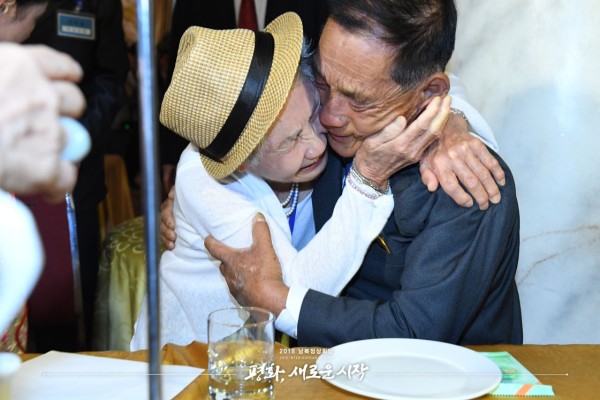
For example, Sanghyuk Shin and his mother Jungran immigrated to Los Angeles in 1980. In 2007, they had a rare opportunity to visit North Korea to reunite with their family. After a beautiful evening of singing, dancing, and reminiscing together, Sanghyuk was able to see his relatives as real people rather than a “vague concept of poor, starving” masses the way Western media often portrays them. Sadly, Jungran recalled feeling “empty” due to the brevity of the encounter. She described it as part of a “series of miseries” of not knowing when she would be allowed to see her family members again.
This kind of cruel and arbitrary family separation still haunts Korean Americans today. The separation is not a force of nature, but the direct result of deliberate, draconian U.S. policies, which ban any travel by U.S. citizens to North Korea–even for those longing to see their family members one last time. These policies do nothing to enhance American security, while needlessly adding to the pain of long-suffering Korean American families who cannot communicate, much less reunite, with their family members in the North.
Enough is enough. 71 years after the Korean War armistice, we must bring the tragedy of family separation to an end. This is why, as a constituent, I am urging Congresswoman Katie Porter to once again back H.R. 1369, the Peace on the Korean Peninsula Act (PKPA), which she co-sponsored in the last Congress. The PKPA would require the Secretary of State to set a concrete agenda for peace and report to Congress on qualifying criteria for travel to North Korea, particularly for the purpose of family reunification.
I know I speak on behalf of not only myself, but also for thousands of Korean Americans in our district and statewide when I say that our continued support of Congresswoman Porter, in her current position as well as for her Senate bid, depends on whether or not she supports this legislation. In 2020, Porter stated, “It’s past time to formally end the Korean War and to see these families reunited.” In 2023, it’s way past time.
When my grandmother passed away over twenty years ago, she spent her last breaths lamenting that she never got to see Korea reunited in her lifetime. I sincerely hope I can depend on Congresswoman Porter to help make it a possibility in my lifetime two generations later.
Comments

Powered by RoundtableAn AI/DeFi-powered Enterprise Media Operating System. Learn more at Roundtable.io.© Roundtable 2026. By using this site you agree to the Terms of Use and Privacy Policy