
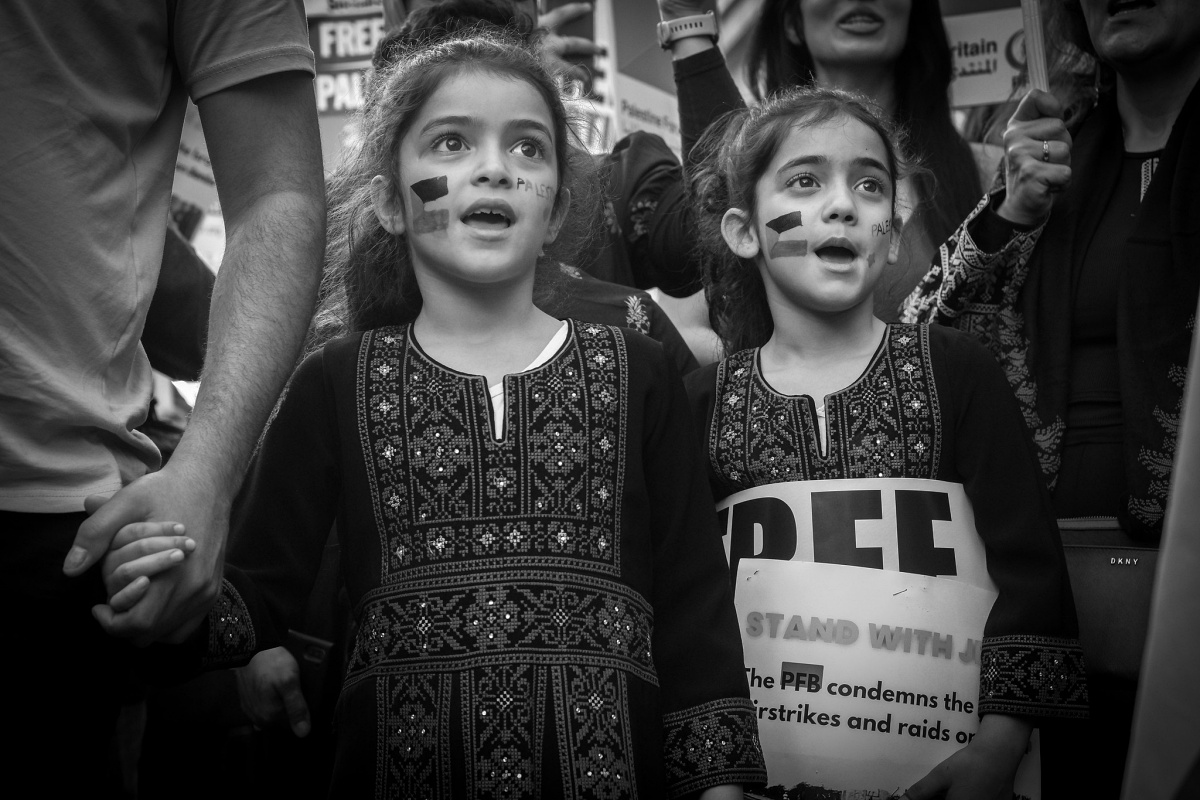
Alisdare Hickson • Attribution-ShareAlike (CC BY-SA 2.0) • Flickr


Sep 3, 2024 4:05 PM
A distinction must be made between criticism of Israel's policies, and attacks on Jews as Jews. The former is legitimate; the latter is not.
Originally published The Bookpress, Ithaca, New York, October 2003
At the close of the Second World War, Americans who were revolted by the Holocaust in Europe supported efforts to establish a Jewish homeland in what was then Palestine. We aligned ourselves with the Jewish struggle; we cheered Paul Newman and Sal Mineo in Exodus; and admired Jewish settlers who developed a barren desert land into a prosperous and advanced democracy. Rarely if ever were the Palestinians presented; when they were, it was as "terrorists.”
Language has helped to shape our understanding of the Israeli-Palestinian struggle, e.g., the appropriation of the term “anti-Semitism" to apply solely to attacks on Jews. Since Palestinians are also Semites, can one be an anti-Semite for supporting them rather than Jews? The use of this term can discourage criticism of Israel under the guise of confronting anti-Jewish attacks; it can divert attention from Israel's colonial actions, thus avoiding an analysis of its founding and subsequent history. A distinction must be made between criticism of Israel's policies, and attacks on Jews as Jews. The former is legitimate; the latter is not.
When one compares the powerful dissent within Israel exemplified by Yehudith Harel's powerful “Israel's Hope” in the last issue of The Bookpress, with the uncritical proIsrael view of the U.S. government and corporate media, the distinction is clear. Despite the fact that Palestinians face the “longest official military occupation of modern history – currently entering its [thirty-sixth] year" (Perry Anderson, "Scurrying Towards Bethlehem," New Left Review (JulyAugust 2001, p. 5), the Bush Administration and Congress remain tied to support of Israel, and dissent within the United States against the Israeli occupation represents "the last taboo" (Edward Said, 'America's Last Taboo', New Left Review, November-December 2000, 45-53).
Related stories
I wish to examine one central aspect of the Israeli-Palestinian conflict: the selective use of "terrorism” as a term of political denouncement. The dominant view is quite simple: Palestinians are terrorists; Israelis are not. There is no effort by those who hold this view, however, to describe terrorism concretely. A Palestinian who kills himself as well as Jewish students on a crowded bus is a terrorist, but what about an Israeli pilot flying an F-16 who bombs Palestinian schools and villages? The term "terrorism" needs to be examined critically in order to understand its ideological use in the U.S. We can begin with the writings of Noam Chomsky, "arguably the most important intellectual alive" in the words of a New York Times reviewer. Chomsky's insights on society and foreign policy are always well documented and powerful. His essential work on the conflict under consideration in this essay is The Fateful Triangle: The United States, Israel, and the Palestinians.
Chomsky agrees with the definition of terrorism found in official U.S. documents: it is "the calculated use of violence or threat of violence to attain goals that are political, religious, or ideological in nature. This is done through intimidation, coercion, or instilling fear" (9-11, p. 9). This definition is certainly concrete enough to condemn Israeli terror against Palestinians. Israel is a U.S. ally and by definition incapable of engaging in terrorism, however, just as the U.S. could not have engaged in terrorism against Nicaragua in the 1980s by funding the Contras who murdered and raped thousands of people in that Central American nation.
The U.N. condemned the U.S.-sponsored Contra war and the World Court ruled in favor of Nicaragua. The Reagan Administration ignored this legally binding verdict and Congress rewarded the Contras with increased aid. As a result of its war against Nicaragua, "the U.S. is the only country that was condemned for international terrorism by the World Court and that rejected a Security Council resolution calling on states to observe international law" (p. 44). The U.N. General Assembly also passed a similar resolution overwhelmingly in December 1987, with the U.S. and Israel opposing it (p. 73). The double standard on international terrorism must be confronted, Chomsky argues, by a faithful and serious application of the "same standards" that we use to condemn others, "to ourselves, always" (p. 47).
The late Eqbal Ahmad taught at Cornell in the 1960s, and later for many years at Hampshire College in Massachusetts. He pointed out that, "until the 1930s and early 1940s, the Jewish underground in Palestine was described as terrorist"; there was even a reward offered for the terrorist Menachim Begin (Eqbal Ahmad, Terrorism: Theirs and Ours, p. 11). To illustrate Ahmad's thesis on the shifting historical views of terrorism and terrorists, Begin later became the Prime Minister of Israel, and Yasir Arafat of the Palestine Liberation Organization (PLO) shared the 1994 Nobel Peace Prize with Shimon Peres and Yitzak Rabin, also Prime Ministers of Israel.
Ahmad asserted that as the news of the Holocaust spread, the perception of Begin and the Jews as terrorists in Palestine changed; they became freedom fighters struggling for a homeland. Subsequently, these Jewish terrorists were replaced by the "PLO terrorists” (p. 11). We were not informed about these dramatic shifts by our teachers and the mass media, and never knew that Begin and other Jewish leaders were formerly considered terrorists. Lacking historical context, therefore, we could not think critically about the Middle East and did not understand that, as Ahmad argues, "terrorists change. The terrorist of yesterday is now the hero of today, and the hero of yesterday becomes the terrorist of today. In a constantly changing world of images, we have to keep our heads straight to know what terrorism is and what it is not. Even more importantly, we need to know what causes terrorism and how to stop it.” (pp. 12-13).
A fundamental characteristic of terrorism, according to Ahmad, is the principle of selectivity. "We are to denounce the terror of those groups which are officially disapproved. But we are to applaud the terror of those groups of whom officials do approve. Hence, President Reagan's statement, ‘I am a contra.’ We know that the contras of Nicaragua were by any definition terrorists, but the media heed the official view” (p. 15). This selective application means that support is reserved for Israel even though by any rational definition it engages in state terror against Palestinians, while the latter are bitterly condemned by the mass media. We also need to confront the fact that "the dominant approach also excludes from consideration the terrorism of friendly governments. Thus, the United States excused, among others, the terrorism of Pinochet [and] Zia-ul-Haq, the military dictator of Pakistan.... The ratio of people killed by the state terror of Zia-ul-Haq, Pinochet, Argentinian, Brazilian, Indonesian type, versus the killing of the PLO is literally, conservatively, 1,000 to 1" (pp. 15-16).
Ahmad's prescription concerning terrorism is straightforward and simple: "First, avoid extremes of double standards.... Don't condone Israeli terror, Pakistani terror, Nicaraguan terror, El Salvadoran terror, and then complain about Afghan ... or Palestinian terror.... Do not condone the terror of your allies. Condemn them” (pp. 24).
Historian and activist Michael Parenti also lays bare the profound hypocrisy involving political terrorism. He points out a fundamental truth that many here steadfastly refuse to acknowledge—despite the overwhelming evidence: "US leaders have been the greatest purveyors of terrorism throughout the world. In past decades they or their surrogate mercenary forces have unleashed terror bombing campaigns against unarmed civilian populations ... causing death and destruction to millions of innocents" (The Terrorism Trap, 7). Political officials and the corporate media have not acknowledged these "pernicious acts of terrorism that go unexamined. No critical discussion is offered regarding who really benefits from such ventures and who is harmed” (p. 18). The absence of such a critical debate on U.S. or Israeli terrorism undermines the democratic process: "With these key issues systematically suppressed ... a void is created in our national discourse." Therefore, citizens do not "treat the central imperatives of public policy in any meaningful or revealing way, a democracy devoid of democratic debate that might challenge the ideology and practices of its leadership" (p. 20).
Edward Said has severely criticized Israel's policies—as well as those of Arafat, the PLO, and Arab governments. He argues that, "there is nothing in Palestinian history, absolutely nothing at all to rival the record of Zionist terror against Arabs.... Moreover, the history ... of Israeli oppression of Palestinians, of state-sanctioned torture, or international lawlessness (refusal to abide by U.N. resolutions, ... unwillingness to sign the nuclear nonproliferation treaty) ... all this makes Palestinian terror a very pale and incompetent thing” (The Question of Palestine, p. 172). For example, Israel is the only nuclear power in the Middle East and has never allowed international inspection, yet commentators and political officials continue to condemn Iraq for its refusal to allow such a process. The double standard for Iraq and Israel is clear, and many people abroad see through this hypocrisy. But most U.S. citizens continue to believe Washington's propaganda that's regurgitated by a compliant mass media.
Evidence of Israel's state terrorism has been documented by Israeli human rights organizations and journalists. However, this information is not the concern of the corporate mass media or "outspoken liberals" who always comment on other abuses. “Any self-respecting intellectual is willing … to say something about human rights abuses ... in Argentina, Chile and South Africa [pick any three today], yet when irrefutable evidence of Israeli preventive detention, torture, population transfer, and deportation of Palestinian Arabs is presented, literally nothing is said" (p. 113).
Israeli abuses that would be assailed if done by Cuba, Iraq, or Iran do not arouse the slightest indignation. The Palestinians' colonized treatment by Israel is itself a form of state terrorism, first noted by the U.N. in 1969 when the General Assembly expressed grave concern "that the denial of [Palestinian rights] has been aggravated by the reported acts of collective punishment, arbitrary detentions, curfews, destruction of houses and property, deportation, and other repressive acts against the refugees and other inhabitants of the occupied territories" (Quoted in Said, p 7). Countless U.N. resolutions have condemned Israel for its abuses; the U.S. has opposed nearly all of them.
Israel's terrorism has not stopped at its borders. Over the past 40 years it has allied itself with extremely brutal regimes; for example, it developed ties with racist South Africa, helping that government to explode its first nuclear weapon and maintain its Apartheid order. In World Orders Old And New, Chomsky summarized the horrendous Israeli record around the world. In the 1960s, with CIA financial support, Israel helped to "establish and maintain the rule of Mobutu in Zaire [and] Idi Amin in Uganda...." It also served the U.S. by "sending ... [jets] to Indonesia in the course of its murderous aggression in East Timor, when the Carter administration was blocked by Congress from doing so directly." But Israel's greatest assistance to U.S. terrorism "came in Central and South America, where it maintained close contacts with the neo-Nazi regimes of the southern cone, undeterred by the virulent anti-Semitism of the ruling generals. It supported Somoza until virtually the last days of his bloody rule.... [It] ... lent valued support to the terrorist rulers of El Salvador in the 1970s, until the United States took over the task of organizing the massacre directly” (p. 205).
Israel's "finest hour" occurred in Guatemala, where its assistance was instrumental in near-genocidal slaughters and repression at a time when the U.S. government was inhibited by popular pressures ... from direct participation. Israel also joined other clients in the training and support of the [Contra] terrorist forces attacking Nicaragua" (p. 205). Just as Israel's terrorism against the Palestinians has elicited strong dissent within that country, "many Israelis find this relationship [its surrogate role assisting U.S. terrorism] both dangerous and degrading” (p. 206). Who can justify the Nazl-like terror In support of the regimes cited above? Israel's terrorism against El Salvador, Guatemala, and Nicaragua is an example of the selectivity and double standard discussed above—all done with U.S. approval and utterly lacking criticism from the corporate mass media.
Said argues that the double standard on terrorism and demeaning generalizations about Palestinians and Islam are part of a classic propaganda effort to avert our gaze from "what it is that Israel and the United States have been doing. Between them, the two countries have bombed and invaded several Islamic countries ... they have (in Israel's case) occupied Arab-Islamic territory in four countries.... Defying international law and dozens of United Nations Resolutions, Israel has annexed East Jerusalem and Golan Heights, has occupied South Lebanon [and] has had a policy of treating (and characterizing) Palestinians as sub-human in effect a race apart...." (Covering Islam: How The Media And The Experts Determine How We See The Rest Of The World, pp. xx-xxi). This history of terrorism, never defined as such, has been conveyed uncritically in the mass media as Americans have acquiesced to the dominant view of the Middle East conflict—a classic historical example of ideological hegemony.
To state that Israeli/U.S. policies are terrorist and have oppressed Palestinians does not mean that Said and others cited have ignored the tyrannical regimes in the Middle East and Asia. Said, for example, has courageously and consistently condemned these governments, arguing that there is no doubt that "in many ... Islamic societies [we find] repression, the abrogation of personal freedoms, unrepresentative and often minority regimes" (p. lvi). He reminds us, however, that these undemocratic regimes in the region, e.g., Saudi Arabia, Afghanistan, Egypt, Iran, Iraq, Kuwait, and Syria, have all been supported at one time or another by Washington in order to maintain the wealth and power of dominant elites there and U.S. multinational corporations. Anti-communism has also been a crucial element in U.S. support of such regimes, all of which is aimed to prevent genuine democracy and nationalist change that would challenge U.S. hegemony in the region.
Terrorism is an inherent part of the war in Israel/Palestine, conducted overwhelmingly and with far greater destruction by Israel. Despite this reality, however, Palestinian resistance has not ended and it is not going away; neither are Jews. Those who see clearly the makeup of a real political solution include many Israelis who courageously dissent from their government's policies and understand that Palestinians too must have a national homeland. But that possibility will be shaped in part by whether U.S. citizens and Jews everywhere are willing to confront a stark historical truth: "... mostly-European Jews came to Palestine, a country already inhabited and settled by another people, destroyed their society, dispossessed them, and drove two-thirds of them out...." (p. xxiv). Few in the U.S. seem willing to confront such a truth, however, as most have uncritically supported Israel's policies. Said argues that this is understandable once we realize that in the U.S., the "Middle East is a domestic, not a foreign, policy issue ... and subject to dynamics within the society that are difficult to predict” (Al Ahram, June 13-19, 2002, p. 1).
Eqbal Ahmad commented on a profound contradiction at the heart of the Israeli-Palestinian conflict: "[Israel] ... was founded as a symbol of the suffering of humanity ... at the expense of another people who were innocent of guilt. It's this contradiction that you have to bring out. And you don't bring it out by armed struggle. In fact, you suppress this contradiction by armed struggle" (Confronting Empire, p. 29). He condemned Palestinian attacks on Israeli civilians as wrong politically and in principle, and remained until his death opposed to every form of terrorism. This contradiction was also a concern of Primo Levi, the Italian Jewish writer and Auschwitz survivor. In 1982, he stated that "Everybody is somebody's Jew [and] today the Palestinians are the Jews of the Israelis." Levi condemned the Israeli occupation of southern Lebanon and the massacres of Palestinian refugees at Sabra and Shatila, calling for the resignation of Begin, then Prime Minister of Israel, and Ariel Sharon, its defense minister. He was bitterly criticized for this view (Joan Acocella, "A Hard Case: The Life and Death of Primo Levi,” The New Yorker, June 17-24, 2002, p. 167).
This profound contradiction was also discussed by the Jewish Marxist theorist and writer Issac Deutscher, shortly after the Six-Day War in June 1967. Deutscher, who lost family members to the Holocaust and had relatives then living in Israel, argued that the "responsibility for the tragedy of European Jews, for Auschwitz, Majdanek ... rests entirely on our Western bourgeois ‘civilization'…. Yet it was the Arabs [i.e., the Palestinians] who were made to pay the price for the crimes the West committed towards the Jews” (Quoted in Tariq Ali, The Clash of Fundamentalisms, p. 322).
Security for war criminal Netanyahu was more extensive than what was provided for 32 heads of state for the recent NATO anniversary in D.C. More Videos
Said, like Ahmad, has also been highly critical of the PLO and its leader, Yasir Arafat, on the issue of terrorism: "If there is one thing along with Arafaf’s ruinous regime that has done us more harm as a cause it is this calamitous policy of killing Israeli civilians, which further proves to the world that we are indeed terrorists and an immoral movement. For what gain no one has been able to say" (Al Ahram, p. 1). Compared to Ahmad's and Said's condemnation of terrorism, what can be said about the U.S. government, the mass media, and leading American intellectuals? Such a concern is not merely a debating point in an academic discussion of this tragic conflict. As the historian Howard Zinn has written: "We can reasonably conclude that how we think is not just mildly interesting, not just a subject for intellectual debate, but a matter of life and death" (Declarations of Independence: Cross-Examining American Ideology, pp. 1-2).
Will leaders and citizens here reexamine assumptions about terrorism and the entire Israeli-Palestinian struggle, to consider the possibility that we share responsibility for this ongoing tragedy because of our uncritical acceptance of dominant-elite and mass media views? It is our government’s material support that allows Israel to continue its occupation, as it "remains a state still ultimately dependent for its defense and prosperity on the United States.... If American support were ever withdrawn from Zionism, its intransigence would swiftly erode [and] the fate of the Palestinians would instantly alter" (Perry Anderson, "Scurrying Towards Bethlehem," p. 29).
The Palestinians deserve our principled support in their struggle to end the illegal occupation and to alter their fate. We owe them a democratic and anti-imperialist U.S. foreign policy that will help bring an end to this historic conflict.
Comments

Powered by RoundtableAn AI/DeFi-powered Enterprise Media Operating System. Learn more at Roundtable.io.© Roundtable 2026. By using this site you agree to the Terms of Use and Privacy Policy