


Mar 2, 2026 5:18 PM
The current situation facing the Iranian people can best be understood as a society caught within what scholars often describe as a “dual violence structure.”
“If it were proved to me that in making war, my ideal had a chance of being realized, I would still say ‘No’ to war. For one does not create human society on mounds of corpses.” Louis Lecoin
On what seemed like another Saturday morning in Iran—when people were at work, students were in school, and daily life was unfolding —the country was suddenly thrust into yet another crisis. A massive military strike, followed by an address from President Trump announcing major combat operations, ignited a full-scale confrontation involving Iran, Israel, and the United States.
In the midst of uprising of Iranian people and just one day after the historic January 2026 massacre carried out by the Islamic Republic of Iran, President Trump declared that “help is on its way” to the Iranian people, framing the large-scale military attack as the fulfillment of his promise. A series of diplomatic talks facilitated by Oman had preceded these events, ultimately culminating on February 28 in the resort to military force rather than diplomacy.
The massive strike took place just two days after the third round of talks mediated by Oman’s foreign minister. Some analysts had described these negotiations over the past year as “unconventional,” reflecting both their informal structure and the fragile diplomatic moment in which they unfolded and called “diplomacy without diplomats” Referring to Steve Witkoff and Jared Kushner to conduct high-stakes and sensitive negotiations with Iran.
Related stories
The current situation facing the Iranian people can best be understood as a society caught within what scholars often describe as a “dual violence structure.” On one side lies internal authoritarian violence — executions, imprisonment, systemic gender discrimination, the brutal suppression of protests, and the steady suffocation of civil society. On the other side are mounting external pressures and threats — crippling sanctions, escalating geopolitical confrontation, and now the devastating realities of an all-out war.
The Crimson Winter: A 50 Day Record of Iran’s 2025–2026 Nationwide Protests published in 2026, documents the atrocities of the latest bloody uprising of the Iranian people. The report records a staggering human toll: 6,488 protesters killed, along with 236 children killed — counted separately and not included among the protesters — while an additional 11,744 cases remain under review and are therefore not reflected in these confirmed figures. It also documents 25,846 injured civilians, 53,777 total arrests, including 555 children, teenagers, and school students, and 369 verified cases of forced confessions. As Iranian society continues to mourn these profound losses, the launch of the United States’ “Operation Epic Fury” and Israel’s “Operation Lion’s Roar” further escalated an already catastrophic situation for the Iranian people.
The threat of war — looming on and off since the presidency of George H. W. Bush — ultimately materialized without authorization from Senate under President Donald Trump, making him the first U.S. president to directly escalate military confrontation with Iran since the establishment of the Islamic Republic in 1979. A twelve-day conflict unfolded, initially triggered by Israeli strikes and soon joined by U.S. forces. The attack to Iran marked an unprecedented level of U.S.–Israeli military coordination in the region, culminating in the largest American military buildup in the Middle East since the 2003 invasion of Iraq.
According to U.S. Central Command and other defense sources, the coalition deployed aircraft, cruise missiles, and precision munitions aimed at degrading Iran’s military capabilities. On the first day of strikes , Iran’s Supreme Leader, Ali Khamenei, along with several senior figures — including the defense minister and the commander-in-chief of the Islamic Revolutionary Guard Corps (IRGC) — were reportedly killed, along with members of his immediate family, including his daughter, son-in-law, and grandson. Reports indicate that the United States provided intelligence on Khamenei’s movements, while Israeli fighter jets carried out the precision strike.
The massive strike also took the life of a number civilian- as of March 2nd, 550 people including children. The devastating explosion struck the Shajarah Tayyebeh girls’ elementary girl school in the southern city of Minab resulting in one of the deadliest single incidents involving children in the recent escalation. Reports indicate that an attack has resulted in the deaths of over 100, students while they were in class.
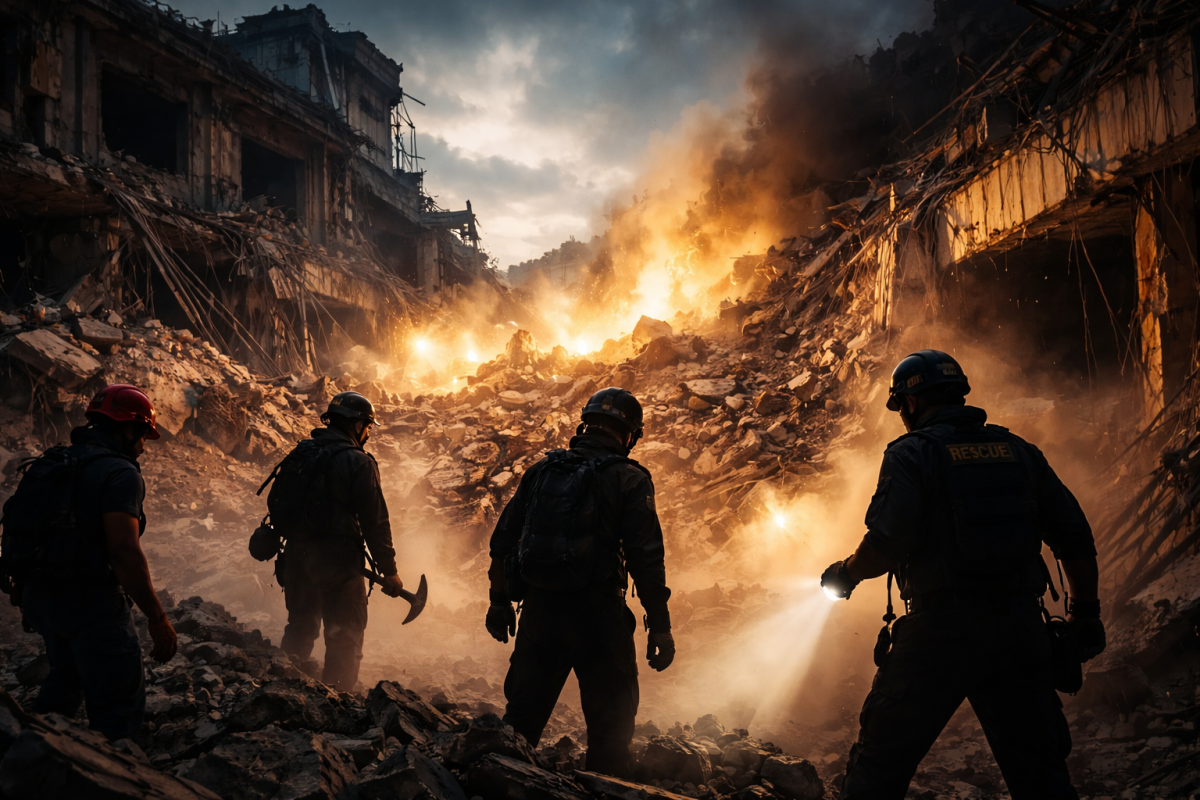
Verified videos and images from the scene showed the two-story school building reduced to rubble, with emergency workers digging through debris in search of survivors. While Iranian authorities attributed the strike to the United States and Israel, other unverified reports raised the possibility that the explosion may have resulted from a misfired Iranian missile, underscoring the conflicting narratives surrounding the tragedy. The killing of pupils in a place dedicated to learning constitutes a grave violation of the protection afforded to schools under international humanitarian law.
The massive strike also claimed the lives of numerous civilians, including children. One of the most devastating explosions struck the Shajarah Tayyebeh Girls’ elementary girl school in the southern city of Minab, resulting in one of the deadliest single incidents involving children during the recent escalation. Reports indicate that more than 100 students were killed while attending class. Verified videos and images from the scene showed the two-story school building reduced to rubble, with emergency workers searching frantically through the debris for survivors. While Iranian authorities attributed the strike to the United States and Israel, other unverified reports suggested the possibility that the explosion may have resulted from a misfired Iranian missile, underscoring the deeply contested and conflicting narratives surrounding the tragedy. The killing of students in a place dedicated to learning constitutes a grave violation of the protections afforded to schools under international humanitarian law.
The killing of Ali Khamenei, the Supreme Leader of Iran, and the reactions that followed revealed the profound depth and complexity of political polarization within Iranian society and in diaspora. On the second day after the strike, crowds of mourners gathered in Tehran and other cities, publicly grieving his death, while the government announced a 40-day national mourning period accompanied by several public holidays. At the same time, news of his death brought visible relief — even painful smiles — to tens of thousands of people, including families who had lost loved ones under his decades of authoritarian rule. Many inside Iran and across the diaspora expressed a more conflicted response: while acknowledging the suffering associated with his leadership, they believed he should have remained alive to be held accountable for the crimes committed during his years in power — judged by the people of Iran themselves, rather than through the intervention of foreign military force.
Ali Khamenei became the Supreme Leader of the Islamic Republic of Iran in 1989, at the end of a decade marked not only by the Iran–Iraq War but also by severe internal repression. Among the darkest episodes were the mass executions of thousands of political prisoners in 1988, later documented by Amnesty International in its report “Blood-Soaked Secrets.” Decades of human rights violations and repeated crackdowns on peaceful protests over the following 36 years have continued to cast a long shadow over the legitimacy and human rights record of the Islamic Republic.
Ali Khamenei stood at the apex of Iran’s political power structure for more than three decades. As Supreme Leader, he exercised ultimate authority over the country’s political, military, judicial, and key economic institutions, shaping both domestic governance and foreign policy. While many of the Islamic Republic’s foundational political, military, and ideological structures were established under Ayatollah Khomeini after 1979, Khamenei significantly consolidated and expanded them. Under his leadership, the Islamic Revolutionary Guard Corps (IRGC) evolved into the most powerful military and economic force in the country, extending its influence far beyond defense into major sectors of Iran’s economy and into regional proxy networks.
Alongside widespread human rights abuses, corruption, and profound economic mismanagement, economic inequality and class divisions widened dramatically. This became especially evident during the expansion of U.S. sanctions, as Iran’s ruling circle — which grew increasingly tight and insulated under Khamenei’s leadership — consolidated its grip on both political and economic power. The burden of economic pressure was shifted onto the working and middle classes. Inflation, currency collapse, and unemployment devastated ordinary families, while financial and commercial institutions linked to the IRGC continued selling oil through informal networks and sanctions-evasion channels, strengthening their dominance and helping shape Iran’s powerful oligarchic system.
This oligarchy consists of a close-knit network of religious authorities, senior IRGC commanders, and politically connected elites who control vast, opaque economic foundations (bonyads) and major state industries. The system — often described as a kleptocracy — has enabled these elites and their children, commonly referred to as aghazadehs, to accumulate immense wealth through corruption, monopolistic control, and sanctions evasion, even as millions of Iranians face deepening poverty and economic insecurity. As journalist Victoria Bekiempis wrote in The Guardian on January 23, 2025, “in Iran, the oligarchy is formed by religious leaders.”
As many observers have long noted, “whatever happens in Iran does not stay in Iran.” As expected, Iran launched widespread retaliatory strikes against military and associated targets across the region. Iranian missile and drone barrages targeted Israel as well as countries hosting U.S. military forces and allied assets, including Qatar’s Al Udeid Air Base, Kuwait’s Ali Al Salem Air Base, Al Dhafra Air Base in the United Arab Emirates, and the U.S. Fifth Fleet headquarters in Bahrain. These attacks formed part of Tehran’s declared counteroffensive following the initial strikes by U.S. and Israeli forces.
The retaliatory launches crossed the airspace of several Gulf states and triggered extensive air defense responses. Although many incoming missiles and drones were intercepted, reports indicated civilian casualties and infrastructure damage across parts of the region, including deaths and injuries in the UAE, Kuwait, and other states. Multiple national airspaces were temporarily closed, underscoring the wider regional consequences of the conflict. The escalation continues to carry significant — and potentially unintended — implications for regional stability, global energy markets, and civilian safety.
The death of a dictator does not mean the end of dictatorship, nor does it automatically signal the end of the Islamic Republic. Iran’s political system is layered and institutionalized, and the regime struggles to remain in place — weakened and facing a profound crisis of legitimacy, while confronting both internal opposition by people of Iran and external pressure from the United States, Israel and to some EU countries. In response, Iranian authorities quickly established a temporary leadership structure, naming Ayatollah Alireza Arafi as a key interim figure overseeing the transition. A three-person governing council was formed, consisting of Arafi, President Masoud Pezeshkian, and Chief Justice Gholamhossein Mohseni Ejei.
Other figures, including Mojtaba Khamenei, the late leader’s son, have also been mentioned in succession discussions. Ultimately, the Assembly of Experts retains the constitutional authority to select the next Supreme Leader — a decision that will shape not only Iran’s internal trajectory but also the future balance of power across the region.
The escalation of the current war across the region is deeply alarming. The Islamic Republic of Iran neither represents nor enjoys the genuine support of the Iranian people, nor does it command broad backing among countries in the region. Iran is not Syria or Venezuela, and this costly war — one that will be borne by the Iranian people, the American people, and communities across the region — has unfolded amid profound legal, political, and humanitarian concerns. The expansion of military confrontation, including attacks that have endangered civilian lives and the prospect of further coordinated escalation, carries consequences that remain dangerously unpredictable.
At this historic and painful moment, we must stand with the people of Iran — not only in words, but in unwavering solidarity with their struggle for human rights, freedom, and justice. Let the global community stand beside them in their grief, in their courage, and in their enduring hope for a future where life, dignity, and peace are valued above all else.
Comments

Powered by RoundtableAn AI/DeFi-powered Enterprise Media Operating System. Learn more at Roundtable.io.© Roundtable 2026. By using this site you agree to the Terms of Use and Privacy Policy