


May 9, 2018 4:32 PM
Updated Feb 10, 2022 10:13 PM
John Peeler: Naturally, if Iran resumes nuclear weapon development because of Trump’s withdrawal, he will blame the other parties for failing to rally around his flag.
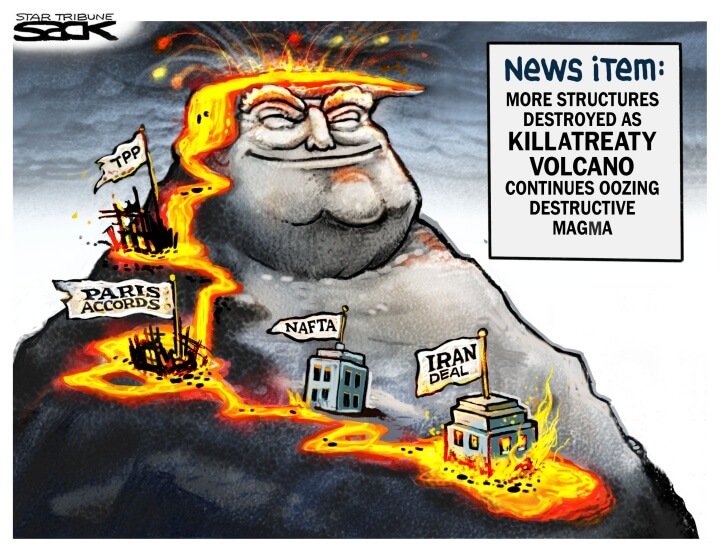
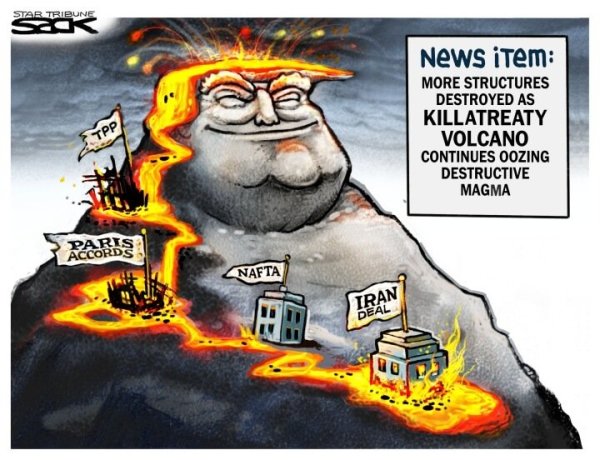
President Trump announced yesterday that he is withdrawing the United States from the multilateral agreement to block Iran from developing nuclear weapons. He has claimed since the campaign that it is a terrible agreement, full of holes, and that he can negotiate a better one. How can he expect to do that?
His first premise is that a united international community, by reimposing sanctions, can force Iran to make more concessions. But he has been working since his election to marshal that international unity and he has made exactly no progress. In fact, all other parties to the agreement (Iran, Britain, France, Germany, Russia, China, and the European Union) have now reaffirmed their intent to stay in. The Iranian government has agreed to negotiate with the remaining parties the terms of a continuing agreement without the United States. So Trump will be completely isolated in his effort to get a better deal from Iran.
A go-it-alone, America-first style does not easily fit with a policy that assumes international unity.
Naturally, if Iran resumes nuclear weapon development because of Trump’s withdrawal, he will blame the other parties for failing to rally around his flag.
But naturally, if Iran resumes nuclear weapon development because of Trump’s withdrawal, he will blame the other parties for failing to rally around his flag. And if, somehow, the other parties negotiate an even better agreement, Trump will claim credit for it, since his tough stance will have pushed Iran into concessions. He will not take personal blame, but he will take personal credit.
Related stories
Suppose the agreement ultimately founders. There are several consequences, all of them bad. Obviously, the Iranians would immediately resume work on developing nuclear weapons and the requisite delivery systems such as ballistic missiles. The balance of power within the Iranian regime would shift decisively to the hard-liners who have never liked the agreement. These are the same people who have aggressively pushed Iran’s interests around the Middle East, including especially in Iraq, Syria, Lebanon and Yemen. They see Iran (the main Shi’a Muslim power) as fighting a long-term war with conservative Sunnis in Saudi Arabia and the Persian Gulf. They will now have even more freedom of action, making more trouble for the conservative Sunnis—and the United States.
The right-wing Netanyahu government of Israel has a tacit alliance with these conservative Sunnis, and Netanyahu has been the foremost advocate of trashing the agreement with Iran. But now that Netanyahu and Trump are on the verge of achieving their objective, it’s not at all clear what they can do next. While Trump is still attracted to the idea of getting out of the Middle East (he thinks our post interventions there have been useless), by rejecting the Iran agreement he is playing into the hands of Netanyahu and the Saudis, who desperately want the US to attack Iran militarily.
But such an attack would have little prospect of success. It is highly likely that the Iranians have either hidden or hardened their nuclear facilities, so that an air or missile attack would at best do partial damage, while reinforcing Iranian determination to develop nuclear weapons. An invasion and occupation of this huge and mountainous country would be hideously expensive in both lives and cash, and would require an ongoing occupation that would last for decades and make the US even more of an international pariah than Trump has already made it.
Oddly, the agreement that Trump has talked about negotiating with North Korea would look a lot like the one he is trashing. The difference, of course, is that the Iranian agreement was negotiated by President Obama, and it is Trump’s obsession to demolish everything Obama did. If Trump succeeds in striking an agreement with North Korea, even if it were identical to the Iran deal, he would say it’s infinitely better, because he negotiated it.
But why would Kim Jong Un of North Korea even consider striking an agreement with an American President who has shown so little regard for the Iranian agreement? If Trump can get a deal with North Korea, it will be worse than the deal he’s just torn up.

Our “America First” president has just made war more likely in both the Middle East and the Far East.
John Peeler
Comments

Powered by RoundtableAn AI/DeFi-powered Enterprise Media Operating System. Learn more at Roundtable.io.© Roundtable 2026. By using this site you agree to the Terms of Use and Privacy Policy