
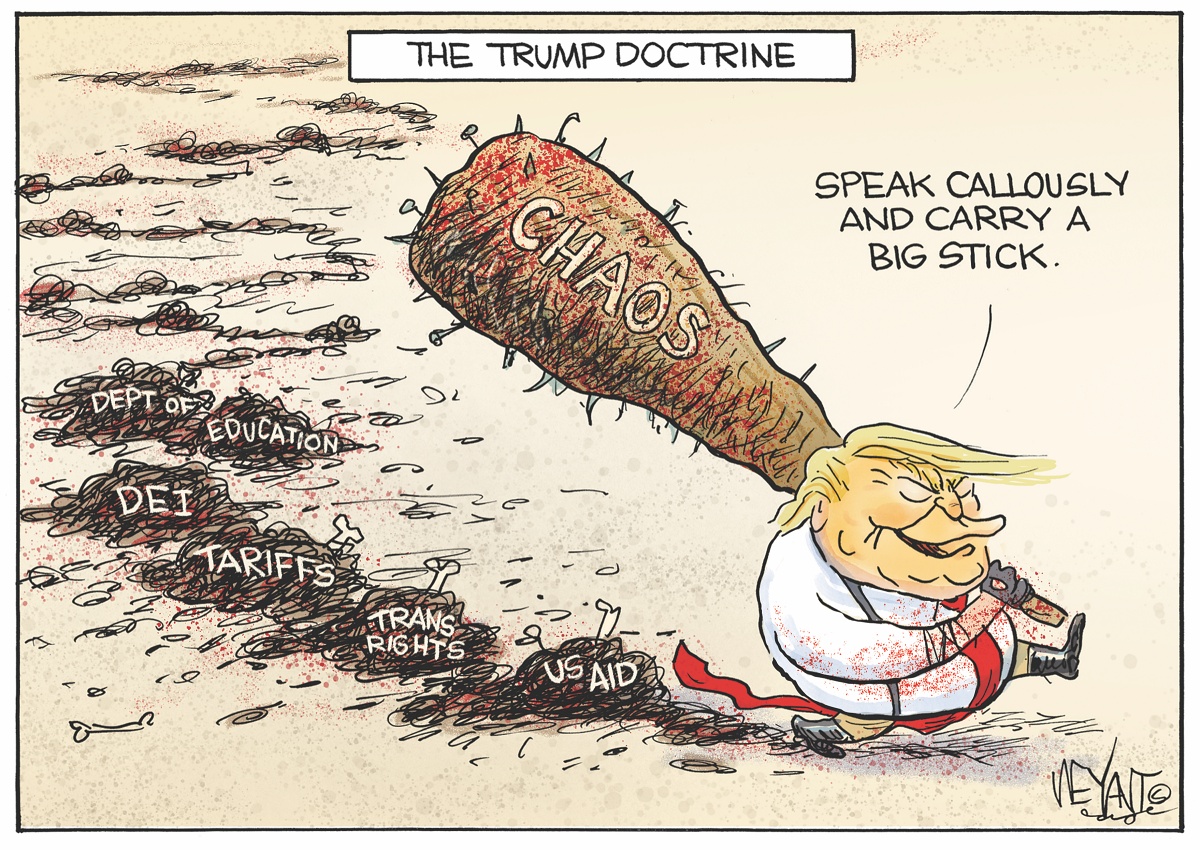


Grand Illusion
Feb 12, 2025 8:26 PM
Peter McLaren: Trump’s Desperate Search for His Legacy in the Rubble of Gaza
In the great American spectacle, Donald Trump steps once again onto the center stage, his voice rising above the din like a carnival barker beckoning the restless crowd. This time, he has conjured a vision so audacious, so steeped in the mirage of his own self-styled omnipotence, that it strains the very fabric of reality. Trump announced that he would consider relocating American criminals (who were American citizens) to El Salvador’s infamous Terrorism Confinement Center at the invitation of President Nayib Bukele. Secondly, he announced that the Gaza Strip should be handed over to the United States by Israel, as though nations were poker chips in one of his gilded casinos. And the Palestinians? Well, they would be resettled in "safer, more beautiful communities," their exile repackaged as a gift, their displacement reframed as liberation. In the same breath, he makes a peculiar association—mocking Senate Minority Leader Chuck Schumer, a Jewish statesman, as one of these hypothetical resettled Palestinians, as if history had not already played out its darkest ironies in forced removals and broken homelands: "The Gaza Strip would be turned over to the United States by Israel at the conclusion of fighting… The Palestinians, people like Chuck Schumer, would have already been resettled in far safer and more beautiful communities, with new and modern homes, in the region. They would actually have a chance to be happy, safe, and free."
The clown show began on a stormy Monday on K Street, with Secretary of State Marco Rubio’s announcement unfurling like a banner in a tempest. This was not the stormy Monday immortalized in the haunting strains of “Stormy Monday Blues”—a melody etched into history by T-Bone Walker, whose electric West Coast blues once soared to record-chart glory in 1948 and kindled BB King's own fiery journey. No, on this fateful day, Rubio declared with dramatic flair that El Salvador’s enigmatic sovereign, President Nayib Bukele—the self-styled “world’s coolest dictator”—had swung open the gates of his realm. In a flourish reminiscent of a conjurer revealing a forbidden secret, he unveiled an audacious proposal: to receive those confined within American jails—undocumented wanderers and citizens alike—into the foreboding embrace of El Salvador’s Terrorism Confinement Center, known ominously as CECOT. This colossal fortress, the leviathan of Central America’s penal realm, stands as a dark monument where echoes of unspeakable human rights abuses weave through its corridors like ghostly lamentations, condemned by the vigilant voices of justice. Trump, as one might expect, is less than unfazed by the idea: "We'll have to find that out legally. I'm just saying if we had the legal right to do it, I would do it in a heartbeat…. "I don't know if we do or not, we're looking at that right now."
Trump loves commercial opportunities, and sending American citizens serving time in prison to El Salvador’s notorious prison would save the U.S. money—lots of it. And we know how much Trump loves waterfront properties; he salivates at the thought as much as any of Pavlov’s dogs.
Recently the renegade maestro of deals has unleashed a torrent of drool at a revelation that has gobsmacked the very bedrock of geopolitical ambition. Like a gambler eyeing a scorched casino floor, Donald Trump cast his gaze upon the rubble of Gaza and saw not ruin, but real estate. With the swagger of a man who deals in towers and gilded lobbies, he proposed an audacious vision: to sweep away the broken bodies and the crumbled homes, to defuse unexploded bombs, and to erase centuries of longing and loss, and in their place, erect a glittering playground—a “Riviera of the Middle East,” owned and sculpted by sturdy and resolute American hands.
Related stories
At a podium beside Israel’s Benjamin Netanyahu, Trump declared his intentions with the bravado of an auctioneer seizing a property at bankruptcy’s edge. The land, long soaked in struggle, would be emptied of its people—some 1.8 million souls uprooted from the only earth they have ever known. And then, with the sweep of a developer’s pen, the U.S. would lay claim to Gaza’s future, a bold takeover wrapped in the promise of luxury, of world-class resorts, of a playground paradise built atop the ashes of war.
"The U.S. will take over the Gaza Strip, and we will do a job with it too," he boasted, as if speaking of a neglected skyscraper in need of a good polish. "It’ll be wonderful for the people—Palestinians, Palestinians mostly, we’re talking about.”
Clearly, however, Trump had not given much thought to what such a plan would entail, including one of the most fundamental questions: Would this involve U.S. troops to be stationed in Gaza?
Trump initially said that U.S. troops would be used to secure the Gaza Strip “if it’s necessary.” Afterwards, Trump said that no U.S. troops would be necessary to secure the region. That is because Palestinians, according to Trump, should relocate permanently out of Gaza.
Brett Samuels of The Hill adds further details to Trump’s boast that, in Trump’s words, no U.S. troops would be necessary because the Palestinians “would have already been resettled in far safer and more beautiful communities, with new and modern homes, in the region. They would actually have a chance to be happy, safe, and free.”
“The U.S., working with great development teams from all over the World, would slowly and carefully begin the construction of what would become one of the greatest and most spectacular developments of its kind on Earth,” Trump continued. “No soldiers by the U.S. would be needed! Stability for the region would reign!!!”
Trump’s words captured the ominous undercurrent of his vision—an imperial machine disguised as benevolence, its gears already turning. It suggests that what is framed as a grand redevelopment project is just another chapter in the long history of dispossession, where imperial power reshapes land and lives with scant regard for those who call it home.
But there is little doubt that if his plan were to be accepted, it would mean as much to Trump’s legacy as having his image carved into Mount Rushmore. Well, perhaps not quite as much, if we take seriously the more than 200 health professionals who say that Trump suffers from 'malignant narcissism'.
But beyond the stage, where cameras flashed and soundbites traveled, the winds of history howled. The ceasefire stands on fragile legs, teetering beneath the weight of a mass of negotiations and humanitarian aid efforts. And yet, Trump’s words sent ripples through the delicate diplomacy, unsettling the tenuous peace.
For those Palestinians who still clung to their land, to the idea of home, the vision of a rebranded Gaza was not a dream of renewal, but a specter of exile wrapped in the language of luxury. Many view this plan as reminiscent of the 1948 Nakba, during which approximately 750,000 Palestinians were forcibly displaced from their homes during the establishment of Israel. The plan has been met with swift opposition from various groups, including the United Nations, Palestinian leaders, and Arab countries.
Undaunted, Trump proclaims that the United States will seize the Gaza Strip and transmute it into a sprawling, Trumpian coastal enclave—140 square miles of Trump-reimagined terrain, a waterfront kingdom echoing the bygone vision of Jared Kushner’s Middle Eastern envoy days.
Envision Trump picking through the darkest regions of his brainpan while sitting in a Las Vegas casino with his pal, UFC chieftain, Dana White: “I’m thinking of turning Gaza into the Riviera of the Middle East, maybe building a high-capacity arena there that could host a future championship fight between a Hamas league fighter and an Israeli league fighter.”
This imaginary scenario might not seem as remote from reality as it sounds. Recall when Trump suggested to Dana White that he set up a migrant league of fighters who would fight opponents from the UFC’s regular non-migrant league. It was in the grand halls of the Washington Hilton, beneath the gilded chandeliers of power and piety, that he revealed this latest spectacle—a vision where the weary and the desperate, those who crossed borders in search of mercy, would instead be thrown into cages for sport.
With the relish of an emperor promising bread and circuses, Trump recounted his bold idea to Dana White, the kingpin of the UFC’s brutal ballet. A migrant fighting league—a coliseum where survival was not a right, but a spectacle for the masses. The faithful gathered at the Faith and Freedom Coalition’s “Road to Majority” conference eagerly listened as their ‘Chosen One’ made a mockery of those who had already fled war and hunger.
Oliver O’Connell captures Trump’s plan:
During a section on the migrant crisis at the southern border — remarking on the toughness of some of those who cross the border illegally — Trump told the crowd about his jaw-dropping idea for a new league in the Ultimate Fighting Championship.
“They so tough,” the Republican nominee said of the migrants. “Dana White, did anyone ever hear of Dana? He’s a legend, right? UFC, Ultimate Fighter, Ultimate Fighting. And he has he’s a fantastic man. I said Dana, I have an idea.
“Why don’t you set up a migrant league of fighters and have your regular league of fighters, and then you have the champion of your league — these are the greatest fighters in the world — fight the champion of the migrants.”
“I think that migrant guy might win. That’s how tough they are,” Trump continued. “He didn’t like that idea too much, but actually, not the worst idea I’ve ever had.”
The story was met with laughter and hoots of approval from the crowd at the religious policy conference.
Given Trump’s penchant for cruelty and for mocking the afflicted, any proposal by Trump that involves vulnerable peoples should give us pause. Trump’s vision of Gaza as a gilded paradise, a jewel plucked from the wreckage and polished to outshine Monaco’s splendor, is the fever dream of a man who sees ruin as raw material and exile as an afterthought. It is the fantasy of a king without a conscience, sketching castles atop graves, promising champagne where there is only blood and dust.
If he can’t turn Gaza into a Monaco, then perhaps he might try to recreate a Palestinian version of “The Villages”—that master-planned, age-restricted, census-designated community in Florida where residents like traveling in golf carts, and where, in the year 2025, Trump’s voice resonated with a resounding 68 percent of the voters. With Ron DeSantis’ visage now likened to the mischievous countenance of Mad Magazine’s Alfred E. Newman, and his political star waning, his objection to Trump’s plan can be easily swept aside. Or perhaps Gaza could become the 51st state, cocking a snook at those Canadians (at least three quarters of them) who don’t want to become part of the U.S.
How about Trump resurrecting in Gaza his casino empire from his Atlantic City days, say, beginning with his Trump Plaza and Casino Hotel by the Mediterranean coast? It might sound good to Trump’s most ardent sycophants until they realize how Trump’s casino ventures ended—in massive business failures. According to the Buettner and Bagli of the New York Times,
His audacious personality and opulent properties brought attention — and countless players — to Atlantic City as it sought to overtake Las Vegas as the country’s gambling capital. But a close examination of regulatory reviews, court records and security filings by The New York Times leaves little doubt that Mr. Trump’s casino business was a protracted failure. Though he now says his casinos were overtaken by the same tidal wave that eventually slammed this seaside city’s gambling industry, in reality he was failing in Atlantic City long before Atlantic City itself was failing.
David Edwards reports about a recent meeting in the Oval Office with Jordan’s King Abullah:
During a Tuesday Oval Office meeting with Jordan's King Abdullah, Trump was asked where he would find the money to buy Gaza after vowing the U.S. would own it.
"We're not going to buy anything," Trump replied. "We're going to have it. We're going to keep it, and we're going to make sure that there's going to be peace, and there's not going to be any problem, and nobody's going to question it."
"And we're going to run it very properly, and eventually, we'll have economic development at a very large scale, maybe the largest scale on that site," he continued. "And we'll have lots of good things built there, including hotels and office buildings and housing and other things."
"But it's it's going to be a wonderful thing. It's going to be wonderful for the Middle East."
That revelation is both shocking and deeply revealing of Trump’s worldview—seeing destruction not as a humanitarian crisis but as a real estate opportunity. His remarks about developing hotels, office buildings, and housing on the Gaza Strip lay bare his transactional mindset, where war and devastation are merely pretexts for profit.
This echoes his long-standing approach to foreign policy: treating geopolitics as a business deal, with no regard for history, justice, or human suffering. It’s a grotesque inversion of diplomacy—where land scarred by bombardment becomes a blank slate for capitalist conquest, and where Palestinian lives are reduced to an afterthought in the grand blueprint of speculation and privatization. I wonder what those ‘other things’ Trump referred to during his interview with King Abdullah. Slots anyone? Starburst or Ugga Bugga?
What’s even more chilling is the implication: if Trump were to return to power, such ideas wouldn’t just be idle musings. They could become policy, with U.S. support shifting further toward a vision of Gaza not as a place for Palestinian self-determination, but as prime beachfront real estate for billionaire investors. It’s disaster capitalism in its most brutal form.
This moment should serve as yet another warning—Trump's vision of the world is one where war is just another business venture, and no tragedy is too great to be repackaged as an investment opportunity.
Few would agree that The Donald deserves another opportunity to realize a Trump Plaza Hotel and Casino or—especially one designed as a gilded beacon amid the citruses and olives and the white sand of the beaches—heralding a new era of opulent ascent for a besieged people. If fortune favors him and he pulls off the greatest a foreign policy swindle in history, might we soon embark on another ride down the golden escalator, stepping from a Trump Tower Gaza, aglow beneath the glorious Middle Eastern sun, in an effort to reclaim a third presidential term? Don’t you think God would ordain it? After all, Trump has been compared to the 9th Century BCE Israelite warrior king Jehu by the Messianic Jewish Leader, Jonathan Cahn, at a National Faith Advisory Board meeting last year:
"President Trump, you were born into the world to be a trumpet of God, a vessel of the Lord in the hands of God…. God called you to walk according to the template. He called you according to the template of Jehu, the warrior king. He called Jehu to make his nation great again."
I bet the Palestinians whom Trump evicts from his Gaza fiefdom will appreciate that comparison.
What catastrophe might befall the audacious blueprint of the U.S. taking long-term ownership of the Gaza Strip, after Palestinians are forcibly pushed out of the beleaguered enclave? Imagine a vast sandcastle of imperial ambition, meticulously built upon a foundation of uprooted lives and ancient grievances. Should the U.S. seize ownership of the Gaza Strip—after forcibly displacing its people (otherwise known as ‘ethnic cleansing’)—the inevitable catastrophe might well be a tempest of unbridled fury. The displaced Palestinians, their spirits unbowed by exile, could ignite a tinder box of resistance, their collective anguish swelling into an insurrection that rattles the very pillars of regional stability. And who could blame them since such forced displacement would disregard the rights and sovereignty of the Palestinian people, exacerbating their suffering and potentially leading to further instability in the region.
In this desolate new reality conjured by Trump, Gaza becomes another battleground—a haunting stage where the echoes of ancestral olive groves mix with the cries of shattered lives into a deafening chorus of revolt. International condemnation is already beginning to swirl like a gathering storm, drawing in regional powers and igniting a cascade of geopolitical fallout. The very blueprint of control, conceived as a masterpiece of American audacity, is destined to crumble beneath the weight of its own injustice, leaving behind a legacy of chaos, shattered trust, and a seething land unwilling to yield its ancient right in order to belong to a country ruled by the world’s richest man with a penchant for Nazi salutes, headed by a tin pot emperor in charge of a court of sycophants, and governed out of Mar-a-Lago, a sprawling, 126-room estate in Palm Beach, Florida. It might serve the Palestinians well to exercise caution regarding a man whose humility could be in question when he claims: “I was saved by God to make America great again”.
It would be wrong to underestimate the spirit of the Palestinians, whose destiny Trump intends to exile to the storied lands of Jordan and Egypt, with Saudi Arabia possibly footing the bill—a maneuver as bold as it is foolish. Yet, should Trump’s plan proceed, and these exiles rise up from their transplanted colonies—fighting to reclaim ancestral homes and the sacred olive groves—the swift shadows of U.S. Navy SEALs would descend, with Pete Hegseth as their herald of order (unless, perhaps, he gets detained at a Betty Ford clinic).
But wait, didn’t Trump, in a charged press conference, with Israel’s stalwart Prime Minister Benjamin Netanyahu at his side, declare with theatrical bravado that the Palestinians would “love to leave” Gaza—a proclamation that reverberated like a manic hack-and-slash across a contested canvas of history and ambition? That declaration would be a shock to 72-year-old Fathi Abu al-Saeed, a weary Palestinian sojourner whose every step on the rubble-strewn streets of Khan Younis’s al-Katiba neighborhood is a reluctant dance with memory and despair. Ever since his return from displacement in the coastal ruins of al-Mawasi following the January 19 Gaza ceasefire, his daily ritual—tracing the jagged scars of a fractured home—has been a testament to survival amid the echoes of lost hope. For Fathi, the notion that anyone might "love to leave" this land is as alien as a distant, unfathomable dream. “Carefully stepping over debris left by 15 months of relentless Israeli bombardment, he raises his cane, pointing at a demolished house. “You see that pile of useless rubble?” he says. “That’s more precious than the United States and everything in it”.
Jeremy Bowen highlights some sobering reasons for rejecting Trump’s ludicrous plan for the Gaza Strip:
It will nourish the plans and dreams of ultra-nationalist Jewish extremists who believe all the land between the Mediterranean and the Jordan river, and perhaps beyond, is a God-given Jewish possession.
Their leaders are part of Netanyahu's government and keep him in power - and they're delighted. They want the Gaza war to resume with the longer-term objective of removing the Palestinians and replacing them with Jews.
The finance minister Bezalel Smotrich said Trump had provided the answer to Gaza's future after the 7 October attacks.
His statement said that "whoever committed the most terrible massacre on our land will find himself losing his land forever. Now we will act to finally bury, with God's help, the dangerous idea of a Palestinian state."
Centrist opposition leaders in Israel have been less effusive, perhaps fearing trouble ahead, but have offered a polite welcome to the plan.
Hamas and other Palestinian armed groups may feel the need to answer Trump with some kind of show of force against Israel.
For Palestinians, the conflict with Israel is driven by dispossession and the memory of what they call al-Nakba, "the catastrophe". That was the exodus of Palestinians as Israel won its war for independence in 1948.
As if history itself had conspired to strip consequence from ambition, Trump, with the flourish of a monarch dissolving an inconvenient edict, swept away Biden’s sanctions on Israeli settlers in the West Bank—men who had unleashed fury upon Palestinian homes and families. What should have been sanctuaries of safety are now turned into battlegrounds once again, with silent approval from those who stood to gain from the ruin.
It was a gift by Trump to those who saw no crime in conquest, a gesture of allegiance that spoke louder than any treaty. Such capriciousness by the world’s most powerful man does not inspire trust—it merely signals to the world that power, in the hands of the reckless, is a force unbound by principle. It is an unholy move that suggests to any discerning mind that what Trump envisions as a brave new world for Gazans might in reality be the opposite, not some opulent paradise of gleaming towers, resorts and golf courses but a Tilt-a-Whirl Palatinate of roller coasters, carousels, theme parks, and second-hand amusement attractions courtesy of Coney Island.
But the tightrope Trump walks this time is fraying beneath his feet. The same Arab-American voices that once championed his presidency have recoiled at his decree. Bishara Bahbah, chair of Arab Americans for Trump, has issued a stern rebuke, rejecting outright the forced relocation of Gazans to Jordan or Egypt. "What the Palestinians need right now is a continuation of the ceasefire, more aid, a reconstruction plan," he tells The Times of Israel, his words carrying the weight of a movement that once lent Trump its support. “We categorically reject the president’s suggestion that the Palestinians in Gaza be moved — apparently forcefully — to either Egypt or Jordan… What the Palestinians need right now is a continuation of the ceasefire, more aid, a reconstruction plan and for the Palestinian Authority to take over the Gaza Strip…We don’t need wildish claims or statements relating to the fate of the Palestinians. The only resolution to the Israel-Palestine question is a two-state solution.” On CNN, his message sharpens into a warning: Arab-American voters hold the political lever, and with Congress hanging by a thread, their patience is not infinite. "Without our support, the Republicans will not be able to hold Congress," he cautions. "We will not accept the relocation of Palestinians outside of Gaza. Period."
Beyond the rhetoric and the political maneuvering, the reality on the ground remains brutal and unforgiving. Jordan and Egypt, longstanding pillars in the region’s fragile equilibrium, have drawn their own red lines. The mass displacement of Palestinians onto their soil is not just a logistical burden but a potential unraveling of their own fragile political fabric, a threat that strikes at the very heart of national identity and stability. The echoes of past exoduses linger heavily in the region, and neither Cairo nor Amman wishes to be etched into history as enablers of another forced dispersal. Their hesitation is rooted in a grim precedent: Israel has yet to offer any assurance that those who leave Gaza will ever be allowed to return. To open their borders under such conditions would be, in the eyes of many, an unspoken complicity in a slow-motion exile. And so, the doors remain largely shut, even as desperation mounts within the besieged Strip.
The prospect of absorbing displaced Palestinians is not just a logistical nightmare but an existential threat, a move they fear would sever Gaza’s people from their land permanently. Israel, for its part, has made no guarantees of return for those who flee—a historical echo that looms like a specter over the displaced.
Yet, desperation has a way of slipping through the cracks. Over 100,000 Gazans have managed to cross into Egypt, their passage not a journey of mercy but one of extortion. Those who have fled have paid dearly for their escape, only to find themselves stranded in a bureaucratic purgatory—unrecognized, unwelcomed, and largely unsupported. Cairo, unwilling to grant them refugee status, has instead left them to navigate a foreign land with neither rights nor refuge, a cruel limbo where survival is an open question.
For many Palestinians still in Gaza, the fear of permanent displacement outweighs even the horrors of war. To leave without a guarantee of return is to risk becoming stateless in a world that has already turned its back too many times. So they remain, holding onto their land not just as geography, but as memory, as identity, as the last unbroken thread tying them to a future that still belongs to them.
And so, the theater of war and diplomacy continues, with Trump playing the showman, spinning fantasies for a crowd desperate for resolution. But as history has shown, the forced movement of peoples is never a trick of stagecraft—it is a tragedy, written in blood and exile, its echoes stretching across generations. The people of Gaza, caught in the eye of the storm, are not chess pieces to be moved at whim, nor an audience to be dazzled. They are the ones left to navigate the wreckage, long after the carnival has packed up and gone.
Comments

Powered by RoundtableAn AI/DeFi-powered Enterprise Media Operating System. Learn more at Roundtable.io.© Roundtable 2026. By using this site you agree to the Terms of Use and Privacy Policy