
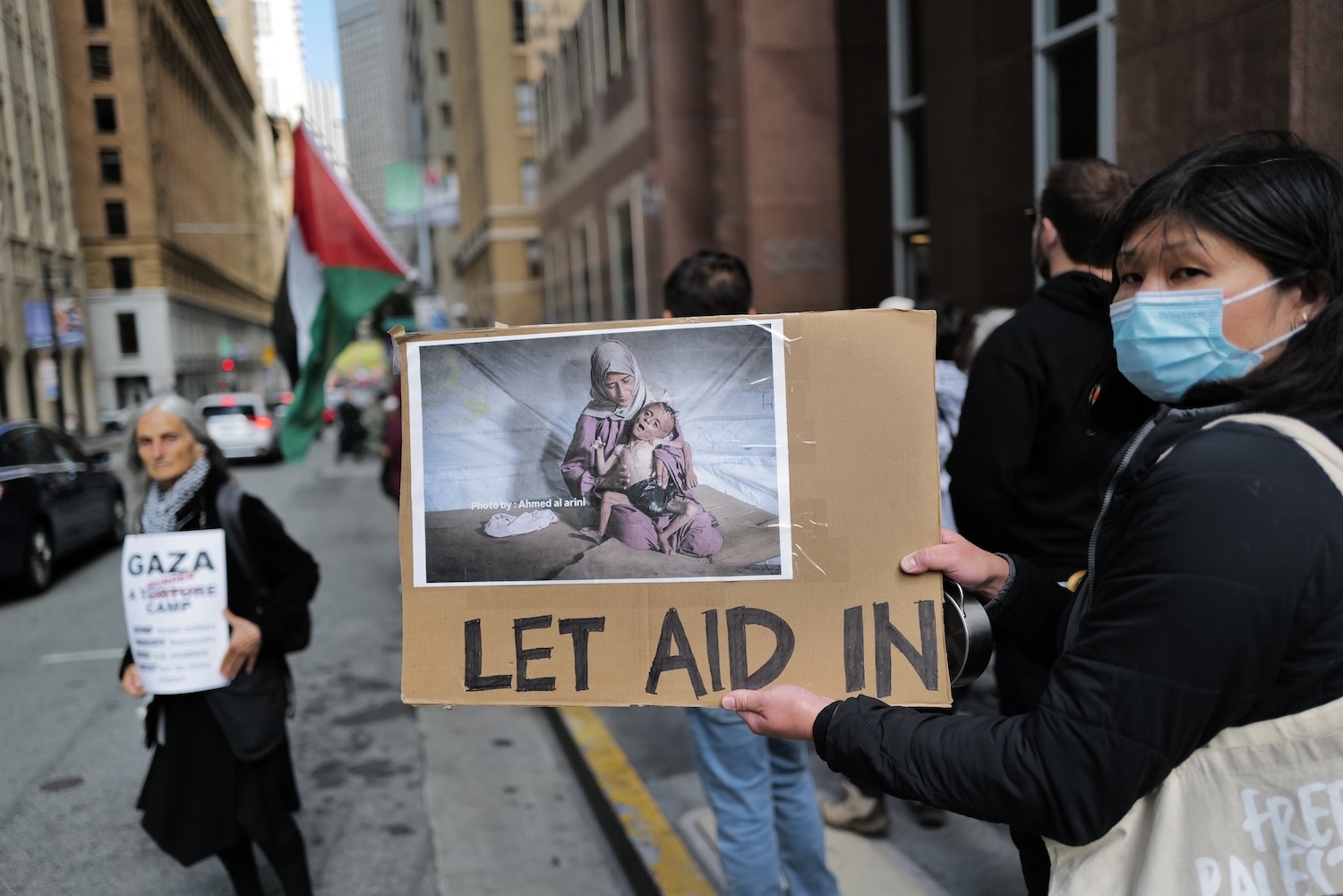
A woman holds a sign of a starving child in Gaza, as activists make noise outside of Senator Alex Padilla’s office in San Francisco charging him with complicity for supporting Israel’s genocide siege.


Aug 11, 2025 11:50 PM
Updated Aug 13, 2025 4:59 AM
Now, more than three quarters of a century after the UN proposed that separate Jewish and Arab states be composed out of the old Palestine, a two-state solution is still sometimes viewed as the only possible way forward.
Prior to World War I (and WWII), there was no Israel. Before WWI the Middle East was controlled by the Ottoman Turkish Empire, which had ruled the area since the 16th century. The British, however, who fought against the Turks, they being an ally of Germany, saw WWI as an opportunity to wrest the Middle East away from the Ottoman Empire.
But in making three different—and at times conflicting—WWI agreements, the British set the area up for future troubles. The first agreement was with Sharif Husayan, a religious/political leader in Mecca who considered himself a voice for Arab independence. The British promised him they would support his quest for an independent Arab state.
The second pact was with the French, by which the British agreed to their future control over Syria and Lebanon, in exchange for British control over Iraq and Palestine (which included future Israeli lands).
The third agreement was, however, the most problematic. By the Balfour Declaration the British promised backing for “the establishment in Palestine of a national home for the Jewish people.” This quest resulted from Zionism, which by WWI had zeroed in on Palestine, the ancient homeland of Jews, as that future “national home.” The main problem with the declaration was: By 1919 the Arabs made up about 90 percent of the Palestinian population.
Related stories
Although the Balfour Declaration also stated that “nothing shall be done which may prejudice the civil and religious rights of existing non-Jewish communities in Palestine,” and some individuals maintain that Zionism is not hostile to Arabs, others—including some Jews—contend that it necessarily led to a “government oppressive to non-Jews in Palestine.”
During the interwar years Britain controlled Palestine, and as Nazi oppression in Germany against Jews increased, the number of them fleeing to Palestine slowly mounted—by the late 1930s they made up about 30 percent of the area’s population.
The horrific treatment of Jews by the Nazis during WWII resulting in the Holocaust and the Jewish death of millions just exacerbated the Palestinian problem. Many people came to accept the Zionist claim that Jews would never be safe unless they had a country of their own. But Palestinian Arabs thought that the Holocaust was Europe’s problem and that they should not have to atone for it.
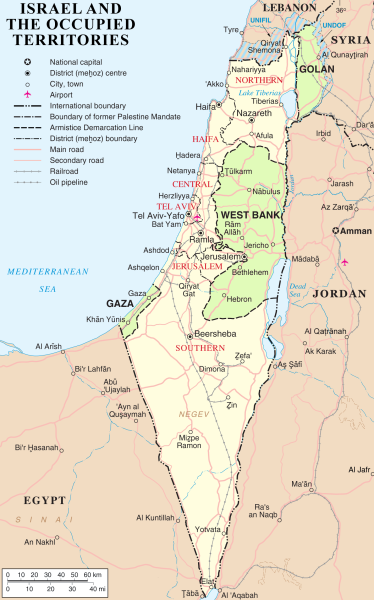
In the face of this dilemma, in 1947 Britain asked the United Nations (UN) to propose a solution, which it did: Palestine to be divided into two states, a Jewish one and an Arab one. Palestinian Arabs opposed the plan, which offered about half of the land, including most fertile coastal areas, to the Jews. In mid 1948, as the British withdrew, Israel announced its existence; the Palestinian Arabs refused to recognize it; and the first Arab-Israeli war began, which the Israelis soon won, increasing Israeli territory by about one‑third more than the original UN proposal. The West Bank, which under the UN plan would have been part of the Arab state, was taken over by Jordan, and the Gaza Strip (also part of the proposed Arab nation) by Egypt.
In 1956 another Arab-Israeli war followed, but it was to be less consequential than an additional one in 1967, which the Israelis quickly won, taking over both the West Bank and the smaller but more densely populated Gaza Strip.
Despite lulls in Israeli-Palestinian Arab antagonism at the time of the Camp David Accords (1978) and the Oslo agreements (1993 and 1995), Israeli control over the West Bank and Gaza Strip has been continuous. And under Prime Minister—(1996-1999, 2009-21, Dec. 2022-present)—Netanyahu it has been harsh, and Jewish settlements into these two Israeli-ruled Arab territories have increased.
Gaza’s situation has become more dire because of the prominence there (since winning 2006 elections) of Hamas, which many nations consider a terrorist organization, more militant than the Palestinian Authority, which the Israelis permit to have limited authority in the West Bank.
It was Hamas that directed the Oct. 2023 surprise attack on southern Israel, killing hundreds of Israelis and taking hostages. And it is that attack that has triggered the massive Israeli response and destruction of much of Gaza ever since--although estimates vary, one reliable source indicates that “nearly every person in Gaza needs urgent humanitarian assistance,” that “1.9 million [out of a population of about 2.1 million] Palestinians have been displaced,” and that “the entire population is facing crisis-level or worse food insecurity, with almost half a million at risk of famine.”
Sen. Bernie Sanders (Jewish himself) has referred to the Israeli response as “a horrific, immoral and illegal war against the Palestinian people.”
Now, more than three quarters of a century after the UN proposed that separate Jewish and Arab states be composed out of the old Palestine, a two-state solution is still sometimes viewed as the only possible way forward. Globally, 147 countries--but not the USA—already recognize a Palestinian Arab state. And France, Britain and Canada have announced their intention to also do so, under certain conditions--the Trumpian U.S. administration has criticized this intention of their NATO allies.
Yet, one U. S. scholar has written that such “recognition is far too little and much too late. It is also a radically inadequate response to starvation—let alone genocide, as many . . . have categorized Israel’s actions in Gaza after almost two years of war there.” (Even two of Israel’s leading human rights groups have recently accused their country of genocide in Gaza.)
In early August 2025 Israeli Prime Minister Netanyahu’s office said the government has adopted “five principles for concluding the war,” including disarming Hamas, bringing back the hostages, demilitarizing Gaza, establishing Israeli security control over the enclave and setting up ‘an alternative civilian administration that is neither Hamas nor the Palestinian Authority.’” Yet, many experts do not believe that Netanyahu’s plans regarding Gaza are realistic, and many in his own country oppose them.
Thus, three quarters of a century after the UN recommended a two-state solution, it seems that the Palestinian Arabs in Gaza are worse off than ever before. TV pictures of them starving and malnourished are truly horrific. And Peter Laarman’s recent question on this site, “They Died. We Did Nothing. What Will History Say?” should trouble us all.
Comments

Powered by RoundtableAn AI/DeFi-powered Enterprise Media Operating System. Learn more at Roundtable.io.© Roundtable 2026. By using this site you agree to the Terms of Use and Privacy Policy