
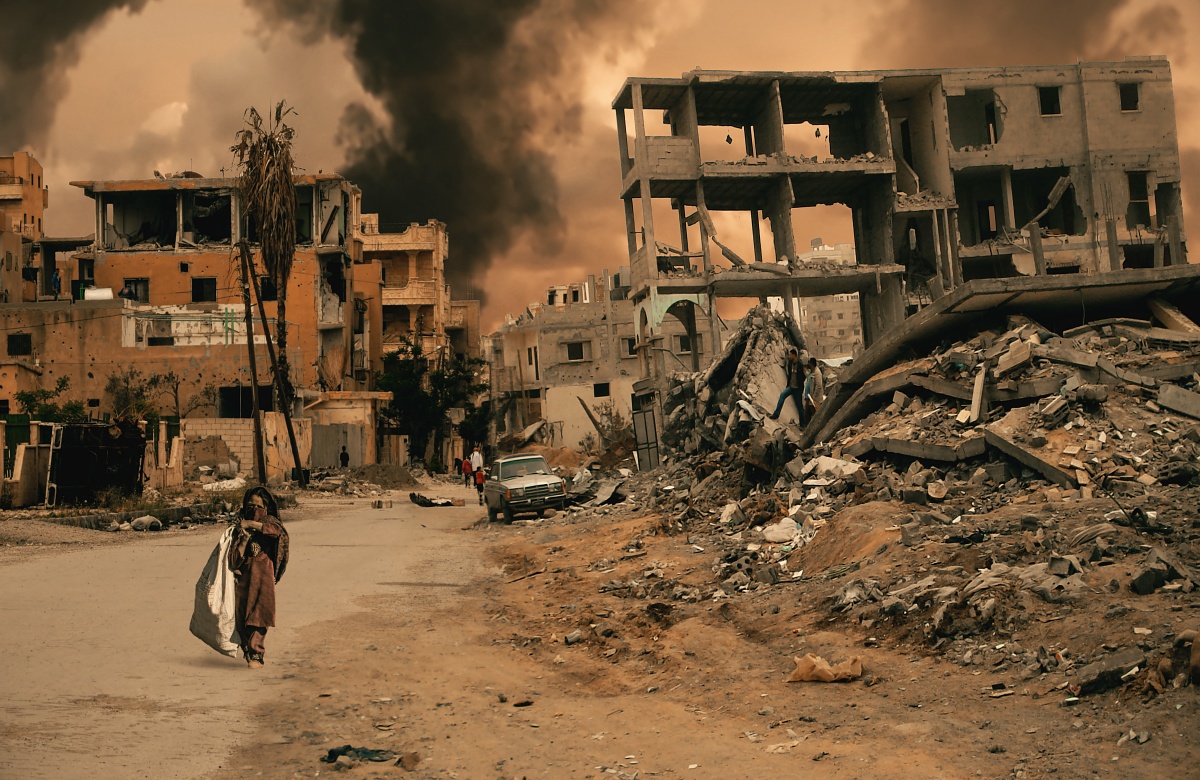
Homeless little girl walking in destroyed city that was bombed by the enemy and she's looking for shelter. By Meysam Azarneshin (Adobe Stock Photos)


Gaza Genocide
Jan 14, 2024 5:31 PM
While Biden and Blinken “caution” Israel about civilian casualties and international law, they rush endless tons of munitions to keep the slaughter going.
Even as the International Court for Justice hears the case for genocide against Israel, its onslaught against the Palestinians threatens to mushroom into a global war. Israel is unlikely to convince the court that it has been a victim of “terrorism” after 75 years continuously terrorizing the original inhabitants of the Holy Land, and after “grass mowing” attacks on Gaza almost every other year since 2008. Unsuccessful in eradicating the Palestinian resistance in Gaza, in spite of the awesome toll of its bombing campaign, Israel has already resorted to provocative targeted assassinations in Lebanon, Syria and Iran. Netanyahu, whose political fortunes seem to depend on “many more months of war,” seems to hope to drag the U.S. into a regional war.
Will the U.S. take the bait? “Endless war” was the nightmare promise of Donald Rumsfeld and George Bush back in 2001, following the attacks on the World Trade Center that year. The world has lived that nightmare ever since, in Afghanistan, Iraq, Syria, Libya, the former Yugoslavia, Yemen, Ukraine,… and at home. The nightmare threatens to morph into global catastrophe, as Israel’s U.S.-backed genocidal slaughter against Gaza hits the brink of regional war in West Asia. It could easily become global, involving both Russia and China. Such a war, even if it did not blow up the world, would destroy the global economy the U.S. and its allies want to dominate.
While Biden and Blinken “caution” Israel about civilian casualties and international law, they rush endless tons of munitions to keep the slaughter going. As 2023 ended, Israel has begun withdrawing ground troops from northern Gaza. The onslaught failed to eradicate the resistance, but succeeded in crushing tens of thousands of civilians, mainly women and children, and demolishing homes, hospitals, schools and Gaza’s entire civilian infrastructure.
How has all this happened? According to Biden, Blinken and Netanyahu, it’s the fault of their enemies: “terrorists” in Palestine and “dictators” in Russia and China. But is that true?
Related stories
A deep fog of lies and false propaganda has been a major strategic weapon of war for the U.S. war makers and their allies.
A deep fog of lies and false propaganda has been a major strategic weapon of war for the U.S. war makers and their allies. “We lied, we cheated, we stole… It’s part of the glory of the American experiment,” declared former U.S. Secretary of State Michael Pompeo in May 2019, bragging to a college audience in Texas. That unusual admission reflects the bipartisan official U.S. approach to maintaining global hegemony.
The lie machine and the war machine are linked: the military-industrial complex and AIPAC (American-Israeli Political Action Committee) are among the largest political donors to politicians in Washington. Together with the major oil corporations, the largest banks and big business as a whole, they forge conformity to the official narrative, especially in time of war. They largely control the mainstream media.
The Big Lie is the weapon of choice for Biden and his neo-cons in waging the proxy war in Ukraine against Russia, in support for Israel’s genocide in Palestine, in the hybrid war against China — and in a wider war in West Asia. In each case the path to peace must first break through the official big lies.
Sensational Lies Uncritically Parroted
“Israel tried desperately to control the narrative in a series of fabrications that immediately unraveled,” Susan Abulhawa wrote in Electronic Intifada. “Sensational lies about rape and beheaded babies were quietly retracted despite being uncritically parroted by mainstream western media.” Biden repeated the Israeli narrative verbatim, even after it was debunked.
The biggest lie is about terror and terrorism. Zionist Israel has waged permanent terror against the Palestinians since 1948, always with massive and lavish support from the U.S. and its allies. Just as Nelson Mandela and the African National Congress were called terrorists by the apartheid rulers of South Africa, with U.S. support, the Palestinians are considered terrorists because they reject the Israeli theft of their land, and have fought against terrible odds to get it back. Hamas and the rest of the Palestinian resistance are called terrorists because they lead this fight. The real terror is on the other side, as both the U.S. and Israel use brute force to protect their theft, and to maintain the racist repression and expulsion of the land’s original inhabitants.
In the case of the conflict in Ukraine, the U.S. has spent billions over decades to transform that country into an effective battering ram against Russia, culminating in the 2014 coup that brought Ukrainian fascists to power. It then backed these fascists in attacks against Russian speakers in eastern and southern Ukraine, while “NATO-izing” the Ukrainian military and bludgeoning its European NATO allies to support the effort. When Russia stepped in to stop these attacks, Biden raised a hysterical hue and cry about the need to protect “Ukrainian democracy” and oppose “Russian aggression.” The war that ensued has gone bad for the U.S. and NATO, because it was false from the start. The U.S. backed an actor and former comedian as Ukraine’s president, and pumped him up as a latter day Churchill who could “fight to the last Ukrainian.” Biden still calls it a success — a sign of difficulty distinguishing his own propaganda from reality.
About China, the war planners and DC politicians are frustrated. They wanted it to be their “war of choice,” following the “pivot to Asia” announced in 2011. Breaking with the One China policy agreed to in the 1970s, they are trying to foment separatism in Taiwan, and use it to weaken and divide China. They tried the same earlier with Hong Kong, and with Tibet in previous decades. They have hoped to stop China’s rise by weakening it however possible. Michael Pompeo’s rants about “genocide” in China’s far-western province of Xinjiang were part of the effort. But the results have been illusory, as China continues to rise, and sticks with its policy of common prosperity for a shared future.
Deceit is Not Enough
Deceit is combined with a war against “disinformation,” designed to suppress anything but the official narrative. “The relentless Western narrative that the West is noble while Russia and China are evil is simple-minded and extraordinarily dangerous,” Columbia University Professor Jeffrey Sachs has said. “It is an attempt to manipulate public opinion….”
Dissent is met with repression. Students for Justice in Palestine and similar groups have been banned at numerous universities. Presidents of Ivy League schools were forced to resign in an AIPAC-sponsored campaign to suppress anti-Zionist activists by smearing them as “antisemitic.”
Then there’s the case of Julian Assange, who is now facing extradition from England to the U.S., after years of torture. He is charged with “espionage” because he publicized information about U.S. crimes in Iraq, and faces up to 175 years in prison (a virtual death penalty) for practicing honest journalism. If the U.S. cared about honest journalism, Assange would get a prize. But he is barely mentioned in the mainstream media.
The rise of social media has helped break the grip of the official information monopoly. Even though Jeffrey Sachs has said he can’t even get an antiwar “op-ed” published in the New York Times or Washington Post, he has become famous on YouTube. So have “turn coat” intelligence analysts like Scott Ritter, Ray McGovern, and others.
The Palestinian resistance movement itself has been a major force in breaking through the media smokescreen. The sight of Israel’s saturation bombing of homes, hospitals and schools in Gaza has brought millions into the streets, just as scenes of Vietnamese children running away naked from napalm attacks ignited a storm of antiwar protest decades ago. They have inspired non-Zionist Jews everywhere to say “not in our name,” and expose the lie that opposing U.S.-backed Israeli genocide is somehow “antisemitic.”
Scenarios for ‘End-Game’
At the start of 2024, after three months of war in Gaza, and nearly two years in Ukraine, “postwar plans” became news items. Blinken took off on another major Middle East tour, stating "goals" of increased humanitarian assistance to Gaza, steps to protect Palestinian civilians and allow them to return to their homes, and plans to “soften” Israeli’s bombing attacks. But the U.S. continues to send tons of bombs and other munitions to Israel. If they really want to “soften” Israel’s bombing attacks, they could stop sending the bombs. Before Blinken took off on his “peace tour,” protesters arrived at his Virginia residence and splashed fake blood on his government vehicle and held signs branding him a war criminal.
Blinken “intends to tackle the thorny topics of plans for governing Gaza and prospects for reaching a political solution between Israel and the Palestinians once this conflict is over,” the New York Times report said. But Netanyahu says he is “proud” to have blocked a Palestinian state during his multiple turns as prime minister since the 1990s. And Israel continues the ethnic cleansing of Gaza, and its plans for Israelis to re-occupy the enclave.
The U.S. officially wants a “revamped and revitalized” Palestinian Authority to govern Gaza after the war, viewing it as a path toward a two-state solution. That would involve “crushing” Hamas and its Palestinian Resistance allies first. But many question “whether resolving to destroy such a deeply entrenched organization was ever realistic,” the Times reports.
Palestinians “are open to any proposal for a final and complete ceasefire in the Gaza Strip but are opposed to administrations imposed by Israel or the U.S.,” said Hamas leader Osama Hamdan at a Beirut press conference Dec. 28.
Following the January 2 targeted Israeli assassination of a top Hamas leader in Beirut, Hezbollah leader Hassan Nasrallah warned Israel against waging war on Lebanon. “If the enemy thinks of waging a war on Lebanon, we will fight without restraint, without rules, without limits and without restrictions,” Nasrallah said. The Yemenis have said the same.
Regarding a wider regional war, there is an internal debate in the State Department. “Hawks” led by Victoria Nuland oppose Blinken’s “moderate” stand. The hawks tend to prevail in such debates. “From Lebanon to the Red Sea, a Broader Conflict With Iran Looms” was the lead headline in the NY Times on January 7. “Iran is posing a new challenge to the West,” the article says, “this time with Russia and China on its side.” Translation: a regional war could become a global war.
Support to Ukraine Has Begun to Erode
Meanwhile on the Ukraine front, the Russians are winning. U.S. leaders are groping to deal with it. “The political willingness to continue providing military and economic support to Ukraine has begun to erode in both the United States and Europe,” say top U.S. foreign policy leaders Richard Haass and Charles Kupchan, writing in Foreign Affairs Nov. 17, 2023. “The time has come for Washington to lead efforts to forge a new policy that sets attainable goals…” They cite “the enormous human and economic costs of the war and the reality that Russia has succeeded…”
The conflict in Gaza has “grabbed the world’s attention, relegating the war in Ukraine to the back burner. The issue is not only that Washington is distracted; the U.S. military has only finite resources, and U.S. defense industrial base has far too limited production capacity. The United States is stretched thin as it supports two partners engaged in hot wars…”
In an earlier Foreign Affairs article (April 13, 2023), the same authors said “the United States must prepare for potential military action in Asia… and the Middle East.” They add that “the war is imposing high costs on the global economy,” and “economic duress is triggering political unrest” and “is also polarizing the international system.”
The solution they offer is “a ceasefire in place.” A ceasefire, they add, “would save lives, allow economic reconstruction to get underway, and enable Ukraine to devote incoming Western arms to investing in its long-term security rather than to quickly expending weaponry on a deadlocked battlefield.” So the proposal is not for a complete ceasefire: “Ukraine could continue using long-range weapons, naval assets, and covert operations to strike at Russian positions in rear areas and in Crimea, raising the costs of continuing occupation.”
The Foreign Affairs leaders admit it’s “likely that Moscow would spurn a cease-fire proposal.” That’s a good bet. In realistic terms, the Ukrainian forces — and their NATO backers — are exhausted. Russian forces are establishing security for Russian speakers in eastern and southern Ukraine, and defending their self-determination. In effect they are implementing the Minsk accords, which all parties agreed to years ago. Meanwhile the sanctions only stimulated Russia to align itself economically with India and China, and the rest of the Global South. The main victim of the sanctions was the western European economy.
A Fantasy World
Western leaders, like the Foreign Affairs writers, continue to live in a fantasy world where they are on top. Their current proposal is modeled on the armed truce in Korea, established seven decades ago. That truce was meant to maintain intense pressure on China, which had helped the Koreans resist the U.S. onslaught. A lot has changed in seven decades. Most importantly, China is no longer exhausted from a century of humiliation and three decades of revolutionary war. Its leader, Xi Jinping, has reaffirmed China’s close friendship with Russia. China has presented a peace plan to the West to resolve the Ukraine crisis. French President Macron, German Chancellor Scholz and European Commission President Van der Leyen all visited Beijing to secure economic ties with China. Europe trades more with China than the U.S.
The Chinese newspaper Global Times reported that “after concluding his visit to China, Macron emphasized that ‘the great risk’ Europe faces is that it ‘gets caught up in crises that are not ours, which prevents it from building its strategic autonomy… The paradox would be that, overcome with panic, we believe we are just America's followers’.” The Global Times report says “Macron is warning Europe not to go so far on this issue and risk damaging Europe’s own interests. Macron’s stressing the need for Europe’s strategic autonomy was a result of a sober awakening from the U.S.’ selfish policies on Europe, especially since the Russia-Ukraine crisis, and also from being emboldened by his ‘very successful’ visit to China, during which he saw China’s good will toward France and the huge potential of cooperation with China.”
Following the European visits to China, Brazil’s President Lula Da Silva was China’s next state visitor. The New York Times report was headlined “Brazil’s Lula Meets Xi in China as They Seek Path to Peace in Ukraine.” Their joint statement said negotiation is “the only viable way out of the crisis in Ukraine.” They want China’s peace plan to be the basis for talks. The Times report said U.S. and some European officials “have been critical” of China’s plan, “because China has not suggested that Russian forces must withdraw from occupied Ukrainian territory.” Lula also wants other countries, like South Africa, India and Indonesia, to help mediate the conflict. They also have not signed on to isolating Russia.
As part of his visit to China, Lula helped inaugurate his political ally Dilma Rousseff as president of the New Development Bank set up by the BRICS nations. Rousseff was Brazil’s president from 2011 to 2016, when she was impeached in a “soft coup” backed by the U.S. At the inauguration ceremony Lula said “Why should every country have to be tied to the dollar for trade?... Who decided the dollar would be the (world’s) currency?” He added that “No bank should be asphyxiating countries’ economies the way the IMF is doing now with Argentina, or the way they did with Brazil for a long time and every third-world country….”
Lula’s comments are a signal of the changed environment in the world. He also called for China’s territorial integrity to be respected with regard to Taiwan, as Macron had done.
Just before hosting these high level visits from France, the EU and Brazil, China hosted the leaders of Iran and Saudi Arabia, scoring possibly the most significant peace agreement of this century so far. No military guarantees were needed to convince Iran and Saudi Arabia to abandon hostilities. Instead the parties agreed to peace on the basis of cooperation in attractive trade deals with China. It’s a new approach, part of China’s Global Security Initiative Concept.
There is no guarantee that a similar approach could work for peace between Russia and Ukraine, or Russia and the EU and NATO. In all these cases the main obstacle is the United States, which does not want peace based on mutual cooperation. But the U.S. may not have a choice, either in the Ukraine conflict, or in western Asia, or against China itself.
A New Movement
The role of popular protest in all this is significant. Digging out the truth and spreading it is not enough. People are hitting the streets in protest and in serious efforts to stop the war machine. Yara Shoufani of the Palestine Youth Movement said it’s “a major watershed moment where the Palestinian Youth Movement has been a part of a movement in North America and Britain to shut down industry and organize mass mobilizations across the world and across North America and Europe.” It goes further, she suggests. “We’re building a broad coalition of national liberation struggles, of working class struggles, of left struggles; and Arab and Palestinian and Muslim communities are coming together.” Now, she says, “we have work to do to channel this moment into serious political organization. And I think what we’re seeing is actually the beginning of that.”
The Palestinians are leading the way. Their resistance, with massive global support, in the face of attempted genocide has exposed the moral and political bankruptcy of both Israel and its U.S. sponsor. The apparent unity of the apartheid settler state is beginning to crack. While the Israelis want to expand their assault on Gaza to a regional war — and force the United States to come to their rescue — they’re betting on a time-worn balance of forces that is no longer valid. Now both Israel and the U.S. are isolated globally. The people who live in historic Palestine, of all religions, will gradually conclude that peaceful coexistence is possible, and is much safer than apartheid.
Comments

Powered by RoundtableAn AI/DeFi-powered Enterprise Media Operating System. Learn more at Roundtable.io.© Roundtable 2026. By using this site you agree to the Terms of Use and Privacy Policy