


Aug 31, 2026 7:15 AM
Updated Aug 31, 2026 7:27 AM
Emerging nations are constructing alternatives to the Western-led order through new trade, defense and diplomatic partnerships.
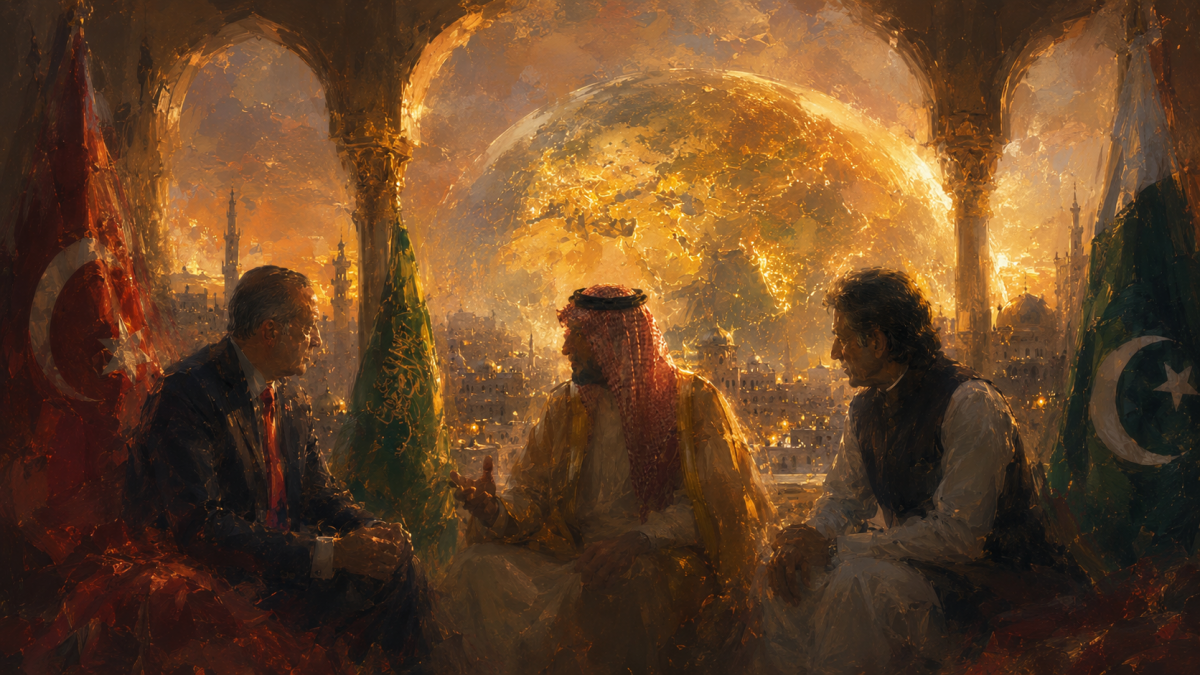
On August 7, 2026, Turkiye, Saudi Arabia and Pakistan signed a tripartite defense pact called the Makkah Agreement. This follows a 2025 bipartite pact between Pakistan and Saudi Arabia, and it may give us some insight into where the world will be moving as the Donald works aggressively to emasculate the American Empire.
In the past week, Russia’s Czar Vlad summoned the U.S. CIA Director to Moscow to receive further instructions on Czar Vlad’s intentions to escalate the war on Ukraine and his assault on NATO and European Union. The Donald was instructed to keep the U.S. out of the Ukraine war and to side with Russia in deconstructing NATO.
Turkiye is a member of NATO and a European Union applicant. It has well developed contacts in the modern Western world. Experts in such things call Turkiye “an emerging” nation, with a fraught relationship with democracy. It maintains civil, perhaps even friendlier, relations with Shia Muslim Iran, although Turkiye is 99+% Sunni.
Saudi Arabia is a feudal state. It was once an independent kingdom. But since WW-I it has been a vassal state of Western powers, which have controlled its oil wealth and controlled its rulers with both occupying forces and with Wahabi Muslim theology. In the past few years, a new generation of rulers has emerged, who are apparently trying to balance national independence, modern technology, and some independent thinking by educated royals, in place of the traditional feudal lords relying on Western technocracy and tribal customs masquerading as religion.
Related stories
Saudi Arabia has a growing, very valuable industrial relationship with India, a barely democratic society with despotic rulers using the pretense of strict Hindu rule to justify oppressive policies. As a basically feudal state Saudi Arabia is comfortable with India’s oppressions. And with its Hindu religious claims, despite Saudi Arabia’s officially strict Islamic claims.
Pakistan is another Muslim country still emerging from colonial rule by Western nations and trying to find its footing. Created out of British Raj India in 1947, it was created to be a Muslim nation with religious freedom for other beliefs. It has vacillated between vicious military rule and elected governments. Both types of governments have taken steps to guarantee education and healthcare to formerly impoverished and unentitled peasants.
As Turkiye has cultivated alliances and cultural connections with the West, and Saudi Arabia has built an industrial relationship with India, Pakistan has looked to neighboring China for business and technological development. Sitting at the east end of the Middle East conflict zone, in an area with both access to the Arabian Sea and to land trade routes between Iran, Afghanistan and China, Pakistan is emerging as a trading nation. Pakistan is naturally situated to provide China with land-based access to Iranian oil, as well as to shipped oil, if Iran develops facilities outside the Strait of Hormuz.
The combination of Turkiye, Saudi Arabia, and Pakistan provides fascinating opportunities. The opportunities face formidable obstacles, many created by situations and policies within the agreeing nations. Among the fundamental opportunities is the appearance that each of the member governments sees their emergence from colonial rule as an opportunity to reconsider the force-based ruling policies of Western colonial rulers.
India and Kenya provide interesting instructional models. In both places, British colonial administrations trained and used local, colonized people for clerical and administrative work. This required some level of education of locals, and some integration of colonized locals into the workings of government. Like 18th century American slaves, some of whom were trained to read and write to serve as clerks and as religious guides for other slaves, people subjugated by the British Raj learned the lessons that Nat Turner and other slave rebels learned from their owners.
More recently, the similarly blind Ronald Reagan touted the Afghan Taliban as the moral equivalent of America’s founding fathers. He, as other empire leaders, had no idea of what it would mean to empower and arm those who were colonized and oppressed.
Turkiye, Saudi Arabia, and Pakistan each have international relationships outside the Middle East, outside of the Muslim religious community, and outside the traditional war-based European colonial model. They have the experience of colonially oppressed people, and the opportunity to build on their new relationships to develop new, less destructive approaches to international relations.
The Makkah Agreement may mirror the BRICs effort of Brazil, Russia, India and China to create a new structure for international economics and trade. The Makkah parties have a more concentrated, war-infested region than BRICs to deal with. But it is fascinating to contemplate what opportunities might emerge if they could use their post-colonial experiences and knowledge to encourage other, warring Middle East parties to find ways to make peace and develop their own post-colonial, less blood-drenched states.
Iran remains an international pariah. At least in Western eyes. But not to 99+% Sunni Turkiye. And Turkiye is clearly part of the European community, even if not yet part of the European Union. Beyond America’s bluster, Turkiye could help Europe and Iran find detent, and maybe more. This does not discount the very real issues of Iran’s policies on human rights. But lessening international tensions is always a way toward allowing a society to feel freer with its internal policies.
Lessening war tensions with Western powers would almost automatically reduce tensions with neighboring states currently caught up in pressures to choose sides in the ongoing warfare. Economic resources now being spent on war related repairs and other expenses could be re-directed toward civilian needs.
Similarly, Saudi Arabia’s strong relations with both Hindu India and Muslim Pakistan sets an example of the possibility of multi-sectarian cooperation. With Saudi Arabia’s help, it might be possible to reduce some of the historic strife between India and Pakistan. Both India and Pakistan desperately need the ability to direct more of their resources to helping their populations deal with the increasingly dire consequences of global warming, which neither of them is responsible for causing.
We should not be pollyannaish about such possibilities. But a realistic view shows us that the U.S. Empire is faltering, Russia is bankrupt, and China is suffering from economic ills at least partially both self-inflicted and externally caused. The world is at an inflection point. The decades since WW-II have seen the growth of emerging nations as they have also seen the expansion of crony capitalism around the globe.
One clear result of unrestrained crony capitalism is that it feeds on itself, eventually destroying itself. Weapons manufacturers, in the name of “anti-communism,” have spread guns around the globe, making indigenous revolts both common and more successful. By spreading education, meant to aid colonial administrations, capitalists have also informed people, sharing ideas of entitlement to human rights, to healthcare, to basic nutrition. They have spread awareness of the exploitation of societies and of the causes of climate change.

The BRICs and Makkah Agreements appear to be efforts by nations traditionally left out of the power decisions of the Western colonial nations. Each presents opportunities to smaller nations near the Agreement members to benefit from Agreement incentives for trade and less warfare. Russia and Iran are both heavily dependent on China, which gives China opportunities to influence them.
So far, China seems to be holding off, not pressuring Russia on Ukraine or Iran on the oil war. China appears to be allowing Russia to dig itself into an ever deeper economic hole. And to be using Iran to let the U.S. to wreck its own international standing even more. But those stances don’t obviate the reality that both BRICs and Makkah are indications of a worldwide transformation away from Eurocentric rule. The possibility for more egalitarian international dealings is emerging as post-colonial nations find their footings.
Comments

Powered by RoundtableAn AI/DeFi-powered Enterprise Media Operating System. Learn more at Roundtable.io.© Roundtable 2026. By using this site you agree to the Terms of Use and Privacy Policy