


Aug 22, 2014 9:20 PM
Updated Feb 10, 2022 11:13 PM
Ray Zwarich: This is the tragedy of war; people devoted to the death of others, whom they rightly consider to be threatening death to them. As each side kills its enemies, where is right or wrong?
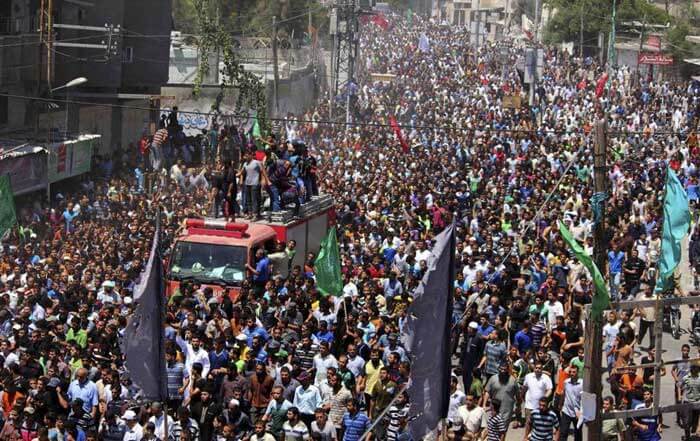
They say that "a picture is worth a thousand words". More than that, perhaps. Today the Boston Globe ran a NY Times report that Israel has marked up a significant victory, in the killing of three senior Hamas military commanders. A picture of these warriors’ funeral procession accompanies the article. A throng of mourners fills the street, as far as the eye can see into the distance. We see fists raised, presumably in defiance, among the throng.
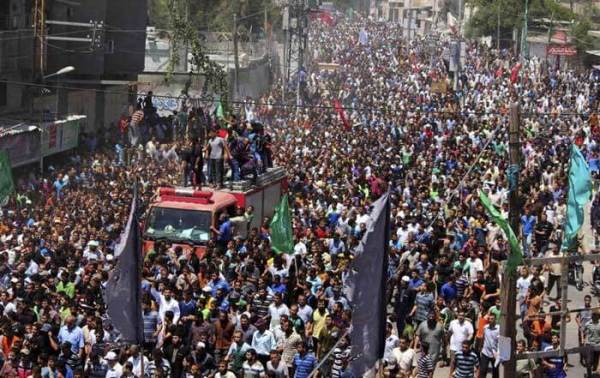
Even in the wake of their victory, senior Israeli military commanders must be looking at this picture through eyes narrowed with serious concern. Senior Israeli military officials have been reported to have considered the recent attacks on Gaza to be very unwise. They have issued public statements that they are bound follow the orders given them by the political authorities, with the heavy implication that they do not think this course is well-considered.
Netanyahu has threatened "massive engagement" against Gaza, seemingly referring to a threatened military occupation, in his bombastic demands that an undefeated enemy should voluntarily surrender and disarm.
Senior Israeli military commanders are not likely encouraged about the prospects for success of such an endeavor when they look at this picture of these masses of people expressing their outpouring of grief for their own warriors. In even a cursory glance at this picture, anyone can see that the spirit of these people is not broken. These people suffered under the brutal and murderous Israeli bombardment, a tragedy that we all had to witness, as large numbers of innocent civilians were killed, including people had fled to shelters seeking sanctuary, after their homes, and whole neighborhoods, had been reduced to rubble. But we can clearly see in this picture that these people are unbowed. They are not cowering in fear. They are not huddling in doors. They are not reduced to inaction. They pour out to support their warriors, as they grieve for these fallen leaders.
Related stories
This is the tragedy of war; people devoted to the death of others, whom they rightly consider to be threatening death to them. As each side kills its enemies, where is right or wrong?
This is the tragedy of war; people devoted to the death of others, whom they rightly consider to be threatening death to them. As each side kills its enemies, where is right or wrong? To any of us looking on from outside any bonds of tribal loyalty to either side, how are we to know which side, or if either side, has any claim to moral right?
Though it does not ameliorate the tragedy of so much suffering on both sides, the principle of 'first blood' is deeply embedded in our perception of moral right. In any fight on any playground, when the teacher separates the combatants, the first question is always "who started it?" Projecting to the tragedy of war, the same question applies, if we undertake the task of knowing if one party or the other has any claim to moral right. Who started the conflict? Who drew first blood?
In a struggle as intractable as this between Israel and the Palestinian Arabs, which has continued over the span of generations, the origins of the struggle can become obscure to many. It was nearly 70 years ago that a group of people from Europe used the deadly tactic of terrorism against defenseless civilians in Palestine, causing large numbers of them to flee their homes and land in terror. These people from Europe then claimed that land for their own, and called it 'Israel'.
The people who had fled for their lives in terror scattered in many directions, and became dispossessed refugees living in the squalor of refugee camps. Many of them fled to Gaza. Most of the people in Gaza are those people who fled in terror, in fear for their lives, from land that is now Israel, or else are the children and grandchildren of those people. These people have lived under the misery of Israel’s military oppression ever since.
Discovering the moral right in the midst of warfare does not remove the tragedy on every side. It does not remove the hardships, to the extent of death, which people on both sides suffer. Many people, on any side, are innocent of any desire to be part of the fighting, and even speak out bravely for peace. But their desire for peace does not indemnify them from danger or death.
But even so, it is deep within our innate moral sense of right and wrong to understand that when one party initiates violence against another, that side bears a moral burden of guilt. Though that 'teacher' on the playground may very well, and rightly so, give a scolding to both boys, the boy who 'started it' is afforded the greater share of blame. The other boy may be admonished for himself resorting to violence, but a larger degree of human sympathy will always be afforded to him.
This tragedy goes on another day. One side’s warriors have fallen, and its people grieve. The other celebrates a victory. A great poet once asked us, "How many deaths will it take 'til he knows, that too many people have died?". The wind still blows. People still die.
Ray Zwarich
Comments

Powered by RoundtableAn AI/DeFi-powered Enterprise Media Operating System. Learn more at Roundtable.io.© Roundtable 2026. By using this site you agree to the Terms of Use and Privacy Policy