
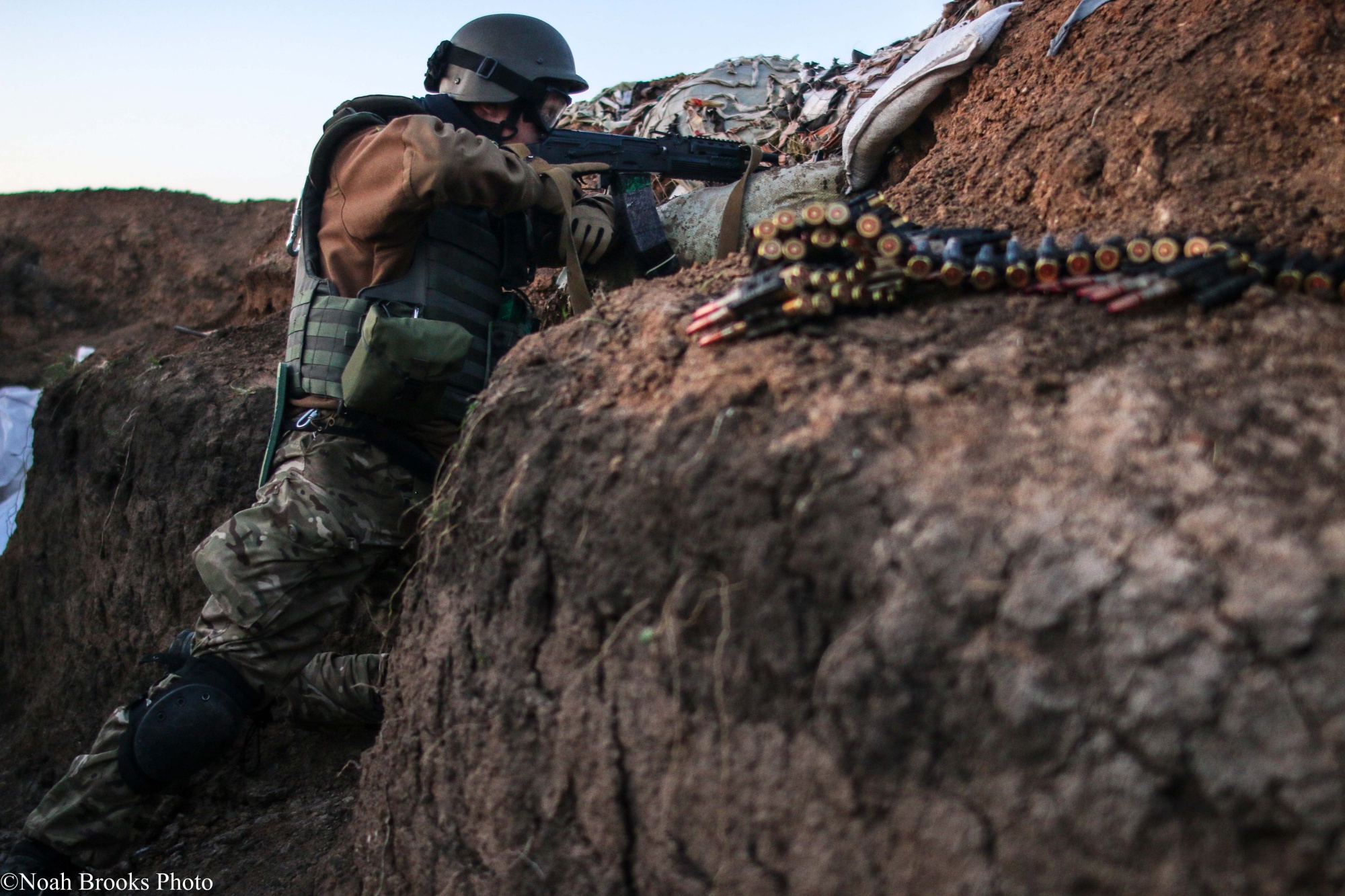
Ministry of Defense of Ukraine, CC BY-SA 2.0, via Wikimedia Commons


The time has arrived for diplomacy that brings collective security. Europe should talks with Russia and should urge Russia and Ukraine to sign a peace agreement.
Jun 19, 2025 4:46 PM
Nationalism turned inward becomes blindness when it refuses to recognize the moral and strategic imperatives of solidarity in the face of tyranny.
Today’s doctrine of "America First" is a double-edged sword, one that exposes both the limits and necessities of nationalist restraint in an interconnected world. On one side, it gestures toward a long-overdue skepticism of America’s entanglement in protracted, morally ambiguous wars—particularly in the Middle East—where interventions have too often served opaque strategic interests while leaving behind chaos and human suffering. Here, "America First" can function as a corrective, a call to cease squandering lives and resources on imperial overreach masquerading as democracy promotion.
Yet, nationalism turned inward becomes blindness when it refuses to recognize the moral and strategic imperatives of solidarity in the face of tyranny. In the context of Russia's brutal assault on Ukraine, a rigid adherence to non-interventionism betrays the very values America claims to uphold. This is not a case of empire-building, but of defending a sovereign democracy from authoritarian aggression—a defense that echoes the principled stand against fascism in the 20th century. The contexts could not be more different: elective wars of dominance versus reluctant resistance to conquest.
I am not calling for the unsheathing of American swords, nor for the drums of war to echo louder across foreign fields. Rather, I am advocating that the United States stand shoulder to shoulder with its European allies—not as a solitary knight, but as part of a phalanx of democracies—offering steadfast financial and military support to Ukraine. This is not the path of conquest, but of covenant; a collective stand at the gates of peace, where deterrence speaks louder than retreat and unity is the shield against tyranny’s advance.
To walk away now would not be an act of prudence, but of abandonment—leaving a fledgling nation to face the tempest alone. What we offer is not escalation, but alignment; not interventionism, but the architecture of peace built on resolve, not retreat.
Related stories
Thus, while “America First” may rightly question the hubris of past interventions, it must not become a euphemism for indifference. The challenge is to discern when restraint is wisdom and when action is responsibility—to understand that isolation is not peace, and that there are moments when the defense of liberty abroad is inseparable from its preservation at home.
What crashes through blood and bone in Kyiv, in Mariupol, in the defiant hearts of countless Ukrainian towns, is the same elemental fire that once scorched the skies over Warsaw, blazed through the barricades of Madrid, echoed in the marches of Selma, and smoldered in the streets of Soweto. The tyrant may change his name, his flag, his accent—but the hunger is the same: dominion, silence, submission. Yet even beneath rubble and ruin, the people’s cry endures—a cry thick with smoke and sorrow, yet radiant with something eternal. It is the ancient anthem of resistance, the sacred refusal spoken across generations: “We will not bow.” The war in Ukraine is a battle for democracy itself, against a creeping darkness that seeks to snuff out the light in Kyiv and every capital where liberty dares to breathe.
This is no mere chess match of geopolitics. It is a moral furnace. Yet as the drums of war echo, many Americans—in power and in the public—hesitate. They question the cost. They fear entanglement. They turn inward as the world ignites. And worse—some support the oppressor, the war criminal bent on restoring the old Soviet empire and in so doing betray the very idea of freedom and democracy.
But history shouts this truth: fascism does not wait. It grows in silence, feeds on division, and devours when the brave falter. The cost of inaction is not peace—it is complicity.
We are fighting fascism not only in standing with Ukraine against the naked barbarism of Russian forces but in our own government. Trump has long cast admiring glances toward Moscow’s throne. His praise for Vladimir Putin is no diplomatic courtesy—it is the deference of a man who sees in autocracy not a threat, but a mirror.
Whispers have swirled for years—some dismissed, some too plausible to ignore. A Facebook post by an ex-KGB agent once alleged that Trump was recruited by Soviet intelligence in 1987, operating under the code name Krasnov. Whether apocryphal or chillingly accurate, the story aligns with a deeper, more verifiable truth: Trump has governed, spoken, and schemed as though his true allegiance lies not with the free world, but with its gravediggers.
Now, under the banner of a so-called “peace deal,” he offers Vladimir Putin everything he desires. Ukraine, that battered and defiant republic, is to be carved up and surrendered on the altar of Trump's ambition. There is no negotiation here—only capitulation disguised as diplomacy. It is a deal written not in ink, but in blood.
And so we must ask, as the world tilts on its axis: is this merely appeasement? Or is it something far darker—a collusion of spirits, a shared appetite for power unchecked by conscience?
To the hesitant, I say this: history does not absolve the bystander. It does not pardon those who watched as the shadows lengthened and did nothing. When darkness gathers and begins its march, neutrality becomes complicity. The choice before us is not shaded in nuance—it is stark, unyielding. Stand with Ukraine. Stand with democracy. Not because the path is smooth, but because it is righteous. Not because it is easy, but because justice rarely is.
And to those who despair, I offer this: the arc of history does not bend on its own—it is not the wind, but the weight of our hands and the courage in our chests that gives it shape. Liberation theology reminds us that God walks not in the palaces of the powerful, but in the dust beside the oppressed—yet it is through us that justice takes flesh.
Paulo Freire teaches that history is not a script to be read, but a page to be rewritten—by those bold enough to lift the pen, even when their hands tremble.
To understand why so many of America’s right-wing extremists, fascists, and neo-Nazis find themselves seduced by the incense-heavy corridors of the Eastern Orthodox Church—especially the Russian Orthodox Church Outside of Russia (ROCOR)—one need only gaze into the darkened iconostasis where Patriarch Kirill presides, not as shepherd, but as high priest of Russian empire.
Like a hierophant of blood and flag, Kirill stands robed in gold yet speaks in iron. He does not tremble before war; he anoints it. He robes the tanks in liturgy. As the Associated Press reports, Kirill has made no effort to hide his allegiance, baptizing Russia’s invasion of Ukraine in the name of moral purity, “describing the conflict as part of a struggle against sin and pressure from liberal foreigners to hold ‘gay parades’ as the price of admission to their ranks”.
It is not hard to see why such utterances have ruptured centuries-old devotions. Ukrainian Orthodox believers, many of whom remained loyal to the Moscow Patriarchate even after the schism that birthed the Kyiv-based Orthodox Church of Ukraine, now wince at the sound of Kirill’s name. Some no longer speak it at all. Others clench it like a thorn between their teeth. And a growing number are rising to demand spiritual sovereignty, refusing to let the thurible swing in time with artillery barrages.
And how could it be otherwise? When missiles turn Ukrainian maternity wards into tombs, what balm is offered by a patriarch who calls Putin a “miracle of God” who “holds the hope that future generations will pick up the spiritual baton from past generations and save the Fatherland from internal and external enemies.” .
A key pillar of Putin's ruling apparatus, the 75-year-old Kirill has championed conservative religious values and buttressed the Kremlin's authoritarian tendencies by denouncing opposition protests.
In recent weeks he has backed Russia's military campaign in Ukraine, calling on supporters to rally to fight Moscow's "external and internal enemies".
In February he spoke of a struggle against the "forces of evil" opposed to the historic "unity" between Russia and Ukraine.
His comments invited a rebuke from Pope Francis, who told Kirill in a video meeting in March that religious leaders "must not use the language of politics, but the language of Jesus."
This is not theology. It is statecraft in vestments.
This is not faith. It is fascism with a crucifix.
And the rest of us? We are left to tear our garments and cry out like prophets in the ruins, praying not for victory, but for exorcism.
A strange weather is gathering over the American Republic. The once-crackling current of moral duty—the electric conviction that justice beyond our shores is still our concern—is dimming, its thunder reduced to a distant murmur. The storm that once roared with the cry to do more now hangs in uneasy stillness. And in that silence, something older, more perilous stirs. The ancient cartographers of power—those who once carved the globe with bayonets and ink—sense the change. Their maps, drawn in conquest and compromise, begin to smolder at the edges, threatened not by fire from without, but by the fading of the light within. The danger is not just that we do too much—but that we forget why we ever did anything at all.
Carlos Roa, Associate Washington Fellow at the Institute for Peace & Diplomacy, in a prescient warning titled “Don’t Look Now, But Isolationism Is Winning,” names the omen: isolationism. Once exiled to the underworld of American politics—cast into Tartarus with the Titans—it now walks openly through the republic’s marketplace, cloaked in red caps and wearing the serene grin of the indifferent.
No longer whispered in shame, isolationism has become a banner—waved not in protest, but in pride. Only the left still calls it heresy. Only they cry out as the Trojan walls of Kyiv begin to crack, while Trump’s faithful look on like aloof gods atop their marble colonnades—unmoved, unmoving—so long as no draft rattles their own gates, no foreign fire reaches their gated lawns.
Roa writes:
The postwar U.S. foreign policy establishment is thus beginning to recognize that its old tactics no longer work. Despite a constant slew of articles, the specter of isolationism doesn’t send shivers down the spine like it once did. The heresy has lost its power. The reasons for this are varied, but the simple reality is that the United States can no longer afford — figuratively and literally — to act as the world’s sheriff and hegemon, and everyone is gradually realizing it.
I am not yet as persuaded as Carlos Roa that isolationism has claimed final victory in America. And if it has—if this weary inward turning is truly the new creed of the Republic—then let history inscribe it not as a triumph, but as a Pyrrhic illusion: a crown of laurels scorched to ash, a parade that limps rather than marches.
It is not resolve that guides this retreat, but exhaustion disguised as principle—a nation folding its wings and calling it prudence, stepping back from the fires of the world and pretending it is peace. This is not the confident stride of a people charting a new path, but the faltering gait of a giant unsure of its own shadow.
If isolationism has indeed claimed the high ground in American politics, it has done so at the expense of our broader moral and strategic vision. The so-called victory—pulling back from the world, retreating behind borders, refusing shared responsibility—has not expanded our strength, but narrowed our scope. We have traded solidarity for solitude: the mutual bonds that tie us to other peoples’ struggles have been exchanged for the cold comfort of disengagement.
And in building walls to keep the world’s troubles at bay, we risk imprisoning something essential within ourselves. Those same walls, meant to shield us from foreign conflict, can also confine our sense of justice, empathy, and responsibility. In trying to avoid being pulled into the suffering of others, we diminish our own capacity to act on behalf of what is right—not just abroad, but eventually, even at home.
This is not a triumph; it is a quiet retreat in disguise—a narrowing of our conscience, and a forgetting of the role we once aspired to play in a world yearning for freedom.
Yes, a great many Americans clutch the comforts of the good life like heirlooms passed down from peace, reluctant to wager their children's tomorrows on the roulette wheel of war. They shudder at the thought of mushroom clouds blooming over cities, of history’s final exclamation point written in fire. And yes, those are reasonable fears.
But is not the greater peril to stand still, eyes wide open, as the frostbitten hand of the Russian empire reaches westward once more—first to Kyiv, then where? To Warsaw? The Baltics? Berlin? The old roads of conquest are still there, waiting to be traveled again. And perhaps even to Finland, where my friend Juha and his family are already bracing for another Winter War, their breath fogging in the cold shadow of history.
Is it not more dangerous still to trade the courage of resistance for the comfort of illusion—to choose the quiet of inaction while the storm gathers? To watch from behind fortified walls as our oldest allies—those who bled beside us in the trenches of Verdun, on the beaches of Normandy, in the rubble of Berlin—are left to face the bear alone?
To abandon them now is not just to risk their fall, but to gamble with our own future. For when the fire comes again, as it always does, it will not stop at the border of our concern.
If we do not stop the fire on the edge of the village, must we not expect it to consume our own home in time?
Empires do not sleep. They march. And if we silence our warnings for fear of war, we may wake one day to find the war already at our gates, uninvited, unforgiving, and undeterred.
Trump, of course, has reshaped the myth: where once shame was a harpy to be feared, he has caged her and taught her to sing lullabies. He tells the people that exile from the world’s respect is no curse—that scorn is but the jealous chatter of the weak—so long as the gold still flows, the meme coins multiply like loaves, cryptocurrency makes a fortune for his family members, and the barbarians are kept from the pharmacy aisles.
Let the globe sneer, he implies, so long as the stock tickers shine and the foreign poor are fenced out like wolves from the temple of convenience. In his gospel, the border is sacred, the brand divine, and dignity a luxury item stocked only for the chosen.
What need has empire for honor, when spectacle suffices?
The question before us is not simply about Ukraine. It is about whether we still believe that freedom is worth defending. Whether solidarity is still sacred. Whether we still dare to look evil in the face and say: you shall not pass.
Donald Trump, high priest of grievance and grifter of nations, has cast his lot with the butcher of Mariupol. While Ukraine burned, he praised the arsonist. While children were buried beneath rubble, he called Putin a “genius.” While freedom cried out from the trenches of Kharkiv, he cut backroom mineral deals, seeking to plunder the land even as it bled. Not aid, but extraction. Not solidarity, but theft.
And when the moment of truth came, he did not stand with liberty—he extorted it. He dangled aid like a tyrant’s coin, demanding political favors in exchange for weapons of survival. He turned the arsenal of democracy into a bargaining chip in his petty game of power. A man unfit to lead a scout troop, much less a republic.
This is not realism. This is rot. This is not restraint. This is betrayal.
He does not see Ukraine as a nation, but as a transaction. Not a people, but a prize. He is not a restrainer of empire, but a midwife to despotism. His gospel is not peace, but profit.
His altar is not justice, but vengeance.
He would let Kyiv fall if it meant a headline. He would abandon Europe to tyranny if it meant another cheer in a stadium.
He would sell out the free world for a tower in Moscow.
And now, like a revenant from the darkest chapter of our century, he rises again—vowing to sever NATO, to reward Putin, to leave our allies gasping in the noose of Russian expansion.
He does not hide it. He promises it.
Shall we pretend not to hear?
History has granted us no innocence, only scars and suspicion. We are right to doubt, to probe the claims offered to us in official tones through flickering screens and corporate megaphones. Skepticism is no sin; it is the inheritance of a people long deceived. But suspicion alone cannot anchor truth. That the news of Russian atrocities arrives via the polished corridors of corporate media does not mean it is false. War crimes do not vanish into myth because they are narrated through polished teeth. Sometimes, even the corrupt must speak of the unspeakable.
If democracy is to endure, it must be nurtured like a fragile flame—not with drones or missiles, but with the steady breath of justice, the unbreakable threads of solidarity, and the bold courage to reimagine the very ground from which our politics take root. This is a task for movements—anti-war, anti-racist, feminist, pro-gender equality, and fiercely democratic. Movements that stand as sentinels against the rise of new monarchs cloaked in political power.
These are not mere add-ons to the pursuit of peace—they are its architects, the builders of a foundation strong enough to withstand the storms of tyranny. Without them, the soil of our democracy withers, fertile only for the growth of new despots.
Let us draw strength and momentum from the millions who marched under the banner of No Kings!—a resounding call that power belongs to the people, and peace to those who dare to defend it.
We, as educators and critical thinkers, are tasked with a sacred vocation: to teach not only how to read the world but how to decipher its illusions. We must draw distinctions between militarized myth and legitimate defense, between the fog of propaganda and the clarity of justice. Polemology must be included in our new grammar: the study not just of war’s history, but its metaphysics, its rituals, its masks.
We cannot delay. Seminar rooms are not sanctuaries when bombs fall. Nor is critique a shelter from flesh-searing fire. We must speak, act, resist.
And in the end, when the historians unearth this hour from beneath the ash and wreckage of time, let them say:
We did not slouch toward Mar-a-Lago.
We marched—weary but unyielding—toward justice.
Comments

Powered by RoundtableAn AI/DeFi-powered Enterprise Media Operating System. Learn more at Roundtable.io.© Roundtable 2026. By using this site you agree to the Terms of Use and Privacy Policy