


Dec 29, 2024 6:42 AM
Have We Entered a Peace Never Moment in the War in Gaza
My time spent in Israel and the Occupied Territories unfurls in my memory like a journey through landscapes etched with horror stories—stories so weighty they pressed against my conscience, leaving indelible marks no passport stamp could ever trace. In 1999, I stood before an audience at the University of Haifa, delivering a keynote lecture on education for coexistence, my words a fragile offering amid the complexities of a fractured land.
I had the opportunity to meet a group of remarkable peace activists from Peace Now, individuals whose courage radiated like a beacon in the midst of turmoil. Peace Now, the largest and most enduring Israeli movement for peace, embodies a relentless commitment to reshaping the public conscience. With unwavering resolve, the organization strives to realize the only sustainable resolution to the Israeli-Palestinian conflict: the establishment of two states—an independent Palestine alongside Israel.
Through demonstrations, debates, public campaigns, and educational initiatives, Peace Now presses against the apathy of the mainstream, channeling the voices of those who refuse to surrender to despair. Their mission is nothing less than to keep the dream of peace alive, ensuring it remains at the heart of both the political agenda and the public discourse. Rooted in the firm belief that politicians bend beneath the weight of collective will, Peace Now works tirelessly to mobilize and inspire, proving that even in the harshest climates, seeds of hope can be sown and nurtured.
The year 2005 swept me into a whirlwind of movement and memory, a time when my work seemed to flow across borders as swiftly as the winds that carried me. It began in Barcelona, where I delivered a keynote lecture on critical pedagogy, and quickly shifted to a week of speaking engagements throughout Venezuela in support of the Bolivarian Revolution that included an impromptu meeting with President Hugo Chávez and travel aboard a National Guard plane, its cockpit shared by two young pilots who carried machine guns as though they were extensions of their own bodies—silent reminders of the stakes at hand.
Related stories
From there, my journey led me back to Israel and Palestine. Invitations awaited me at the University of Haifa, the Van Leer Jerusalem Institute, and the Hebrew University of Jerusalem. But it was an invitation from Birzeit University, nestled deep in the Occupied Territories and a symbol of the First Intifada, that lingered most powerfully in my thoughts.
It has now been twenty years since I last walked these storied lands, where every step seemed weighted by the echoes of history and the urgency of unfinished struggles.
At Birzeit, as I addressed an audience whose lives were shaped by the realities I could only theorize, my voice faltered—not from fear, but from the gravity of the moment. There, words didn’t float on the air as academic abstractions; they landed with the weight of lived experience, resonating with the audience’s daily reality of checkpoints, curfews, and resistance. I knew my words would always remain an abstraction compared to the reality of those before me.
Later, under the veil of secrecy, I was led to a clandestine safe house overlooking a market in Ramallah to meet with Pan-Arab nationalists, activists who had endured the isolation of Israeli prisons. Their quiet resolve spoke volumes, their presence a testament to the resilience that pulses beneath the surface of this embattled land. It was a time defined by the weight of words spoken, the depth of encounters shared, and the realization that even as an observer, I had been irrevocably marked by the intensity of it all.
The air was heavy with tension, yet charged with purpose—a convergence of stories, hopes, and convictions shared in whispers, away from prying eyes. It was a journey that illuminated not only the complexities of the land but the courage of those who live and fight within it.
One day I found myself standing amidst the ruins of what remained of Yasser Arafat’s compound, its shattered walls a stark testament to the relentless power of the Israeli Defense Forces. The air hung heavy with the echoes of conflict, and as I walked among the debris, I came upon Arafat’s tomb—a silent marker of a man whose legacy, like the land itself, remained contested and unresolved. Years later, in 2012, his body would be exhumed, an act of both science and suspicion, as investigators searched for traces of poison in his bones, another chapter in a history marked by intrigue and tragedy.
On my return to Jerusalem, I paused outside the compound, where the streets bore their own scars—scattered shell casings, glinting in the sunlight like mute witnesses to the violence that had unfolded. I bent to gather a few, tokens of a moment I could neither fully grasp nor forget, fragments of a story too vast to be contained, yet one that demanded remembrance.
The streets of Jerusalem unfolded like a palimpsest, layers of history and heartbreak bleeding through each other, while the hills of the West Bank seemed to hold their breath, waiting for justice that always seemed just out of reach, where words felt inadequate to the enormity of the conversations they tried to carry.
Now, as today’s headlines spill across screens and pages with the urgency of a wound reopened, I find myself haunted by those moments—moments that refuse to fade, demanding attention like echoes that reverberate across time. They remind me of an enduring truth: beneath the proclamations of power, beneath the rhetoric of ideologies, lies a deeper, human truth, etched into the land itself. It waits patiently, a quiet sentinel, for those with eyes willing to see and hearts strong enough to bear its weight.
Upon my return to Los Angeles, a woman approached me at my campus office, introducing herself as the niece of George Habash. She carried photographs of herself with her uncle as proof of her identity and invited me to write his biography. Habash, a towering yet polarizing figure, had led the Popular Front for the Liberation of Palestine (PFLP) during its most infamous period. Under his leadership, the PFLP orchestrated a series of airplane hijackings, including the simultaneous abductions of three Western passenger jets to a remote Jordanian airstrip in September 1970. The audacity of these actions destabilized the Jordanian monarchy, forcing King Hussein into a violent reckoning. The crackdown on Palestinian guerrillas escalated into a bloody civil war, ultimately driving the PFLP and other factions out of Jordan.
To write such a biography would have required not just chronicling the events but stepping into the tumultuous moral terrain that defined Habash’s life and legacy. It was a path I chose not to walk, though the shadows of those choices—and the consequences they unleashed—still linger in the edges of my memory.
And so, as 2024 draws to a close, tragedy once again engulfs the Gaza Strip, now a landscape of devastation, while illegal Israeli settlements continue their unrelenting expansion across the West Bank. There is no disputing Israel’s right to defend itself, and the October 7 massacre carried out by Hamas was appalling in its brutality—an act of such heinous slaughter that it stripped Hamas of any credible claim to be a legitimate resistance movement.
Yet, the scale and ferocity of the IDF’s retaliatory strikes in Gaza cast a shadow over Israel’s assertions that its actions do not amount to acts of genocide. The unrelenting suffering of civilians and the obliteration of entire communities challenge the moral and legal underpinnings of its defense, leaving an enduring question that weighs heavily on the conscience of the world.
In 2023, an investigative report by the Israeli media outlets +972 and Local Call – one based on interviews with several Israeli military and intelligence sources—describes how the IDF knows precisely the number of civilians that are present in the buildings that it strikes. It has knowingly killed hundreds of Palestinian civilians to kill one single alleged top Hamas commander. The lead investigative reporter, Yuval Abraham, from +972 Magazine, publishing in Israel, in a report entitled A Mass Assassination Factory: Inside Israel’s Calculated Bombing of Gaza, describes how the Israeli military operates inside Gaza. In a story based on seven Israeli military and intelligence sources, some former, some current, who have participated in attacks against Gaza, Abraham reports that the IDF is using a system that is called Habsura, or The Gospel. The system is largely built on artificial intelligence and can ‘generate targets almost automatically at a rate that far exceeds what was previously possible.’ This AI system, as described by a former military intelligence officer, essentially facilitates a ‘mass assassination factory.’
Abraham writes:
In one case discussed by the sources, the Israeli military command knowingly approved the killing of hundreds of Palestinian civilians in an attempt to assassinate a single top Hamas military commander. ‘The numbers increased from dozens of civilian deaths [permitted] as collateral damage as part of an attack on a senior official in previous operations, to hundreds of civilian deaths as collateral damage,’ said one source. ‘Nothing happens by accident,’ said another source. ‘When a 3-year-old girl is killed in a home in Gaza, it’s because someone in the army decided it wasn’t a big deal for her to be killed — that it was a price worth paying in order to hit [another] target. We are not Hamas. These are not random rockets. Everything is intentional. We know exactly how much collateral damage there is in every home.’
Abraham reports the targeting of Hamas as follows:
According to the sources who spoke to +972 and Local Call, the targets in Gaza that have been struck by Israeli aircraft can be divided roughly into four categories. The first is ‘tactical targets,’ which include standard military targets such as armed militant cells, weapon warehouses, rocket launchers, anti-tank missile launchers, launch pits, mortar bombs, military headquarters, observation posts, and so on.
The second is ‘underground targets’ — mainly tunnels that Hamas has dug under Gaza’s neighborhoods, including under civilian homes. Aerial strikes on these targets could lead to the collapse of the homes above or near the tunnels.
The third is ‘power targets,’ which includes high-rises and residential towers in the heart of cities, and public buildings such as universities, banks, and government offices. The idea behind hitting such targets, say three intelligence sources who were involved in planning or conducting strikes on power targets in the past, is that a deliberate attack on Palestinian society will exert “civil pressure” on Hamas.
The final category consists of ‘family homes’ or ‘operatives’ homes.’ The stated purpose of these attacks is to destroy private residences in order to assassinate a single resident suspected of being a Hamas or Islamic Jihad operative. However, in the current war, Palestinian testimonies assert that some of the families that were killed did not include any operatives from these organizations.
Defenders of Israel point to the carpet bombing of German cities during WWII as a legitimate tactic that helped hasten the end of the war. Israel’s ‘mowing the grass’ bombing strategy is justified, they claim, citing the ‘area bombing’ campaign by England during World War II. This tactic was developed by the head of RAF Bomber Command, Arthur Harris (commonly referred to as ‘Bomber’ Harris), during the height of the Anglo-American strategic bombing campaign against Nazi Germany in World War II. Yet, there was considerable controversy after the war about Harris’s use of ‘area bombing.’ Queen Elizabeth the Queen Mother unveiled a statue of Harris outside the RAF Church of St Clement Danes, London, in 1992, and was jeered at by protesters who considered Harris a war criminal. Not a single member of the cabinet attended the unveiling. The statue was often vandalized and had to be kept under 24-hour guard for months. During World War II, the US and the Nazis also area bombed (known as ‘carpet bombing’) both military and industrial sites along with schools, churches and homes. The US also used carpet bombing during the Korean War and the Vietnam War. There were huge protests throughout the US against carpet bombing during the Vietnam War and during the ‘Shock and Awe’ campaign that opened the US invasion of Iraq in 2003. Yes, ugly events happen during war. But this is no excuse for what the IDF refers to as ‘mowing the grass.’
And so, as 2024 draws to a close, tragedy once again engulfs the Gaza Strip, now a landscape of devastation, while Israeli settlements continue their unrelenting expansion across the West Bank.
The testimonies of willful carnage rise like smoke from a scorched earth, suffused with the stench of unrestrained violence and unburied truths. Gaza, already an open-air prison, now emerges as a vast graveyard where life itself is hunted down by an invisible line—a boundary drawn not with maps or logic, but with the cold calculus of annihilation. Here, the very soil is imbued with terror, and even the winds seem heavy with grief.
According to Haaretz, and as reported by Sharon Zhang [https://truthout.org/articles/report-israel-kills-anyone-who-crosses-line-splitting-north-and-south-gaza/], the corridor carved into Gaza, slicing north from south, has become a no-man’s land where humanity is reduced to shadows and silhouettes. Soldiers allegedly receive orders to shoot on sight, their targets stripped of identity, age, or intent. Everyone, from child to elder, is branded a “terrorist,” their lives extinguished beneath the weight of a single word. Those who fall remain unclaimed, their bodies rotting beneath the sun until scavenging dogs arrive to finish what the bullets began. “In Gaza, people know that wherever you see these dogs, that’s where you must not go,” one commander said, as if the beasts had become sentinels of despair.
This charnel reality has become a perverse game, a grim arithmetic of death. A soldier from Division 252 confessed that the tally of dead has morphed into a grotesque competition between units. “If Division 99 kills 150, the next unit aims for 200,” he said. Life has become a statistic, death a quota.
At the heart of this machinery of destruction lies an unspoken doctrine, articulated in the words of Brigadier General Yehuda Vach, who declared, “There are no innocents in Gaza.” It is a credo that strips away the last vestiges of humanity, replacing compassion with cruelty and duty with domination. Under this shadow, every person who steps across the line is marked for death, their existence judged an affront to the architects of this desolation.
The testimonies of the soldiers—voices hardened by war yet cracked with unease—lay bare the horror of this doctrine in practice. One soldier described unleashing “hundreds of bullets” from a tank-mounted machine gun into four unarmed individuals. Three were killed; the fourth was stripped, caged, and spat upon. Eventually, the interrogators discovered he was no enemy—merely a man trying to visit his uncles.
Another soldier recounted with grim candor the killing of a boy, no older than sixteen. They shot him, laughing, their bullets carving his youth into silence. When the body was found, the commander hailed the act as a victory, congratulating the soldiers on their success. “Anyone crossing the line is a terrorist,” he declared. “No exceptions, no civilians. Everyone’s a terrorist.”
According to Clarissa-Jan Lin, [https://www.msnbc.com/top-stories/latest/death-toll-children-gaza-israel-rcna143269], as of March 2024, “More than 30,000 people in Gaza have died — 70% of whom are women and children — and more than 70,000 people have been injured since October, the local health ministry said in its latest report. Those numbers illustrate the staggering cost of human life in the war, now in its fifth month. Israel's assault on Gaza has killed women, children, aid workers and journalists; destroyed housing and critical civilian infrastructure; pushed the strip to the brink of famine; and led to the spread of a host of diseases.”
Clarissa Jan-Lin also reveals that
More than 12,300 children in Gaza have been killed since Israel began its retaliatory assault on the enclave after Hamas' Oct. 7 attack, according to the Gaza Health Ministry — a staggering toll that surpasses the number of children killed in wars globally in the four years prior.
From October 2022 to February 2023, the number of children killed, according to the Health Ministry's count, is more than that of children killed in conflicts around the world from 2019 through 2022, according to the UNRWA, the United Nations’ relief agency for Palestinian refugees.
These statistics reflect not isolated acts of cruelty but fragments of a deeper, more insidious reality. They reflect a system in which dehumanization is woven into the fabric of policy, where moral boundaries vanish beneath the weight of unrelenting violence. In this place, existence itself is a provocation, and survival is a rebellion punished with death.
The land, once alive with voices and stories, now lies silent beneath the weight of this calculated brutality. Yet it remembers. It remembers the laughter that accompanied the killing, the cries that rose before they were silenced, and the unclaimed bodies that bore witness to a world that looked away. And for those who dare to see, the line of dead bodies is not just a boundary but a scar—on the earth, on the people, and on the conscience of humanity itself.
Now, as today’s headlines spill across screens with the urgency of wounds reopened, I find myself haunted by those moments: the whispered stories in the safe house, the heavy silence of the West Bank hills, the restless hum of Jerusalem—they remind me that beneath the proclamations of power lies a deeper truth. It is a human truth, etched into the land and into the lives of those who endure, waiting for eyes that dare to see and hearts brave enough to bear it.
The dream of a two-state solution now lies in tatters, as though hope itself has been crushed beneath the rubble of Gaza’s shattered streets. Nathan J. Brown’s words [https://carnegieendowment.org/posts/2015/06/the-right-way-to-bring-peace-to-the-middle-east?lang=en] reverberate like a bell tolling in a darkened landscape. Efforts at creating a two-state solution “would likely codify existing injustices rather than resolve them.” Once, there was a glimmer—a fragile, trembling possibility—that alleviating the suffering of Gazans might chart a path toward peace. But that glimmer now lies buried, ensepulchered beneath the indiscriminate leveling of homes, hospitals, and schools by the relentless hand of the Israeli Defense Forces.
Netanyahu and his architects of destruction, their hands stained with blood, must be stopped. As long as they wield unchecked power, their tools of war will carve deeper wounds into the fabric of humanity. And we, who watch from the sidelines, must shudder—no, quake—at the specter of what horrors may yet come. But let us not look away from Hamas, whose fanatical hatred of Jews poisons the wells of Palestinian liberation. Their path, too, is a road to ruin, and it must be rejected by those who still dream of a future free of vengeance.
History offers us glimpses of courage—men and women, Jews, Christians, Muslims, and those of no faith at all—who defied the cynics, who stepped out of the shadows to risk everything for peace. These souls, reckless in their goodness, refused the safety of silence, challenging the sectarian hatreds that sought to divide them. Their example is a beacon for our time, a time when hate is normalized by symbols and slurs, by the whispered poison of conspiracy theories. Each label of “animal” slapped upon a Palestinian, each antisemitic echo reverberating through a podcast, is a weapon of war, as deadly as any missile.
Even now, amidst the carnage, there are those who refuse to surrender to despair—Israelis and Palestinians who still labor for peace, who stand defiant against Likud’s colonial ambitions and Hamas’s campaigns of terror. They reject the far-right’s cynical use of free speech to incite hatred. They denounce the conflation of all Jews with the repressive policies of the Israeli state, just as they resist the demonization of all Muslims for the actions of extremists. They fight for a vision where self-determination does not come at the price of dehumanization—where neither antisemitism nor Islamophobia is the currency of liberation.
The words of Thomas Merton, the Trappist monk and prophet of peace, [https://www.spiritualityandpractice.com/book-reviews/excerpts/view/16426] cut through the noise of our age like a thunderclap:
“To some, peace merely means the liberty to exploit other people without fear of retaliation. To others, it means the leisure to devour the goods of the earth while others starve. But such peace is only another form of war.” Merton urges us to look inward, to confront the appetites and disorders within ourselves that sow the seeds of conflict. “If you love peace, hate injustice, hate tyranny, hate greed—but hate these things in yourself, not in another.”
Merton is worth quoting in full:
"If men really wanted peace, they would sincerely ask God for it and He would give it to them. But why should He give the world a peace which it does not really desire? The peace the world pretends to desire is really no peace at all.
"To some men peace merely means the liberty to exploit other people without fear of retaliation or interference. To others peace means the freedom to rob brothers without interruption. To still others it means the leisure to devour the goods of the earth without being compelled to interrupt their pleasures to feed those whom their greed is starving. And to practically everybody peace simply means the absence of any physical violence that might cast a shadow over lives devoted to the satisfaction of their animal appetites for comfort and pleasure.
"Many men like these have asked God for what they thought was 'peace' and wondered why their prayer was not answered. They could not understand that it actually was answered. God left them with what they desired, for their idea of peace was only another form of war. The 'cold war' is simply the normal consequence of our corruption of peace based on a policy of 'every man for himself' in ethics, economics, and political life. It is absurd to hope for a solid peace based on fictions and illusions!
"So instead of loving what you think is peace, love other men and love God above all. And instead of hating the people you think are warmongers, hate the appetites and the disorder in your own soul, which are the causes of war. If you love peace, then hate injustice, hate tyranny, hate greed — but hate these things in yourself, not in another."
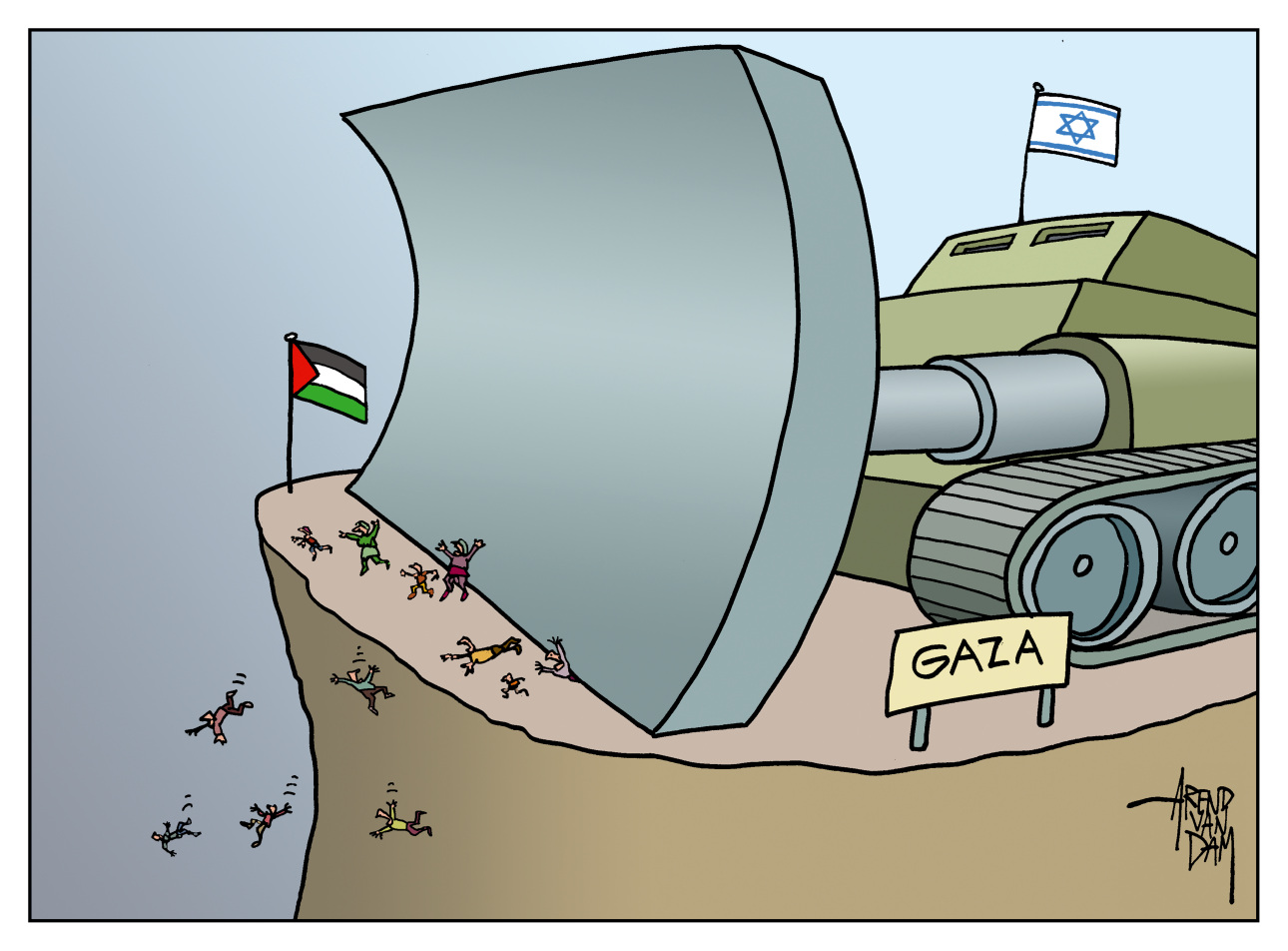
Hope, fragile though it may be, is not a wall to be scaled but a force that dissolves walls entirely. And yet, as this war grinds on, my own faith in hope falters. Each airstrike, each body pulled from the ruins, each scream silenced by rubble feels like another step into the abyss. The Israeli military, wielding its firepower with unrelenting force, turns living bodies into debris, treating flesh and blood as though it were mortar to be smashed.
The imagery of William Blake’s Tyger burns in my mind—a ferocious, devouring beast prowling among the lambs. Its blazing eyes illuminate a scene of unthinkable destruction, where innocence is consumed, and mercy is nowhere to be found. And as I bear witness to this horror, I wonder: Can hope survive the slaughter? Or are we all, like Blake’s lamb, helpless before the fearful symmetry of the Tyger’s wrath?
Comments

Powered by RoundtableAn AI/DeFi-powered Enterprise Media Operating System. Learn more at Roundtable.io.© Roundtable 2026. By using this site you agree to the Terms of Use and Privacy Policy