
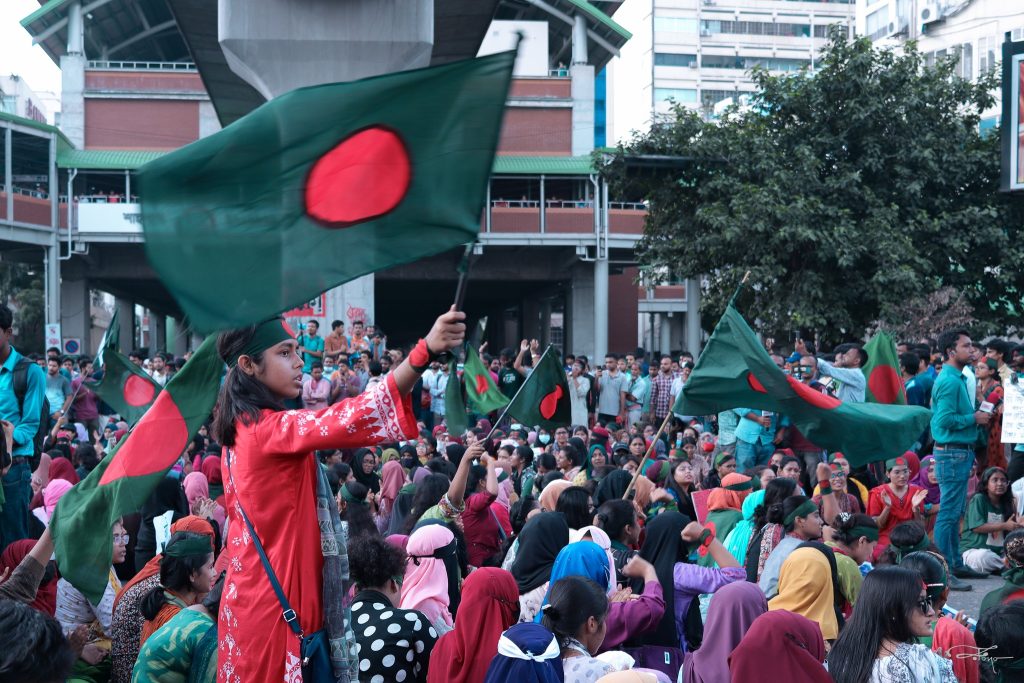
The day the fascist dictatorship was overthrown in Bangladesh


The day the fascist dictatorship was overthrown in Bangladesh.
May 10, 2025 2:52 PM
Updated May 10, 2025 4:22 PM
While we are watching the rollback of democratic institutions and norms in America, there are burgeoning democracies like the one in Bangladesh. Here at the five things that the international community can do support its democratic evolution and learn from it.
Bangladesh recently once again rose from the ashes of authoritarianism to reclaim its democratic soul. In August 2024, a student-led mass uprising in Bangladesh brought down a fascist regime that had gripped the nation for 15 years. The fall of Sheikh Hasina and her Awami League’s autocratic rule marked more than a political shift – it opened a historic window for democratic renewal. This civic movement, now widely referred to as the “July Revolution,” ended an era marred by political repression, surveillance, violence, and systemic corruption.
Yet as history shows us, the collapse of an authoritarian regime is only the prologue. The real challenge lies ahead: building the democratic architecture that was so systematically dismantled.
Under the leadership of Nobel Laureate Dr. Muhammad Yunus, the new Interim Government has been navigating that complex terrain. In a region where democratic backsliding has often been normalized, Bangladesh is attempting a rare and ambitious path forward. But reforms – no matter how visionary – face real resistance from entrenched interests and arefraught with obstacles, both internal and external, that threaten to derail Bangladesh’s progress.
Reforming a Hollowed State
The Interim Government has initiated comprehensive reforms aimed at restoring democratic governance and the rule of law. Eleven reform commissions have been established, focusing on critical areas such as the constitution, electoral system, police, judiciary, anti-corruption measures, and public administration. Notably, six of these commissions have already submitted their reports, outlining actionable steps for systemic change.
Related stories
For instance, the Constitutional Reform Commission proposed significant changes, including the introduction of a bicameral legislature, limiting the prime minister’s tenure to two terms, and an independent judiciary oversight board. Meanwhile, the Electoral Reform Commission made over 100 recommendations, such as empowering the Election Commission to suspend flawed elections for up to 90 days, contingent on Supreme Court approval, and disqualifying candidates accused of serious human rights abuses.
To ensure these reforms are rooted in broad consensus, a National Consensus Commission – comprising 26 political parties and 100 national leaders – was formed to co-develop a national charter of short- and long-term reforms. This approach, emphasizing dialogue over decree, marks a notable departure from Bangladesh’s often confrontational political culture.
The Reform-Election Dilemma
Timing the next national election has become a central debate. The Interim Government has proposed elections between December 2025 and June 2026, arguing that key reforms must precede voting to avoid a reversion to illiberal governance. By contrast, the largest political party currently, the Bangladesh Nationalist Party (BNP), insists elections be held within six months, citing democratic legitimacy.
Without structural changes, an early election risks repeating the cycles of cronyism and clientelism that led to democratic collapse in the first place.
Without structural changes, an early election risks repeating the cycles of cronyism and clientelism that led to democratic collapse in the first place. Political responsibility at this critical juncture must mean prioritizing reformed and strengthened institutional foundations over opportunistic timelines.
Geopolitical Fault Lines: India and China
The regional geopolitical context adds further complexity. India, long aligned with Sheikh Hasina’s government, has refused to extradite her, despite evidence from a recent investigation by the United Nations that documented widespread corruption and human rights violations under her regime. India’s support for the Awami League has come at the cost of its credibility among Bangladesh’s democratic reformers.
Furthermore, there is credible evidence of coordinated disinformation campaigns originating from both Indian state actors and Awami League affiliates. Over 3000 false claims were debunked in 2024 alone. These campaigns aim to delegitimize the Interim Government and sway international opinion against Bangladesh’s democratic resurgence.
On the other side of the geopolitical equation, Bangladesh’s relationship with China is evolving. China has offered support to the Interim Government, eyeing Bangladesh as a potential logistics and manufacturing partner in a shifting global economy. But while Chinese investment may offer economic lifelines and infrastructure development opportunities, the terms of such engagement must be transparent, equitable, and preserve Bangladesh’s strategic autonomy.
Economic Rebuilding: Between Recovery and Risk
Economic recovery has been central to the current rebuilding in Bangladesh. Despite uncertainty, investor sentiment has improved. At the Bangladesh Investment Summit 2025, over $260 million in FDI was pledged. Investor sentiment is improving as political stability returns, evidenced by a renewed appetite for capital markets and infrastructure projects. Remittances remain strong, bolstering foreign exchange reserves. The central Bangladesh Bank recently emphasized the need for enhanced regulatory oversight, particularly in banking, to stabilize economic expectations amid global slowdown.
Justice must not only be symbolic, it must be materially restorative.
Yet true recovery requires accountability. The Interim Government has launched a global asset repatriation initiative to recover $234 billion looted during the Awami League era, as documented in a 397-page official report released in December 2024. These funds, when returned, are intended for critical public services, including education, healthcare, and infrastructure. Justice must not only be symbolic, it must be materially restorative.
A Call to the International Community
Global superpowers such as the UK, US and the EU must resist the temptation to fall back on India-centric diplomacy when engaging with Bangladesh. This is a pivotal moment for principled partnerships – not realpolitik.
Here’s what global partners can do:
- Endorse the Reform Roadmap: Recognize and support that the Interim Government is undertaking complex structural and systemic reforms that go beyond surface-level change, but aim for sustainable democracy with strong institutions.
- Support Accountability: Urge India to end safe harbor for alleged war criminals and push for international mechanisms to counter disinformation. Support fact-checking and ground-truthing narratives around Bangladesh.
- Invest Equitably: Facilitate investments and collaborations that align with Bangladesh’s development goals while upholding democratic principles. Prioritize investments in labor-friendly, climate-resilient sectors aligned with Bangladesh’s long-term goals.
- Assist in Asset Recovery: Provide legal and diplomatic frameworks for repatriating stolen public wealth.
- Listen to Bangladeshis: Foster people-to-people engagement to cut through misinformation and understand what’s truly at stake.
A Final Reflection
Democracy is not restored with the fall of a dictator – it is rebuilt in the ruins of what authoritarianism hollowed out. Bangladesh’s journey will be long and messy. But it is also deeply hopeful. Let us support and honor the phoenix rising from the ashes – lifted by the courage of thousands of young people who gave their lives for a freer, fairer, and stronger Bangladesh.
This is not just a Bangladeshi moment. It is a global one. Let the world confirm that solidarity with democratic transformation means more than press statements. It means investment in reforms, justice, and truth.
Comments

Powered by RoundtableAn AI/DeFi-powered Enterprise Media Operating System. Learn more at Roundtable.io.© Roundtable 2026. By using this site you agree to the Terms of Use and Privacy Policy