


Jan 13, 2026 6:57 PM
Updated Jan 13, 2026 7:16 PM
A nationwide, leaderless movement—rooted in decades of protest—signals a deepening legitimacy crisis as Iranians demand dignity, sovereignty, and democratic rule
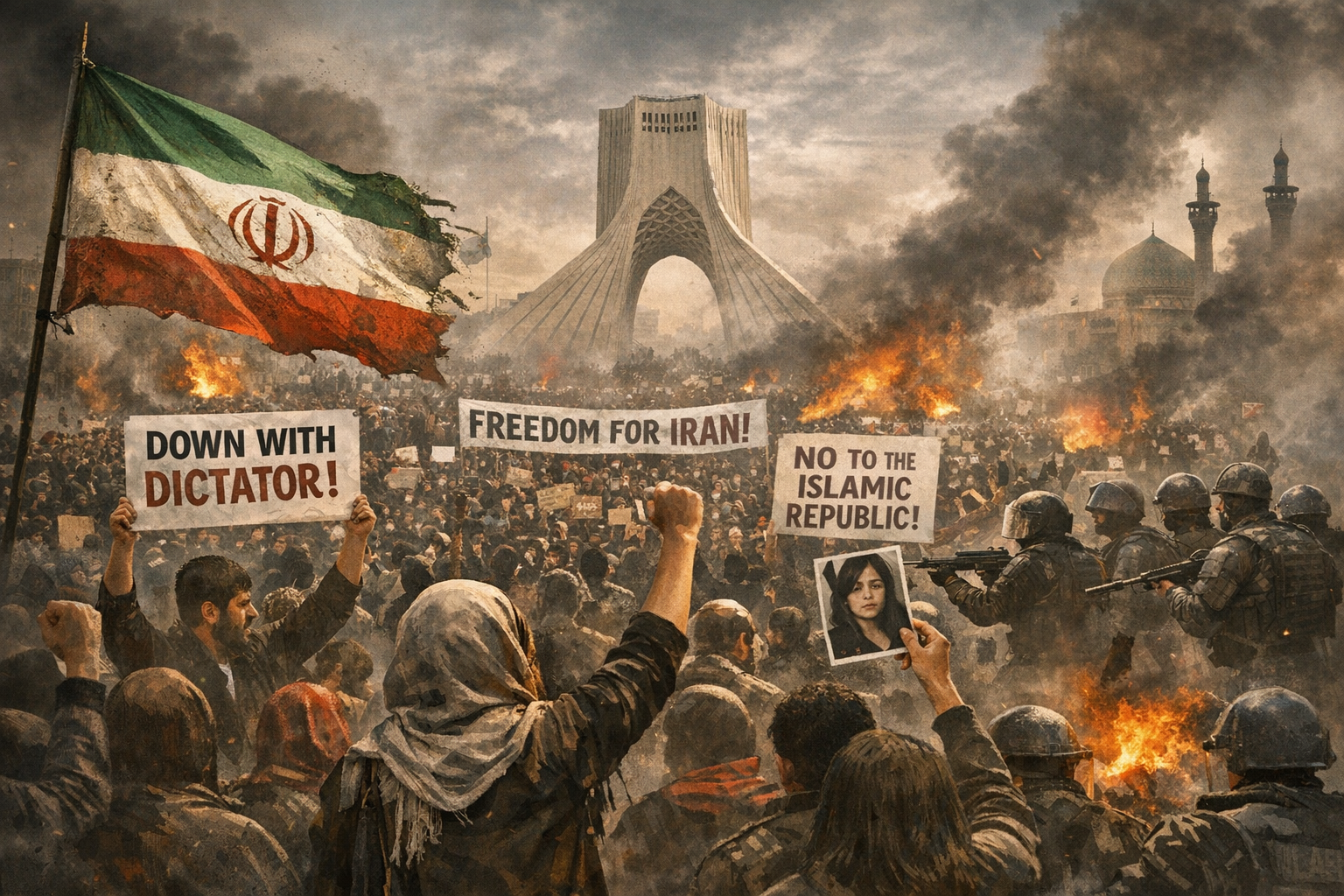
Mass demonstrations erupted across numerous Iranian cities on December 28, 2025, driven by ever increasing widespread public dissatisfaction with the Islamic Republic and a deepening economic crisis. The 2025–2026 protests are part of a continuing chain of popular uprisings against the Islamic Republic of Iran.
Since the 1979 Revolution, Iran has experienced recurring waves of popular uprising and mass protest, including but not limited to the 1998 and 2003 student uprisings; labor and teachers’ mobilizations in the mid-2000s; the 2009 Green Movement; nationwide economic protests in 2017–2018; the deadly November 2019 fuel-price uprising; the 2022–2023 Woman, Life, Freedom uprising sparked by the killing of Jina (Mahsa) Amini; and continuing the current wave of protests which initially sparked by soaring inflation, escalating food prices, and the sharp depreciation of the Iranian rial. The protests rapidly evolved into a broader political movement demanding an end to the current regime.
Across these 46 years, protest has shifted from reformist demands to explicit rejection of the political system; expanded from students and the urban middle class to workers, women, ethnic minorities, and marginalized regions; and increasingly linked to economic survival, environmental collapse, and human dignity. Movements have become more decentralized, leaderless, and feminist-centered—especially since 2022—while the state’s consistent response has been repression, resulting in a deepening and unresolved crisis of legitimacy.
The current wave of protests began with shopkeepers and bazaar merchants in Tehran, the demonstrations soon spread to other cities and provinces and universities, drawing large numbers of students across the country. Protesters voiced their grievances through explicitly political slogans, including “Death to the Dictator,” signaling a clear shift from economic protest to regime rejection.
Related stories
The current protests mark the most extensive wave of unrest in Iran since the nationwide demonstrations of 2022–2023 following the death of Mahsa Amini. As of January 5, 2026, at least 35 people have been killed and more than 1,200 individuals detained. Reports indicate that four of those killed were under the age of 18. Demonstrations were reported in over 250 locations across 17 of Iran’s 31 provinces, underscoring the national scope and resilience of the movement despite the Islamic Republic’s sustained use of repression and violence.
State violence has accompanied the protests in multiple regions. In Ilam Province, clashes in the Malekshahi area resulted in fatalities and numerous injuries. Security forces reportedly surrounded Khomeini Hospital in an attempt to arrest wounded protesters, an effort that was resisted by family members and medical staff. Such incidents highlight the regime’s disregard for medical neutrality and basic human rights and international law. Public mourning and memorial ceremonies for victims—such as that of Ahmad Reza Bowiri Barseni—have themselves become acts of resistance, further galvanizing public solidarity and defiance.
A wide array of civil society organizations and professional networks inside Iran have publicly aligned themselves with the protests. These include statements of support from the Writers Association of Iran, teachers’ unions, students, nurses, retirees, and segments of the labor movement. Among the most significant interventions was a joint statement issued on January 2, 2026, by seventeen prominent political and civil activists, entitled “A Peaceful Transition from the Islamic Republic: An Irrepressible Necessity for Iran’s Future.” The statement characterizes Iran as standing at a “decisive historical crossroads” and condemns decades of resource depletion, corruption, and authoritarian governance that have transformed inflation, poverty, and insecurity into instruments of repression.
The signatories emphasize that the ongoing civil resistance reflects a collective national will to dismantle an illegitimate political system and reclaim fundamental rights, including dignity, freedom, justice, and popular sovereignty. They explicitly warn law enforcement and security forces against participating in violence, stressing that such actions constitute crimes that will be permanently recorded in Iran’s historical memory. The statement reaffirms that a peaceful transition from the Islamic Republic is neither temporary nor suppressible and asserts that Iran’s future must rest on a democratic order grounded in popular sovereignty, national interests, and normalized international relations. A number of diaspora-based organizations and activist networks have also endorsed this statement, reinforcing its transnational resonance.
Importantly, both domestic and diaspora actors have stressed that these protests are neither engineered by political elites nor driven by factional competition. Rather, they represent the autonomous voice of a society seeking life, dignity, and a future free from systemic oppression. Teachers, workers, retirees, nurses, unemployed youth, women, residents of marginalized regions, and small business owners have collectively borne the costs of decades of mismanagement, structural corruption, and institutionalized deceit.
This emphasis on popular ownership of the protests is echoed in a separate statement by the Coordinating Council of Iranian Teachers’ Trade Associations, which declared unequivocally that the protests “belong to the people—not to factions or individuals.” The Council warned that any attempt to appropriate or engineer the movement would constitute a betrayal of the people and undermine the prospects for freedom and justice, drawing on the bitter lessons of past political failures.
International reactions have further complicated the unfolding crisis. On January 2, 2026, U.S. President Donald Trump issued a public threat of intervention should the Iranian regime continue to kill peaceful protesters, declaring that the United States was “locked and loaded.” Iran responded by formally appealing to the United Nations Secretary-General and the Security Council, urging them to condemn what it described as unlawful threats against its sovereignty. On January 5, UN Secretary-General António Guterres called on Iranian authorities to prevent further casualties, uphold the rights to freedom of expression, association, and peaceful assembly, and urged all regional and international actors to refrain from actions that could escalate tensions or destabilize the region.
These warnings are underscored by the findings of the UN fact-finding mission on Iran, which previously concluded that the Islamic Republic committed crimes against humanity during the “Woman, Life, Freedom” uprising. The regime’s capacity for repression remains formidable, including the systematic use of mass executions as a tool of intimidation. In 2025, Iran recorded its highest number of executions in over a decade, with at least 2,167 individuals sentenced to death.
The memory of more than 20,000 arrests and over 500 protesters killed during the Woman, Life, Freedom uprising might suggest that social recovery would require many years; however, the depth of the economic, social, and political crisis has created conditions that have once again driven large numbers of people into the streets to protest. Yet, the persistence of mass protests—reflected in street slogans and coordinated statements from civil society groups across sectors—demonstrates a renewed collective determination to effect change.
Crucially, these actors have also rejected foreign military intervention, emphasizing that Iran’s transformation must be led by its people alone. The courageous and fearless struggle against authoritarian rule does not, in their view, legitimize external political or military interference.
Iran’s future, as articulated by a broad spectrum of protesters and civil society actors, is being shaped through grassroots agency rather than foreign intervention or military force. Any sustainable political trajectory must therefore be grounded in the collective interests, equal citizenship, and democratic aspirations of all Iranians.
Comments

Powered by RoundtableAn AI/DeFi-powered Enterprise Media Operating System. Learn more at Roundtable.io.© Roundtable 2026. By using this site you agree to the Terms of Use and Privacy Policy