


May 11, 2026 6:51 PM
Watching Sachs today is like watching one of the engineers of the late twentieth century wander back through the machine room after the turbines have exploded.
Few economists have wandered so restlessly through the wreckage of the modern world as Jeffrey Sachs. Once the celebrated prodigy of Harvard’s economics department, Sachs became one of the most recognizable architects of the post–Cold War order, moving from debt crises in Latin America to the shattered economies of Eastern Europe and the former Soviet Union carrying the sacred instruments of neoliberal modernity: stabilization plans, fiscal restructuring formulas, and the cold algebra of global markets. Today he holds the title of University Professor at Columbia University— the institution’s highest academic rank — while serving as Director of the Center for Sustainable Development at the Columbia Climate School.1 For decades he has occupied the overlapping worlds of academia, international diplomacy, development economics, public health advocacy, and United Nations policy circles, becoming one of the most recognizable intellectual figures associated with sustainable development and global cooperation.
In recent years, however, Sachs has become something else entirely in the public imagination. He now appears with increasing frequency in the flickering digital amphitheaters of YouTube interviews, podcasts, livestreams, and online political forums, where millions listen as he delivers sweeping critiques of American foreign policy, militarism, sanctions regimes, economic nationalism, and the accelerating fragmentation of the international order.2
Watching Sachs today is like watching one of the engineers of the late twentieth century wander back through the machine room after the turbines have exploded. The language of growth statistics and trade flows still flickers through his speech, but beneath it one increasingly hears another register entirely: moral exhaustion, geopolitical anxiety, historical dread.
Whatever disagreements one may have with Sachs — and I have serious ones — it is impossible not to recognize the sharpness of his intellect. He possesses that increasingly rare capacity to move fluidly between economics, geopolitics, history, diplomacy, development theory, and moral philosophy while exposing the hidden assumptions beneath official narratives. His recent body of work has increasingly taken the form of a warning — a sustained alarm against what he sees as reckless U.S. geopolitical provocations threatening to push the world toward permanent instability and potentially catastrophic conflict.3 Beneath the economist now stands a global diagnostician warning that empires intoxicated by dominance often lose the ability to perceive reality itself.
Related stories
My own relationship to Sachs has been marked by profound disagreement. After Russian invasion of Ukraine, I strongly rejected his tendency to frame the war primarily through the lens of NATO expansion and Western provocation.4 I believed then, and still believe now, that Sachs underestimated the imperial character of Vladimir Putin’s project and too often reduced Ukraine’s struggle for sovereignty to a geopolitical contest between great powers. Ukraine is not merely a strategic corridor in the anxieties of Moscow and Washington. It is a nation with memory, language, democratic aspiration, and the right to resist conquest.
At times Sachs’ analysis seemed to dissolve the suffering of Ukrainians into the abstractions of geopolitical realism. Part of the problem, perhaps, is methodological. Sachs often approaches crises through systems analysis — balances of power, security arrangements, economic incentives, strategic miscalculation. Such frameworks can illuminate structural pressures shaping international conflict, but they can also flatten the moral and historical specificity of nations struggling against imperial domination. The anti-colonial dimension of Ukraine’s resistance risks disappearing inside the machinery of geopolitical explanation.
I cannot follow him there.
Yet intellectual seriousness requires the capacity to recognize when a thinker with whom one sharply disagrees nevertheless perceives truths of enormous consequence elsewhere. And on the question of Donald Trump’s foreign policy — particularly regarding Iran, tariffs, and the collapse of diplomacy into nationalist theater — Sachs has emerged as one of the most urgent and morally lucid critics in public life.
Based on his recent commentary throughout 2025 and 2026, Sachs views Trump not simply as a flawed leader but as an impulsive and profoundly dangerous figure operating within what Sachs repeatedly calls a “delusional” worldview detached from rational statecraft.5 Sachs portrays the Trump administration as a political culture driven less by informed analysis than by improvisation, grievance politics, coercive spectacle, and ideological fantasy. In Sachs’ estimation, the administration’s hostility toward international cooperation, climate agreements, diplomacy, and multilateral institutions threatens not merely American stability but the foundations of international order itself.
What makes Sachs’ critique so powerful is that he is not merely criticizing individual policies. He is dissecting an entire worldview. In Sachs’ analysis, Trump approaches international politics not as diplomacy but as spectacle. Negotiation becomes performance art conducted beneath giant floodlights of ego and grievance. Threats replace understanding. Humiliation substitutes for strategy. Coercion masquerades as statecraft.
Nations, however, are not casino rivals waiting to be psychologically intimidated into submission. They are historical actors shaped by memory, insecurity, domestic political pressures, cultural identity, and the accumulated trauma of war and intervention. Iran remembers the 1953 coup.6 Iraq remembers invasion. Russia remembers imperial collapse and encirclement anxieties. Ukraine remembers centuries of domination from Moscow. Diplomacy that ignores historical memory eventually collapses into strategic blindness.
Sachs repeatedly argues that Trump fundamentally misunderstands the nature of negotiation itself. Trump approaches diplomacy the way a casino owner approaches a debt collection: escalate pressure, cultivate unpredictability, project menace, and force submission through intimidation. But Sachs insists that sovereign nations do not negotiate according to the emotional logic of corporate acquisition culture. They negotiate through historical memory, survival instinct, nationalism, domestic political pressure, and fear. When diplomacy becomes humiliation theater, durable agreements become nearly impossible.
This critique becomes especially devastating in Sachs’ analysis of Iran. Sachs has described Trump’s posture toward Iran and the broader Middle East as reckless brinkmanship bordering on what he called a “war of whim,” driven more by impulse and political theater than constitutional or diplomatic seriousness.7 According to Sachs, the Trump administration’s approach reveals the bankruptcy of coercive diplomacy detached from reciprocity and realism.
The contradictions are stark. Washington issues maximalist demands while simultaneously tightening sanctions, escalating military threats, and signaling hostility toward the regime itself. Yet no government shaped by the historical memory of foreign intervention and regional insecurity can politically survive unconditional surrender. The collapse of the Iran nuclear agreement, followed by escalating sanctions and periodic threats of military confrontation, deepened precisely the atmosphere of distrust that diplomacy is supposed to overcome.8
Trump’s volatility intensifies the instability: one day comes the language of annihilation, the next vague promises of peace and “great deals.” Negotiation dissolves into geopolitical performance art. Sachs warns that such volatility is not strategic sophistication but strategic incoherence masquerading as strength. The danger, he argues, lies in the normalization of impulsive decision-making in a nuclear and heavily militarized world where miscalculation can produce irreversible consequences.
Sachs has gone even further in recent interviews, openly questioning Trump’s mental competence and emotional stability. In one widely circulated interview carried by ANI Broadcast, Sachs described Trump as “mentally unstable,” “delusional,” “impulsive,” and a “liar,” portraying him as a leader detached from disciplined analysis and increasingly governed by grievance, theatricality, and erratic instinct.9 Referring to Trump as impulsive, uninformed, chronically dishonest, and psychologically volatile, Sachs argues that the administration increasingly operates inside what he calls a “delusional environment” where ideological fantasy overrides institutional expertise and rational policy formation. For Sachs, this is not merely a matter of political disagreement but a profound danger to democratic governance itself.
The same pathology, Sachs argues, appears in Trump’s tariff policies. Trump treats trade deficits as though they were personal insults inflicted upon the nation, reducing the staggering complexity of global economics to the emotional language of revenge and humiliation. Tariffs become nationalist theater — giant iron gates slammed shut to reassure an anxious empire that it still controls the machinery of history.
Sachs dismantles this logic with biting precision. He repeatedly argues that Trump fundamentally misunderstands the structure of the modern global economy. Trade deficits are not signs that other countries are “cheating” the United States; they emerge from highly complex interactions involving capital flows, investment structures, consumer demand, reserve currency dynamics, labor markets, technological integration, and global supply chains.10
Trump’s economic worldview, Sachs argues, reduces these immense systemic realities to simplistic nationalist mythology.
The danger of this worldview extends far beyond economics. Sachs warns that escalating tariff wars accelerate geopolitical fragmentation by transforming economic competition into nationalist antagonism. Alliances weaken. Resentments deepen. Economic coercion feeds military rivalry. Trade policy becomes inseparable from strategic hostility. In such a world, diplomacy itself begins to decay because every negotiation becomes framed through domination rather than reciprocity.
And fragmentation, Sachs fears, eventually becomes geopolitical combustion.
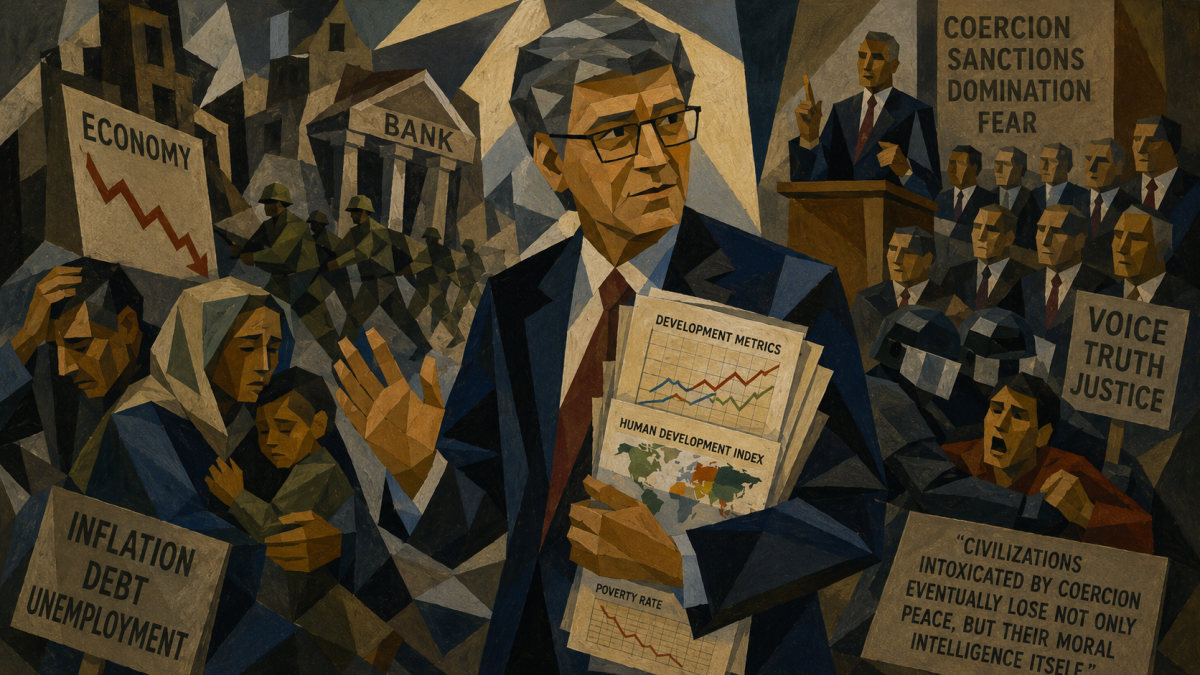
What emerges in Sachs’ recent commentary, therefore, is something more than economic criticism. Beneath the old technocrat now stands the humanist. The man who once moved through collapsing economies carrying spreadsheets and development metrics now sounds increasingly like a witness warning that civilizations intoxicated by coercion eventually lose not only peace, but their moral intelligence itself.
I still believe Jeffrey Sachs underestimated the imperial reality of Russia’s invasion of Ukraine. I still believe he too often framed that catastrophe through the prism of NATO expansion while insufficiently centering the lived reality of Ukrainians defending their sovereignty. But as Trumpian nationalism reduces diplomacy to branding, negotiations to humiliation rituals, and global economics to tariff mythology, Sachs has become one of the clearest voices insisting that the survival of international order depends not upon domination but upon understanding. The spreadsheets remain. But another voice has entered the calculations now — the voice of the humanist warning that a world governed by coercion alone eventually loses not only peace, but its capacity for reason itself.
Footnotes
- Columbia Climate School, “Jeffrey D. Sachs,” Columbia University, accessed April, 2026.
- Jeffrey Sachs has appeared widely on international podcasts, public lectures, and digital media forums discussing geopolitics, sanctions, and global instability throughout 2024–2026.
- Jeffrey D. Sachs, “The Geopolitics of Peace,” Other News, various essays and interviews, 2024–2026.
- Jeffrey D. Sachs, “The Causes and Consequences of the Ukraine War,” speech delivered at the European Parliament, February 19, 2023.
- Jeffrey Sachs, interviews and public commentary on U.S. foreign policy and the Trump administration, 2025–2026.
- All the Shah’s Men, by Stephen Kinzer (Hoboken, NJ: John Wiley & Sons, 2003).
- Jeffrey Sachs, interview commentary regarding Iran, U.S. foreign policy, and Middle East escalation, 2025–2026.
- Losing an Enemy, by Trita Parsi (New Haven: Yale University Press, 2017).
- Jeffrey Sachs, interview commentary on Donald Trump and U.S. foreign policy, ANI Broadcast, 2026, including remarks describing Trump as “mentally unstable,” “delusional,” “impulsive,” and “a liar.”
- Globalization and Its Discontents Revisited, by Joseph Stiglitz (New York: W.W. Norton, 2017).
Bibliography
Columbia Climate School. “Jeffrey D. Sachs.” Columbia University Climate School.
Kinzer, Stephen. All the Shah’s Men. Hoboken, NJ: John Wiley & Sons, 2003.
Parsi, Trita. Losing an Enemy. New Haven: Yale University Press, 2017.
Sachs, Jeffrey D. “The Causes and Consequences of the Ukraine War.” Speech delivered at the European Parliament, February 19, 2023.
Sachs, Jeffrey D. “The Geopolitics of Peace.” Other News. Various essays and interviews, 2024–2026.
Sachs, Jeffrey D. Interview commentary on Donald Trump, U.S. foreign policy, and geopolitical instability. ANI Broadcast, 2026.
Stiglitz, Joseph E. Globalization and Its Discontents Revisited. New York: W.W. Norton, 2017.
Comments

Powered by RoundtableAn AI/DeFi-powered Enterprise Media Operating System. Learn more at Roundtable.io.© Roundtable 2026. By using this site you agree to the Terms of Use and Privacy Policy