


Oct 17, 2024 3:12 PM
We all know that in most wars, there are usually high numbers of civilian casualties. But often many people just shrug and say that’s the price of war.
Think of all the civilian deaths caused by wars! To take just the most outrageous cases, consider Hiroshima and Nagasaki. In the twentieth century’s two world wars, civilian deaths outnumbered military deaths, staggering as the latter number was. In WWI, for example, the British naval blockade of Germany, which continued for months after the November 1918 armistice, caused anywhere from 424,000 to 800,000 civilian deaths, primarily due to malnutrition.
One of my favorite passages about all the deaths comes from novelist Ian McEwan in his Black Dogs (1993). World War II, he said, involved a “multiplicity, a near-infinity of private sorrows . . . a boundless grief minutely subdivided without diminishment among individuals . . . all those unique and solitary deaths, all that consequent sorrow, unique and solitary too, which had no place in conferences, headlines, history, and which had quietly retired to houses, kitchens, unshared beds, and anguished memories.”
In Israel’s present year-long war against Hamas (in Gaza) and its recent attack against Hezbollah (in Lebanon), Israeli Prime Minister Benjamin Netanyahu often claims, which may well be true, that Hamas and Hezbollah sometimes use or operate within civilian buildings like schools and hospitals. Thus, Israeli attacks destroying some of these structures--and civilians within. Collateral Damage--“injury inflicted on something other than an intended target; specifically: civilian casualties of a military operation”--is the claim.
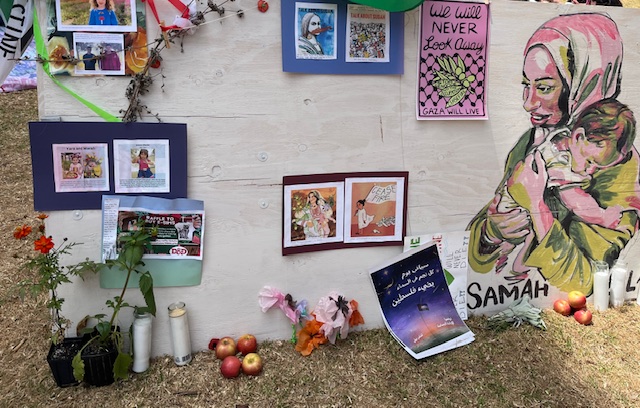
While the total number of Arab Palestinian deaths in Gaza is uncertain and disputed, it certainly includes more civilians than militant combatants against Israeli rule in that area. In mid-September 2024 the British newspaper The Guardian noted that Gaza’s health ministry issued a 649-page report “that identified 34,344 Palestinians killed by Israeli attacks in the territory, publishing a list of names, ages, gender and ID numbers that cover more than 80% of [the 41,000 plus] Palestinians killed in the war so far.” The remaining number “are Palestinians whose bodies have been received by hospitals and morgues, but whose identities have not yet been confirmed.”
Related stories
While the paper notes that Israeli officials dispute the health ministry numbers, it cites other sources that maintain the figures are generally trustworthy. Moreover, “a majority of the 34,344 [known] dead can be identified as civilians based on age and gender alone. It includes 11,355 children, 2,955 people aged 60 or older, and 6,297 women.” The newspaper also indicated that the known dead are “listed largely by age,”and the “first adult names do not appear until page 215.”
Regarding the more recent Israeli bombing in Lebanon aimed at rooting out Hezbollah, The Washington Post ran a story on 11 October, 2024 with the headline “Israeli airstrikes in Lebanon take heavy toll on civilians.” The article noted that “as Israel expands a ferocious air campaign in Lebanon that it says targets Hezbollah with precision, the civilian toll is soaring--reviving critical questions about the consideration Israel gives to noncombatants when it carries out the strikes.”
Like the reports of Leila Molana-Allen on the PBS News Hour (see, e.g., here), The Washington Post article gives individual examples of civilian suffering and creates the impression that it is out of proportion to the goals Israel seeks. For example, it writes of a 7-year-old girl who “sat in her hospital bed last week, wounded in both legs by an Israeli airstrike,” but who “had not been told that the strike had killed her mother, a brother and four other members of her family.”
We all know that in most wars, there are usually high numbers of civilian casualties. But often many people just shrug and say that’s the price of war. And whether they consider the war justified or not depends on other criteria.
Like McEwan, however, I’ve lately been thinking of a “multiplicity, a near-infinity of private sorrows . . . a boundless grief minutely subdivided without diminishment among individuals . . . all those unique and solitary deaths, all that consequent sorrow.” And I’ve concluded that Netanyahu and those who support him do not feel that pain, that sorrow, enough. They do not use their imaginations enough; they are not empathetic and creative enough to maintain Israeli security by less deadly means.
One does not have to be a total pacifist to have such thoughts. Take, for example, Yitzhak Rabin. After a military career and serving at times as Israeli defense minister and prime minister, in the latter roll he signed the Oslo Peace Accords in 1993 and 1995. But as I pointed out late last year, unlike Rabin, “Netanyahu lacks the imagination and empathy to lead Israel to a peaceful path.”
Regarding imagination, Netanyahu is certainly not the first political leader to demonstrate a paucity of it. To take just one example, in 1968 writer Wendell Berry said: “We have been led to our present shameful behavior in Vietnam by this failure of imagination, this failure to perceive a relation between our ideals and our lives.”
Less than a year before, Martin Luther King Jr. (MLK) had displayed such imagination (and empathy) when he stated:
All the while the [Vietnamese] people read our leaflets and received the regular promises of peace and democracy and land reform. Now they languish under our bombs and consider us, not their fellow Vietnamese, the real enemy. They move sadly and apathetically as we herd them off the land of their fathers…. So they go, primarily women and children and the aged. They watch as we poison their water, as we kill a million acres of their crops. They must weep as the bulldozers roar through their areas preparing to destroy the precious trees. They wander into the hospitals with at least twenty casualties from American firepower for one Vietcong-inflicted injury…. They wander into the towns and see thousands of the children, homeless, without clothes, running in packs on the streets like animals. They see the children degraded by our soldiers as they beg for food. They see the children selling their sisters to our soldiers, soliciting for their mothers.
In addition to all the civilian deaths and suffering, I’ve also been thinking of the whole question of proportionality, a question that should be central to the defense of any war.
According to the website of the Internet Encyclopedia of Philosophy (IEP), which spells out the “Just War Theory,” it goes way back, and in the 13th century St. Thomas “Aquinas presents the general outline of what becomes the traditional just war theory. . . . He discusses not only the justification of war but also the kinds of activity that are permissible.”
According to the IEP website, the principles of the just-war theory commonly include “having just cause” and “the end being proportional to the means used.” Regarding the proportionality principle, the site adds that the war “commonly entails the minimizing of war’s destruction.”
This “minimizing of war’s destruction” is what (at least since 1914) has gone completely out of whack. The radical monk, writer, and poet Thomas Merton (1915-1968) realized this. One book about him states that although he never completely rejected Catholic just-war teachings, he believed that “war in the twentieth century had gone far beyond the point at which morality entered into it.” In 1964, he wrote a favorable essay on Gandhi, the individual who in the twentieth century contributed the most to non-violence thinking and was a major influence on MLK. And like MLK, Merton vigorously opposed the Vietnam War.
Now in 2024, with Israel killing a great number of civilians in both Gaza and Lebanon--however justified more limited responses might have been--and with Russia assaulting Ukraine, a major problem remains that our thinking about peace, about maintaining or restoring it, has advanced so little since the deaths of Gandhi and in 1968 of MLK and Merton. We continue to make technical advances (like, for example, regarding Artificial Intelligence), but if making a profit is not involved, other progress is sluggish, or even nonexistent.
In 1948, the year Gandhi was assassinated, General Omar Bradley said, “Ours is a world of nuclear giants and ethical infants. We know more about war than we know about peace.” Today, more than three-fourths of a century later, his words are still true.
Comments

Powered by RoundtableAn AI/DeFi-powered Enterprise Media Operating System. Learn more at Roundtable.io.© Roundtable 2026. By using this site you agree to the Terms of Use and Privacy Policy