


Feb 5, 2023 2:00 PM
It's not an exaggeration to say that China, as a civilization state, pioneered the very concepts of diversity, inclusion and ecumenical, multi-religious tolerance and harmony.
Holocaust Remembrance Day, Jan 27th, memorializes the date when Auschwitz was liberated by the Red Army in 1945. This day commemorates the millions of Jewish lives lost during the holocaust, as well as countless other minorities.
In the current historical moment it's also important to remember another part of this story.
In 1938, in early July, a group of the representatives of 32 countries met at Evian-les-Bains, France, to decide whether to let in Jewish refugees fleeing Nazi Germany.
The Jews had already been stripped of their citizenship by the Nuremberg Laws and had been designated "enemies of the state". To their eternal shame, most of the countries participating refused to allow entry, not wanting, as the US representative put it, to "import a Jewish problem" to their own countries.
Only the tiny Dominican Republic agreed to allow in Jewish refugees. (Scholars point out that Zionist leaders like Ben Gurion did not support the Evian process in order to pressure migration to Palestine.) Again, in 1943, in the Bermuda conference, the US and the UK refused to allow entry of Jews.
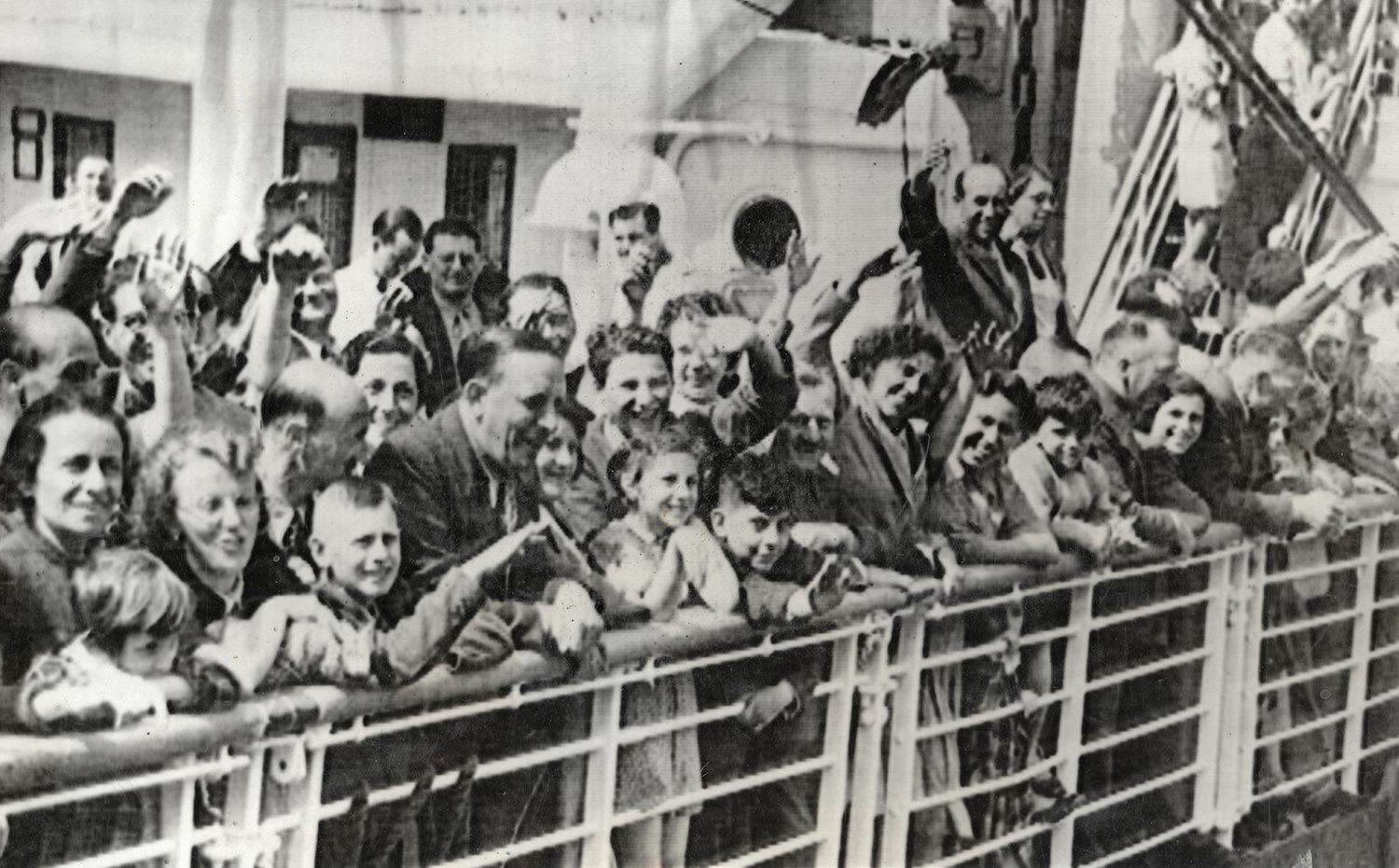
In 1939, May 13, over 900 desperate Jewish passengers boarded the St. Louis from Hamburg to go to Cuba, where most were refused entry. They then went to Miami, where they were again denied entry. Canada also denied entry. They eventually returned to Europe, where hundreds of them would eventually perish in the Holocaust.
The world essentially became cleaved into two: countries forcing Jewish people out, and countries refusing to let them in.
During this horrific period, it's also a fact that China became the only place on the planet that allowed continuous, open, unconditional sanctuary to fleeing Jews.
This was not a random accident of history, but a result of China's long cultural traditions: there were already vibrant 19th and 20th century Jewish émigré communities in Tianjin, Shanghai, and Harbin. But even before that, for over thirteen hundred years, merchant Jews had traded and settled in China, and synagogue communities had been established all in all major port cities of China, including Hangzhou, Ningbo, Yangzhou, Ningxia, Guangzhou, Beijing, Quanzhou, Nanjing, Xi'an, Luoyang, and Kaifeng.
Seven Chinese family names can also be Jewish, Ai (艾), Shi (石), Gao (高), Jin (金), Li (李), Zhang (張), and Zhao (趙); "Jin" and "Shi" are, of course, Chinese translations of "Gold" and "Stone". These Jewish communities also freely intermarried with Muslim communities, who also had a large, unfettered, and open presence in China, to the astonishment of early Western observers to China.
In fact, it's not an exaggeration to say that China, as a civilization state, pioneered the very concepts of diversity, inclusion and ecumenical, multi-religious tolerance and harmony—drawn from its Confucian, Buddhist, Taoist, and Mohist traditions. In particular, Mohism's concept of Jian Ai ("inclusive/universal care": 兼愛) argues for a inclusive care and universal love, based on the bedrock belief of humanity as one large family. This carries up to the current moment with the statement that "All under Heaven are one family". This contrasts with the centuries of oppression when European Christians were mercilessly subjecting Jews to violent pogroms and slaughtering Muslims wholesale.
Harvard Historian Simon Schama describes the contrast succinctly in his book Belonging: The Story of the Jews 1492–1900:
"To survey the predicament of Jews in much of the rest of the world is to marvel at what the Kaifeng community escaped. In China, Jews were not subjected to violence and persecution, not demonized as God killers. Their synagogues were not invaded by conversionary harangues. They were not physically segregated from non-Jews nor forced to wear humiliating forms of identification on their dress. They were not forced into the most despised and vulnerable occupations, not stigmatized as grasping and vindictive, and portrayed neither as predatory monsters nor pathetic victims."
Related stories
Other historians concur: Scholar of Religion Jordan Paper stated in his ground-breaking study, Theology of the Chinese Jews, 1000-1850:
"For nearly a millennium ..[Jews in China] existed in an atmosphere of tolerance, indeed of complete acceptance, and they not only maintained a traditional Jewish life but adapted to a Chinese one as well."
Likewise, Nathan Katz points out that Jews in China were among that rare historical group of diaspora who "never experienced anti-Semitism, making them unique among the world's Jews."
This inclusive care was also reflected, during the Holocaust, in the individual actions of Ho Feng-Shan, the Chinese Consul-General in Vienna known to have issued 1000's of visas to Jews in Austria. This allowed Jews to leave the country (whether they were going to China or not), thus saving countless lives. Ho is known to have never publicized his actions in his lifetime, and recognition was conferred only after his death from the testimony of survivors and the descendants of survivors. His granddaughter explained away this modesty as her grandfather's attitude that this was unremarkable, expected behavior of any human, "something anyone should have done in his position". He is sometimes referred to as the "Chinese Schindler".
Shanghai itself was a genuine sanctuary for Jews, according to Courtney Lichterman:
Shanghai—already home to a few thousand Jewish immigrants who started slowly arriving as early as the mid-19th century for business or later to escape the Russian Revolution—not only did not require visas for entry, but issued them with alacrity to those seeking asylum. In many cases, newly arrived immigrants were not even asked to show passports. It was not until 1939 that restrictions were placed on Jewish immigrants coming into Shanghai and even then these limitations were decided not by the Chinese, but by the amalgam of foreign powers that controlled the city at the time. This body, made up both of Westerners and Japanese who wanted to restrict the influx of Jews, decided that anyone with a “J” on their passport would now have to apply in advance for landing permission...
Nevertheless, many of the Shanghai locals, in spite of their own hardships, welcomed their new neighbors and shared what little they had, whether that meant housing, medical care, or just simple kindness. Gradually, with that support, Jewish refugees began, little by little, to create lives in their new country, and before long, the proliferation of Jewish-owned businesses was such that the Hongkou area became known as “Little Vienna.” Like their Chinese neighbors, they did their best to survive in difficult circumstances. They established newspapers, synagogues, retail businesses, restaurants, schools, cemeteries, guilds, social clubs, and even beauty pageants. They practiced medicine, started hospitals, got married, had babies, and held bar and bat mitzvahs. They learned to cook in coal-burning ovens and to haggle with street vendors.
Eventually 20,000 Jews found refuge in Shanghai.
"If the [people of Shanghai] had not been so tolerant, our life would have been miserable," Moses [a Jewish Shanghai refugee] is quoted as saying. "In Europe, if a Jew escaped, he or she had to go into hiding, and here in Shanghai we could dance and pray and do business."
Such camaraderie was key to maintaining the spirit of Shanghai's Jewish community, many of whom still had family in mortal danger back in Europe. At a time when hopeful entrepreneurs from across the world looking to strike it rich had turned Shanghai from a humble fishing village into the world's fifth-largest city, Tilanqiao [quarter in Shanghai] didn't offer Jewish refugees wealth or luxury, but something much more valuable: safety.
As the US attempts to prepare the world mentally for war against China using a torrent of lies, slander, and propaganda against the Chinese peoples and government—that the Chinese are a threat to the world and to the global order; that they are committing "genocide"—it's important to remember this critical history.
These slanders are refuted categorically by the facts on the ground, most notably in the multi-fold increase in minority populations, their increasing economic well being, their soaring life expectancies, and above all, in the quality of their lives.
Uighurs, Tibetans, and the other fifty three ethnic minorities—are thriving, proud inheritors of their own history and culture, even as they are given representation to participate as equal, valued, and respected actors in the collective development of a prosperous multi-ethnic civilization-state. This project itself is grounded in millennia-long traditions of multi-religious/multi-ethnic coexistence, inclusivity, and universal care, continued dialectically to the current moment in the socialist mass line of "serve the people"—all people—in order to create a community of common destiny for all mankind
An earlier version appeared in Asia Times: Forgotten history: China as Holocaust sanctuary
Comments

Powered by RoundtableAn AI/DeFi-powered Enterprise Media Operating System. Learn more at Roundtable.io.© Roundtable 2026. By using this site you agree to the Terms of Use and Privacy Policy