
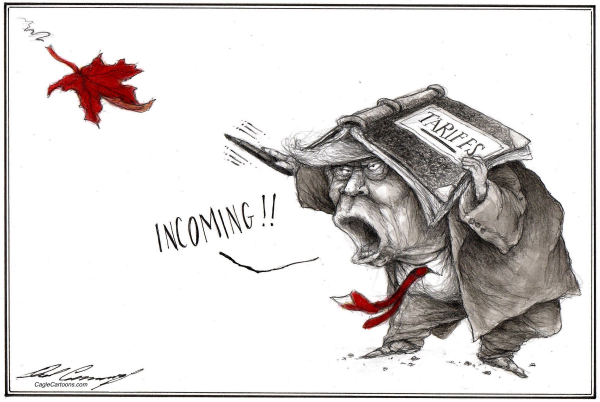


Cagle Cartoons: Dale Cummings
Mar 24, 2025 9:11 AM
Updated Mar 24, 2025 6:42 PM
His words strut forth like gaudy peacock plumage, his imagination bloated and swollen with the excess of imperial dreams
President Trump, with his words laced in arrogance, has called my native country, Canada, "nasty" to deal with, deeming it unworthy of its sovereignty—suggesting it could fit more neatly as America's fifty-first state. His words strut forth like gaudy peacock plumage, his imagination bloated and swollen with the excess of imperial dreams, as though the world itself were his to conquer and reshape.
In this grandiose fantasy, he sees the nations of the world as pieces on a chessboard, their autonomy mere obstacles to his vision of dominance. But what he fails to grasp, in his hubris, is that Canada’s sovereignty is not a prize to be claimed or a trophy to be displayed. It is a nation—its own people, history, and spirit standing tall, free from the shackles of outside control.
Trump’s words do not just sting—they are an assault on the dignity of a people, an affront to the quiet but profound garden of diplomacy that once flourished between nations. His pomposity, towering and unchecked, tramples on the delicate petals where civility once bloomed, casting shadows over what was once a relationship built on respect and mutual understanding.
His visions of grandeur drown out the quiet hum of cooperation, as if his crude swagger could replace the gentle firelight of diplomacy that once flickered warmly between our lands, as if his brazen, uncaring rhetoric could cast aside the centuries of peaceful coexistence between two nations that share so much more than borders.
Related stories
But this is not the world that we, as Canadians, will accept. For we are not a vassal or a colony to be absorbed. We are a proud, independent nation—one whose strength lies not in conquest, but in the quiet resilience of our people, the wisdom of our leaders, and the deep-rooted belief in our sovereignty.
Throughout our shared history, Canada and the United States have woven threads of unity and shared purpose. Our nations, standing shoulder to shoulder, have faced the tempests of war, emerging not as mere neighbors, but as steadfast allies. The world's longest undefended border stretches between us—a testament to mutual trust and respect.
Our economies, like two rivers converging, have flowed together, enriching both lands. Each day, goods and services worth billions traverse our border, fueling prosperity and innovation. This economic symbiosis has fostered a bond that transcends commerce, nurturing a shared commitment to democratic ideals and global stability.
Then came Trump. Policies that echo protectionism and imperialism threaten to unravel the fabric of our alliance. Proposed tariffs and expansionist rhetoric not only jeopardize economic ties but also challenge the principles of sovereignty and mutual respect that underpin our relationship.
Such actions risk dismantling a partnership that has been a cornerstone of peace and progress that are the envy of the world. The imposition of tariffs, for instance, could disrupt integrated supply chains, harm industries on both sides, and strain the goodwill cultivated over a century. Moreover, expansionist ambitions undermine the rules-based international order established post-World War II, eroding the trust that nations have placed in peaceful coexistence.
It is imperative to remember that our strength lies in unity, not division. The challenges of the 21st century—be they economic, environmental, or security-related—demand collaboration.
We cannot afford to let the corrosive touch of short-sightedness cast shadows over an alliance that has long been a beacon of hope and prosperity across our shared continent. For generations, the partnership between Canada and the United States has illuminated the path of peace, progress, and shared ideals—its light reaching far beyond our own borders to inspire the world.
Now, more than ever, it is imperative to reaffirm our commitment to this enduring alliance, to nurture the ties that have not only benefited both nations but have served as a cornerstone of global stability. To abandon this partnership in the name of division and mistrust would be to sever a lifeline woven through history’s most arduous trials.
Let us stand firm against the encroaching darkness. Let us defend the common bonds that have united our peoples in times of war and peace alike. For it is only through unity and resolve that we can ensure a brighter, more just future for all.
The world stands at a precipice, its breath caught in a chill of dread. The danger Trump poses is far worse than many Canadians and Americans dare to imagine. What we face now is not a political squabble or a passing storm. It is a world-historical reckoning, a firestorm of madness that even the sharpest political minds of a generation ago could scarcely have foreseen.
We live within a tinderbox, the air thick with the sulfurous stench of division, where a single spark could engulf entire nations. It is no exaggeration to say the world now trembles, for it has seen in Trump this nightmare before. The same madness draped in new regalia, but exuding the same rot and decay. Then, it was a continent away, barely over 90 years ago.
Our fathers and grandfathers knew that horror well. They trudged through blood-soaked soil, their boots sinking into the mud of battlefields suffocating in the acrid scent of death and iron. They stared into the eyes of tyranny itself—eyes burning with a hunger so ravenous it devoured entire nations.
They saw the rise of a madman whose deranged thirst for power sought to conquer the entire world. Clad in regalia of terror, he bellowed promises of greatness while sowing ruin with every step. And yet, against such darkness, our ancestors stood their ground.
In the trenches of World War II, they clung to the fragile hope that evil could be buried beneath the rubble of its own cruelty. They bled, they fought, they died to crush the engines of fascism, to silence the madness that threatened to engulf the world in shadow. But history is a restless beast, never content to be held at bay. The echoes of those madmen’s voices still slither through the corridors of history, their terrible notes of conquest and bloodlust reverberating through the ages.
And now, the darkness does not gather from across a distant ocean. It is here, spreading like rot through the heartland of America. The flames of tyranny have been kindled by the very hands sworn to defend liberty. The same madness, inspired by a cult of glory, fear and dread, dressed in new slogans but reeking of the same ancient decay, prowls our own soil with the hunger of a beast unleashed.
Donald Trump, a man in whose shadow fascism steps with renewed confidence, fans the embers of hatred and division with a cruelty familiar to those who have glimpsed the abyss of dictatorship. His words are not mere rhetoric; they are weapons, bludgeoning truth until it lies bloodied and misshapen, unrecognizable to those who once cherished it.
The cult of Trump, a grotesque distortion of loyalty, a feverish devotion fed by lies delivered in cadences craven and cruel. His words, poison wrapped in the honeyed allure of destiny, sway not only to the sound of his voice but to the twisted visions he paints: purity, power, vengeance. In his presence, decency withers.
Followers of MAGA, once the salt of the earth, now embrace brutality as virtue. The madness is not only his—it is theirs, woven into the very fabric of their belief.
And yet, his power was not forged through brute force alone. It was conjured through manipulation, through the slow erosion of truth until only his warped reality remained.
Entire nations tremble before the cult he has built, a machine of hatred now aimed at Canada. The sheer scale of his influence is a testament to the terrifying power of a single, deranged mind given free rein to spread its contagion.
The cult of Trump is not just a political movement; it is a descent into moral darkness, a collective surrender to the worst impulses of humanity. And as history will bears witness, the true horror lay not only in the man himself, but in the millions who choose to follow him into the abyss.
His ambitions are ravenous, his hunger for power the same beast our forefathers bled to destroy. He speaks of greatness, but his vision is one of conquest, not unity.
For tyranny is never content with merely existing—it consumes. And when it is left unchecked, it spreads like wildfire, razing all that stands in its way. History’s lesson is carved into the gravestones of millions: tyrants do not stop at borders. They expand, they consume, they devour until nothing but ashes remain.
To ignore this is to invite catastrophe. To remain silent is to become complicit. The flicker of authoritarianism has already been ignited; it spreads now not only from foreign shores, in the battlefields of Ukraine, but from within.
For tyranny is a disease that feeds on division and thrives in silence. And if we do not stand against it, united and unyielding, we will find ourselves drowning in the very darkness our fathers fought to destroy.
We must not forget the lessons our ancestors paid for with their lives. We must not allow the darkness they vanquished to rise again, this time from within.
What we face now is not merely a political squabble between neighboring nations, but a fundamental rift in the fabric of civilization itself. The ideals of cooperation and peace—principles fought for in the mud and ruin of battlefields—are threatened by voices that preach division, by leaders who would tear down the bridges built by better men.
The world watches with baited breath, for the stakes are not confined to our own shores. Our alliance, once a beacon of hope, now flickers with uncertainty. The forces of authoritarianism gather, emboldened by our disunity. They see not the strength of our convictions, but the cracks in our resolve.
If we let this alliance wither, if we allow resentment and greed to poison what generations have built, we invite a darkness that will not stop at our doorstep. For tyrants do not seek borders—they seek dominion. And if history teaches anything, it is that the hunger for power is never sated by mere conquest; it is a beast that devours until nothing remains.
But there is still time. Time to remember who we are. Time to restore the common purpose that binds our nations. Time to stand, not as adversaries, but as allies whose fates are intertwined. As the saying goes: in unity, there is strength. And in strength, there is hope.
Now, America teeters at the precipice of another dark age. A new tyrant, this one draped in the cheap gold of vanity and grievance, enthralls the minds of his followers with promises of conquest and revenge. Territorial expansion is his new dream, although he ran for office as an isolationist. His lust for power reaches beyond borders, his gaze fixed hungrily upon Panama, Greenland, Canada—as if the very earth itself is his birthright to claim.
But it is not only the man himself who poses the threat. It is the machinery built around him, the schemers and zealots grinding gears of policy into weapons. Project 2025 is MAGA’s blueprint for dominance, a ruthless script written with the ink of cruelty and ambition. Its architects do not seek to govern; they seek to subjugate, grooming a nation into ideological submission, fashioning foot soldiers eager to sacrifice themselves upon the altar of their Dear Leader’s whims. Its architects work in shadows, their aim is nothing less than to rewrite America itself.
Trump’s diatribe against Canada was a fevered anthem, fit for a torchlit parade where iron clashes against iron, the din echoing through Charlottesville’s shadowed avenues where a twisted procession of “very fine people on both sides” swayed to a dissonant dirge of hate, their chants rising like a polluted tide of malice dressed as patriotism.
Trump’s imperial rhetoric has draped the land in a cold fog, leaving citizens of both Canada and the United States to wrestle with the discordant notes of our shared humanity, stumbling through the haze where truth and malice blur.
The air is thick with the acrid stench of books aflame and liberties vanishing skyward like the breath of a dying age. Anthems once radiant with the pulse of freedom now stagger and convulse, lunatic hymns stripped of grace, their meanings disfigured into cruel jest. And those who drape themselves in the tattered mantle of “Republican” crawl like shadows toward a throne of rot and ruin, forged from the shattered remnants of truth and the bleached bones of justice.
Gil McGowan’s call to arms is a sharp reminder that this battle cannot be won through appeasement. The man in the golfing jersey at Mar-a-Lago is oblivious to reason and tethered to indecency. His followers have turned cruelty into virtue, and slogans into scripture. Their loyalty is not to America, but to the cult of personality that now grips their souls.
If Americans will not heed the warnings of history regarding tariffs, then they are destined to feel the pain of their own choices. High power bills and blackouts in New York. Gasoline shortages in Detroit and Cleveland. Empty shelves in supermarkets where abundance once reigned. It is a cold calculus, but one grounded in reality: pain, after all, has a way of breaking through the noise. It is a bitter arithmetic, precise and unyielding, etched in the harsh ink of economics. For pain, relentless and raw, possesses a brutal eloquence—a sharpness that slices through the clamor of illusions and half-truths, leaving only the undeniable ache of what is real.
Canada does not wish to be the hand that tightens the economic vise. But if that is the only language understood by a nation led astray, then so be it. Better to be reviled for holding a mirror to the face of madness than to kneel before it in submission.
Because the alternative is unthinkable: a world where the flames of fascism once more engulf the innocent, where the lessons of the past are erased and rewritten by those who worship power above all else.
The contagion will spread like wildfire. Across borders, across oceans. No nation will be safe from the disease of hatred and domination if it is not stamped out where it festers.
To my American friends who tear down the pillars of the Department of Education and bleach the pages of history, scrubbing away the historical stains of cruelty and conquest as if purity could be conjured from denial—you kneel before your saints while turning your gaze from those who dared to illuminate the minds of the oppressed. You shun voices like Paulo Freire, revered as the patron of education in Brazil, a torchbearer whose light has guided countless souls toward freedom’s horizon. You preach of righteousness while dismantling the very tools that might forge a more just and compassionate nation. Yet even as darkness gathers, the light of resistance burns.
Freire’s work is not just a text; it is a praxis-oriented narrative that empowers the marginalized, encouraging them to question oppressive structures and claim their voices. His work, Pedagogy of the Oppressed, has been embraced across continents as a critical means to question oppressive structures and claim their voices. In Brazil and in dozens of countries whose inhabitants yearn for freedom, Freire’s ideas have inspired countless educators and social movements striving for genuine democracy.
Freire’s legacy endures as an inspiration to educators and social movements who refuse to yield to tyranny’s shadow.
Where Project 2025 envisions a nation of indoctrinated foot soldiers, Freire’s pedagogy offers a sanctuary of critical consciousness. A mirror held up to the face of power, demanding accountability. A hammer and chisel wielded by the oppressed, carving pathways toward freedom.
Yes, MAGA fears Freire’s vision like fire in a dry field. To MAGA, history is a predator lurking at the edges of their manufactured idyll, a feral truth that threatens to shatter their brittle order. Authoritarians have always known that an educated populace is a double-edged sword—one that can carve pathways to liberation as easily as it can sever the chains of ignorance. They understand all too well the power of a people who can read the world as fluently as the word, who can decode the language of oppression and rewrite it with the ink of resistance. And so, they wage war against Freire’s teachings and that of other critical educators, desperate to raze the foundations of critical thought and dialogue, to snuff out the spark that dares to call itself freedom. To destroy Paulo Freire’s legacy is to silence the cry for justice. And yet, the struggle persists. From the favelas of Brazil to the classrooms of the world, his influence endures. His words echo against the walls of oppression like thunder rolling over distant hills, a promise that the storm can be weathered, and that freedom can still be reclaimed.
Because if America falls, it will not fall alone. And if Freire’s light is extinguished, then the darkness will have truly won.
But there’s a tragic irony in how his legacy is under attack today. MAGA despises Freire’s work precisely because it arms people with the tools to question power. Freire’s pedagogy, with its emphasis on dialogue, reflection, and action, is the antithesis of the indoctrination authoritarian regimes rely upon.
Freire’s work indeed unfolds like a poetics of hope, a luminous rebellion against the cold metrics of oppression. It is a pedagogy that rejects the sterile calculus of transaction, rising instead as a transcendent outlawry—an education that defies the chains of conformity and summons the audacity to dream. His vision speaks with the cadence of prophets and poets alike, invoking a prophetic imagination that does not merely critique the unjust order but dares to envision its unraveling. Freire’s pedagogy is both a mirror and a torch, reflecting the wounds of the world while igniting the courage to heal them, to struggle, to transform, to create something more humane and just from the broken architecture of cruelty.
My American friends, you turn away from those critics of capitalism, whose teachings can steer us away from the oligarchic mad hatters of neoliberal policies that feed the rich and betray the poor. Many of these algorithms produce racially biased outputs on online platforms enabling companies to discriminate against users of color or promote propaganda that reinforces false narratives, and that plays to negative stereotypes.
Have you stood in the shadow of Stephen Miller’s voice, a serpent’s hiss wrapped in silk, coaxing darkness to bloom where reason withers? Have you watched Elon Musk, a jester-king in gilded armor, dancing madly on a tightrope of ego stretched across a chasm of emptiness? Have you strained your ears to the clanging cacophony of Lauren Boebert and Marjorie Taylor Greene, their words the shrieks of rusted metal grinding against the bones of truth? And you choose this grotesque opera over the works of Freire, of Martin Luther King, of Malcolm X, of bell hooks? And the saints? They watch from the distance, heads bowed, voices weeping like rain.
Have you heard Steve Bannon, that grinning architect of decay, his voice a rasping forge stoking the fires of fear and fury? He spins darkness into doctrine, his words molten iron poured into the brittle molds of the desperate, forging legions blinded by their own rage. His gaze is a lidless eye, searching always for the next vein of hatred to mine, the next soul to conscript into his army of the damned. And yet, the masses drink his poison as if it were salvation, mistaking the stench of his lies for the incense of truth. But even the most twisted prophets sometimes speak fragments of truth, their words slipping through the cracks of their own malice. Bannon is not mistaken about Elon Musk. Musk, the self-styled Prometheus of Silicon Valley, who claims to wield the fire of progress, is also a creature of power, his ambitions straddling the line between genius and arrogance. His empires of metal and code, of rockets piercing the heavens and algorithms mapping the human mind, serve not merely the stars but the shadowed architecture of control. And in this, Bannon’s suspicion rings true—a warning whispered from the mouth of a mad trillionaire.
The word “solidarity” has taken on a new resonance, their syllables heavy with the weight of a nation’s reckoning. We Canadians are now standing on the edge of an abyss, facing an existential threat of such magnitude that at it feels as if the very air trembles with warning. The cold wind carries whispers of what might be lost—democracy’s fragile breath, justice’s flickering light.
And yet, in this darkness, solidarity is no longer a polite nod of agreement but a shield forged in the fires of urgency. It is the binding of hands across the vastness of Canadian land, the collective pulse of resistance beating against the encroaching night of a fascist MAGA.
I come from bloodlines rooted deep in the blackened veins of the earth, where the miners of Scotland’s iron-hearted highlands and the soil-bent farmers of Ireland’s rain-swept coasts broke their backs in toil. And then, there were the travelers — wild-eyed drifters with silver tongues and the wanderlust of peddlers and prophets, magical tales and melodies carried like smoldering coals from the old world to the new, flaring into song under skies cruel and kind.
They crossed the Atlantic on creaking ships, their wind-wracked bones turned into ominous chimes. Dreams, fragile as threadbare fabric, were stitched into the frayed linings of their tattered coats, and hope, sharp as the edge of the pickaxes they wielded, drove them forward—gripping the horizon with a fierce, unyielding hunger. The sea roared beneath them, but they pressed on, bound by the promise of something more, even if they did not know what it would be.
Apple Hill, in Glengarry County, was where they anchored themselves with their ancestral kin who had settled there in 1792, a hard-won haven where roots dug deep into the stony ground. The McLarens took their final sleep in orchards of bones and shards of memory, the wind's whispers caught in the heather and wild grass, singing their names to the restless night.
My father’s life was hard, its trials sharpened like the edge of a claymore. At fourteen, he dug his father’s grave with hands too young to understand the depth of death’s cruelty. But life’s brutality had no mercy. In the gaping maw carved to cradle his father's final rest, he unearthed a tiny casket—a sorrowful cradle of polished wood encasing a nameless child. It was as if the earth itself had whispered a dreadful omen, a mislaid soul standing as a bleak harbinger of the madness soon to consume the world. From that day, a pack of cigarettes became his unyielding companion, each ember a brief, borrowed solace until the inevitable reckoning of emphysema claimed him at sixty-eight.
My father would take me to the Highland Games, where the air throbbed with the wild, keening cry of the pipes, their mournful wail echoing like the laments of ancient prophecies. It was a thunderous revelry of blood and lineage, where sweat and grit met tradition’s ironclad grip. Men with shoulders like granite hurled stones and tree trunks skyward, as if defying not only the stubborn pull of earth but the relentless passage of time itself. There, amidst the clash of strength and the swirling tartans, I felt the pulse of something older than history, a fierce and unyielding pride stitched into the very fabric of the soul. I saw the fire in my father’s eyes, a thistle’s stubborn bloom refusing to bow to wind or frost. He was a man of lakes and forests, of our summers in Manitoba spent in the rugged embrace of the Lake of the Woods, where he would weave stories of his youth, of days when he left my mother’s arms to chase the Nazi scourge across Europe’s charred soil.
But before disease could snatch his breath, the war had already tried to steal his soul. In battle, he fought alongside his comrades from the Royal Canadian Engineers, men who stared into death’s unforgiving gaze and dared to push forward. His hands, scarred from years of labor, now cleared minefields where a single misstep meant obliteration. He hurled grenades into the heart of enemy fortifications, his Sten Gun’s rattle a desperate song against the swarming shadows of hate.
And then there was my uncle, Terry Goddard, the sea-worn hero of the Royal Navy, a man forged in the salt and fury of the Atlantic. His legend was not whispered but shouted from the throats of men who had seen the impossible made real. In the chaos of the hunt, his Swordfish squadron struck the Bismarck, that dreaded titan of the Nazi Germany's Kriegsmarine, with a torpedo’s precision. The beast’s iron skin was breached, and its pride brought low. The king himself placed the Distinguished Service Cross upon my uncle’s chest, but the true honor lived not in the medal’s gleam but in the quiet resolve that anchored his gaze.
These men were warriors of necessity, not of choice. They did not fight for glory but for the hope of something better, a world where the poison of fascism could be purged from the veins of history. They returned home battered and worn, their bodies branded by the scars of war, their spirits tempered by the fire of resistance.
Fascism is like a virus, insidious and malignant, a twisted ideology that can spread through the veins of a nation, infecting minds with the delusion of a white supremacy and the insatiable hunger for imperial conquest.
Trump’s attack on democracy is not an isolated incident—it follows a pattern, a blueprint laid out by Viktor Orbán, one of Trump’s idols and a self-proclaimed architect of illiberal democracy. Like Orbán, Trump seeks to dismantle the institutions that safeguard freedom, pushing toward a system where power is consolidated, and dissent is silenced. In Orbán’s Hungary, a regime built on the suppression of opposition, media manipulation, and the erosion of judicial independence has become the norm—a model of control that Trump admires, not for its governance, but for its strength over democratic checks and balances.
And Trump’s admiration does not stop there. He gazes upon Russia with a longing that betrays his disregard for human rights and democracy, seeing in Putin a leader who knows how to bend power to his will, even if that means silencing opposition and using force to stifle the truth.
I think of my father, of my uncle, of the men and women who rose to confront that monstrous ambition among fascists, when they threatened to swallow the world whole. They fought with courage born of necessity, their sacrifices standing as a testament to what must be defended—truth, justice, and the very idea of freedom. Now, as that darkness rises again, I wonder—will we rise against fascism? Or will we let this new storm sweep us away?
Their courage demands something of me. Of all of us.
I left Canada in 1985 to eke out a living as a professor, was welcomed by my neighbor to the south, and I became a dual citizen in 2000. And as grateful as I am to America, my native Canada never left me. Its granite and pine, its brutal winters and honeyed summers, its legacy etched in the sinew of miners, farmers, scientists, poets, artists and dreamers.
In my own field of critical pedagogy and the sociology of education I was restless. I wandered beyond the echoes of my heritage, my footsteps leaving prints in the dust of distant lands, tracing a map not yet drawn. It was a pilgrimage of sorts, one that led me into the presence of a man who moved mountains with the weight of his words. Paulo Freire — the exile, the wayfarer, the firebrand from Brazil whose spirit burned with a fevered brilliance. He was an alchemist of consciousness, transmuting suffering into a path for liberation.
I met Paulo Freire through some of my brilliant American mentors, Henry Giroux and Donaldo Macedo, in 1985.
Freire had wrestled with history’s tyrants, wielding critical analysis and praxis like twin swords cutting through the tangled thickets of oppression. He invited me to his home in Sao Paulo where he spoke of the oppressed as if he cradled their sorrows in his own scarred hands, as if his own exile was a purifying flame meant to ignite his resolve. In his presence, I felt the pulse of a truth that had thrummed through the marrow of generations. His stories were gifts, rough-hewn and weathered, meant to steel my soul against the darkness he hoped I would never have to face. But never in the furthest reaches of my imagination did I expect to be writing about a potential war between Canada and the United States—a war that could escalate beyond trade. Two nations that have shared a history of peace, mutual respect, and interwoven destinies, whose people have crossed borders freely and whose economies are bound together like twin engines of a continent, now stand on the precipice of something unimaginable.
The thought alone is an affront to reason, a betrayal of the very essence of what the relationship between these two countries once symbolized. It is the stuff of nightmares, a scenario born not from the depths of any geopolitical struggle, but from the reckless whims of an empire in turmoil. A war between these neighbors, once considered unthinkable, now drifts on the horizon like a dark cloud, powered by the volatile storm of hyper-nationalism, unchecked power, and rising authoritarianism.
How did we arrive here? How did the warmth of shared ideals and cooperative spirit turn into the bitter cold of suspicion and preparation for conflict? What happened to the vision of a peaceful North America, where the United States and Canada stood side by side as beacons of democracy and stability in a world increasingly fraught with danger?
In the end, it is a question that demands an answer. And yet, as I write, I can’t help but feel the haunting weight of history behind these words, for what we are witnessing now is no mere political shift. It is a fracture, a deepening of a rift that was once invisible, one that threatens to rewrite the relationship between two nations in ways we never thought possible.
Canada is up against a looming imperialist darkness from its neighbor in the south. The struggle continues, a song whose refrain remains unfinished, its feverish pulse quickening with each new rebuke from below the border. The pace of fascism is swift — a storm-driven tide smashing against the crumbling levees of democracy. Especially a fascism rooted in the cult of personality, a fever-dream of iron-willed demagogues whose voices swell to a roar that drowns out reason.
As the shadow of American imperial ambition looms larger, the world watches with bated breath. Panama, once a symbol of strategic importance, braces itself for the possibility of another American invasion, as memories of the past—and the ever-present threats of expansion—linger in the air. In the icy reaches of Greenland, the Danish flag flutters in uneasy resolve, as the Arctic territory scrambles to fortify itself against any encroachment, leaning heavily on its partnership with Denmark for security.
The United States invaded Panama in mid-December 1989, under the presidency of George H. W. Bush, in a military operation dubbed Operation Just Cause. The official rationale behind the invasion was to depose General Manuel Noriega, the de facto ruler of Panama, who had long been a thorn in the side of U.S. interests. Noriega, once a CIA ally, had become a target of U.S. authorities due to his involvement in racketeering, drug trafficking, and his increasingly authoritarian rule over Panama.
But beneath this justification lay other motivations—such as protecting U.S. citizens living in Panama, safeguarding U.S. interests in the region, and asserting dominance in Central America at a time when the Cold War was winding down. The invasion resulted in significant casualties and sparked a great deal of controversy, both domestically and internationally. Critics of the invasion decried it as an overreach of U.S. power, questioning the legitimacy of intervening in a sovereign nation’s affairs.
Despite the U.S. military's overwhelming force and the eventual capture of Noriega, the invasion left a lasting legacy of resentment in Panama and across Latin America, serving as a painful reminder of the lengths to which the United States would go to assert its will in the region. The operation, wrapped in the language of democracy and stability, exposed the complex and often hypocritical nature of American foreign policy, where geopolitical interests, that often fall under the banner of imperialism, frequently collide with the ideals of sovereignty and self-determination.
I am at that cold edge of life’s journey where the nights grow longer and the road narrows to a splintered path, where I wander in search of burial grounds fit to cradle these brittle bones. The scourge of old age is upon me, fierce and unyielding, a beast with iron jaws that clamps down hard on the marrow of what is left of my existence. Yet still, I dream of my spirit winging northward, carried on the wild breath of the wind, to the cities, the towns, the farmlands and lakes of Canada—a land where respect for our neighbors blooms and decency runs as deep as our ancient rivers.
But make no mistake—Canadians are fierce warriors when it comes to war. Trump would be wise to drop his desire to absorb this sovereign land. Throughout its history, Canada has demonstrated formidable military prowess. From repelling American invasions during the War of 1812 to significant contributions in both World Wars, Canadians have consistently showcased their resilience and strength. Recent tensions have only galvanized this spirit, with a surge in nationalism and public movements like the "Elbows Up" rallies, reflecting a collective readiness to defend their sovereignty. Any ambitions to undermine Canada's autonomy would undoubtedly be met with unwavering resistance from a nation deeply rooted in a legacy of courage and independence.
Canada is bravely standing at the crossroads of its own uncertain future. While the likelihood of a full-scale American invasion is slim, it remains a nagging specter, one not completely out of reach, especially under a regime so enamored with territorial ambitions. In the face of this uncertainty, Canadians are not idly waiting—they are organizing, arming themselves, and preparing for what could come. The economic disaster that might follow the fracturing of North American relations looms large on the horizon, threatening everything from trade agreements to border stability. Canada’s deep ties to its southern neighbor are undeniable, yet it must also face the painful reality that loyalty to a nation that has lost its way may soon prove more costly than ever before.
The tale of the War of 1812 is rich with the tension and drama that defined those fateful years for the defense of Canada. The struggle for Canada was not just a military conflict but a test of will, of endurance, and of identity. The United States, fresh from its victory in the Revolutionary War, sought to extend its borders to the north. But the vast, untamed land and the people who defended it were not so easily subdued.
The British, though weakened by the Napoleonic Wars, still had a presence that loomed large over North America. Their tenacity, embodied by figures like Isaac Brock, combined with the fierce spirit of Indigenous leaders like Tecumseh, proved to be a formidable force.
General Hull’s surrender at Detroit is poignant, highlighting how fear and psychological warfare can collapse the most assured of invaders. Brock’s brilliance in tactics and Tecumseh’s strength in unity show how the defense of Canada was not just a military strategy but a cultural rallying cry.
The battle at Queenston Heights, where Brock fell, is one of those tragic moments in Canadian history—an iconic sacrifice that sparked a sense of unity and resolve among the Canadians and their allies. Brock’s death became a symbol of their defiance, propelling them to victory even in the face of overwhelming odds.
The third prong of the American invasion faltered not just from lack of strength but from a lack of a deeper understanding of the land itself.
My Masters Degree in education is from Brock University, named after Isaac Brock, a name that resonates with courage and tenacity.
This narrative of Canada’s resistance in 1812 is a story of national identity. It shapes the principles of what it means to be Canadian: to fight not for glory or land, but to defend the country from invasion.
Canada is no stranger to defending its sovereignty, but this time the stakes feel different. The winds of militarized nationalism, fueled by an unchecked and volatile American government, have pushed the nation into a position of self-preservation. Canadians, once welcoming and trusting, are now forced to look inward, fortifying both their borders and their sense of self-determination. What was once a quiet understanding of neighborly friendship now takes on the edge of a defensive posture, as the reality of a world where borders are redrawn and empires seek expansion looms ever closer. The question is no longer if Canada must defend itself, but how—and whether the alliances of old will hold, or whether it must stand alone.
And now social justice itself has become a hunted thing, a flame smothered by those who twist language to serve their brutality. “Wokeness” — once a word of wisdom and survival, born from the hard-won knowledge of African Americans who understood all too well the treachery of this world. To be “woke” was to be streetwise, eyes sharpened against the daggers of injustice lurking in the shadows.
But language is a battlefield, and words are torn from their origins, refashioned into weapons by those who would see justice erased. They hurl “wokeness” like a curse, a sneer spat from bloodless lips, as if to strip the word of its truth and render it hollow. And I see the way their poison spreads, infecting the public discourse like rust creeping through iron, causing it to become brittle and ready to break.
What use is a pen against such a tide? But still, educators choose to wield it, carving words from the wind, striking where they can, hoping the blade remains sharp enough to pierce through the darkness. The struggle continues, even as the world’s engines grind toward tyranny. And teachers know that the work must go on — relentless, defiant, aflame with the possibility of something better.
Of course, some of the DEI stipulations may stretch too far, like vines growing wild beyond the garden’s edge. But far more dangerous is the iron fist of fascism, a brutal forge pounding the world into cold, bloodless conformity. One is the undisciplined reach of ideals; the other, a relentless machinery crushing dissent beneath its rusted gears.
To our American friends: Mallory McMorrow, Alexandria Ocasio-Cortez, Gretchen Whitmer, Kamala Harris, will you serve as the shield maidens of democracy who will make the necessary changes to the feckless Democratic Party that is grown weak and borders on cowardice? Will you take on MAGA and create a platform of resistance that will shatter Trumpism’s rot and decay? Will we be seeing you in the Oval Office? I hope you will intensify your journey toward reclaiming America. We stand together in the fight for democracy and the rule of law.
Will you sharpen your weapons of justice, tempered in the blistering forge of a fractured republic, where dreams and nightmares collide? Will you, Gavin Newsom, Josh Shapiro, Pete Buttigieg, rise with the courage of conviction and the clarity of vision to remake a land whose democracy is in the process of being irrevocably shredded? Will yours be the voices that pierce the suffocating haze of complacency, the blade of truth slicing through the Party’s worn and fearful hesitation? Or do we stand here, straining our ears for the thunderous call of an unknown voice, still buried within the throng, waiting to ignite the charge? There is a voice, old but not shaken, that can light the way. And we know who that is—Bernie Sanders. The Democratic Party has grown frail, its spine buckling under the weight of compromise and fear. But we are the ones who must raise the banner of resistance high, carving a path through the rot and decay of Trumpism. Our courage will be the hammer that shatters the sickly veneer of cruelty and fake populism masked as toughness. We have much work to do. We must take seriously Bernie Sanders’ path, unafraid of the word ‘socialism.’ This is what the Republicans are counting on, the fear of a new Red Scare.
Canada will, for its part, refuse to disappear from Trump’s rearview mirror, nor bow before his gluttonous hunger for dominance. No empire of golf courses and beauty pageants can bear the weight of a sovereign nation’s resolve. Especially a nation like Canada. Trump’s gaudy palaces built on sand will crumble beneath the weight of history’s tide. And yet, when America is at its most vulnerable, Americans can still count on the fact that Canada will always come to America’s aid. Canadians may drop their gloves and spin a Gordie Howe elbow or two along the way, but Canadians will stand shoulder to shoulder with their American friend and ally.
We hope that Trump, in some nearly unimaginable and terrifying moment of clarity, may one day realize that his gilded dreams are nothing but ash scattered by the winds of time. That he will recognize that a friendship that has outlived 150 years need not be wreathed in fire and bile, twisted into howls of grievance and bloodlust, or snapped like brittle sticks in a winter fire.
Unity flares where arrogance falters. Compassion roars where cruelty fails. The memory of those who fought against fascism becomes the battle cry of a people who will not be cowed by the hollow roar of a false king.
America, do you now understand why the world recoils at the specter of such darkness rising again? When Trump’s loyal minions, drunk on grievance and illusion, refuse to condemn his fevered dreams of conquest—Panama, Greenland, Canada—all fertile ground for the seeds of empire. They praise his visions not as madness but as destiny, their faith twisted into ideological bondage, shackled by the cruel promise of dominion. They stand, eyes glazed with devotion, hailing the man who would reshape the world with clenched fists and gilded lies, their oaths of loyalty rattling like chains forged from the ruins of conscience.
In their madness, they cast their lot with Russia, lighting the path for Putin to march forth unchallenged. And if that darkness is not stopped, Europe and North America will once more find itself engulfed in flames of its own making. If Russia is not defeated, World War III will be upon us, if it has not already begun. Trump’s betrayal is not mere ignorance but a calculated surrender of Ukraine to Russia, a grotesque bargain struck with the master of tyranny, a war criminal with imperial designs.
Trump may sneer and call Canada a nasty country, but no American president in the tortured annals of the United States has embodied nastiness with such venomous precision as Donald Trump.
Critical pedagogy, grounded in the work of Freire and others is one means of addressing the renewal of democracy in the age of Trump, of challenging those who shamelessly identify as white supremacists, who advocate a patriotism perfumed with the vapors of willful amnesia, a studied oblivion where history is not remembered but rewritten, where truth is not confronted but chloroformed into submission. It is a nationalism not of substance but of spectacle, built on the shifting sands of lies.
This imagined “patriotic education” of Project 2025 embalms history in a frozen orthodoxy, a necrotic form of scholarship that transforms the classroom into an intellectual crypt. Here, students are not enlightened but interred beneath the weight of a mausolocracy—an eerie regime ruled by the dead, by white men long turned to dust yet still dictating the terms of memory. Within this sepulcher of scripted recollections, truth is but a ghost, democracy a whisper lost in the wind, courage a relic, justice a mirage glimpsed only in the twisted fog of sanctioned deceit. It is the living that are entombed, the future shackled by the ghosts of an imaginary past.
This is not an education; it is an indoctrination, an unholy covenant sworn not to truth but to political expediency. It is a servile genuflection before a dogma so worn it reeks of mothballs and the must of Jim Crow’s shadow. History, once a living, breathing testament to human struggle, is now shackled and gagged, made to march backward into the hazy hallucination of a “great again” America—a rancid dreamscape where the past is not studied but sanctified, where ignorance is not an affliction but a virtue, and where the only crime is remembering.
Engaging with American history critically was once a hard-won battle, one that sought to unearth the buried truths of oppression and struggle. But today, under the administration of Donald Trump, these gains are being ruthlessly rolled back, as though the past can be buried beneath the wreckage of falsehoods. The very essence of education, once a tool for liberation and critical engagement, has been hijacked by an administration that seeks to rewrite the narrative, to whitewash the truth of what has been done in the name of empire, in the name of power.
Critical pedagogy, the rebellious force that rose out of the writings of Paulo Freire, Henry Giroux, Donaldo Macedo and others was what drew me to America, and I eagerly welcomed the challenge of breathing life into the struggle for social justice. It was a force that understood that education was not a passive transmission of facts, but a living, breathing interrogation of the systems that shape our world. It did not confine itself to the walls of ivory towers; it bled out into the streets, into the struggles of the marginalized, where the silenced found their voices and their stories became part of the ever-evolving narrative of resistance. It was not just about knowledge, but about the fight for dignity and freedom. It was a refusal to let the oppressed remain invisible, to let their suffering go unnamed.
Yet, this pedagogical struggle is not confined to the humanities or schools of education. A biology student, probing the role of insulin in diabetes, may find the science pristine, untainted by the shadow of social inequality. But critical pedagogy asks: Who suffers from diabetes in disproportionate numbers? Who is denied access to care because of race or poverty? Who profits from the suffering of the poor, and how does the pharmaceutical industry, that iron-fisted god of life and death, stand in the shadow of this injustice? Critical pedagogy steps in here, demanding that we not only describe the world but interrogate the very power structures that govern it. It is a call not just to learn, but to disrupt, to question, to break the shackles of complacency and complicity.
Critical pedagogy is not a monolith. It is not a neatly packaged set of answers, nor is it a doctrine awaiting your faithful adherence. It is a practice, forged in struggle, honed in the fires of resistance. It asks not merely what we teach, but how we teach, and why. What histories are we erasing? What truths are we concealing? What future are we shaping with our silence? It is in the classrooms, in the streets, in the homes of the marginalized, where critical pedagogy thrives. It is a space where learning is not just an act of memorization, but of defiance—a refusal to let the world remain as it is.
But it is not enough to hope. To hope is to believe that everything will be made right in the end. To hope is to surrender to the false promise of a perfect future, one that never arrives. I do not hope—for hope is fragile, a flower that withers in the heat of brutal truth. I am optimistic, but not hopeful. And there lies the difference—optimism is the stance of the warrior, eyes wide open, fully aware of the darkness ahead, yet refusing to succumb to it. Optimism is the belief that resistance has power, that even the smallest act of defiance can chip away at the foundations of tyranny.
Hope, on the other hand, is a trap. It is a belief that things will somehow right themselves. Optimism, however, sees the struggle for what it is: a battle that will never be won by those who wait for salvation, but by those who fight for it.
I am optimistic because resistance continues, even as the darkness thickens. I see those who refuse to be silenced, who fight even when the odds are against them. But I do not believe in a happy ending. I have seen how power consolidates, how fascism mutates, adapts, and survives. I have watched as lies take root faster than truth, as cruelty becomes normalized, as the lessons of the past are buried in the smoke of comforting illusions. The struggle is not for hope—it is for justice.
The battle is not for an easy victory but for the defense of dignity. And it is in the fight, the struggle itself, where the true heart of optimism lies. For as long as there are those who fight, there is light—even in the deepest shadows.
And so, this conversation continues—through words, through actions, through the refusal to accept the lies that seek to smother the truth. It is a conversation about what it means to be human in the wreckage of today’s world, about what it means to resist, to remember, and to rise against the forces that would erase us all.
Comments

Powered by RoundtableAn AI/DeFi-powered Enterprise Media Operating System. Learn more at Roundtable.io.© Roundtable 2026. By using this site you agree to the Terms of Use and Privacy Policy