
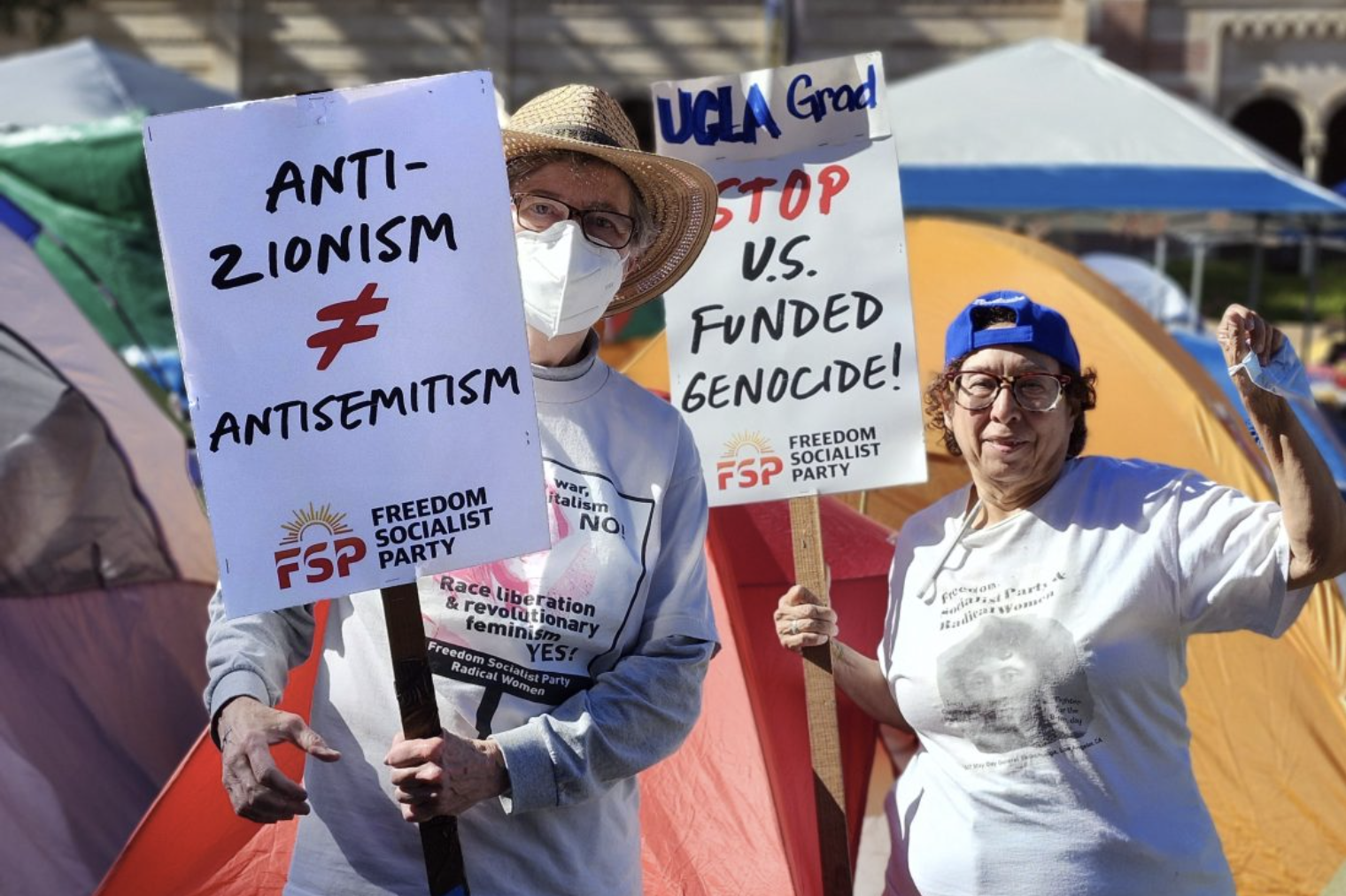
FPS member Val Carlson (left) visits the author at her “little red tent.” PHOTO: FSP/LA


Campus Upsurges
Aug 21, 2024 10:14 PM
The 1970s lacked the revolutionary leadership to take the movement toward anti-capitalism. I think that has changed.
The courage of the student protesters moved me to join the University of California, Los Angeles, Palestine Solidarity Encampment in April. This elder, a Chicana student activist from the ’70s and a UCLA alumna, set up my little red tent and spent two nights as part of the community. We endured Zionists waking us up with loud music and foul language. I made friends with my fellow campers, discussing politics of the campus and the world.
Grad student Cameron said, “I have a responsibility as a U.S. citizen to protest because the U.S. and UCLA have profited from Israel’s apartheid and genocidal regime.” I completely support the students’ demands: UCLA divest funds from Israel, stop the genocide of Palestinians.
I was often asked: What were the similarities and differences from back then to today?
These questions reminded me of my undergraduate experience at the University of Washington in Seattle. Students took over freeways and buildings, and faced off with cops, demanding an end to the Vietnam war. Chicanos and other students of color also called for formation of ethnic studies, implementation of affirmative action, and hiring more professors of color.
Related stories
In the 1970s, there was often a lack of solidarity between campus workers, students, faculty, and the broader community.
In the 1970s, there was often a lack of solidarity between campus workers, students, faculty, and the broader community. I think that is a big change between then and now. The UCLA students I met see the importance of broadening the movement to include all aspects of the working class. I find that very hopeful.
A second question often asked was what has kept me going en la lucha?
In a nutshell—socialist feminist politics. Fortunately, while I was at the UW, I met Radical Women (RW), a socialist feminist organization that was fighting for childcare, something I needed as a mom and a student.
I joined RW and then the Freedom Socialist Party, a vanguard, Leninist, and Trotskyist party (see socialism.com). I found my purpose and political collaborators within this multi-hued revolutionary party that believes in equality for all, making an international revolution, and orienting to the needs of the most oppressed.
By embracing a Marxist and an optimistic perspective—that capitalism is on its death bed, and that the leadership of those most harmed by this rotten economic system is key to making socialist revolution—I have been able to sustain myself for all these years.
The 1970s lacked the revolutionary leadership to take the movement toward anti-capitalism. I think that has changed.
It was exhilarating to link arms with young, brave, and committed student activists at UCLA. They recognize the problems caused by capitalism and the necessity of class solidarity with faculty, staff, and their union. It is my hope and belief they will take up the task of making socialism a reality.
What better way to stick it to the man and to stop genocide, imperialist wars, and colonialism than to make a revolution in the belly of the beast?
Comments

Powered by RoundtableAn AI/DeFi-powered Enterprise Media Operating System. Learn more at Roundtable.io.© Roundtable 2026. By using this site you agree to the Terms of Use and Privacy Policy