


Antony Blinken
Dec 5, 2023 2:00 PM
During the long South African anti-apartheid struggle the US government stubbornly maintained support for apartheid, just as it supports apartheid Israel today.
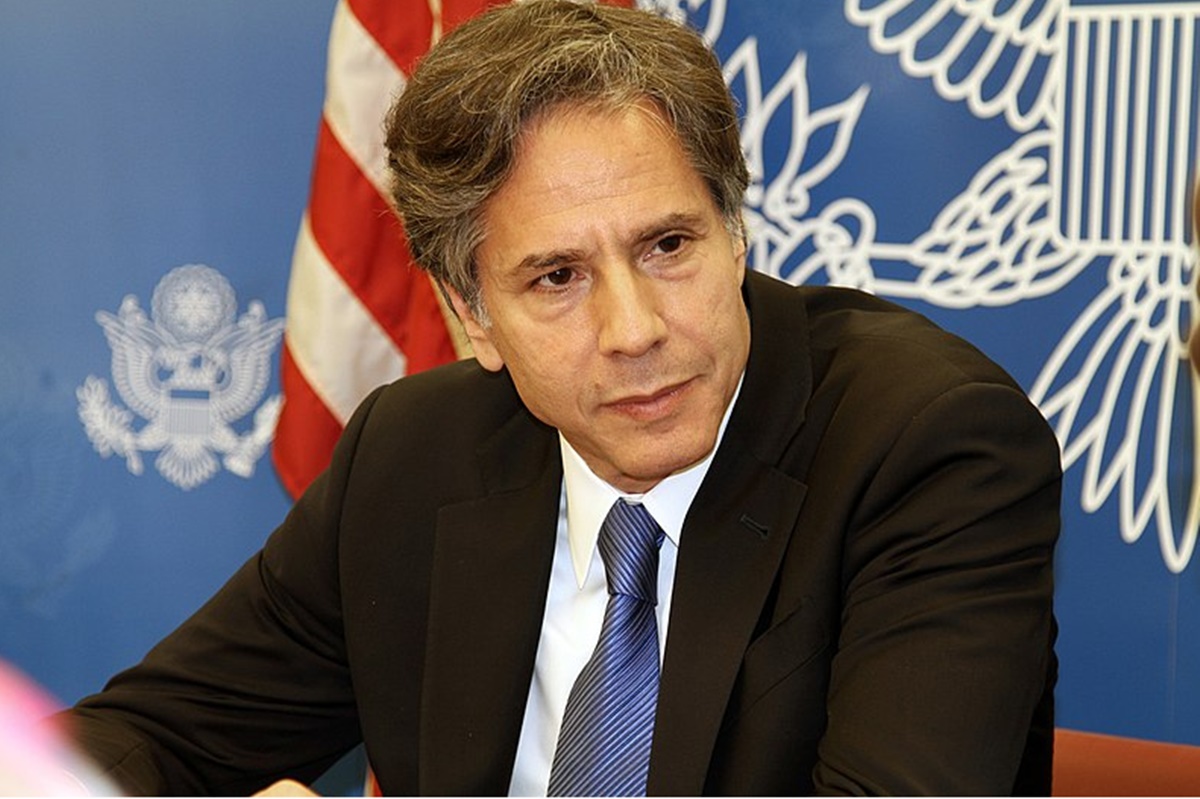
After meeting with Israeli Prime Minister Netanyahu the night before the truce ended, US Secretary of State Blinken blamed Hamas: the truce “came to an end because of Hamas. Hamas reneged on commitments it made.” He also said “Israel has the right to do everything it can to ensure that the slaughter that Hamas carried out on Oct. 7 can never be repeated… Hamas cannot remain in control of Gaza. It cannot retain the capacity to repeat that carnage.” The Israeli Prime Minister’s office said it was leaving the talks because Hamas “did not fulfill its part of the agreement, which included the release of all children and women on a list that was passed to Hamas and which it approved,” the New York Times reported.
Regarding carnage inflicted on Palestinians, Blinken said “before Israel resumes major military operations, it must put in place humanitarian civilian protection plans that minimize further casualties of innocent Palestinians,” adding that “It’s imperative that Israel act in accordance with international humanitarian law and the laws of war.”
Israeli Prime Minister Netanyahu defiantly responded “We have sworn, I have sworn, to eliminate Hamas. Nothing will stop us.”
Israel’s plan for ‘Greater Israel’
When Netanyahu spoke at the United Nations General Assembly in September, he presented a map of “The New Middle East,” showing Israel in 1948 “surrounded by a hostile Arab world. In our first seven years we made peace with Egypt and Jordan, and then in 2020 we made the Abraham Accords – peace with another four Arab states. Now look at what happens when we make peace between Saudi Arabia and Israel: the whole Middle East changes! We tear the walls of enmity.” He took a red marker and drew a line that “connects Asia through the UAE and Saudi Arabia to Israel and Europe.” Palestine was gone. During the General Assembly debates in October, both Israel and the United States repeatedly opposed resolutions to stop the Israeli bombing of Gaza and allow aid convoys to enter.
Related stories
The October 7 Hamas operation broke through the wall of enmity Israel had erected and maintained since 2006. “Israel Knew Hamas’s Attack Plan More Than a Year Ago,” reported the New York Times December 2. “The approximately 40-page document, which the Israeli authorities code-named ‘Jericho Wall,’ outlined, point by point” the military operation (not a terrorist raid) which Hamas carried out. The document “described a methodical assault designed to overwhelm the fortifications around the Gaza Strip, take over Israeli cities and storm key military bases, including a division headquarters. Hamas followed the blueprint with shocking precision,” the report said, including “a barrage of rockets at the outset of the attack, drones to knock out the security cameras and automated machine guns along the border, and gunmen to pour into Israel en masse in paragliders, on motorcycles and on foot — all of which happened on Oct. 7.”
The document circulated widely among Israeli military and intelligence leaders, the Times reported, “but experts determined that an attack of that scale and ambition was beyond Hamas’s capabilities, according to documents and officials.” They seemed to ignore it.
Targeted terror bombing
Israel has conducted repeated terror bombing sorties against Gaza: “Operation Protective Edge” in 2014, another violent escalation in November 2018, and “Operation Guardian of the Walls” in 2021, according to Israeli journalist Yuval Abraham, reporting in +972 Magazine. The article, “A Mass Assassination Factory: Inside Israel’s Calculated Bombing of Gaza,” says the Israeli army has perfected a system of “bombing targets that are not distinctly military in nature. These include private residences as well as public buildings, infrastructure, and high-rise blocks, which sources say the army defines as ‘power targets’.”
The article says “The bombing of power targets, according to intelligence sources who had first-hand experience with its application in Gaza in the past, is mainly intended to harm Palestinian civil society: to ‘create a shock’ that, among other things, will reverberate powerfully and ‘lead civilians to put pressure on Hamas’… The Israeli army has files on the vast majority of potential targets in Gaza — including homes — which stipulate the number of civilians who are likely to be killed in an attack on a particular target. This number is calculated and known in advance to the army’s intelligence units, who also know shortly before carrying out an attack roughly how many civilians are certain to be killed.”
That’s terror bombing – a program of state terrorism, systematically developed and implemented by the Israeli government with US approval and financing.
Israel wants to crush Hamas, of course, but its actions target all Palestinians. During the seven-day truce, according to the Mondoweiss Palestine Bureau, Israel imprisoned more Palestinians than were released during the hostage swap, and killed at least 20 Palestinians in Gaza, the West Bank, and East Jerusalem. So in fact Israel is waging war against all Palestinians, in both Gaza and the West Bank.
While Blinken and Netanyahu condemn Hamas, “Israel’s bombardment of Gaza and the elation over the prisoners’ release have deepened support for Hamas in the Israeli-occupied West Bank,” the New York Times reported. The freed prisoners have become “a potent symbol of Hamas’s ability to achieve tangible results and its willingness to fight for the Palestinian cause. Each night in Ramallah, as new batches of prisoners were released, one refrain echoed across the crowds: ‘The people want Hamas! The people want Hamas!’”
New elections are due for the Palestinian Authority, which shares administrative functions with Israel in the West Bank. Hamas could win, replacing Fatah, perhaps in alliance with all the Palestinian groups that have participated in the current Intifada, like those in the 1980s and early 2000s. In reality Hamas and its allies are a national liberation movement, that has led Palestinians in resistance repeatedly over decades. Intifadas are mass popular uprisings against Israeli occupation and repression.
The United Nations Human Rights Council opened Nov. 30 with a call for submissions to its investigation into violations of international law in Israel and the occupied Palestinian territories since October 7. The invitation specified “attacks against and killing and injuring of civilians, including children, attacks on civilian structures and objects, … collective punishment (including denying access to and availability of essential resources and services), starvation, incitement to violence (ethnic, political, religious), the dissemination of misinformation/disinformation, and other actions constituting a crime under international law.”
An Axis of Resistance
Hamas and its allies inside Palestine are far from alone in resisting Israel’s attacks, as well as threats from the US to widen the war in support of Israel’s ambitions to forge a “greater Israel.” According to CodePink’s Medea Benjamin and Nicholas Davies, there is an “axis of resistance” that includes the Lebanese-Palestinian front Hezbollah, which repulsed an Israeli invasion in 2006, and recently helped Syria defeat a ten-year US proxy war. In Iraq the Popular Mobilization Forces (PMF) have been fighting against the remnants of the US invasion of the early 2000s. Now rebranded as the Islamic Resistance in Iraq, they have conducted numerous attacks against US bases in both Iraq and Syria. They responded to US airstrikes with two attacks on another US base on Nov. 22 and several more on Nov. 23.
Iranian Foreign Minister Hossein Amir Abdollahian held meetings in Qatar on Nov. 23, first with Hezbolla leader Nasrallah and Lebanese officials, and then with Hamas leader Ismail Haniyeh, the Benjamin-Davies report said. “In the meeting with the leaders of the resistance,” the Iranian foreign minister said, “I found out that if Israel’s war crimes and genocide continue, a tougher and more complicated scenario of the resistance will be implemented. The leaders of the resistance will not allow the Zionist regime to do whatever it wants in Gaza and then go to other fronts of the resistance.”
Another formidable and experienced military force opposing Israel and the United States is the Houthi army in Yemen. The Houthi Deputy Information Secretary Nasreddin Amer told Newsweek that if they had a way to enter Palestine, they would not hesitate to join the fight against Israel. “We have fighters numbering hundreds of thousands who are brave, tough, trained, and experienced in fighting,” Amer said. “They have a very strong belief, and their dream in life is to fight the Zionists and the Americans.”
Cracks in support for Israel’s war
Cracks are appearing in Western support for Israel’s war against Palestine. Spanish Prime Minister Pedro Sanchez said November 29 he had “genuine doubts” regarding whether Israel was complying with international humanitarian law in Gaza, and called for the European Union to recognize a Palestinian state. And the Belgian government, according to a November 16 Human Rights Watch report, “questioned the legality of some Israeli airstrikes, condemned its collective punishment of the Palestinian population, and called for targeted sanctions and accountability for those responsible.” It also expressed support for an International Criminal Court investigation on the situation in Palestine. The Belgian federal parliament has introduced a bill to ban trade with settlements in occupied territories.
President Recep Erdogan of Türkiye has called the Israeli war on Gaza a massacre amounting to genocide. Turkish civil society groups are spearheading a campaign to send humanitarian aid to Gaza on cargo ships. The Palestine Information Center reported November 23 that approximately 1,000 boats gathered in Türkiye November 22 before heading toward Gaza in an attempt to break the Israeli blockade. Organizers said the boats will carry 4,500 people from 40 countries, “including anti-Zionist Jews.”
Chinese Foreign Minister Wang Yi appeared in New York in late November as part of China’s month-long presidency of the Security Council. He announced a proposal to end the Israel-Palestine conflict through intensified diplomatic mediation, and convene a “more authoritative and effective” international peace conference as soon as possible. Chinese President Xi Jinping also hosted an emergency meeting of BRICS countries – including new members Saudi Arabia, Iran, Egypt and Ethiopia, as well as South Africa, Russia and Brazil – with the same message.
A movement to “Shut It Down for Palestine”
A leader of the Palestinian Youth Movement, Yara Shoufani, told the Real News Network Israel has obliterated more than half of the buildings in northern Gaza, killed over 20,000 Palestinians, wounded over 32,000, and forced more than 1.7 million Gazans to flee their homes. “The human toll of Israel’s latest bombing campaign now officially surpasses the bloodshed and displacement of the initial Nakba of 1947 to 1949, in which Zionist settlers killed more than 15,000 Palestinians, burned down over 500 villages, and drove some 700,000 people from their homes to clear the land for the founding of the state of Israel.” The Israeli leadership is mounting “a new Nakba,” calling Palestinians “human animals.”
The Real News Network report says “a global mass movement in opposition to Israel’s genocide in Gaza has mobilized millions of people from Jakarta to Johannesburg, Ottawa to Oslo. Workers in Belgium and Spain have refused to transport weapons bound for Israel. Students have walked out of their schools and universities, activists have shut down arms factories, ports and government offices generating political crisis in many of the nations allied with Israel.”
In the US the November 4 national march on Washington DC, was the largest action in favor of Palestine in US history, with estimates of more than half a million. “At the center of this campaign is really a refusal to continue with business as usual while the Palestinian people are facing a genocide that is part of a 75 year long process of colonization,” Shoufani said. “And what we’ve seen in the context of this campaign have been a myriad of direct actions and mass mobilization. We’ve seen high school and university walkouts; in the Bay Area the shutdown of a highway; in New York protesters shut down the Brooklyn, Manhattan and Queensborough Bridges. We saw the Macy’s Thanksgiving parade disruptions, the occupation of BlackRock and the New York Times. Across the world, we’ve seen the shutting down of train stations. We’ve seen labor organizers refuse to transport weapons to Israel, and block boats with weapons being sent to Israel.”
Shoufani said it’s “a major watershed moment where the Palestinian Youth Movement has been a part of a movement in North America and Britain to shut down industry and organize mass mobilizations across the world and across North America and Europe.” But it goes further, Soufani suggests. “We’re building a broad coalition of national liberation struggles, of working class struggles, of left struggles, and Arab and Palestinian and Muslim communities are coming together.” Now, he says, “we have work to do to channel this moment into serious political organization. And I think what we’re seeing is actually the beginning of that.”
Ceasefire has been a central demand of this movement, Shoufani says, “because of its urgency and necessity amidst a violent genocide.” But he says “ceasefire cannot be the only demand… We have also been calling for an end to complicity and aid” – over $3.6 billion per year in US aid to Israel, and now an attempt by the US government to approve an additional $14 billion in aid – “showing that the United States government is interested in rewarding Israel for its genocide.”
The third demand is to end and lift the siege on Gaza. “For nearly 17 years, the people of Gaza have effectively been held in an open air prison whereby Israel controls access to air, land and sea, determining what goes in and what goes out; what medicine is allowed in, what building products are allowed in, rationing food that is allowed in.” When the truce ended, the flow of urgently needed aid for Gazans has stopped. Numerous groups are headed to Egypt to pry open the Rafah crossing to Gaza.
The broader demands are to end the occupation and to release all Palestinian prisoners, Shoufani concluded.
“From the River to the Sea” – two views of one vision
There has been lots of controversy about the popular slogan, “From the River to the Sea, Palestine will be free!” Maha Nassar, a scholar of Palestinian history and part of the Palestinian diaspora, has “observed the decades-old phrase gain new life – and scrutiny – in the massive pro-Palestinian marches in the US and around the world” recently.
Pro-Israel groups, including the U.S.-based Anti-Defamation League, have labeled the phrase “antisemitic.” It has even led to a rare censure of House Rep. Rashida Tlaib, the only Palestinian-American member of Congress, for using the phrase. But to Tlaib, and countless others, the phrase isn’t antisemitic at all. Rather, it is “an aspirational call for freedom, human rights and peaceful coexistence.”
The phrase can be considered a call for a unitary Palestinian state where people of all religions share equally.
Israel’s far-right Netanyahu government has a kind of mirror image of the same vision: a Foreign Affairs article last April says “Between the Mediterranean Sea and the Jordan River, one state controls the entry and exit of people and goods, oversees security, and has the capacity to impose its decisions, laws, and policies on millions of people without their consent.” It notes that “Netanyahu has written that ‘Israel is not a state of all its citizens’ but rather ‘of the Jewish people – and only it.’ The man he appointed as minister of national security, Itamar Ben-Gvir, has declared that Gaza should be ‘ours’ and that ‘the Palestinians can go to . . . Saudi Arabia or other places, like Iraq or Iran’.”
Israel’s one-state reality, the Foreign Affairs article says, reveals a situation of apartheid. The term “refers to the system of racial segregation that South Africa’s white minority government used to enshrine white supremacy from 1948 to the early 1990s. It has since been defined under international law and by the International Criminal Court as a legalized scheme of racial segregation and discrimination and deemed a crime against humanity. Major human rights organizations, including Human Rights Watch and Amnesty International, have applied the term to Israel.…” Another demand is Restore Historic Palestine/End Zionist Apartheid!
So there are competing interpretations of what life can and should be “from the River to the Sea.” The anti-apartheid movement against the racist colonial state of South Africa supported the African National Congress in its decades-long fight, which finally won in 1994. During that long struggle the US government stubbornly maintained support for apartheid, just as it supports apartheid Israel today. Few people today would claim that opposing apartheid in South Africa was a form of “anti-white racism.” It seems reasonable to conclude that opposing apartheid in Zionist Israel should not be considered anti-semitism. It should be considered removing past injustice and forging a better future for everyone.
Comments

Powered by RoundtableAn AI/DeFi-powered Enterprise Media Operating System. Learn more at Roundtable.io.© Roundtable 2026. By using this site you agree to the Terms of Use and Privacy Policy