


Sep 16, 2025 5:58 PM
What I enjoy most about bike racing is that it is so international. There is no chanting of “USA! USA!” No flag-waving jingoism. No military fly-over at the beginning of the race.
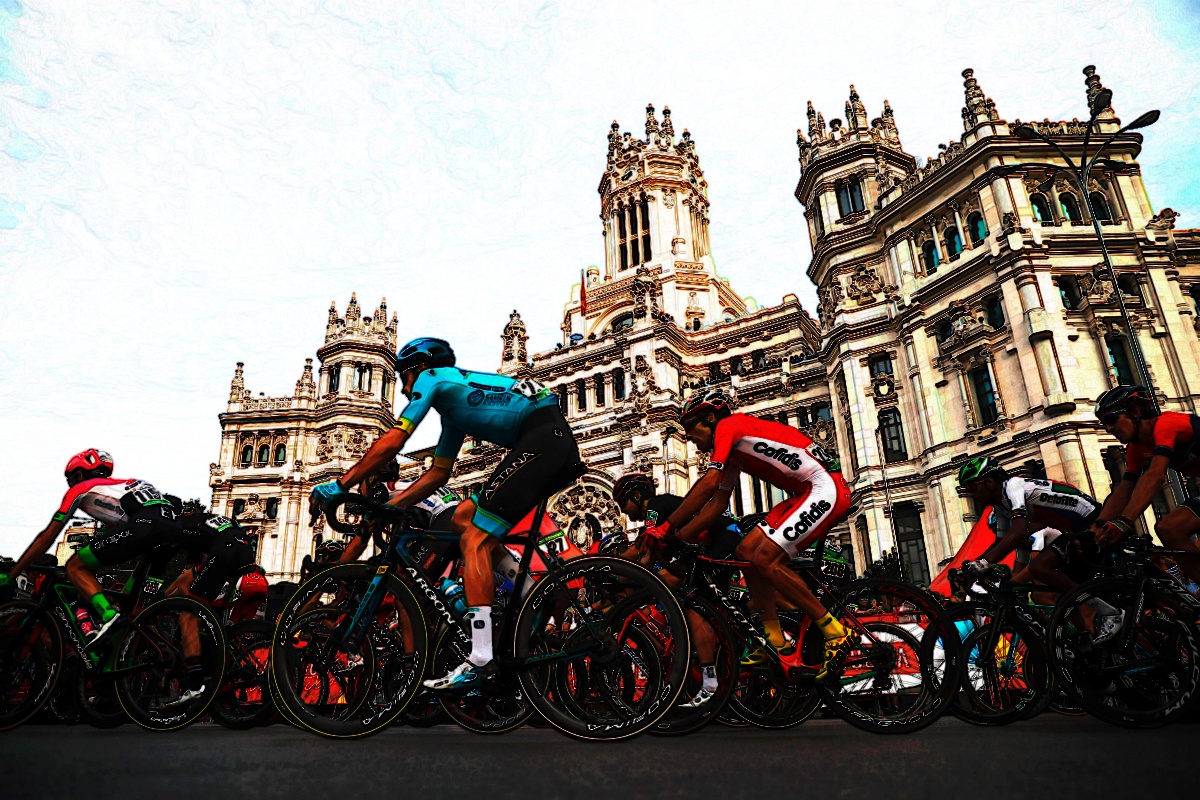
The final stage of la Vuelta a Espana, the third of this year’s Grand Tours of professional bicycle racing, was abandoned uncompleted when pro-Palestinian demonstrators in Madrid, where the race was to conclude, broke through pedestrian barriers by the hundreds and stormed into the streets, facing off against Spanish police wielding batons and teargas.
Over the past thirty years, I’ve become a big fan of professional bicycle racing. I’m not sure why I started watching, but ever since the mid-1990s, I’ve watched Le Tour de France every summer. When the Capitalist Swine started airing the race only on Peacock—which I have to pay extra for—I grudgingly went ahead and shelled out the extra $$$$$.
The only silver lining there was that I now also have access to La Vuelta a Espana, the third of the Grand Tours. (The first is the Giro d’Italia, but that one requires yet a different Pay-Us-Even-More channel—talk about Capitalist Swine—and enough’s enough, so I don’t watch that one.)
Anyway, I’ve been enjoying the Tour of Spain this month, a 21-stage race that takes over three weeks to complete, and covers a total of 1,958 miles. And what I enjoy most about bike racing is that it is so international. There is no chanting of “USA! USA!” No flag-waving jingoism. No military fly-over at the beginning of the race. No Star-Spangled Banana. No military color guard.
Related stories
This year’s Vuelta began with 23 teams totaling 184 riders. Only six of the riders are Americans (in itself an unusually high number), and they ride for five different teams. The teams are not (for the most part) national teams, but are made up of riders from multiple countries in North and South America, Africa, Australia, and New Zealand, and the teams are named for their corporate sponsors: Caja Rural, Red Bull Bora Hansgrohe, Cofidis, and Alpecin-Deceuninck, for instance. Even UAE and Bahrain Victorious, while named for countries, have riders from different nations.
Spectators display many different flags along the race course. The national flags of their favorite riders: the Spanish flag of Marc Soler, for instance, or the Colombian flag of Egan Bernal, or the Eritrean flag of Amanuel Ghebreigzabhier. And through bike racing, I’ve also learned to recognize the Basque flag, the Breton flag, and the flag of the Isle of Man.
But this year’s race included a political element—an awareness, whatever you want to call it—I have not seen before in my thirty years of watching pro bike racing. Along the racecourse this year, day after day, spectators were waving the Palestinian flag. Often, dozens of them at a time. Even scores of them. I’ve seen maybe three flags of Israel throughout the entire 21 stages, but the Palestinian flags have been ubiquitous.
At least some of the protesters have done more than wave flags, blocking roadways and causing serious disruptions. Stage 11 had to be shortened—and no stage winner declared—because of protests. And the distance of the individual time trial stage was reduced by more than 50% because of concerns about protesters endangering rider safety. Sunday's Stage 20 was disrupted again by protesters who blocked the course, though the riders did finish the entire stage.
But the final stage, #21, the grand finale in Madrid, was abandoned with 35 miles still to race; there was no stage winner declared, and the final awards ceremony was cancelled. My favorite rider, Jonas Vingegaard of Denmark and Visma Rent-a-Bike, was declared the overall winner, but there was no podium presentation.
Some of the reports I’ve been reading and seeing about the demonstrations say that the protests were directed at the team of Israel Premier Tech. This may be true, but during the race itself—which I watched every day—I neither saw nor heard anything directed at that team in particular, nor at any of the individual riders on the team, most of whom are not Israelis.
It seemed to me that the protests were simply in support of the people of Palestine and in reaction to the genocide being perpetrated against them. And it is worth noting that Spain as a nation has recognized Palestine as a sovereign nation (joining a growing number of other nations), and has ceased shipments of arms and fuel for use by the Israeli military. So there is significant support for Palestine and the Palestinian people within Spain.
Indeed, just about the only nations on this planet that are unwilling to call Israeli actions genocide are Israel and the United States. What the Netanyahu government, the Israeli Defense Forces, and radical right-wing Israeli settlers have been doing for nearly two years now goes far beyond defending Israel against Hamas. It has clearly become ethnic cleansing. Genocide.
I am not convinced that disrupting la Vuelta a Espana is an effective tactic for supporters of Palestine to employ. I’m all for displaying the Palestinian flag often and everywhere. Maybe a few viewers who are not familiar with what’s been going on in the sadly misnamed “Holy Land” will take the time to find out what those flags mean and why people are waving them.
But disrupting the race itself, causing stages to be cut short or not completed, would seem to me to generate not sympathy for Palestine, but rather antipathy for the protesters and perhaps for Palestine itself. As you ought to be able to tell from what I’ve written so far, I am entirely supportive of Palestine and the Palestinian people. It is not antisemitic to oppose genocide. It is not antisemitic to oppose the ethnic cleansing of Gaza. It is not calling for the destruction of Israelis to call for an end to the destruction of Palestinians.
And while I cannot condone the actions of Hamas because I truly believe that violence here will solve nothing, I can certainly understand that 75 years and more of living with injustice and humiliation and apartheid would make some people really, really, really angry.
What triggered this essay in the first place, however, which I began to write even before I had heard what had happened during the final Stage 21, were the utterly inane remarks of the Peacock channel commentators when demonstrators blocked the course, causing several riders to go down (though all of them got up uninjured and continued on).
“Oh, my gracious,” said one, “That’s a disaster.”
“Inconscionable” [sic], said his partner.
“You can imagine what the racers are going through,” said the first commentator. “The suffering. To try to impede them. I can’t wrap my head around that.”
I have seldom in my life heard such blockheaded blather, such vacuous drivel. Do these two men have any idea what a true disaster is? What true suffering is? The death toll since October 7th, 2023, has reached over 64,000 Palestinians, thousands of them women and children. Many thousands more have been injured. Twenty thousand children show visible signs of malnutrition. Some have already starved to death. Seventy percent of all infrastructure—roads, hospitals, water and sanitation, schools—has been destroyed. Ninety percent of the population has been displaced, many of them multiple times.
And these well-paid, well-fed, perfectly secure commentators who extol the virtues of the local Spanish wines are applying terms like “disaster” and “suffering” to a bicycle race? Come on, fellas. A bicycle race?!
Comments

Powered by RoundtableAn AI/DeFi-powered Enterprise Media Operating System. Learn more at Roundtable.io.© Roundtable 2026. By using this site you agree to the Terms of Use and Privacy Policy