
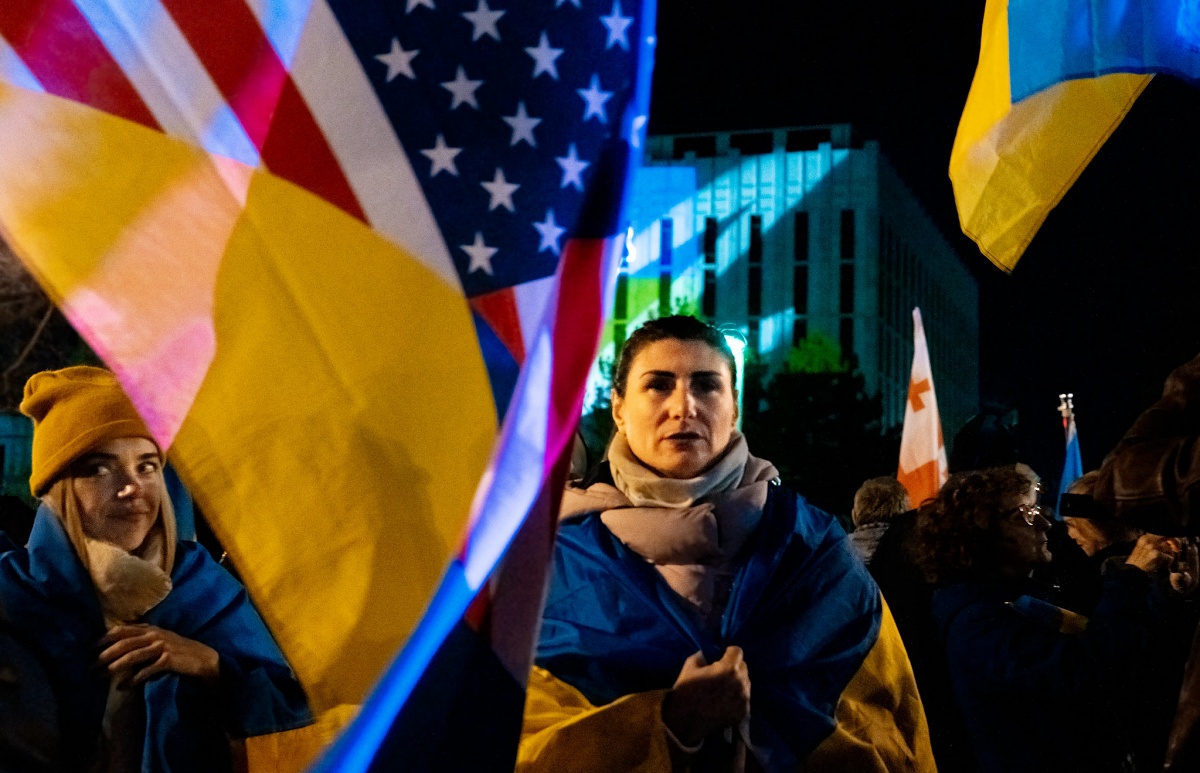
Victoria Pickering • Attribution-NonCommercial-NoDerivs (CC BY-NC-ND 2.0) Flickr


Bargaining with Fire
Dec 1, 2024 7:50 PM
Can Ukraine navigate the razor’s edge of diplomacy?
On 24 February 2022, Russia invaded Ukraine in a major escalation of the Russo-Ukrainian War, which started in 2014. It has been described as the largest and deadliest conflict in Europe since World War II, inflicting staggering costs on Ukraine and its people.
As someone who continues to serve on the editorial board of the Ukrainian journal, Philosophy of Education and has dedicated years to documenting and analyzing the conflict in Ukraine through numerous articles and a book, I cannot help but view the Biden administration’s approach with a deepening sense of disquiet. The war in Ukraine is not just a battle of soldiers and territories but a collision of principles—freedom against tyranny, sovereignty against imperial ambition, and democracy against the long shadow of authoritarianism.
Yet, the United States’ measured restraint in equipping Ukraine with the weapons necessary to prevail on the battlefield feels like an orchestra halting mid-symphony. The administration’s reluctance to provide long-range missiles, modern fighter jets, and the advanced tools Ukraine needs to defeat Russia outright has, in effect, left the Ukrainian people in a liminal space—fighting valiantly but forever one step behind. The stakes are nothing short of existential for Ukraine, yet the flow of Western aid often seems calibrated to contain the conflict rather than resolve it.
This half-measure strategy may be grounded in fear of escalation, but history is rarely kind to timidity in the face of aggression. If the world’s most powerful democracies cannot fully arm a nation defending itself against a brutal invasion, what does that say about the strength of their convictions?
Related stories
As Russian missiles continue to rain down on Ukrainian cities and as children and families live under constant threat, the weapons withheld by the West are not just absent from the battlefield—they are absent from the hope for a swift and just end to this war.
Any negotiated end to the war must address these damages, not merely cease the fighting. This includes resolving accountability for an estimated half-trillion dollars in property destruction, the forced displacement of 3-4 million Ukrainians, and the loss of or injury to hundreds of thousands of lives. Beyond reparations and restoration, the stakes rise significantly if a peace agreement involves territorial adjustments, security guarantees, or the presence of external forces, as such terms would require intricate, high-stakes diplomacy.
Russia’s extensive missile campaigns against Ukraine—over 11,000 missiles fired to date—have devastated civilian infrastructure and exacerbated the humanitarian crisis. While Ukraine’s defensive and retaliatory strikes into Russian territory have been effective and tactically justified, critics like Joe Rogan and others have questioned whether such actions escalate the conflict unnecessarily. However, arguments against Ukraine’s right to defend itself on equal terms fail to acknowledge the principle of self-determination and the fundamental right to resist aggression, especially when survival as a nation is at stake.
Ukrainian strikes on Russian military assets have not only disrupted Moscow’s war machine but also demonstrated that Ukraine’s capabilities are far from passive. In targeting supply lines, logistics hubs, and airfields within Russia, Kyiv has shown the strategic necessity of counteroffensives in balancing the uneven playing field.
Critics calling for unilateral restraint from Ukraine must contend with the ethical and practical implications of denying a sovereign nation the right to respond proportionately to aggression. As history has repeatedly shown, enduring peace is rarely achieved by permitting unchecked impunity on the part of an aggressor.
Any successful resolution of this conflict must, therefore, incorporate not only the immediate cessation of violence but also ensure justice, accountability, and robust guarantees to prevent future aggression. These conditions remain critical to the survival and sovereignty of Ukraine.
Enter retired General Keith Kellogg, whom Trump has identified as his pick to serve as US envoy to Ukraine and Russia. In this new position, Kellogg will be tasked with crafting a path toward a negotiated resolution, focusing on "peace through strength" to end the nearly three-year war.
Not every appointment made by president-elect Donald Trump has been an unmitigated calamity, whose cabinet picks often felt like casting choices from the Razzie Awards, and where competence was traded for chaos, and loyalty became the golden ticket to power. Each appointment was another roll of the dice, yielding a motley crew of ideologues, loyalists, and controversial figures whose legacies left deep marks on their respective domains—some unforgettably disastrous, others quietly effective, and many divisive to their core. With few exceptions, they will be remembered as a patchwork of ambition and implosion, with some appointments serving as cautionary tales and others as rare bright spots in an administration defined by disruption.
Among the bright spots is General Keith Kellogg, who has been picked by Trump to be US envoy to Ukraine and Russia, a figure who stands out like a lone lighthouse in a sea of missteps, offering a steady, strategic presence amidst the turbulence. A military leader forged in the fires of Vietnam and seasoned by decades of high-stakes national security roles, Kellogg brings a gravitas that few in Trump’s orbit could rival. Kellogg's career spans pivotal moments in U.S. military and national security history, including service in the Vietnam War as part of the 101st Airborne Division, known as the Screaming Eagles. Later, during the Gulf War, Kellogg was named commander of Special Operations Command Europe (SOCEUR), highlighting his leadership experience in complex geopolitical arenas. His military career concluded in 2003 with the rank of lieutenant general, leaving behind a legacy of strategic command in both military and civilian roles. In this new position, Kellogg will be tasked with crafting a path toward a negotiated resolution, focusing on "peace through strength" to end the nearly three-year war.
While figures such as Tulsi Gabbard and Linda McMahon have unleashed a tempest of incredulity among critics, others, such as RFK Jr., Elon Musk and Marjorie Taylor Greene, remain lightning rods of controversy. In contrast, Kellogg has quietly operated with a clarity of purpose. His appointment as special envoy to Ukraine-Russia is no ordinary choice; it’s a calculated move that speaks to the importance of the Russo-Ukrainian war on the global stage. Kellogg is not just a soldier or a statesman; he is a bridge-builder with deep roots in the art of conflict resolution. His experience, from commanding special operations in Europe to navigating the labyrinthine politics of the National Security Council, positions him as uniquely qualified to tackle one of the thorniest geopolitical challenges of our time
In this role, Kellogg’s presence feels almost mythic, a warrior-diplomat tasked with coaxing a fractured world toward peace. His strategy, though pragmatic, carries profound risks—calling for Ukraine to defer its NATO aspirations in pursuit of a broader peace accord. It’s a proposal fraught with peril, a bitter pill for Kyiv and a gamble that tests the resolve of the West. Yet, if anyone can navigate this treacherous terrain, it is Kellogg, whose career has been defined by walking the line between war and diplomacy.
In an administration often defined by its chaotic appointments, Kellogg emerges as a reminder that even in the most unpredictable storms, there can be anchors of wisdom and stability. Whether his efforts succeed or fail, his legacy may ultimately be that of a man who, against the odds, sought to reconcile the irreconcilable.
Kellogg has been a vocal proponent of arming Ukraine to bolster its defenses while pursuing peace negotiations. Notably, he co-authored a policy recommendation earlier this year advocating for delaying NATO membership for Ukraine as a means to encourage Russian cooperation in reaching a comprehensive peace deal. However, this stance could understandably face significant challenges, as Ukrainian President Volodymyr Zelensky has maintained that any ceasefire requiring territorial concessions is unacceptable.
This appointment underscores the complexities of balancing military support for Ukraine with diplomatic efforts to engage Russia in meaningful negotiations, a challenge that will define Kellogg's role and its broader implications for U.S. foreign policy in the region.
Kellogg also brings a storied Washington résumé, having served as chief of staff for the National Security Council and national security adviser to Vice President Mike Pence during the Trump administration. His influence extended to critical moments, such as during the January 6 Capitol riot, where he reportedly advised against evacuating Pence to ensure the certification of President Biden’s electoral victory proceeded uninterrupted. "Leave him where he’s at. He’s got a job to do," Kellogg is quoted as saying, reflecting his resolute approach to duty under pressure.
Kellogg embodies the type of seasoned military strategist who understands the complexities of both war and peace. As he takes on the mantle of special envoy, his extensive background in both military strategy and high-level diplomacy will be put to the test in navigating the precarious terrain of the Russia-Ukraine war. This role requires not just a command of battlefield realities but also the diplomatic finesse to manage competing interests and broker a potential path to peace. Critics and observers alike will be closely watching to see how his leadership shapes what has become one of the most significant foreign policy challenges of this era. Kellogg brings his no-nonsense approach to a conflict that has already cost thousands of lives and destabilized the region. For Kellogg, the task ahead is daunting—negotiating peace in a war where neither side is willing to concede a clear victory will require not only military acumen but diplomatic finesse.
The broader implications of his peace plan extend beyond Ukraine’s borders, with observers warning that concessions to Russia could embolden autocratic regimes globally. The West's challenge, then, lies in finding a delicate equilibrium—ensuring that Ukraine retains sovereignty while securing a durable peace in a region fraught with volatility. Kellogg, with his deep military and diplomatic experience, now bears the weighty responsibility of steering this vision into reality amid an international landscape defined by competing priorities and profound mistrust.
But credentials alone are not a guarantee of success. The situation in Ukraine is fraught with complexities—historical grievances, competing geopolitical interests, and the very real threat of escalation. Any peace plan, no matter how well-conceived, will have to contend with these powerful forces. What Kellogg’s appointment suggests, however, is a glimmer of hope that the diplomatic apparatus of the United States could take a more active role in seeking a solution, rather than merely reacting to events as they unfold.
Yet, as with any peace initiative in a conflict so deeply entrenched, the durability of such a plan is as elusive as it is uncertain. Will it stand up to the volatility of war? Will it be embraced by all parties, or will it crumble under the weight of partisan politics, the inertia of state functionaries and unyielding national interests? There is no way to know. What is clear, however, is that Kellogg is a man who understands the stakes, and his appointment is, if nothing else, a statement that the pursuit of peace requires both strategic vision and the willingness to take bold action.
In the coming months, we will no doubt watch closely to see whether General Kellogg’s efforts will bear fruit—or whether the winds of war will, once again, prove too powerful to resist. Until then, the world waits, holding its breath for what may be an elusive but desperately needed moment of resolution. My own position is that, as a first step, Russia should immediately withdraw all of its troops from Ukraine, including the Donbas and Crimea. But that is unlikely to happen.
Under the [AFPI] America First Policy Institute white paper drawn up by Kellogg and co-author, Fred Fleitz (a former CIA analyst and policy adviser serving since January 2022 as Vice Chairman of the America First Policy Institute Center for American Security), there would be a ceasefire based on prevailing battle lines during peace talks.
The Kellogg-Fleitz plan hinges on balancing diplomatic pressure with incentives for compromise. Central to this strategy is the West's dual approach: employing military and economic "sticks" to deter further Russian aggression while offering "carrots" to incentivize negotiation. For Ukraine, however, the plan’s implications are stark—requiring concessions that could undermine its territorial integrity and sovereignty, a trade-off that would leave lasting scars on its national identity and security.
The plan reportedly calls for delaying Ukraine’s NATO membership to appease Russia, a concession that many view as anathema to Ukraine's long-term security ambitions. In exchange, the U.S. would push for a verifiable peace agreement that includes security guarantees for Ukraine. This approach reflects a pragmatic acknowledgment of the geopolitical reality but faces criticism from Kyiv, (and I dare say from a majority of Ukrainians) where President Zelensky has consistently rejected any ceasefire or peace terms that involve territorial compromises.
The complex derring-do of Kellogg’s plan seems audacious to some but to others it is giving away too much to Russia and will do little to curtail Putin’s imperial ambitions. As the war in Ukraine rages on, the prospect of a negotiated peace seems as distant as the horizon, obscured by the fog of battle. Yet, in the corridors of military strategy and diplomacy, the voice of General Kellogg rings out, offering a plan that, though scant on specifics, carries a heavy, implicit wager: that the path to peace lies not in unrelenting combat, but in a delicate game of coaxing, threats, and hard bargains. It is a plan that effectively holds a mirror up to the bitter reality of the Ukraine conflict, revealing an image that few in Kyiv, or the West, are eager to face: a negotiated settlement that asks Ukraine to make impossible choices for the sake of ending a war that neither side can win.
The calculus behind the new peace plan put forward by the Trump administration appears in many ways to be an echo of the counsel long given by General Mark A. Milley, the former chief military adviser to President Biden, according to Betsy Reed. Reed affirms that Milley, like Kellogg, has repeatedly underscored a sobering reality: the war is one that neither side can decisively win. For Ukraine, the dream of total territorial reclamation is a costly and elusive hope. For Russia, the ambition to subjugate its neighbor has become a quagmire. As both nations bleed resources, Milley has argued that the only way forward is a negotiated settlement, however fraught with difficulty.
The Kellogg-Fleitz plan, in its essence, reflects this grim pragmatism, proposing a way to shepherd both Russia and Ukraine to the bargaining table that some have described as blackmail. The general’s approach is simple, almost stark in its clarity: diplomacy through coercion, where the carrot and stick are wielded with equal force.
At the heart of the Kellogg-Fleitz plan lies a proposition that will not be well received by Ukraine—delaying Ukraine’s NATO membership “for an extended period” in return for a “comprehensive and verifiable peace deal with security guarantees.”
For a nation whose aspiration to join the Western alliance has long been a guiding star of its foreign policy, this is no small concession. The prospect of NATO membership has been both shield and sword for Ukraine, a guarantee of security against Russian aggression and a symbol of its commitment to the West. To pull that promise away—or at the very least, to postpone it indefinitely—would be to ask Ukraine to set aside a fundamental element of its post-Soviet identity.
But Kellogg argues that this is the price Ukraine must pay for peace: “We tell the Ukrainians, ‘You’ve got to come to the table, and if you don’t come to the table, support from the United States will dry up,’” Kellogg explained to Reuters in June. The message is clear: without a resolution, the flow of military and financial support from the West could wane, leaving Ukraine vulnerable not just to Russian aggression, but to the looming fatigue of international backing. It is a gambit designed to push Kyiv toward pragmatism, even as it wrestles with the painful calculus of survival.
But the true force of the Kellogg-Fleitz plan is aimed squarely at Moscow. In Kellogg’s vision, the Russian bear must also be lured from the shadows of its defiance. Here, the stakes are raised even higher: “You tell Putin, ‘He’s got to come to the table, and if you don’t come to the table, then we’ll give Ukrainians everything they need to kill you in the field’”. This is a blunt, almost brutal warning: the Kremlin must negotiate, or else the West will supply Ukraine with the weapons and support necessary to deliver a decisive military blow to Russia.
It is a strategy that relies not just on the power of persuasion, but on the threat of escalation—an acknowledgment that the battle for Ukraine may be reaching a pivotal moment where decisive aid could tip the scales, pushing the war into a new phase where Russia’s ability to fight could be severely compromised. This, Kellogg seems to believe, is the leverage that will force Putin’s hand.
Stefan Korshak of the Kyiv Post has reacted to the threats against Ukraine and Russia embedded in the Kellogg-Fleitz plan as follows:
In comments made in June to the Reuters news agency, Kellogg had effectively reversed his position that Ukraine should be armed for victory: “We tell the Ukrainians, ‘You’ve got to come to the table, and if you don't come to the table, support from the United States will dry up’... and you tell Putin, ‘He’s got to come to the table and if you don’t come to the table, then we’ll give Ukrainians everything they need to kill you in the field’."
But from both the Ukrainian and Russian perspectives, threats like that, even though made by a superpower, are arguably hollow.
Barria writes: “In an interview with VOA after Reuters reported on the plan, Kellogg framed the proposal as an effort to prioritize diplomacy over combat while helping Ukraine negotiate from a place of strength, saying: “I don’t care about Russia. I care about Ukraine.” He also blamed the Biden administration for the war’s current state, suggesting more support to Ukraine earlier on could have ended the war with a better outcome for Ukraine.”
While the plan may seem to reflect a certain brutal clarity, it is also a high-risk proposition. For Ukraine, the idea of backing away from NATO is tantamount to relinquishing a long-held dream. For Russia, the plan presents an ultimatum that is unlikely to sit well with the Kremlin’s pride or quench its thirst for imperialist conquest and grandeur. Putin has remarked: “Peter the Great waged the great northern war for 21 years. It would seem that he was at war with Sweden, he took something from them. He did not take anything from them, he returned [what was Russia’s]”. Both sides would be asked to swallow bitter pills: Ukraine’s national aspirations for security and sovereignty would be postponed, while Russia would be presented with a stark choice between diplomacy and further military disaster.
The question, then, is whether either side is truly willing to make the compromises necessary for peace. For all its appeal as a pragmatic solution, the Kellogg-Fleitz plan hinges on the assumption that both Ukraine and Russia are prepared to recognize the futility of a war they cannot win. It also relies on the willingness of the international community to maintain a delicate balance of pressure, with the U.S. and its allies acting as brokers of both carrot and stick.
Ultimately, the plan asks not just for military strategies to be recalibrated, but for hearts and minds to shift—both in Kyiv and Moscow. In this sense, the peace proposal is less a roadmap than a fragile truce, where the dangers of failure loom larger than the promises of success. If it succeeds, it could mark the moment when the storm of war begins to subside. If it fails, the tempest could rage on, with both sides locked in a dance of destruction from which neither may emerge unscathed. And it is one that Ukraine must win, since Russia is unlikely to stop its imperialist conquest at the border of Ukraine.
In a world scarred by the bloody echoes of war, where hope for peace feels as elusive as daylight in a storm, the Kellogg-Fleitz plan emerges as both a proposition and a gamble.
In a candid interview with Reuters, Fleitz, made an assertion that strikes to the heart of the plan: Ukraine would not have to formally cede any territory to Russia. The rub, however, is more subtle. Kyiv would be forced to acknowledge that regaining full control over its lost lands—including Crimea and the eastern Donbas region—would be an improbable, if not impossible, feat.
Fleitz said Ukraine need not formally cede territory to Russia under their plan. Still, he said, Ukraine was unlikely to regain effective control of all its territory in the near term.
"Our concern is that this has become a war of attrition that's going to kill a whole generation of young men," he said.
A lasting peace in Ukraine would require additional security guarantees for Ukraine, Kellogg and Fleitz said. Fleitz added that "arming Ukraine to the teeth" was likely to be a key element of that.
While Fleitz underscores that Ukraine is not required to formally give up territory, the reality is far more stark—a sobering thought as the bodies of Ukraine’s bravest are stacked high, and the world watches, helpless, as the war grinds on. Fleitz has argued that while Ukraine would not be required to formally cede any territory to Russia, it would have to come to terms with the reality that regaining control over all its lost land may no longer be feasible. His comments reflect the growing sense of urgency among military strategists, including Kellogg, who see the conflict evolving into a war of attrition—a slow, grinding battle that exacts a heavy toll on both sides but is unlikely to result in a decisive victory for either.
For Ukraine, the notion of giving up on the dream of regaining every inch of its territory feels like an unbearable betrayal—a concession too great to make without an equal and substantial promise of security. Ukraine, in its fight for survival, would have to accept that its territorial integrity—its very identity—would remain forever altered. For a nation that has already paid an immense price in lives and infrastructure, this is no small ask. Fleitz’s words carry a chilling undertone: this is a war of attrition—one that risks consuming an entire generation.
To soften the blow, the Kellogg-Fleitz plan offers Ukraine a lifeline: additional security guarantees. These guarantees would not be the mere whisper of promises, but rather, a pledge to arm Ukraine “to the teeth”, ensuring that it has the means to defend itself against future aggression. But is this enough to offset the psychological cost of accepting such a peace?
Kellogg and Fleitz acknowledge the fundamental tension: “It would be hard for Ukraine to accept a peace deal that does not give them back all of their territory or, at least for now, hold Russia responsible for the carnage it inflicted on Ukraine.” This is where the plan meets its greatest hurdle: How do you convince a nation that has borne the brunt of Russia’s brutality and countless war crimes (the bombing of shopping plazas, Okhmatdyt Hospital, Ukraine’s largest children’s hospital, residential buildings, electricity grids) to walk away from a peace deal that does not offer retribution or restoration?
For Ukraine, the prospect of such a peace deal is not just a matter of territorial loss—it’s an emotional and moral wound. The nation would have to find a way to forgive, or at least to accept, the suffering it has endured. The challenge, then, is not just military or diplomatic, but existential. Can Ukraine, scarred by war, ever truly reconcile with the notion of an imperfect peace?
The weight of global security, it seems, should fall more heavily on the shoulders of European allies, especially if they decide to continue to arm Ukraine, or even send troops to help train Ukrainian soldiers. It is a stark reminder that, for all the moral imperative at play, geopolitics remains a balancing act of national interests.
General Kellogg now stands at the center of this high-stakes diplomatic gamble, holding firm to his broader worldview: that sometimes, in order to survive, nations must make uncomfortable compromises.
The need for a lasting peace settlement, one that would involve bolstered security guarantees for Ukraine, must include extensive military support, which is why Western nations would need to provide the country with sufficient armament to defend itself, “arming Ukraine to the teeth.”
Not everyone is pleased with the AFPI peace plan as it stands. Stefan Korshak of the Kyiv Post asserts that the Kellogg-Fleitz white paper “boils down to, on the face of it, something close to ‘Reaganite Republican’ textbook core assumptions” which he lists below:
- Russia and Putin are aggressive and cannot be trusted
- NATO warfighting capability must be credible to deter Russian aggression
- A continued war between Ukraine and Russia weakens NATO and distracts the US from China
- The Kremlin must be engaged so that US leverage can work
- Formalization and/or recognition of Russian occupation of Ukrainian territory is unacceptable
- Ukraine cannot sustain a long war due to manpower shortages
- There is not enough will in the US and NATO to arm Ukraine to enable it to take back lost territory
- The war and US military support to Ukraine has drained US weapon stockpiles to dangerously low levels
- US national security institutions, if unchecked, will seek status quo, not resolution of the war
Korshak reports that the [AFPI] white paper “calls for a formal ceasefire and creation of a demilitarized zone between Russian and Ukrainian forces. Ukraine would give up its aspirations for NATO membership ‘for an extended period in exchange for a comprehensive and verifiable peace deal with security guarantees.’
Western sanctions on Russia would remain largely in place and would not be lifted, until such time as Russia removed its forces from Ukrainian territory. Ukrainian reconstruction would be paid for by “levies” on Russian energy sales.
Kellogg acknowledges Russia has ignored international agreements it has signed and invaded Ukraine despite commitments not to. Therefore, the Kremlin cannot be trusted to keep its word in the future.”
Clearly, the idea of peace, as envisioned in the Kellogg-Fleitz plan, is not without its bitter compromises. Both Fleitz and Kellogg have acknowledged that the road to peace would be fraught with obstacles, particularly the Ukrainian desire for full territorial reclamation and Russia’s insistence on avoiding responsibility for the suffering it has caused. Ukraine’s struggle to regain control of its territory is deeply tied to its national identity and its aspirations to regain what was lost in the wake of Russia’s invasion. For many Ukrainians, any peace deal that doesn’t guarantee the return of all their lands, or at least hold Russia accountable for its actions, may be seen as a non-starter.
The Kellogg-Fleitz plan, with its stark realism about territorial losses and its call for continued military support, is an attempt to break the deadlock. Whether it will succeed in pulling Ukraine, Russia, and the West away from the brink of further escalation remains to be seen. But the broader message is clear: while full territorial restoration may no longer be a realistic goal, the pursuit of peace—and the need to end the war’s brutal toll—must take precedence. Whether this plan can bring the conflicting parties to the table remains uncertain, but it is a sign that the search for peace, however imperfect, is a path that must be pursued. But not at the cost of lost Ukrainian land and sovereignty and the capacity to deter future invasions.
For Ukraine, the road to peace is fraught with peril. The Kellogg-Fleitz plan, though born out of a desire to halt the bloodshed, presents a stark reality—one where victory, in the traditional sense, may not be achievable. For Russia, it offers an opportunity to cement its territorial gains, albeit with the threat of further isolation if negotiations fail. For the world, it is a bitter reminder that, in war, the ideal is often sacrificed at the altar of necessity.
The question remains: can Ukraine—its people, its government, its allies—accept the terms of this uneasy peace? Or will the desire to reclaim every inch of its land, and to hold Russia accountable for its actions, prove too great a burden? As the world watches, the war’s trajectory is shaped not only by the battlefield but by the fragile balance of diplomacy, coercion, and compromise. And in the end, it is not just Ukraine’s future that hangs in the balance, but the future of a world teetering on the brink of a new global order.
The stakes have escalated beyond the borders of Ukraine, with global powers standing in the wings, awaiting the next grim note. Yet in this cacophony, Kellogg's peace plan appears like a solitary, clarion call—an attempt to find harmony amidst the chaos.
At the heart of his proposal lies a stark but simple metaphor: a bridge, spanning the chasm of animosity between East and West, between Moscow and Kyiv, between the past and the future. The General, with his military mind honed on the battlefield, is not blind to the intricate nature of the task. Building peace is no less challenging than erecting a bridge over a ravaging river, whose current is swift and unforgiving. But Kellogg is a man accustomed to difficult calculations, and in his blueprint, the river does not seem quite as insurmountable.
Kellogg envisions a structured, phased approach—each step deliberate, each concession a calculated offering. The first stone in his bridge: a ceasefire. A quieting of the guns, a momentary respite for the war-weary, to allow for the fragile seeds of diplomacy to take root. From there, an international peacekeeping force would stand watch—guardians at the gates, ensuring that the stillness of the ceasefire holds like the calm before a storm.
Next, Kellogg proposes a system of incremental de-escalation—much like the slow, measured return of soldiers from a battlefield, carefully, cautiously, until they can walk freely once more. For Ukraine, this means a long-term commitment to sovereignty, with a watchful eye on territorial integrity. For Russia, a promise of security guarantees—diplomatic armor against the specter of NATO expansion, but not a carte blanche to reassert dominance through force.
For those who view the conflict as a zero-sum game—a fight where one side must be utterly defeated for peace to be achieved—Kellogg's vision may seem naïve, even impossible. But in the quiet spaces between his words, one hears a different rhythm, a soft counterpoint to the harsh percussion of artillery: the music of hope.
And yet, even as the plan begins to take shape, there are questions that linger. Will Russia, emboldened by its military advances, accept a compromise? Can Ukraine, scarred and torn by war, trust in the promise of peace when its very survival hangs in the balance? Can the world—fractured and divided—unite long enough to allow this delicate bridge to rise above the wreckage?
What General Kellogg has offered is no guarantee of peace. It is, however, a map—a rough, untraveled road that invites the possibility of calm. And for a world drowning in the noise of conflict, the mere suggestion of silence may be the most hopeful sound of all.
As the storm clouds gather, the world holds its breath, waiting to see if this bridge—fragile, yet full of promise—can withstand the weight of history’s gaze.
On the political side, Trump campaigned on a platform of ending what he called exorbitant US arms transfers to Ukraine that US taxpayers neither wanted nor could afford. If implemented as written, however, the Kellog/AFPI plan recommends the exact opposite.
Consider the actual scale of the money involved, should this peace plan be implemented. The Kellogg/AFPI plan calls for “long-term security architecture” that will enable Ukraine to deter a future invasion by Russia – a nuclear power fielding one of the most powerful militaries in the world.
What kind of funding would Ukraine need in order to deter Russian aggression according to the proposed peace plan? Stefan Korshak draws attention to the scale of money necessary to protect Ukraine if it is excluded from the NATO military alliance:
Then there is the actual scale of the money involved. The Kellogg/AFPI plan calls for “long-term security architecture” that will enable Ukraine to deter a future invasion by Russia – a nuclear power fielding the second, or third-most powerful military in the world.
NATO states with a national security interest, like Ukraine, in deterring Russia from invading spent about $380 billion in 2024 on defense, which excludes the amounts spent by the US.
Both France and Britain back up deterrence with their own nuclear weapons. From the perspective of policymakers in Kyiv, if Ukraine is excluded from the NATO military alliance it would, as a non-nuclear power, need a force with similar combat power to that fielded by the 32 Alliance members if it was to convince the Kremlin it was too risky to invade Ukraine again.
If we use European NATO defense expenditures as a reasonable yardstick to measure the cost of deterring Russia, then the promised US support of $60 billion to Ukraine is less than one-sixth of the $380 billion provided by NATO’s European members.
Based on that, if the Kellogg/AFPI strategy was to work, US taxpayers would have to pony up six times more money for Ukraine than currently – every year for as long as Russia was a threat to Ukraine, in order to deter Moscow from invading again.
The Zelensky administration has signaled a preparedness to negotiate on sensitive issues such as territory and war crimes, but not on a deal that compromises Ukraine’s future sovereignty and security.
Korshak conclude:
If the US proposals led to the provision of weaponry insufficient to deter Russia, then Kyiv would justifiably feel that the existential national security risk for Ukraine would be unacceptable. In that case, Ukraine would have no option but to fight on against Russia, rather than giving the Kremlin breathing space to re-arm before attacking Ukraine again.
Moscow, for its part, has repeatedly stated its war objectives [as a minimum] are total control of Ukraine’s Zaporizhzhia, Kherson, Donetsk, Luhansk and Crimea regions, ongoing Ukrainian neutrality and no security alliances with any state, a Ukrainian military cut to roughly one quarter its present size, along with no reparations or war crimes prosecutions. Putin’s position is that anyone unhappy with those terms can just sit back and watch the Russian army take the territory it wants by force.
Both Moscow and Kyiv will, in upcoming negotiations be aware that veteran national security experts that, like Kellogg, worked for Trump during his first term as US President from 2016-2000, were often sidelined or simply sacked if they were seen to directly disagree with him.
For Ukraine to entertain the Kellogg-Fleitz proposal, the cornerstone would have to be robust and enforceable security guarantees. These guarantees would require legally binding commitments from the United States, NATO, or other international actors to provide automatic military assistance if Russia violates the agreements. Without such assurances, Ukraine would face renewed vulnerabilities.
I agree with Yuriy Bohdanov’s emphasis on the importance of bolstering Ukraine’s defense capabilities even in a post-conflict scenario. This includes guaranteed supplies of advanced weaponry, such as aircraft and high-tech systems, to ensure that Ukraine can independently deter future aggression. These measures are essential for creating a stable deterrence framework in the absence of a permanent resolution.
The "Korean scenario" Bohdanov mentions—a frozen conflict with no formal peace treaty—provides a striking parallel. Like the division of the Korean Peninsula after the armistice in 1953, the Kellogg plan risks institutionalizing a tenuous status quo rather than resolving fundamental issues, such as territorial integrity. In this scenario, both Ukraine and Russia might claim symbolic victories: Ukraine for maintaining independence and Russia for retaining occupied territories. Yet, the reality would be a stalemate, with neither side emerging as a true victor. For Ukrainians, it would be akin to enclosing the psyche, depriving everyday Ukrainians of the reality that comes from being seen and heard by their relatives and friends in the territories that have been stolen by Russia.
For Russia, even with partial sanctions relief, the war’s long-term economic and political consequences would leave the regime fragile and isolated. Ukraine, while preserving its sovereignty, would face lingering dissatisfaction over territorial losses and a challenging recovery process
The Kellogg-Fleitz plan, much like many grand diplomatic schemes throughout history, teeters precariously on the edge of possibility and impossibility. Its remote chance of success lies in its intricate demands: the orchestration of significant international coordination and a collective willingness among adversaries to embrace an imperfect peace. These are formidable challenges, for history teaches us that peace built on unresolved grievances is a fragile edifice, prone to collapse under the weight of its own contradictions.
The plan evokes echoes of the Korean Armistice Agreement of 1953—a temporary truce that solidified a division but left the fundamental questions of sovereignty and reunification unanswered. However, Bohdanov notes that Ukraine’s economic position offers a somewhat more optimistic outlook. The scars of that unresolved conflict persist, serving as a cautionary tale for Ukraine. To freeze the Russo-Ukrainian conflict under a similar framework would mean not just deferring a resolution but entrenching a geopolitical stalemate that risks becoming a powder keg for future generations.
The Kellogg-Fleitz plan offers, at best, a fragile reprieve. Its proposed framework, which tacitly accepts territorial losses and depends on tenuous security guarantees, might shield Ukraine from immediate destruction but leaves the heart of the conflict—territorial sovereignty and national identity—bleeding and unresolved. For Russia, such a scenario provides neither the sweeping triumph Putin seeks nor the economic rehabilitation the nation desperately needs. It locks both nations into a state of uneasy limbo, a bitter standoff disguised as peace.
Ultimately, history may judge the plan not for its aspirations but for its limits. Peace that delays justice and leaves wounds unhealed often becomes a prelude to further strife. Whether this plan marks the beginning of a prolonged cold conflict or the foundation for eventual reconciliation will depend on the will of the international community and the endurance of those caught in its shadow. For now, it stands as a grim reminder that diplomacy, like war, often demands sacrifices that no one wishes to make.
At worst, the Kellogg-Fleitz plan risks becoming an interlude—a precarious interregnum that Russia could exploit to regroup, rearm, and reignite its war of aggression against Ukraine. History offers stark reminders of the dangers inherent in temporary truces with belligerent states. Just as the Treaty of Brest-Litovsk in 1918 bought Lenin’s Soviet Russia time to consolidate power before resuming expansionist ambitions, any poorly enforced cessation of hostilities could grant Russia the breathing space it so desperately seeks to rebuild its military strength and reassert dominance in Eastern Europe.
In this light, a far more resolute and enduring solution would be Ukraine’s immediate accession into NATO. Such a move would shift the balance of power decisively, effectively placing Ukraine under the protective umbrella of the alliance’s Article 5, which mandates collective defense. By solidifying Ukraine’s integration into the Western security framework, NATO would not only deter future Russian aggression but also signal a categorical rejection of Moscow’s imperialist ambitions. This would serve the dual purpose of safeguarding Ukraine’s sovereignty and reinforcing the principle that borders in Europe cannot be redrawn by force.
Forcing Russia back into its territorial boundaries—an outcome that respects Ukraine’s sovereignty and international law—may seem audacious, but it is the only path that aligns with long-term stability. Anything less risks normalizing territorial theft and undermining the post-World War II international order. A durable peace requires clarity, not ambiguity, and strength, not concession. By rejecting half-measures and prioritizing Ukraine’s membership in NATO, the West would be taking a stand not only for Ukraine’s future but also for the integrity of the global rule-based order.
Comments

Powered by RoundtableAn AI/DeFi-powered Enterprise Media Operating System. Learn more at Roundtable.io.© Roundtable 2026. By using this site you agree to the Terms of Use and Privacy Policy