
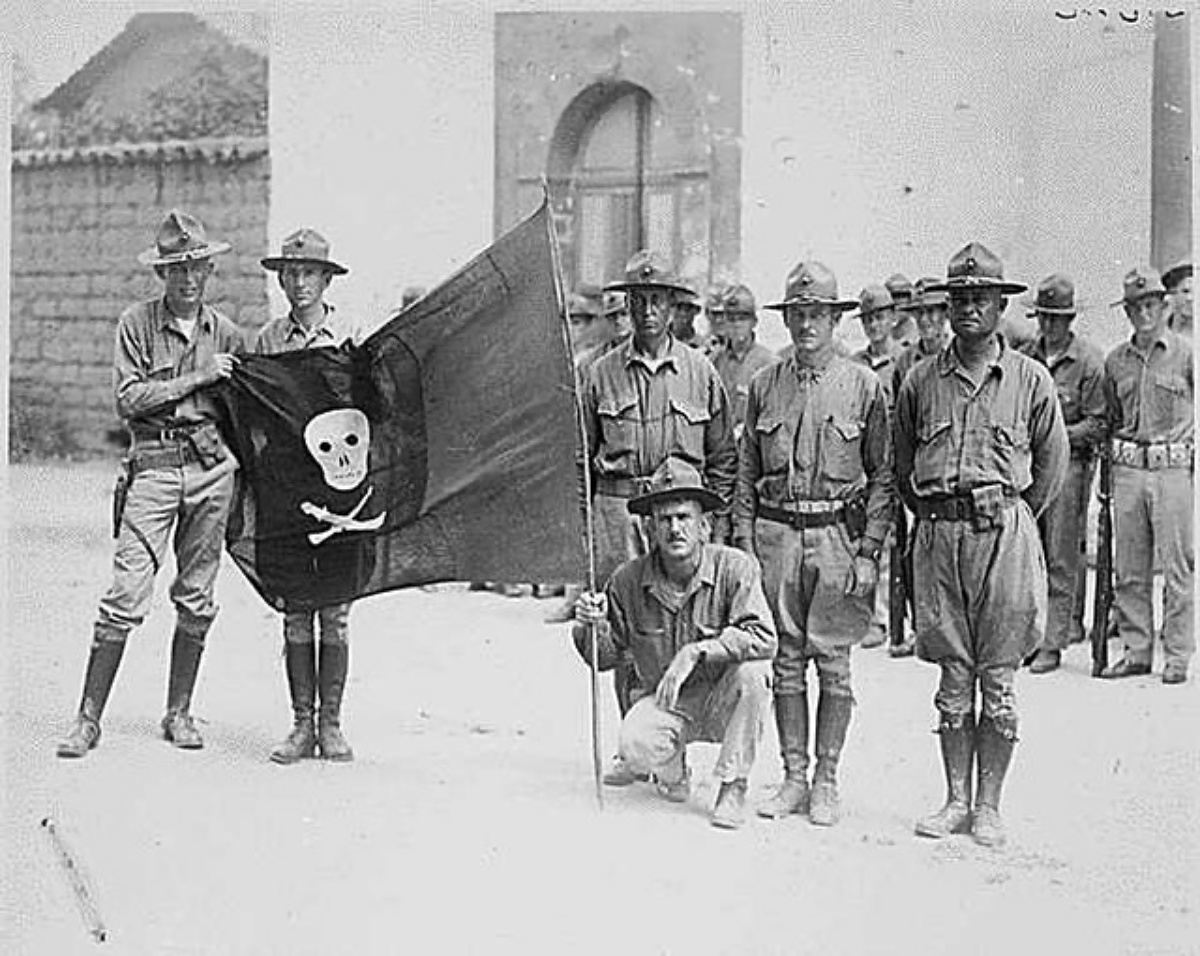
US Marines with the captured flag of Augusto César Sandino in Nicaragua in 1932.


Constant War: the Enemy of Democracy
Jan 8, 2026 7:02 PM
Trump’s attack on Venezuela is in a long tradition of American war against Central and South America, and against people from those areas.
Donald Trump has kicked off the new year by sending his myrmidons to invade Venezuela and seize its leader. His announcement reads in part: “The United States of America has successfully carried out a strike against Venezuela and its leader, President Nicolas Maduro, who has been, along with his wife, captured and flown out of the Country.” This attack was what US leaders typically call a “heinous act of unprovoked aggression against an independent sovereign state.” And there is another perspective worth considering.
In 1935, Major General Smedley Darlington Butler, one the most decorated officers in the history of the Marine Corps, published a little essay called “War Is a Racket.” The essay opens:
War is a racket. It always has been. It is possibly the oldest, easily the most profitable, surely the most vicious. It is the only one international in scope. It is the only one in which the profits are reckoned in dollars and the losses in lives. A racket is best described, I believe, as something that is not what it seems to the majority of people. Only a small “inside” group knows what it is about. It is conducted for the benefit of the very few, at the expense of the very many.
Butler’s military career included participation in imperialist wars around the turn of the twentieth century, in the Philippines, China, and Mexico, as well as in World War I, and the socalled “Banana Wars” in Central America and adjoining regions between 1898 and 1934. He was clear about what was at stake in those conflicts. “Out of war a few people make huge fortunes,” he wrote, and he added, “I spent 33 years and four months in active military service...as a high class muscle man for Big Business, for Wall Street and the bankers.”
Related stories
“How many of these war millionaires shouldered a rifle?” he wonders. “How many of them dug a trench? How many of them knew what it meant to go hungry in a rat-infested dugout? How many of them spent sleepless, frightened nights, ducking shells and shrapnel and machine gun bullets? How many of them parried the bayonet thrust of an enemy? How many of them were wounded or killed in battle?” And how many of them, we could add, avoided all of that by securing exemptions for bone spurs?
I thought of Butler because of his involvement in those “Banana Wars,” and also because his is the most accurate account of what’s actually happening here. It seems we’ve always viewed Central and South America as a sort of free fire zone. From the Monroe Doctrine through James K. Polk’s war with Mexico to Ronald Reagan’s claim that the communists were coming across our southern border, our presidents have never hesitated to inflict both overt and covert violence on territories south of the Rio Grande. Trump practically declared war on Mexico in 2015 when he announced his run for the presidency. “When do we beat Mexico at the border?” he asked. “They’re laughing at us, at our stupidity....They are not our friend, believe me.”
He went on to dehumanize desperate people seeking to escape poverty and squalor and build better lives for themselves in this country. “When Mexico sends its people,” he said, “they’re not sending their best....They’re sending people that have lots of problems, and they’re bringing those problems with us. They’re bringing drugs. They’re bringing crime. They’re rapists. And some, I assume, are good people.” We may wonder what “good people” would be in such company, and whether some of them are now among the tens of thousands being rounded up and deported in Trump’s much ballyhooed project to thwart an ongoing invasion.
Trump’s attack on Venezuela is in a long tradition of American war against Central and South America, and against people from those areas. And the United States will now “run” Venezuela, Trump tells us, possibly with the aid of American “boots on the ground.” His supporters surely will applaud this move, but veterans of the “war on terror” might wonder why Trump would be sending troops to do the same things in Venezuela that he said troops never should have been sent to do in Afghanistan and Iraq And is this the same man who won the presidency in 2024 partly on the strength of a promise not to involve the US in any more foreign wars?
More likely, Smedley Butler already told us what’s going on here: “Out of war nations acquire additional territory....They just take it,” he wrote. “This newly acquired territory promptly is exploited by the few—the self-same few who wrung dollars out of blood in the war.” And what is there for the few to exploit in Venezuela? Beneath that country are rich petroleum reserves—as much as twenty percent of the global total. This whole performance looks remarkably like what Butler characterized as “...something that is not what it seems to the majority of people.”
In 2004, senior Bush advisor Karl Rove told an interviewer, “We're an empire now, and when we act, we create our own reality.” Trump’s well-publicized attacks on “drug boats” have created a bogus reality—interdicting drug trafficking—and have set the stage for what Rove would have called “regime change,” but what is in fact a shameless violation of Venezuelan sovereignty in pursuit of the “huge fortunes” Butler tells us are the ultimate payoff when governments go to war.
This drama was never about drugs. But there’s no irony in any of this—none at all. Trump may think he’s breaking new ground. He does tend to aggrandize himself and everything he does. But this ground was broken two centuries ago, and has been torn up repeatedly in the decades since—always in pursuit of profit, and always in the name of national security. We may never learn.
Comments

Powered by RoundtableAn AI/DeFi-powered Enterprise Media Operating System. Learn more at Roundtable.io.© Roundtable 2026. By using this site you agree to the Terms of Use and Privacy Policy