
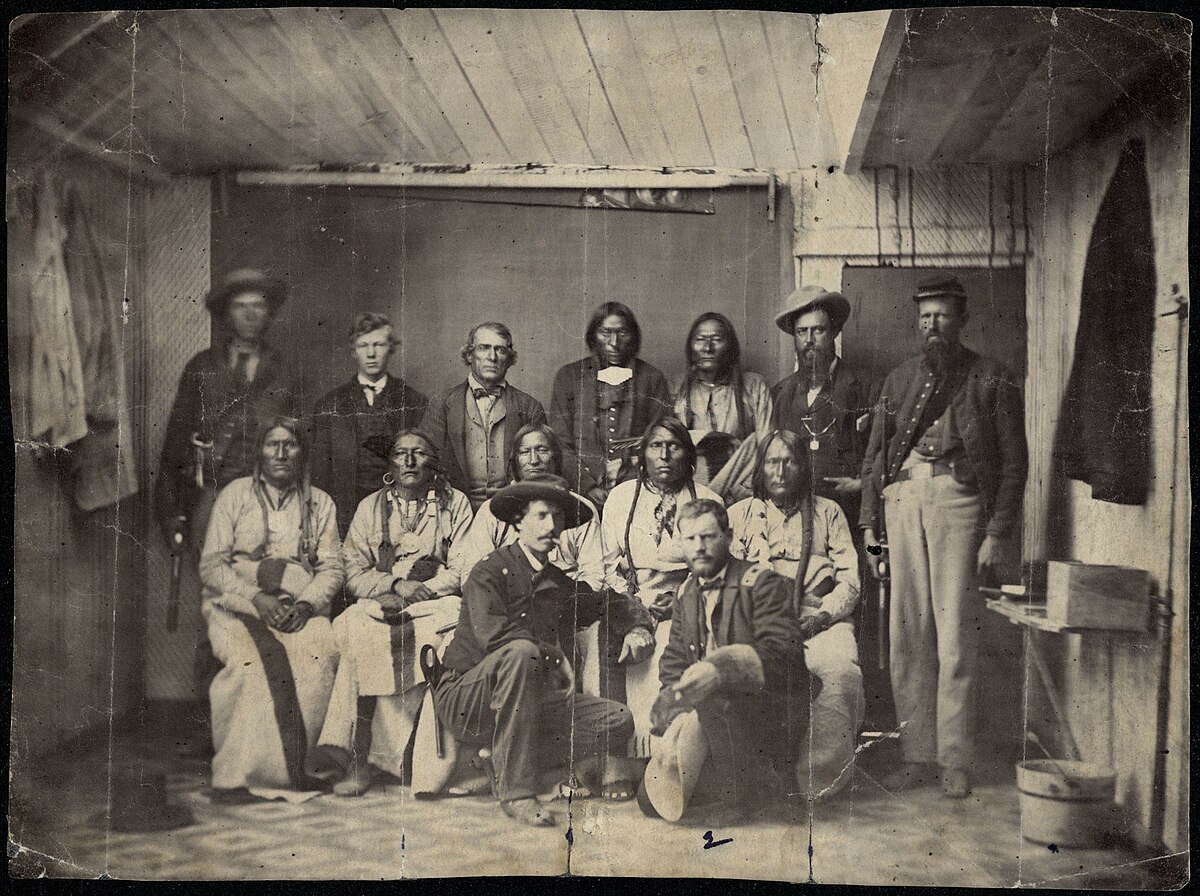
Not all of the identifications of Cheyenne and Arapaho leaders are certain. Front row, kneeling, left to right: Major Edward W. Wynkoop, commander at Fort Lyon and later agent for the Cheyennes and Arapahos; Captain Silas S. Soule, provost marshal, later murdered in Denver. Middle row, seated, left to right: White Antelope (or perhaps White Wolf), Bull Bear, Black Kettle, One Eye, Natame (Arapaho). Back row, standing, left to right: Colorado militiaman, unknown civilian, John H. Smith (interpreter), Heap of Buffalo (Arapaho), Neva (Arapaho), unknown civilian, sentry. Another identification states that Neva is seated on the left and the Indian next to Smith is White Wolf (Cheyenne).


Nov 24, 2025 8:14 PM
Updated Nov 26, 2025 10:40 PM
The Peace Keepers monument represents an enduring promise, cast in bronze, that the stories, names, and spirit of the Cheyenne and Arapaho people will no longer be absent from Colorado's history.
The Burdens of Bronze and Blood
The Colorado State Capitol in Denver is positioned on a rise at the edge of downtown. The building is topped by a gold dome, with the city’s skyline and the front range of the Rocky Mountains rising beyond. On the east side of the building is a bronze sculpture titled, The Closing Era, portraying “the end of the traditional lifestyle of Native Americans in Colorado.” It echoes James Earle Fraser’s The End of the Trail, conveying the popular 19th-century notion of the ‘Vanishing Indian’ depicting native people as ghostly specters frozen in America’s historical past.
Until recently, another statue known as the Civil War Monument, titled On Guard, was centered in front of the Capitol complex. It depicts a Union soldier draped in a raincoat, with rifle held at the ready. Affixed to the four sides of the granite base were a set of plaques “Erected By The State of Colorado,” detailing important people and events in the state’s history. One listed Civil War era “Battles and Engagements” involving Colorado troops.
Included among these were skirmishes at Apache Cañon and Pigeon’s Ranch in New Mexico that formed the Battle of Glorieta Pass. This is followed by entries focused on settler conflict waged primarily against the Arapaho and Cheyenne nations from whose traditional homelands the city of Denver and a large portion of eastern Colorado were carved.
These clashes involved US soldiers and Cheyenne and Arapaho warriors on the Eastern Plains, with the final clash listed being Sand Creek. Although these details were intended to highlight crucial moments leading to Colorado statehood, they also make the Capitol a place where the perpetrators of an appalling massacre were celebrated as heroes alongside Civil War soldiers who defended the territory against the Confederacy.
Related stories
The monument was defaced and ultimately toppled during national demonstrations against police brutality and injustice of June 2020. The statue was then put on display at the History Colorado Center while a new location is being determined. As was announced in the Spring of 2025, plans for a new monument at the site are also in the works. The Colorado Legislature, in a rare moment of bipartisanship, unanimously approved a new memorial dedicated to the Sand Creek Massacre.
The “Peace Keepers” monument design, depicting Cheyenne and Arapaho Chiefs Black Kettle and Left Hand, alongside a figure of a woman holding a child, is a remarkable step forward. Given the widespread assaults on historical truth currently taking place within the federal government, this move is far from a final victory—but it’s a vital one.
Instead, for Cheyenne and Arapaho elders and educators like Otto Braided Hair and Gail Ridgely, this development marks a significant push against the edifice of historical amnesia. These are individuals who have dedicated much of their lives to educating the public about the atrocity—a reminder that for Cheyenne and Arapaho people, Sand Creek is a sacred place of remembrance for a crime that defies erasure.
The memorial’s hard-won approval was nearly a decade in the making since the proposal was first approved in 2016 within the Colorado Legislature. From its inception, the effort has been guided by the memory and spirit of Cheyenne and Arapaho ancestors. For Sand Creek descendants like Ridgely and Braided Hair, the memorial will be much more than an inert statue. It will represent an acknowledgment of their history, placed precisely where the coldblooded murder of their ancestors was once celebrated. As Southern Cheyenne scholar, Henrietta Mann observes, to this day “Cheyennes and Arapahos carry the memory of this massacre.”
The Blinding Ambitions of John Evans and John Chivington
The military assault at Sand Creek on November 29, 1864, resulting in the murder of over 200 Cheyenne and Arapaho people, most of whom were women, children, and elders, was long designated a “battle” in history books. Despite the framing intended to justify the attack, as reported in May 1865 by New York Tribune, a congressional investigation found it to be “a most brutal and unprovoked slaughter of men, women and children, who were living in a quiet manner in a state of entire peace with the whites.”
For Colorado Territorial Governor, John Evans, who also founded Northwestern University and the University of Denver (where I am a professor), however, the Cheyenne and Arapaho were an obstacle to his grandiose schemes. As Evans would declare years later in an interview with the historian H.H. Bancroft, and in the face damning investigations into Sand Creek: “the benefit to Colorado, of that massacre, as they call it, was very great, for it ridded the plains of the Indians.”
As an ambitious land speculator, railroad investor, and politician, Evans stood to benefit handsomely from the removal of the Cheyenne and Arapaho from Colorado. He didn’t participate in the massacre itself. However, in his concurrent role as Superintendent of Indian Affairs in which the main responsibility was to maintain peace and negotiate treaties with the native nations under his jurisdiction—a task treated with indifference—he bears responsibility for the massacre perpetrated on that fateful day.
This liability is magnified by the fact that the massacre was carried out by the very military units Evans was instrumental in creating—for the expressed purpose of waging war against the native peoples of the territory—the Third Colorado Regiment. He officially requested funding for the Third from the Department of War in the Summer of 1864. It was approved for 100 days and led by Colonel George L. Shoup.
The combined forces of the First and Third Colorado Regiments that carried out the massacre were commanded by Colonel John Chivington. Dubbed, ‘the fighting Parson,’ Chivington was a member of Denver’s Methodist Church alongside Evans, while also serving together on the Colorado Seminary’s (later renamed the University of Denver) Board of Trustees.
These personal ties led Evans to recommend Chivington’s promotion to Brigadier to President Lincoln. When Chivington’s aspirations were squashed by a report alleging that he had conspired to assassinate a fellow officer, Evans appointed him commander of the First Colorado Cavalry Regiment, which he’d created it 1862.
Playing With “A Loaded Gun”—John Evans, John Chivington, and the Refusal of Peace
Another damning facet of Evans’ role in Sand Creek was his August 1864 Proclamation, calling on “citizens of Colorado...to go in pursuit of all hostile Indians on the plains, scrupulously avoiding those who have responded to my said call to rendezvous at the points indicated also, to kill and destroy, as enemies of the country, wherever they may be found, all such hostile Indians.” The stipulation to refrain from harming those complying with his vague call to surrender is seen by historians as “half-hearted” at best, since no guidelines were provided to distinguish ‘friendly’ from ‘hostile Indians.’
The commanding officer at Fort Lyon, Maj. Edward Wynkoop, having participated in and led multiple offensives against native peoples of the region, facilitated just such meeting to ensure peace. Within a context of smoldering hostility, Cheyenne Chief, Black Kettle, who was eager put an end to conflict with settlers, invited Wynkoop to a council. Although initially distrustful, Wynkoop accepted and travelled with a force of cavalry to Black Kettle’s camp on the Smokey Hill River. The meeting convinced Wynkoop of their sincerity.
Wynkoop reciprocated Black Kettle’s gesture by escorting him, along with other Cheyenne and Arapaho chiefs, to Denver where they requested a meeting with Evans. Accompanied by Chivington, Evans met with the delegation at Camp Weld. Evans and Chivington spurned their requests for peace, “instead telling them their only recourse was to surrender to Wynkoop at Fort Lyon.”
Despite the insulting treatment, the Cheyenne and Arapaho in attendance accepted Evans’ terms. Wynkoop, believing that peace was assured, would soon be reassigned to Kansas due to complaints arising from the perceived “privilege” he’d extended to the Cheyenne and Arapaho who’d come in to place themselves under military protection. He departed Fort Lyon on November 25, mere days before the massacre.
As former Colorado State Historian, David F. Halaas said of the larger context of Sand Creek, “the person most responsible was John Evans. He more than any other person caused the creation of the Third Regiment.” Considering the origins of the massacre itself, Halaas continues, “think of the Third Regiment as a loaded gun. He handed that loaded gun to Chivington, and Chivington pulled the trigger.”
The Courage and Conscience of Silas Soule and Joseph Cramer
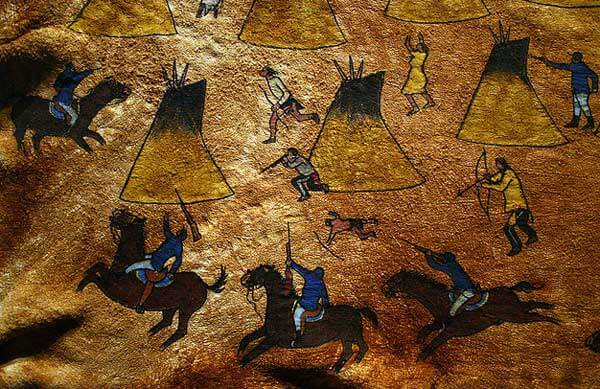
Chivington arrived at Fort Lyon on November 28th with a force of 500 soldiers after leading a secret march from Denver. He didn’t reveal his plan for a surprise attack upon the peaceful Cheyenne and Arapaho to the new commander, Maj. Scott Anthony, until his arrival. Other officers present who had assisted Wynkoop in the brokering of the truce with the Cheyenne and Arapaho now camped nearby at Sand Creek, voiced their opposition. Lt. Joseph Cramer reported that Capt. Silas Soule, who had been alongside Wynkoop at the Camp Weld meeting, was outraged and condemned Chivington.
Hearing of Soule’s resistance, Chivington threatened to have him arrested. Soule would not be silenced, sharply rebuking the officers who bowed to Chivington’s plan, saying, “any man who would take part in the murders, knowing the circumstances as we did, was a low lived cowardly son of a bitch.” An enraged Chivington threatened Soule’s life, declaring, “damn any man who’s in sympathy with Indians.”
Other officers assured Soule that the main assault would be concentrated against Cheyenne Dog Soldiers to the north, but this was said to be a ruse hatched by Anthony to prevent further revolt. At dawn on November 29th, Chivington and Shoup, along with Majors Anthony and Jacob Downing, led a combined force of 750 soldiers—including 250 from Fort Lyon—in the attack against the Cheyenne-Arapaho encampment. Seeking to inflict maximum casualties, Chivington reiterated the repulsive phrase he’d uttered in sermons and speeches in Denver, “kill and scalp all, big and little, nits make lice.”
As the first shots rang out, Soule and Cramer realized they’d been deceived and ordered the soldiers under their charge—numbering around 200—to stand down, refusing to participate in the massacre. In the days following, both officers provided chilling accounts of the ensuing slaughter. Cramer, writing to Wynkoop to inform him of the catastrophe, said plainly it was “murder to jump them friendly Indians.”
Colonel Shoup, who went on to become Governor of Idaho and the state’s US Senator, touted the massacre in the Rocky Mountain News as “the severest chastisement ever given to Indians in battle on the American continent.” In Downing’s testimony, the genocidal logic behind Chivington’s orders would be laid bare: “I heard Colonel Chivington give no orders in regard to prisoners. I tried to take none myself, but killed all I could...I think and earnestly believe the Indian to be an obstacle to civilization and should be exterminated.”
Speaking on the legacy of Soule’s and Cramer’s actions, David Halaas observed that the Cheyenne and Arapaho “today revere those two men.” Such heartfelt sentiments were earned, much like the trust Wynkoop had grown to have in Black Kettle, through the courage of their convictions in rejecting the “dominant ideas” perpetuated by influential and powerful figures like Governor Evans.
The Many Faces of the Banality of Evil
Evans’ divisive rhetoric was trumpeted by his friend and booster, William Byers, the founding editor of the Rocky Mountain News. Scholars have noted that by 1863 Byers was “publishing regular stories favoring extermination and offering graphic—and often exaggerated—accounts of Indian ‘depredations’ against travelers and settlers.” True to form, in an editorial penned mere weeks after the massacre, Byers described it thusly: “Among the brilliant feats of arms in Indian warfare, the recent campaign of our Colorado volunteers will stand in history with few rivals and none to exceed it in final results.”
The violent rhetoric of Evans and Byers did more than echo the prejudices of their time; it helped forge the ideology that made the slaughter at Sand Creek conceivable. As Halaas further notes, without Soule’s and Cramer’s courageous refusal to disobey Chivington’s orders, “the descendants probably wouldn’t be alive today.” These actions—taken at great personal risk to shield the Cheyenne and Arapaho and blunt the force of the attack—stand in sharp contrast to the deep cynicism required to absolve Evans.
To be clear, efforts to rationalize or minimize the motives behind Sand Creek—the self-serving, political, and economic schemes of men like Evans—do more than just excuse their actions. This strain of historical whitewashing seeks to bury the courage and sacrifice of heroes like Soule and Cramer, for the relativism used to excuse the guilty cannot survive in the light cast by their deeds.
But this kind of deception is nothing new. Isn’t this “product of their time” charade just another version of the rationalization claimed by Nazis at Nuremberg? The same cowardly, “I was just following orders” excuse Hannah Arendt identified as lying at the core of the “banality of evil” and used to justify atrocities throughout history.
It’s hardly surprising that the very men who fueled callous, racist attitudes toward native people—Evans, Chivington, and Byers—were also positioned to profit enormously from driving the Cheyenne and Arapaho from their Colorado homelands.
What makes Governor Evans’ actions so reprehensible is that this wasn’t just about greed and a blinding thirst for power; it was also the result of his willful dereliction of duty. He didn’t just ignore and demonize the Cheyenne and Arapaho, but actively disregarded the U.S. government’s own laws. He knew their land rights were legitimate, affirmed by the federally ratified Treaty of Fort Wise, yet he chose to incite warfare anyway.
The historian Gary L. Roberts offers another take on Evans’ actions and inactions in Massacre at Sand Creek. In tracing the evidence, Roberts concludes that far from being a victim of any dominating attitudes or sentiments of his time, Evans himself was among their main authors. On this critical point, he damningly asserts that Evans “contributed more than any single individual to the atmosphere of fear and hate that dominated Colorado” during his time.
A Failure to the Memory of Sand Creek
Though Congressional and military investigations agreed that Chivington’s attack was an unprovoked “massacre,” in Colorado the memory of Sand Creek was nonetheless pushed aside and allowed to disappear into historical obscurity. As a mental exercise, just ask yourself: when and to what extent do you remember learning about Sand Creek in a history class? Can you recall the event being mentioned at all?
As orchestrator of the massacre, Chivington resigned his commission to escape military punishment. In the years following, he drifted between Colorado and Nebraska, taking work in freight transport. A string of failures and dubious ventures eventually drove him back to his native Ohio, where his pattern of abuses continued. His attempt to launch a political career were damned by his association with Sand Creek.
Yet in Colorado, Chivington remained a celebrated figure. Returning at the invitation of the Pioneers of Colorado, he defiantly proclaimed, “I stand by Sand Creek.” Emboldened by the enthusiastic reception, he soon relocated to Denver. It wasn’t long, however, before he resumed his habitual lawlessness. Though his behavior repeatedly landed him in court, many in Colorado were more than willing to overlook his indiscretions to preserve his reputation as one of the state’s founding heroes.
In an account based on Chivington’s deeds, Lori Cox-Paul of the Nebraska Historical Society offers this on his grim legacy: “what sort of man commanded the military force that butchered a sleeping Indian village? Simply stated, an evil man whose entire life was filled with evil deeds.”
John Evans’s trajectory could not have been more different. Shielded by wealth and bolstered by powerful allies, he proved remarkably skilled at distancing himself from the disgrace of Sand Creek. Remaining in Colorado—where many viewed the massacre as an unfortunate but ‘inevitable’ outcome of Manifest Destiny—allowed him to preserve his reputation and continue amassing influence and wealth.
Even when President Andrew Johnson forced Evans to resign over the massacre—an act that effectively ended his political career—the setback proved brief. Soon after leaving office, Evans joined forces with investors including William Byers to form the Denver Pacific Railroad Company. He then successfully lobbied Congress to award the company 900,000 acres of land taken from the Cheyenne and Arapaho. As president of the railroad, Evans used this grant to secure a vital connection to the Union Pacific transcontinental railroad by 1870.
Cheyenne and Arapaho Lessons on Truth and Healing
On the other side of this history stand the Cheyenne and Arapaho people, who—after more than a century of being silenced and written out of the record—have reclaimed the work of telling their own story. As an act of affirmation and a rejection of the debilitating label of victimry, Cheyenne and Arapaho descendants of Sand Creek in Montana, Wyoming, and Oklahoma have, for the past twenty-six years, honored their ancestors and preserved their memory through the Sand Creek Massacre Spiritual Healing Run.
Each year, they return to the Sand Creek Massacre National Historic Site to honor the lives stolen in 1864. Following a sunrise ceremony, they set out on a 180-mile relay that retraces Chivington’s grim march back to Denver—a path desecrated by the grotesque trophies he and his men carried from the massacre. Greeted as heroes, the soldiers brought scalps, body parts, and looted belongings that would be publicly displayed at Denver’s Apollo Theater. As Braided Hair reflects, “The purpose is healing—spiritual healing, emotional healing—healing doesn’t have boundaries, doesn’t discriminate . . . I was taught, all prayer is good.”
The Healing Run further challenges the historical amnesia Simon Ortiz identifies in his poetic work, from Sand Creek, demanding recognition of this monstrous deed. For the participants, the run is an essential act of memory similar to the immersive theater performance, "Breathing Healing Into the Banks of Sand Creek," by Northern Cheyenne storiers, Cinnamon Kills First and Bill Tall Bull, who also performs in the play.
Efforts to pin historical violence on a handful of villains—while excusing those whose hateful rhetoric and cruel decisions made that violence possible—are intellectually dishonest. Such arguments aren’t meant to illuminate the past; they’re designed to obscure it and to shield the powerful from accountability. The recent pronouncement by a government official that the soldiers who participated in the Wounded Knee Massacre were worthy of commendation takes this thinking to its disgraceful conclusion.
These contrasts come into even sharper relief when we remember that Evans and Chivington lived alongside men who embodied genuine moral courage. Silas Soule and Joseph Cramer—joined by the Fort Lyon soldiers who followed their example—refused to take part in the massacre. They recognized the hatred and calls for violence against the Cheyenne and Arapaho for what they truly were: an incitement to cold-blooded murder. And yet, like so many details of Sand Creek itself, their stories have remained buried in obscurity. We are left to ask why such heroism has gone untold for so long?
The annual Sand Creek Healing Run concludes in Denver where the runners visit Soule’s grave at Riverside Cemetery to honor his memory through ceremony. His life and deeds are cherished and remembered. After the massacre, Soule led efforts to expose the brutality of Sand Creek, testifying against Chivington and other officers before a military commission. His reward for this unsparing testimony?
He was assassinated days later on the streets of Denver. Honoring one of the men who spoke the truth at the site of his death is the runners’ final stop before concluding their commemorations at the Capitol.
Cheyenne educator Lorraine Waters, of Chief Dull Knife College on the Northern Cheyenne Reservation in Montana, underscores the depth of their courage. She notes how individuals who act with integrity and principle are often mocked or punished by those driven by selfishness, hatred, or malice.
Speaking to its broader significance, Braided Hair frames the entire effort as a necessary “journey to healing.” One that keeps contemporary and future generations connected to the past, driven by a single, profound motivation, as he says, “it’s all to honor the victims, that’s what motivates me.”
Reflecting on Soule and Cramer, Waters laments that they “were so honorable and so strong, but I felt like they were alone, and sometimes when you want to do the right thing, the people who want to do the right thing suffer. Even today.”
A Monument Not to an End, But to a New Beginning
The Peace Keepers memorial will stand where the lone bronze soldier once spun the Sand Creek Massacre as a “battle” worthy of honor (click here to support this effort). But this vital act of truth-telling isn’t a final payment on an enormous historical debt of Sand Creek. Nor does it erase the trauma that continues to affect the Cheyenne and Arapaho people.
Instead, it represents another small step in the long journey towards historical understanding. Joining other gestures like the official public apology Colorado Governor John Hickenlooper offered on the 150th anniversary of the massacre—the first to do so for such an atrocity in American history.
Hickenlooper’s decision was partly informed by the John Evans Report produced by an independent faculty committee at the University of Denver that determined Evans bore serious culpability for the massacre (full disclosure, I was a founding member of the committee and a lead co-author of the report).
Contrasting with a report written by a committee formed by the administration of Northwestern University—also founded by Evans—Cheyenne and Arapaho community members were invited to participate in the DU committee to share their stories. Whereas, “the Northwestern Committee felt that the inclusion of Cheyenne and Arapaho people would bias the report,” we listened.
Another step forward occurred on August 17, 2021 when Colorado Governor Jared Polis signed a resolution finally rescinding Evans’ Proclamation. In his remarks before a delegation of Cheyenne and Arapaho people he condemned Evans’ proclamation as an “awful symbol of hate.” This came 157 years and 6 days after it was issued.
A year later, History Colorado unveiled a new permanent exhibit on Sand Creek, serving as another crucial site for the reckoning with truth. Developed in direct collaboration with Cheyenne and Arapaho Sand Creek descendants and community members, this exhibit offers a stark departure from the dioramas in celebration of “manifest destiny” that have plagued such museums in the past. Rather, this collaborative exhibit directly confronts the state’s brutal and infamous history, prioritizing the voices and perspectives of Cheyenne and Arapaho people.
The Peace Keepers monument represents an enduring promise, cast in bronze, that the stories, names, and spirit of the Cheyenne and Arapaho people will no longer be absent from Colorado's history. As Gail Ridgely, a direct descendant of Arapaho Chief Little Raven, explains, the memorial is an essential step forward, one that “after all this time,” helps to “tell the oral history and the actual events that happened to us at Sand Creek.”
Otto Braided Hair, a citizen of the Northern Cheyenne nation and a longtime organizer of the Sand Creek Massacre Spiritual Healing Run has a similar understanding. He sees this new monument as a vital means “to memorialize the event so that it will never be forgotten.”
Comments

Powered by RoundtableAn AI/DeFi-powered Enterprise Media Operating System. Learn more at Roundtable.io.© Roundtable 2026. By using this site you agree to the Terms of Use and Privacy Policy