


Nov 29, 2022 5:09 PM
Updated Nov 30, 2022 10:03 PM
Despite the neglect of Soule’s experience in the history of the American West, his memory lives in the hearts and minds of Cheyenne and Arapaho people.
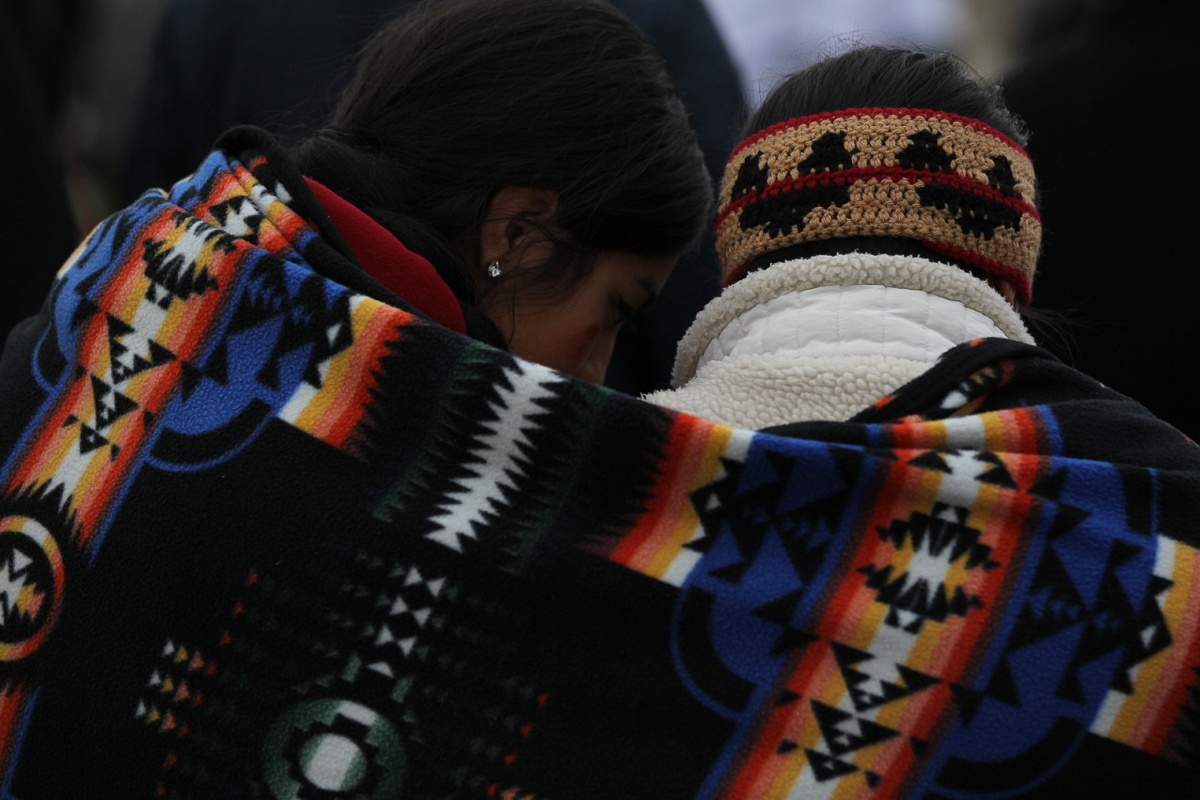
Before its interruption by coronavirus pandemic, starting in 1999 Cheyenne and Arapaho descendants of the Sand Creek Massacre of November 29, 1864 have organized an event known as the Sand Creek Massacre Spiritual Healing Run. The run itself has been done to retrace the steps of the soldiers who perpetrated the massacre on their return to Denver where the soldiers, carrying grisly bodily trophies, received a hero’s welcome. As one of the main organizers, Otto Braided Hair of the Northern Cheyenne nation, observes, the healing run serves a vital function in helping Cheyenne and Arapaho people integrate past and present from which they can build a positive future, “the purpose is healing—spiritual healing, emotional healing—healing doesn’t have boundaries, doesn’t discriminate… I was taught, all prayer is good.”
On the last day of the healing run, the assembled Cheyenne and Arapaho runners, along with their supporters, would gather in downtown Denver at an office complex on the corner of 15th and Arapahoe streets. Affixed to the outside wall of the building is a brass plaque put up in 2010 as a memorial to Captain Silas Soule, a soldier who was at Sand Creek, witnessing the carnage that took place, and was assassinated at this location on April 23, 1865. The runners meeting here would do so after first assembling for a sunrise ceremony at Soule’s grave at Riverside Cemetery in tribute to the memory of a fallen hero whose act of courage is still remembered and honored by Cheyenne and Arapaho people to this day. Aside from the historic marker, Soule also has a prominent place in the exhibit recently opened at History Colorado where he is distinguished for “his willingness to disobey evil orders” issued by the Methodist minister and US Army Colonel, John Chivington, helping to inform and educate people on a figure who has been largely neglected in American history.
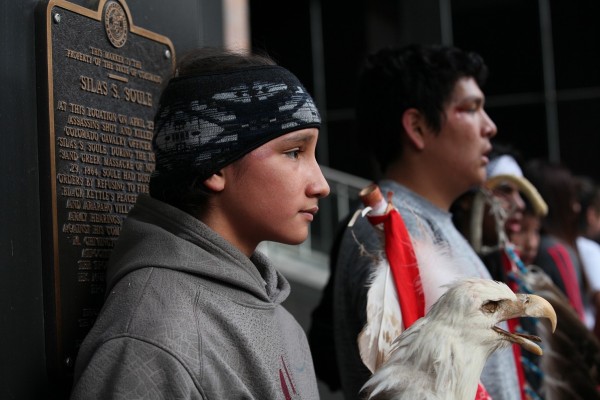
Despite the neglect of Soule’s experience in the history of the American West, however, his memory lives in the hearts and minds of Cheyenne and Arapaho people, while his grave and place of death in Denver serve as hallowed sites of remembrance within the tangled sprawl of traumatic history that binds their lives together. That the Cheyenne and Arapaho participants in the Healing Run have honored these sites as part of their broader commemorations of the Sand Creek Massacre, originating each year from the ground of the Sand Creek massacre itself, speaks to the cherished place Soule, and his fellow officer Lieutenant Joseph Cramer, continues to have in their memories and stories. In visiting the places of Soule’s death and his final resting place, Cheyenne and Arapaho people continue to honor his conscience and humanity through their blessings and prayers, accompanied by the stirring performance of honor songs that reach back through time and space to soothe and to heal.
Within this larger historical context, however, there seems to be a commonly held view that the actions of the people who inhabit this past should not be judged too harshly for their actions and indiscretions, nor viewed through the ethical or moral imperatives of contemporary society. This is often expressed when the people who propagated and committed various forms of violence, injustice and oppression are described as if without agency and merely products of their time. According to this view, instead of focusing our attention on the crimes of the past, we would be better served by taking note of the advances that has come to pass since. Such ideas are also reflective of a view of history in which the actions of individuals are minimized within the broader course of historical events in which the lines of responsibility and guilt, agency and victimization become obscured and blurred as tangled elements within the overarching context of western frontier conflict occurring as part of the so-called ‘Indian wars’ of the nineteenth century.
Related stories
From this perspective, the often-violent behaviors and ‘tragic’ events that took place become lost through an implicit appeal to historical relativism, with atrocities all-too-often framed as having been committed to an equal extent by both Euro-American settlers and native peoples alike. It’s a view of the frontier that supports the characterization offered by the eminent historian, Frederick Jackson Turner, of the western frontier as “the meeting place between civilization and savagery.”
The issue with such a relativistic conception of history, as later generations of new west historians and novelists have pointed out, is that it lacks a nuanced understanding of subjectivity and allows little space for the memories and stories of people who resisted and rejected the deterministic, and often genocidal, logic of binary oppositions that draw meaning from the linear designs of Manifest Destiny and the doctrine of progress. These assumptions form the underpinnings of a system of historical understanding whereby attitudes grounded in frontier colonial, knowledge render the actions of those who challenge authority invisible, especially when relating to the experiences of marginalized populations whose perspectives are often minimized and excluded from triumphalist narratives.
In contrast to dominant histories that tend to celebrate those in position of authority, the people who speak truth to power in declaring their intellectual and moral independence through acts of resistance in the face of hatred and injustice are, of course, the people who ought to be remembered and honored. This kind of moral courage was displayed by Silas Soule and Joseph Cramer, and most of all, of course, by the Cheyenne and Arapaho people who were subjected to the violence and dispossession in the first place. In turning from standard patterns of historiography, the exigencies of Providential design that rationalize and justify the invasion and dispossession of native lands become untenable, thus, releasing us from the blinds of historical amnesia.
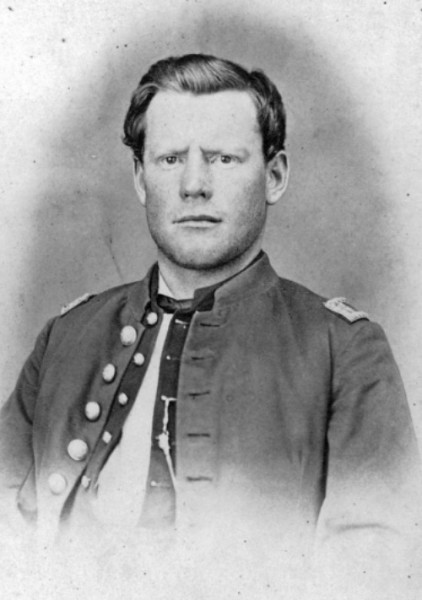
Information about the life of Joseph Cramer is scarce, while he also died at the age of 33 in Kansas. Silas Soule was born in Maine into a family of prominent abolitionists before relocating to Boston, and then coming to Kansas to join the fight against slavery. It was here that Soule became a key figure in abolitionist causes and an active Jayhawker who participated in armed raids to free slaves throughout Kansas. At the same time, living in a family home that had become a stop on the underground railroad. Disillusioned by the failed raid led by John Brown at Harper’s Ferry and his subsequent execution, which Soule tried to stop in a plan to break Brown out of jail, he eventually ended up in Colorado in search of opportunity, trying his hand at mining. With the outbreak of the Civil War, Soule was among the initial group to enlist in the pro-Union Colorado First, carrying on in his combat against slavery while also becoming involved in clashes with the native peoples of Colorado Territory.
Despite the intersection of these seemingly incongruous activities, they need not be viewed strictly as contradictory or damnable associations as they reflect Soule’s profound sense of loss for Brown’s martyrdom and the futility of his own life in Kansas, which he confided in a letter to a friend he was “getting damn sick of,” calling it a “God-forsaken place.” Despite these disappointments, Soule’s commitment to causes dedicated to freedom and justice continued to be reflected in the sense of humanity displayed in letters written to his mother and sisters. In these dispatches home, Soule details his experiences as a soldier in Colorado, ensuring his sister, “I am the same boy, Annie, as I used to be,” before adding, “you know I never was much of a Christian, and am naturally wild, but I have seen so much of the world and are not much changed. I think there is not much danger of my spoiling.” In another letter to his mother, Silas expresses a desire to marry and settle down, writing, “all I care for is to have part of the farm in Kansas to live on when I get out of the service.”
Soule, along with Cramer, were military officers who refused to take part in the murderous plans of Col. Chivington and that of Major Scott Anthony who had just taken command of Fort Lyon with the reassignment of Maj. Edward Wynkoop. In Soule’s and Cramer’s courageous acts, which were met with the threat of hanging, both men thoughtfully and actively refused to follow Chivington’s orders to attack the peaceful village of Cheyenne and Arapaho people camped along a winding stream in the frozen plains of southeast Colorado on that fateful morning. Further, they also ordered the soldiers under their commands to stand down and not to fire when the massacre commenced, saving untold lives in the process.
The resulting catastrophe of the Sand Creek Massacre is still recognized almost 160 years later as among the most infamous acts of brutality in the history of the American frontier. An event that remains a traumatic, lived presence in the hearts and minds of the Cheyenne and Arapaho people in remembrance of those who were forced from the security and warmth of their lodges on that fateful morning.
In a letter to his mother on this atrocious event dated December 18, 1864, Soule laments, “I was present at a Massacre of three hundred Indians mostly women and children. It was a horrable scene and I would not let my Company fire. They were friendly and some of our soldiers were in their Camp at the time trading. It looked too hard for me to see little Children on their knees begging for their lives, have their brains beat out like dogs.” Although Soule and Cramer were able to keep their soldiers out of the massacre, it didn’t save them from the horror of witnessing an attack that quickly descended into frenzy of killing and ghastly acts of cruelty and mutilation.
Soule and Cramer remained true to their convictions despite being threatened by Chivington and other soldiers after expressing their protests to the plan and in the aftermath of the massacre. Each wrote urgent letters to Wynkoop, condemning Chivington’s and Anthony’s actions, along with the soldiers who carried out the massacre, which Soule described as “a perfect mob.” During a meeting held amongst the assembled officers at Fort Lyon on the eve of the attack, Soule reported to Wynkoop, “as soon as I knew of their movement I was indignant as you would have been were you here and went to Cannon's room, where a number of officers of the 1st and 3rd were congregated and told them that any man who would take part in the murders, knowing the circumstances as we did, was a low lived cowardly son of a bitch. Capt. Y. J. Johnson and Lieut. Harding went to camp and reported to Chiv, Downing and the whole outfit what I had said, and you can bet hell was to pay in camp.”
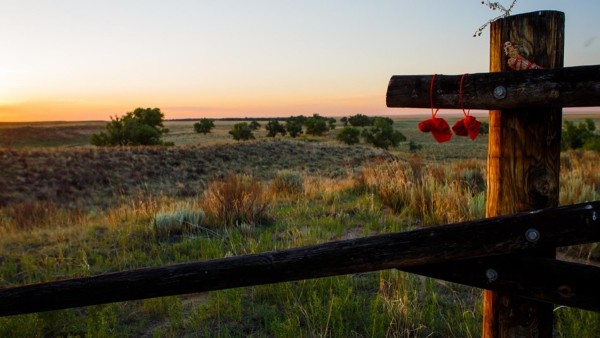
While Soule and Cramer could not prevent the massacre, their shocking testimony prompted three military and congressional investigations into the atrocity. The heartbreak of the Sand Creek Massacre was made even more senseless by the fact that treaties had been signed by Cheyenne and Arapaho leaders ensuring the preservation and exclusive use of the very lands they were on when the massacre occurred. As with other treaties signed by the Cheyenne and Arapaho, and many other native nations during this period, having been ratified by the federal government, they carried the endorsement of the US Constitution.
The resulting investigations, in which both Soule and Cramer served as witnesses, while not leading to punishment for any of those responsible, brought condemnation upon Chivington, while costing Colorado Territorial Governor and Superintendent of Indian Affairs, John Evans, who had raised the largest body of troops involved in the massacre, his political career. Soule’s assassination on the streets of Denver in the spring of 1865 was reported at the time in local newspapers as carried out in reprisal for his testimony against Chivington and other soldiers involved in the massacre.
By the time Chivington was called as a witness Soule was dead, and at the far-too-young age of 26. Another mournful casualty of the massacre, perhaps, and like John Brown, now a martyr himself to the truth of a crime that he felt compelled to condemn and expose as a means of bringing some small degree of justice to the Cheyenne and Arapaho people who suffered and died at Sand Creek, along with those forced to abandon all that they loved and had in a frantic fight and flight for their lives in the harsh cold of that November morning.
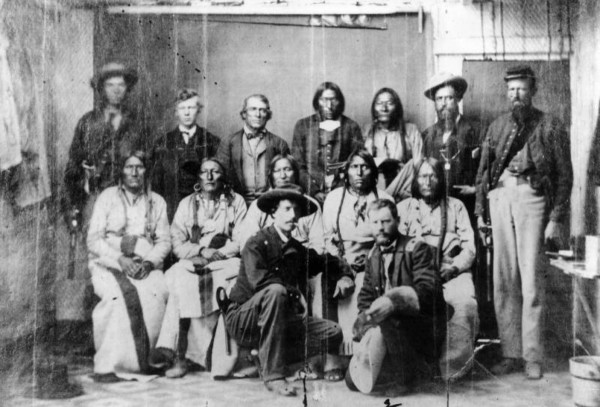
Few historians who went on to detail this bloody chapter of American frontier history have shown much interest in telling of the courageous actions of Soule and Cramer, much less the brutalities visited upon Cheyenne and Arapaho peoples, whose stories are subsumed within a narrative of triumph where little room was made for competing perspectives. As such, Soule’s and Cramer’s objections to the attack of peaceful Cheyenne and Arapaho peoples at Sand Creek, as well as their testimony, was soon ignored and forgotten.
Just two more dauntless voices of dissent rendered ill seen with the loss of the words that bore witness to the unimaginable brutality of their fellow soldiers—their very presence and existence obscured within the triumphalist narrative of the western American frontier, much like details of the massacre itself. Theirs has been an absence that persisted almost until the dawning of twenty-first century, and in many ways is still in force today. That the details of Sand Creek remain elusive to so many, while representing but one example within the panoply of genocidal violence associated with colonial expansionism, only reinforces this point.
The omission of Soule and Cramer from the historical record would likely still be the case had it not been for the storage and unexpected discovery of manuscript copies of Soule and Cramer’s letters in an old trunk in small town in Colorado. A descendent of some of the earliest settlers to Colorado, Linda Rebeck, made the find in the summer of 2000 when sorting through some documents that had been saved by her mother. Soon after, Soule’s voice was being heard through the letters, eventually being read into the Senate record by former Colorado Senator Ben Nighthorse Campbell at a hearing to establish the Sand Creek Massacre National Historic Site.
Through this unlikely turn of events, Soule’s powerful words were made to speak to the memory of the present while bearing witness to the hatefulness and brutality perpetrated at Sand Creek, but, so too, of the kindness and compassion of the human spirit. Even with its availability, however, the testimony provided by Soule and Cramer can only assume its rightful place within our collective historical consciousness if we are willing to listen, act and remember. So now, again, on the anniversary of the Sand Creek Massacre, may we follow the example of Cheyenne and Arapaho people in remembering the brutality of the crime perpetrated by Chivington and his men while honoring the courage of two soldiers who were also there on that fateful day.
In all their strength and richness of spirit, may we renew our commitment to the principles Silas Soule sacrificed his life in trying to uphold. For it is the courageous but profoundly human stories of historical figures such as Soule, Cramer and others—people who stood up for what was right and just in the face of the hatred, violence and death so pervasive and inextricable to the American colonial experience—that can shape the construction of a different kind of monument. One that offers a story and an example that is different from the one most Americans are taught in school, and that all Americans can feel proud to honor, remember and actualize in our own lives.
Comments

Powered by RoundtableAn AI/DeFi-powered Enterprise Media Operating System. Learn more at Roundtable.io.© Roundtable 2026. By using this site you agree to the Terms of Use and Privacy Policy