
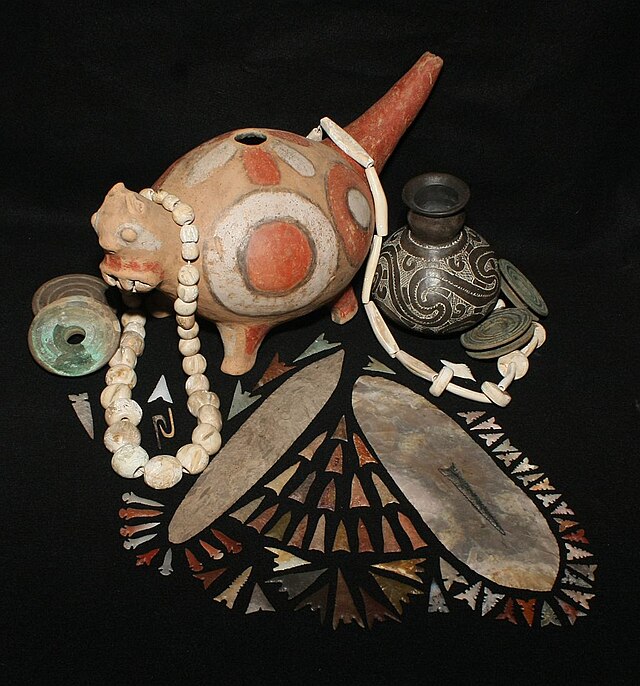
CliffJackson • Creative Commons Attribution-Share Alike 3.0 • Wikimedia Commons


May 6, 2024 2:08 PM
Updated May 8, 2024 7:45 PM
Looking back at this depressing historical record, one wonders what responses would have been best for Native Americans.
Most of us know that throughout most of our history, Native Americans have been treated badly in the USA by Whites. Some scholars —for example, Russell Thornton in American Indian Holocaust and Survival: A Population History since 1492 (1990) and David Stannard in American Holocaust: Columbus and the Conquest of the New World (1993)—have used the word “holocaust” to describe U.S. actions toward them. The latter historian even stated that “the destruction of the Indians of the Americas was, far and away, the most massive act of genocide in the history of the world.”
According to a Library of Congress website, “After the passage of the 1924 citizenship bill [the Snyder Act], it still took over forty years for all fifty states to allow Native Americans to vote.” In 1993, Stannard still faulted the U. S. government for “its willful refusal to deal adequately with the life-destroying poverty, ill health, malnutrition, inadequate housing, and despair that is imposed upon most American Indians who survive today.” Now, more than three decades later, some of these impediments still plague Native American life.
Looking back at this depressing historical record, one wonders what responses would have been best for Native Americans. Seek assimilation into the so-called American “melting pot”? Offer greater resistance to White efforts to subject them and their culture and the seizure of their lands?
These type of choices have faced many peoples in various parts of the world. Those colonized, as were many Africans by European powers. Those occupied during wartime, as were many European countries by the Nazis.
Related stories
Just recently, I came across one Native American, Andrew Blackbird, who confronted the dilemmas of his people, and he even attended the same university where I taught for four decades.
Just recently, I came across one Native American, Andrew Blackbird, who confronted the dilemmas of his people, and he even attended the same university where I taught for four decades—today Eastern Michigan U.; when he attended for two and a half years in the late 1850s, Michigan State Normal School, “the first teacher training school west of the Allegheny Mountains.” (Most of my information regarding him comes from his 1887 work, “History of the Ottawa and Chippewa Indians of Michigan: A Grammar of Their Language, and Personal and Family History of the Author,”and from Theodore J. Karamanski’s excellent 2012 book, Blackbird’s Song: Andrew J. Blackbird and the Odawa People, which is the source of all unattributed quotes that follow.)
After his birth within the Ottawa (Odawa) tribe around 1820, Andrew spent his early years in the area of Little Traverse Bay around today’s Harbor Springs, Michigan The main occupation of his father (an Ottawa chief) and brothers was hunting—beaver and raccoon for their furs; bear, deer, and elk for their meat.
In his history of his people, Andrew wrote that decades before his own birth his “father was once left to perish on a lonely island [in Canada] by the fur traders, not because he had done any crime, but simply from inhuman cruelty and disregard of Indians by these white men. . . . From this time hence my father lost all confidence in white men, whatever the position or profession of the white man might be, whether a priest, preacher, lawyer, doctor, merchant, or common white man. He told us to beware of them, as they all were after one great object, namely, to grasp the world's wealth. And in order to obtain this, they would lie, steal, rob, or murder, if it need be; therefore he instructed us to beware how the white man would approach us with very smooth tongue, while his heart is full of deceit and far from intending to do us any good.” (In his recent environmental history, Peter Frankopan traces a similar unswavering “pursuit of profit” as a main driving force in environmental degradation.)
By 1835, in the midst of President Jackson’s two-term appalling treatment of Native Americans and forced removal of them from the southeastern part of the USA, the Ottawa “were in the midst of a crisis that affected every aspect of their lives, economic, political, social, and environmental. . . . It was a time when a venerable and successful culture was challenged to pioneer a new way.” But “to find a path of peace and yet still protect their identity and homeland would prove more difficult than any military battle.”
In his history, regarding 1835, Andrew wrote of some of his tribe’s leaders, including his father “going to Washington to see the Great Father, the President of the United States [Jackson], to tell him to have mercy on the Ottawa and Chippewa Indians in Michigan, not to take all the land away from them.” Many of the Ottawa, having adopted Catholicism about a decade earlier, after getting in their canoes, Andrew continues, “took off their hats, crossed themselves and repeated the Lord's prayer.”
The opening of the Erie Canal in 1825 greatly increased the influx of white emigrants to the Michigan Territory. Karamanski tells us that the “first and foremost goal” of the Ottawa trip to DC “was to dispel the dark cloud cast by the United States’ removal policy” of President Jackson.
In 1829, Andrew’s mother had died and in 1833 so too did his older brother William, who was nearing the end of his preparations in Rome to become a Catholic priest. Andrew’s loneliness and adjustments to these deaths were compounded by the cultural transition from hunting to maple sugar production, fishing, and some agriculture work, an activity that had previously been left more up to women. “This lack of a secure emotional base made the transition through puberty all the more difficult for Andrew.” Still by 1835, more of the Ottawa were being educated, and by the early 1830s Andrew had completed four years of missionary schooling before he stopped attending classes.
Andrew’s father and a few other Ottawa leaders did arrive at the White House in early 1836 (a year before Michigan became a state) and were received by President Jackson, but he left the negotiating of a treaty with them to Henry Rowe Schoolcraft, the U. S. agent for Indian Affairs in the Michigan Territory, who was normally stationed on Mackinac Island. It was “to the disgust of the Ottawa” that they had to deal with him—their previous relations had soured them on him.
Karamanski’s evaluation of this Treaty of Washington?
The 1836 Treaty of Washington was the most important agreement the Indian peoples of western and northern Michigan ever made with the United States.
The 1836 Treaty of Washington was the most important agreement the Indian peoples of western and northern Michigan ever made with the United States. It was the contradictory document that both set the stage for their potential removal from Michigan and at the same time was the basis for their eventual persistence in the state. It was a deeply flawed agreement that was fated to be very shortly undermined by events on the ground, yet paradoxically it proved to be the legal taproot of tribal rights for the Ottawa and Chippewa people well into the twenty-first century. Like so many agreements between the United States and the native people of the Great Lakes region, this treaty was an instrument of European-American hegemony whose primary purpose was to separate Indian people from their land. At the same time, this treaty also provided a legal framework and political opportunity so that Ottawa and Chippewa people could continue to live within their culture.
The Ottawa agreed to the treaty for many reasons, including some financial compensation, but one of them was that earlier that month (March 1836) the Senate approved the Treaty of New Echota (Georgia). By this “removal treaty” the Cherokee people were forced to leave (within two years) their southeastern U. S. lands and relocate west of the Mississippi River, which they did in new territory (present-day Oklahoma). But many did not do so willingly, but only after being forced to do so by U.S. soldiers. Thousands of men, women, and children died on the way on what became known as the Trail of Tears.
By the Treaty of Washington, the Ottawa were to cede some of their lands, but were to be left with others, including a sizeable tract on Little Traverse Bay. But the U. S. Senate altered the treaty, and in the words of Karamanski “changed the agreement from one that guaranteed the Ottawa persistence in their homeland to one that set the stage for removal to an alien environment.” What the Senate foresaw—but never implemented—was to limit their collective residence on Little Traverse Bay to five years and stipulate Kansas, which was not yet even officially opened to settlement by Whites, as their new home.
In the late 1830s and early 1840s, Andrew worked at various jobs on or nearby Lake Michigan, including Green Bay, Wisconsin. They included farm labor, upon fishing boats, clerking in a white man’s store, and (for five years in Grand Traverse, Michigan) as a blacksmith. He also attained some proficiency in the English language and became increasingly disenchanted with Catholicism.
Karamanski depicts him in the early 1840s as “a rootless teenager...curious about the world that was dawning on the Great Lakes frontier, open to whatever opportunities might present themselves, and utterly uncertain as to his future.”
One of the opportunities that opened up for him (in 1845) was the chance to attend the Twinsburg Institute, a school of more than 300 students, some girls as well as boys. Located in Twinsburg, Ohio, a city between Cleveland and Akron, Andrew was a boarding student there, along with a small number of other Native Americans, and worked part-time as a blacksmith to pay for his boarding. The founder of the institute was a young Calvinist minister named Samuel Bissell, who greatly aided Andrew and some other Native Americans at his school and who became not only one of his teachers, but a longtime friend. Partly as a result of Bissell’s influence, Andrew continued his transition from Catholicism to Protestantism, and in the 1850s, back in Michigan, often became embroiled in the conflicts between missionaries and other representatives of the two Christian branches.
In late 1846-early 1847, Bissell took Andrew on a two-month fund-raising trip to cities such as Philadelphia, Newark, and various towns in Connecticut and Massachusetts. While in New Haven, Andrew went down to its harbor and imagined Native Americans wondering at the seafaring Puritans arriving centuries earlier. He asked himself, “O where are they now, these broken remains of my race! Alas! they have mouldered & gone to decay. The plague of the White Man hath swept them away.”
Back at the Twinsburg Institute in the winter of 1847, Andrew continued his college- preparatory studies until returning to Michigan in the summer of 1850, after which he intended to return—but did not—to the institute.
One of the main reasons he remained in Michigan was to win citizenship rights for the Ottawa.
One of the main reasons he remained in Michigan was to win citizenship rights for the Ottawa. As he wrote in his “History of the Ottawa and Chippewa Indians of Michigan,” “my object of promulgating this cause was, I thought it would be the only salvation of my people from being sent off to the west of the Mississippi, where perhaps, more than one-half would have died before they could be acclimated to the country to which they would be driven.” (By 1856, the Ottawa, unlike Native Americans in most U. S. areas, seemed to gain citizenship rights when they were permitted to vote in “their first presidential election.”)
While battling for those rights, Andrew confronted alcohol abuse among the Ottawa, often encouraged by white traders, by launching a temperance campaign. And in 1852, he also opened a short-lived school for the Ottawa, one purpose of which was to heighten their English-language ability.
About the late fifties, Andrew writes in his “History . . . ,” “The next five years were passed among my people, doing a little of everything, laboring, teaching, and . . . . I met much opposition from the Catholic community, because I had already become a Protestant.” By the middle of the decade, he saw “education as the foundation of his people’s future.”
But also important was the allotment of land to Native Americans. Andrew, along with many other Ottawa leaders, thought that only individual landownership would lead to full citizenship for the Ottawa. But the U.S. government insisted “that allotment be controlled by its agents” and that “tied the Indian’s future to an inept and often corrupt system that undermined the promise of independent native land ownership.”
In late 1858, according to Andrew’s “History . . . ,” he was advised by U. S. Michigan Senator Lewis Cass to attend Michigan State Normal School, who recommended it as “one of the best colleges in the State." Founded just five years earlier, it had about 120 students. Little is known about his two and a half years there, except he married an English woman, Elizabeth Fisk, with whom he had four children; and, as he tells us, after two and a half years, because of poverty or fear he “would starve to death” before he graduated, he “was forced to abandon my studies and leave the institution.”
One of the causes of his poverty (and that of his new wife) was that the U. S. Indian agent who determined how much assistance he was going to get approved (besides tuition) only a “total allowance of $37 per academic term.” Andrew’s bitterness at this inadequate stipend was reflected in his “History . . . ,” where he wrote about this period, “When the white man took every foot of my inheritance, he thought to him I should be the slave. Ah, never, never! I would sooner plunge the dagger into my beating heart, and follow the footsteps of my forefathers, than be slave to the white man.”
From his truncated college experience, Andrew, along with Elizabeth, returned to the Little Traverse area. Within about a year, as he tells us in his “History. . . .” he obtained a job as interpreter for “Hon. D. C. Leach, U. S. Indian Agent for Mackinac Indian Agency, to whom I ever feel largely indebted, and I continued to hold this situation under several of his successors in office.”
He also indicated that during Civil War he “was loyal to the Government [the Union cause], and opposed the bad white men who were then living in the Indian country, who tried to mislead my people as to the question of the war, to cause them to be disloyal.” At the conclusion of the war, he continued, “I was appointed as an auxiliary prosecutor of the Indian soldier claims, as quite a number of our people also helped to put down this rebellion [of the Confederacy], and many were killed and wounded. But most of this kind of business I performed without reward. Before I was fairly out as Interpreter, I was appointed with a very small salary as postmaster at Little Traverse, now Harbor Springs, where I discharged my duties faithfully and honestly for eleven years.”
“From 1855 to 1874, Andrew... served in a number of local elected offices, including register of deeds, county treasurer, county board, township supervisor, circuit court commissioner, and deputy sheriff.” During these years, he was described as a “small man with hands and feet no larger than those of a woman, body straight and trim.”
But in the postwar county (Emmet) where Andrew lived, which contained Harbor Springs, more and more Whites were entering. Although in 1870 the Ottawa made up more than 95 percent of the county’s 1,211 population, a decade later there were 5,500 more Whites than all Native Americans combined. And most Whites looked upon the latter with disdain. Not untypical was the remembrance of one White newcomer: His mother “numbered as her friends all who had white faces and Christian names; Indians, in Iowa and Michigan, regardless of age or sex, were to her of Satan’s brood.”
As the Ottawa percentage of the county’s population declined, so too did its political leadership. “A new white majority took hold of the institutions of local government, and Blackbird never again [after 1874] held elected office.”
As the Ottawa percentage of the county’s population declined, so too did its political leadership. “A new white majority took hold of the institutions of local government, and Blackbird never again [after 1874] held elected office.” About this same time he “also lost his position with the Office of Indian Affairs,” and in 1877 his job as postmaster in Little Traverse (soon to be renamed Harbor Springs).
A few years later, however, he regained his interpreter position with the Office of Indian Affairs and continued in that role until 1883, and he “played a key role bringing abuse to light, but in the end the government did not want to undertake any meaningful intervention.”
Despite the loss of his positions, Andrew attempted to aid many Ottawa that were being swindled out of their lands. In the words of Karamanski, “Many people felt that in order to achieve the ‘permanent and desirable development of the country,’ it was justifiable for whites to use ‘every possible means’ to ‘dispose them of their lands.’ The ‘means’ whites employed were as varied as they were unethical.” And local government, which was “once under the direct control of Ottawa voters, now was turned into a tool for land seizures. . . . The plunder of Ottawa property was carried out by the leading white citizens of Emmet County.”
In the late 1880s, Andrew tried to receive a federal government appointment as Michigan Indian agent, but instead, in 1889 (two years after the publication of his history of his people), Congress “removed funding for the position. The move was no doubt a victory for the influential lumbermen and land speculators who objected to federal interference with their efforts to obtain Indian lands by whatever means were necessary.”
In 1900 Andrew had a new publication released by the same organization—the Women’s National Indian Association, which had a branch in Ypsilanti—that had published his 1887 book. The 1900 work was a pamphlet titled “The Indian Problem from the Indian’s Standpoint.” It emphasized the importance of education and “the placement of Indian students in regular public schools and elite boarding schools.”
Eight years later, Andrew died in the Emmet County Poor Farm. “The old man’s health had been poor for many years, with his eyesight in particular deteriorating.” His still living wife, Elizabeth, was also in poor health and may not have been capable of caring for him at home. At the time of his death, the Probate Court declared that “the only thing of value he had” was a “per capita share of the payment the Court of Claims had determined the United States owed to the Little Traverse Ottawa.” It amounted to $21.16. (Probably because of fears of unfair Indian treatment, the family home was in Elizabeth’s name.)
Karamanski sums up his life: “He had tried to bring education to his people, but had largely failed. He had tried to protect his people from those who would steal their land, but the citizenship rights he fought for proved a poor shield against white avarice and government indifference. He had sought an equal place in the American future, yet found himself exoticized as a colorful ‘relic’ of the past.” Furthermore, “his life was a betrayal of the implicit promise of American life. Blackbird’s experience and the fate of his people in the nineteenth-century Midwest was a sad case of arrested development. The Ottawa sought both to become part of American society and to preserve their unique identity, only to have their efforts circumscribed by racism and indifference. . . . At their moment of crisis, Andrew Blackbird tried and failed to protect his people from the abuse of the law, and they were relegated to the status of a despised minority group in their homeland.”
Like many of us flawed human beings, he tried to live his life according to how he thought best. He made some mistakes, and he often didn’t accomplish his goals. But they were noble ones, and his lack of more successes was due more to white racism and injustice than any faults of his own.
Comments

Powered by RoundtableAn AI/DeFi-powered Enterprise Media Operating System. Learn more at Roundtable.io.© Roundtable 2026. By using this site you agree to the Terms of Use and Privacy Policy