
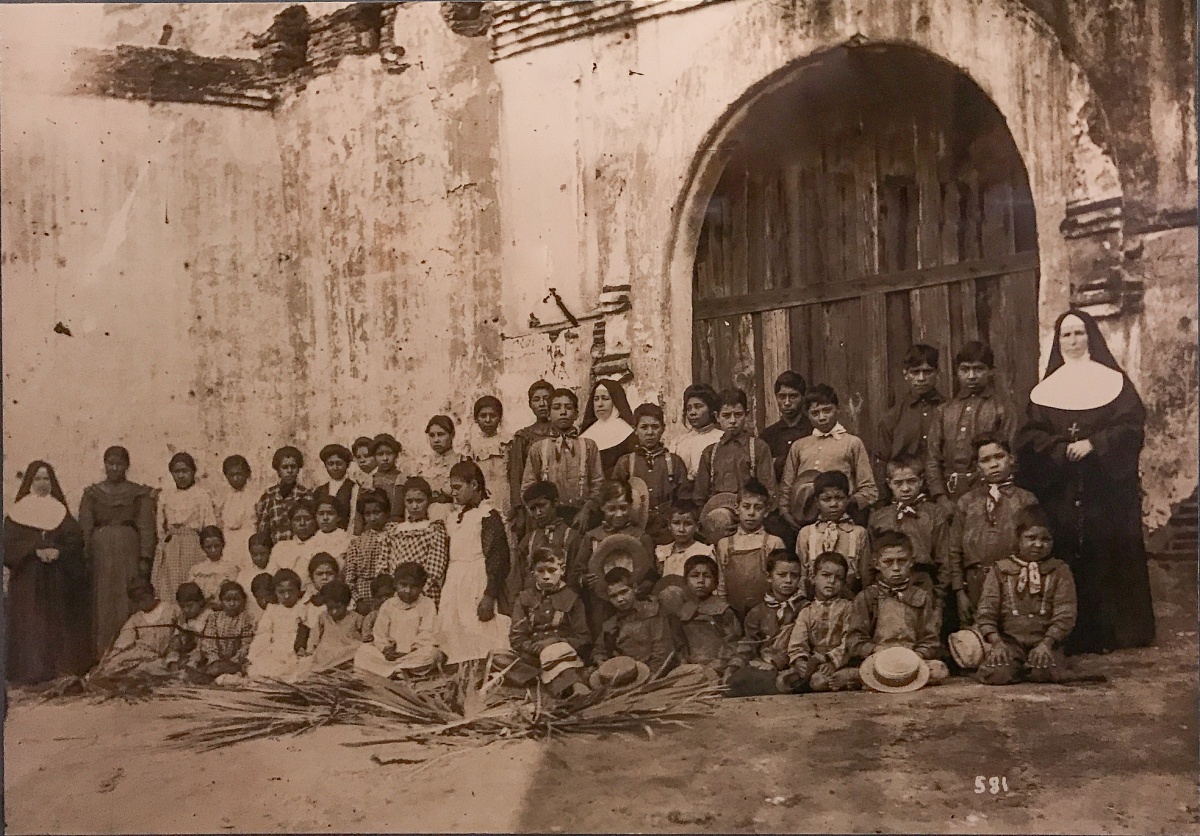
A.Davey • Indian School circa 1890 • "Sisters of St. Joseph of Carondolet, under the guidance of Father Antonio Ubach, began a school for Indian children at the Mission." Attribution-NonCommercial-NoDerivs (CC BY-NC-ND 2.0) • Flickr


Apology to Native Americans
Oct 27, 2024 3:50 PM
It is important to recognize the differences regarding Native Americans between the Biden-Harris administration (and Democrats in general) on the one hand and ex-president Donald Trump and most Republicans on the other.
Regarding Native Americans, almost exactly a year ago I quoted a LA Times article that stated, “As with the residential or boarding schools that operated in Canada and the United States . . . what begins as, or is sold as, a welfare program became a witting or unwitting instrument of cultural genocide and often child abuse.”
Four years ago I noted that “Unlike the Germans We Have Failed to Recognize and Atone for Our Holocausts.” Furthermore, I defended the use of “holocuasts” becaue I thought it captured “best the enormity of what European colonizers and then white Americans have done to Native and African Americans.”
Now, however, (on 25 October, 2024) President Joe Biden has finally recognized one great wrong that was done to Native Americans. In his own words on a Native reservation in Arizona, “I have a solemn responsibility to be the first president to formally apologize to the Native peoples, Native Americans, Native Hawaiians, Native Alaskans, and federal Indian boarding schools. It's a long, long, long overdue. Quite frankly, there's no excuse that this apology took 50 years to make. The federal Indian boarding school policy, the pain it has caused, will always be a significant mark of shame, a blot on American history.” Biden’s remarks also included the following, our policy was “horribly, horribly wrong” and “a sin on our souls.”
Some of the details of this “sin” were elaborated in news reports of the Biden speech. One such report was in the The Washington Post (WP); another on my favorite news program, the PBS News Hour. Both reports featured Native American Dana Hedgpeth, for decades a WP reporter, who co-wrote the WP article and was interviewed on the PBS program.
Related stories
The “sin” included the government’s creating and operating (in 37 states) more than 400 federal Indian boarding schools from 1819 to 1969—or paying religious groups to run them. The goal was to assimilate Native children (from ages four upward) by removing them from their families, languages, and culture. Results included the death of “at least 973 Native American children” from disease and malnutrition; the reported sexual abuse of more than 1,000 children; and being beaten for speaking a tribal language.
The background for Biden’s apology included an Interior Department report undertaken by Native American Interior Secretary Deb Haaland, whose grandparents and great-grandfather were sent to such boarding schools.
Although some Native Americans believed Biden’s apology was just a first step in needed redress toward Native peoples, others like Sam Torres, deputy chief executive of the National Native American Boarding School Healing Coalition, stated that his apology was “a very historic moment for Indian Country,” and that hearing him “recognize the hurt, the pain and the lasting impacts of the policies of the federal government and Christian denominations was a commitment to expanding the truth.”
With our presidential election soon to occur, it is important to recognize the differences regarding Native Americans between the Biden-Harris administration (and Democrats in general) on the one hand and ex-president Donald Trump and most Republicans on the other.
Looking back in 2018 on our U. S. history I wrote, “No other highly ranked president has a better record toward Native Americans than FDR.” And just a year ago I outlined the problems Republicans were having with recognizing (using some of Biden’s words) our marks of shame, our blots on American history.
I mentioned that in 2017 New York Times conservative columnist Ross Douthat indicated that some people preferred “the older narrative” of U.S. history, the one that glorified Columbus, the Pilgrims, the Founding Fathers, Lewis and Clark, and Davy Crockett, the one that emphasized the melting pot (not multiculturalism), and the U.S. Christian tradition, (not separation of church and state, and certainly not any secularist thinking). Furthermore, Trump’s ascent was “an attempt to restore their story to preeminence.”
In writing of the Republican’s difficulty in dealing with our past sins, I mentioned Trump’s “not-so-subtle signals that he perceives himself as defending the fortress of white, primarily male and Christian, dominance against the threat of increasing darker-skinned peoples"—and, I might have mentioned, against any past discriminations.
The Republican difficulty is clearly indicated by the works of Republican-led state legislators. Take, for example, the 2021 Oklahoma law that prohibited public-school teachers from teaching anything that would make “any individual. . . feel discomfort, guilt, anguish or any other form of psychological distress on account of their race or sex.” But what should have made made many whites from Oklahoma feel “discomfort” was the unpunished killing of perhaps “hundreds and hundreds” of Native American Osage for the money they had gained when rich oil deposits were discovered on their tribal lands—a reality captured in Martin Scorsese’s recent film, “Killers of the Flower Moon.”
The Republican effort to bury unpleasant truths about our history is wrong and counter-productive. As Biden said in his apology: “We must know the good, the bad, the truth. We do not erase history. We make history. We learn from history, and we remember so we can heal as a nation.”
Every nation has had its shameful moments, its mistreatment of peoples and its miscarriages of justice. We have had our tragic treatment of our Native Americans, our slavery and segregation, but we have also had presidents like Lincoln and FDR, and citizens like Martin Luther King, Jr.—none of them perfect, but using Lincoln phrase indicative of “the better angels of our nature.”
Four years ago, months before an earlier presidential election, I wrote, “Truth is especially important in this year of a crucial presidential election. Competing versions of the truth are already battling each other.” One NYT columnist wrote that Trump’s goal “was to annihilate the distinction between truth and falsity . . . to overwhelm people with misinformation and disinformation.”
But I also noted what former President Obama said in the middle of Trump’s presidency: “Too much of politics today seems to reject the very concept of objective truth. People just make stuff up. . . . We see it in state-sponsored propaganda. . . . We see it in the promotion of anti-intellectualism and the rejection of science from leaders who find critical thinking and data somehow politically inconvenient.” Moreover, Obama added, “the denial of facts runs counter to democracy, it could be its undoing, which is why we must zealously protect independent media; and we have to guard against the tendency for social media to become purely a platform for spectacle, outrage, or disinformation; and we have to insist that our schools teach critical thinking to our young people.”
Despite Obama’s warning, however, Trump’s Republican Party was descending into the lying pit along with him. In a 2018 Washington Post poll only 49 percent of Republicans thought it was important “for presidential candidates to be honest.”
Today, in late October 2024, with Trump dominating the Republicans, those who value truth among them would seem to be at an all time low. How else account for all those who support a man who during his presidency made 30,573 false or misleading claims?
Comments

Powered by RoundtableAn AI/DeFi-powered Enterprise Media Operating System. Learn more at Roundtable.io.© Roundtable 2026. By using this site you agree to the Terms of Use and Privacy Policy