
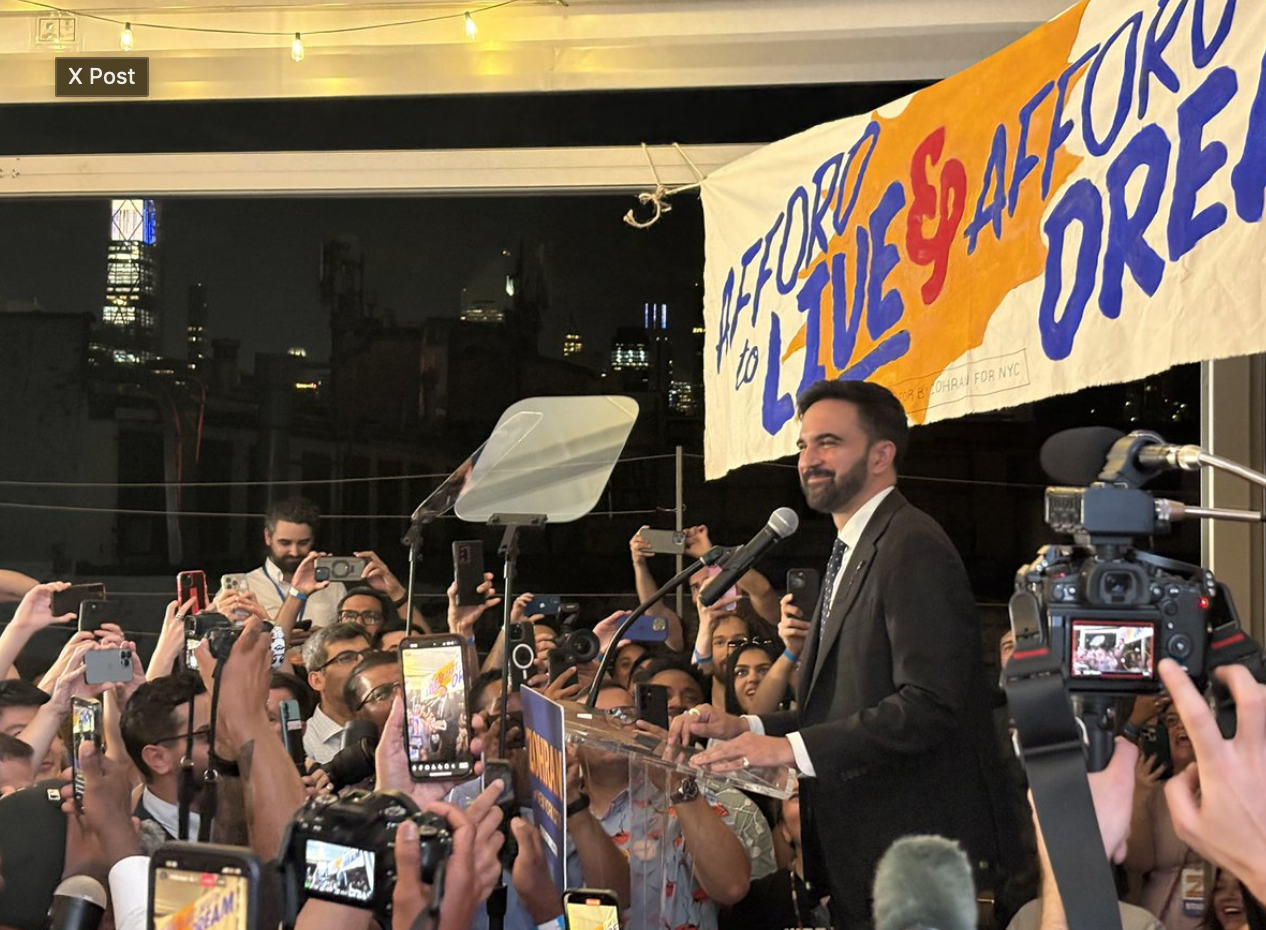


Jun 25, 2025 4:52 PM
Mamdani’s victory is the clearest sign yet that a new political coalition, anchored by Rep. Alexandria Ocasio-Cortez, Sen. Bernie Sanders, the Working Families Party, and local movement leaders, is not just ascendant, it’s capable of governing.
Zohran Mamdani’s win in the Democratic primary for mayor of New York City marks a profound shift in the city’s political landscape and beyond. A 33-year-old Ugandan-Indian Muslim democratic socialist, Mamdani has spent the past few years building trust with tenants, immigrants, artists, and youth in Astoria and across the boroughs. He wasn’t supposed to win—at least, not by the old rules of machine politics, donor networks, and whisper campaigns. But the old rules are collapsing. And Mamdani’s victory is the clearest sign yet that a new political coalition, anchored by Rep. Alexandria Ocasio-Cortez, Sen. Bernie Sanders, the Working Families Party, and local movement leaders, is not just ascendant, it’s capable of governing.
This win didn’t happen overnight. It was the result of years of movement-building and infrastructure that can’t be faked. Sanders backed Mamdani early and called him one of the most principled and clear-eyed leaders he’d seen emerge from the new left. AOC’s Courage to Change PAC brought its organizing engine to the campaign, driving digital outreach and boots-on-the-ground energy from the Bronx to Bay Ridge. The Working Families Party invested early and deeply, turning out multilingual canvassers, neighborhood captains, and labor organizers. And then there was Comptroller Brad Lander, who quietly offered political ballast. Lander understands city budgets, procurement, housing finance, and he made the coalition stronger by grounding it in policy and not just platform. This victory was a calculated, broad-based coalition with discipline and reach.
Mamdani’s policies were treated by many in the press as lofty or unrealistic. But as someone who works at the intersection of property law, decarceration, climate justice, and energy equity, I’ve seen how these policies are not only necessary, they’re workable. His plan to build 200,000 units of deeply affordable housing over the next decade is ambitious, but it’s grounded in a deep understanding of land use, public ownership, and the need to de-commodify housing. The rent freeze proposal is a direct response to the realities of tenants whose paychecks have stayed flat while their rents doubled. Public grocery stores address food apartheid, not just access but dignity. Free public buses aren’t a dream; they’re already being piloted in places like Kansas City and Boston. Mamdani’s climate and energy justice policies reflect the urgency of the moment, centered on mass transit, local resilience, and lifting the energy burden on working families.
These plans are designed to meet New Yorkers where they are, in a city where it’s increasingly impossible to live with any stability unless you’re wealthy or heavily subsidized by family wealth. Mamdani’s campaign spoke to the renters who’ve watched their buildings flip from rent-stabilized to luxury condos, to the mothers who ride two buses and a train to get their kids to school, to the students organizing for Palestine who’ve been met with arrests instead of dialogue. He met the moment, because he’s of the moment. His coalition reflects that: Muslim, Jewish, Black, Brown, queer, immigrant, working-class, and fed up.
Related stories
Andrew Cuomo misread the room. He returned to the political arena with a donor list and a Bloomberg-style platform promising competence. But voters were looking for something else: someone who would not only manage the city but fight for it. Cuomo’s politics of control and consolidation simply couldn’t compete with Mamdani’s clarity, his commitment, and the people who showed up for him in record numbers. What Mamdani’s team built wasn’t a campaign, it was a movement architecture. And it did something the Democratic establishment still struggles with: it made people feel powerful.
Brad Lander’s involvement helped bridge progressive pragmatism with movement demands. Lander, with his long-standing work on housing policy, police accountability, and public finance, brought a different kind of credibility. His presence gave the campaign an added layer of seriousness for those who care not just about what you promise, but how you’ll implement it. Coalition politics worked here because everyone had a role, those in elected office, those in the streets, those in legal clinics and union halls. That’s what it will take to transform cities.
What comes next matters just as much. The real work begins with governing. Mamdani has promised to reshape the city’s budget around care, not criminalization; housing, not hotel conversions; and public power, not privatized grids. He’ll need to work with a City Council that’s still learning to reckon with progressive momentum and a media class that remains reflexively skeptical of anything outside centrist orthodoxy. But he’s not alone. The same organizing infrastructure that won this race can be mobilized to push policy, hold agencies accountable, and fight for implementation. This is where many progressive experiments stumble: moving from values to operations. If Mamdani can navigate that transition, New York City could become a national proving ground for equitable, climate-resilient, community-driven governance.
And this win is already shaping 2028. AOC hasn’t announced a presidential run, but the infrastructure her team has built along with the Working Families Party, Sanders’ network, and aligned state legislators across the countr is evolving into something durable. This is not about any one person, but about co-governance. It’s a model. The next few years will be about deepening it, testing it, and scaling it.
Zohran Mamdani’s win is proof that politics doesn’t have to be hollow, consultant-driven, or afraid. It can be joyful, grounded, sharp, and bold. It can be about offering more than harm reduction, it can build something better. And it reminds us that who governs matters. Especially in a moment when protest is criminalized and dissent is suppressed, Mamdani’s leadership sends a signal that another kind of politics is not only possible, but here.
Mamdani is part of a shift that’s happening across the country and the globe. And he’s not going to be the kind of mayor who calls the NYPD on student protesters demanding justice for Palestine. He’s going to listen. And he’s going to act.
Comments

Powered by RoundtableAn AI/DeFi-powered Enterprise Media Operating System. Learn more at Roundtable.io.© Roundtable 2026. By using this site you agree to the Terms of Use and Privacy Policy