


Jul 10, 2026 7:09 PM
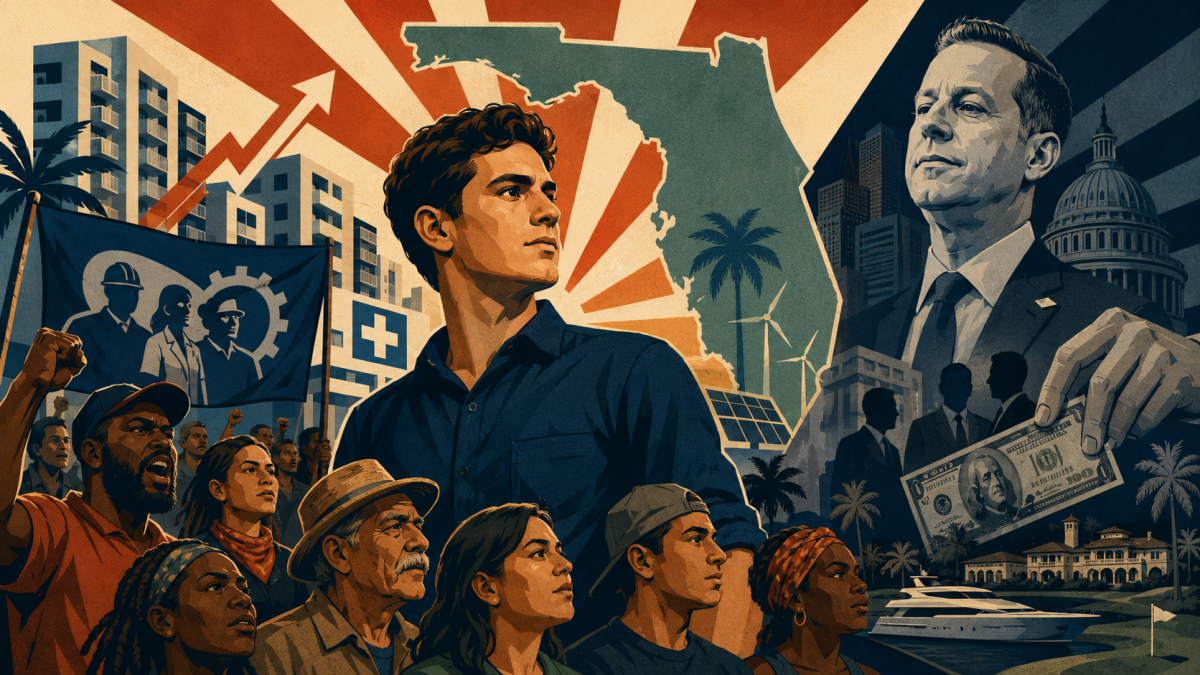
Jared Moskowitz and Oliver Larkin offer South Florida Democrats fundamentally different answers to the question of whom political power should serve.
The Democratic primary in Florida’s 25th Congressional District isn’t just a choice between two names on a ballot. It is a collision between two fundamentally opposed visions. It is a battle for the soul of the party.
On one side stands the politics of accommodation. Incumbent Jared Moskowitz is a career institutionalist who cut his teeth serving in Ron DeSantis’s administration. He broke ranks to become the first Democrat to join the Republican-led DOGE Caucus—trading solidarity for “efficiency.” He is backed by corporate-leaning PACs, deeply entrenched in the establishment, and has offered unwavering defense of the Israeli government’s military campaign in Gaza, refusing to draw a line when basic human rights are violated.
On the other side stands the politics of organizing. Oliver Larkin is not a product of the Washington machine. He is a labor organizer forged on the ground. His campaign was not engineered in a boardroom. It was built shoulder-to-shoulder with working people demanding a higher standard of living. His platform is an uncompromising demand for what we deserve: Medicare for All, untouchable union rights, housing families can afford, climate justice, and a foreign policy that refuses to fund genocide and values every human life equally.
One vision believes change is handed down from above—managed by donor networks, brokered in backrooms, and delivered through incremental, watered-down compromises.
Related stories
The other knows lasting change is always forced from below—built by ordinary people organizing, agitating, and challenging entrenched power.
South Florida does not have time for politics as usual. We are out of patience.
Working families are suffocating under skyrocketing housing costs while corporate landlords count their profits. Healthcare remains a luxury instead of a human right. Workers are squeezed tighter, expected to bleed for a system that busts their unions and silences their voices. We are watching billionaires and lobbyists buy the policies they want while the working class foots the bill.
The question on the ballot is not just who is “electable.”
It is who is accountable.
When the pressure mounts, whose call does the next member of Congress take?
Do they answer to the Washington establishment and well-funded lobbying organizations?
Or do they answer to the nurses, teachers, hospitality workers, retirees, immigrants, and working families whose labor makes South Florida run?
This divide shapes foreign policy, too. One candidate measures policy in geopolitical calculation and lobbyist approval. The other measures it in human lives, demanding an end to U.S. complicity in Gaza and fighting for a foreign policy rooted in international law and human dignity.
Look at history.
The eight-hour workday was not a gift from benevolent politicians.
Segregation was not dismantled because the establishment suddenly found a moral compass.
The right to vote was not handed over because power felt generous.
Every expansion of freedom in this country was won because ordinary people organized in solidarity, agitated, and forced the system to bend.
Politicians followed.
Movements led.
That is why FL-25 matters far beyond its borders.
We are choosing between an establishment politician and a movement organizer.
Between power financed from the top down and solidarity built from the ground up.
Between a system that demands we settle for less and a movement that fights for everything we are owed.
In FL-25, we are not just sending a representative to Washington.
We are sending a warning to the establishment—and a lifeline to the working class.
Comments

Powered by RoundtableAn AI/DeFi-powered Enterprise Media Operating System. Learn more at Roundtable.io.© Roundtable 2026. By using this site you agree to the Terms of Use and Privacy Policy