
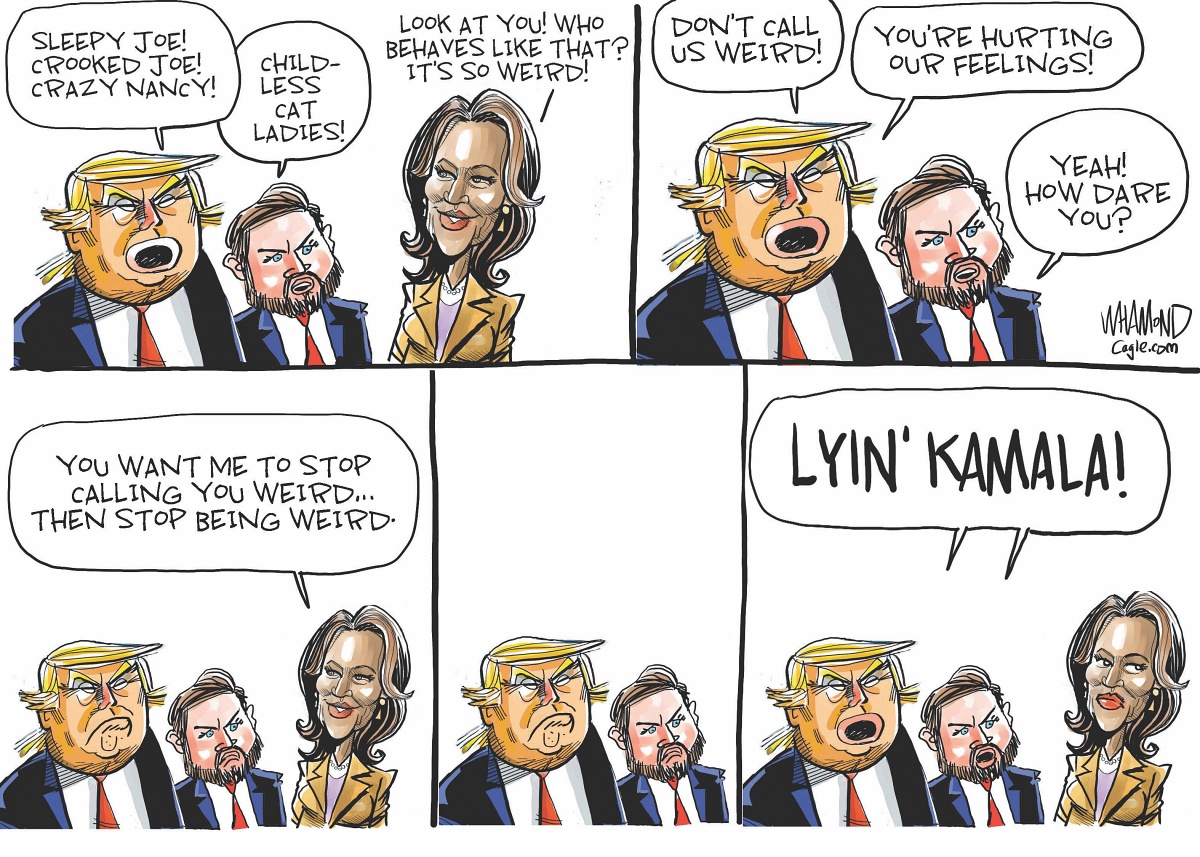
Cagle Cartoon: Dave Whamond


We’re Not Going Back
Jul 31, 2024 4:40 PM
I attended the 2008 Democratic Convention in Denver. It was the happiest crowd of political activists one will ever see.
In the space of 24 hours Kamala Harris turned anxious Democrats into fervent supporters. The anti-Trump constituency that seemed to lack the fire to defeat him has been galvanized as almost never before.
Almost never. Because we saw a similar campaign vibe in 2008.
Barack Obama’s grassroots campaign excited young people and boomers alike. Electing a black president was thought to be politically impossible—Obama’s massive volunteer operation proved otherwise.
Obama brought door-knocking in swing states to an entirely new level. I was particularly happy to see this because UC Press was just releasing my book on the legacy of the farmworkers’ movement. The UFW pioneered this method of statewide door-knocking in the 1968 election. Further, Obama’s “Yes We Can” was the English-translation of Cesar Chavez and Dolores Huerta’s “Si Se Puede.” Obama’s campaign confirmed how the farmworkers’ movement continued to impact progressive politics.
Related stories
I attended the 2008 Democratic Convention in Denver. It was the happiest crowd of political activists one will ever see.
Obama’s “Yes We Can” chant became a staple of his campaign speeches. We saw the same last week with Harris’s “We’re Not Going Back.” Consistent with how culture spreads in 2024, Harris’ slogan quickly became a song.
Beyoncé then gave Harris approval to use her huge hit “Freedom” as her campaign theme. Young people are swarming to Harris’ campaign like we haven’t seen since 2008 (many groups prioritize youth voter outreach; my favorite is Blue Future).
This unified vibe was absent when Hillary Clinton sought to become the first woman president in 2016. Even the campaign to defeat Donald Trump in 2020 did not mobilize young voters as powerfully as this campaign is on track to do.
Conventional wisdom said young voters had checked out of the 2024 presidential election. Harris’ candidacy radically changed this dynamic.
The Harris Impact
Harris offers another chance for a woman presidential candidate to break America’s ultimate glass ceiling. It is an opportunity few pundits foresaw. One that many Clinton supporters thought they might never see again.
“Common wisdom” said that 2016 showed that a woman candidate could not defeat Donald Trump. Today, running a woman against Trump is seen as a brilliant political move.
In her first week Harris’ campaign raised $200 million, 66% of whom were first-time donors. 170,000 volunteers signed up to work on the campaign.
It’s more than the Dobbs decision that overturned Roe v. Wade. Activists who felt a once in a lifetime chance to elect a woman president had been wrongly thwarted in 2016 are going all out to get this done in 2024.
The Harris campaign could match the excitement surrounding Barack Obama. And with an equally happy election outcome for Democrats. Here’s why.
A Referendum on Trump
The 2024 election should always have been a referendum on Donald Trump. That the New York Times, Washington Post and other legacy media tried to make this election about President Biden’s age and cognitive capacity while ignoring Trump’s own cognitive problems and plan to become a dictator is shameful.
Biden likely left the race less due to poll numbers than the realization that these media outlets were committed to driving him out. It wouldn’t have mattered how many great interviews or press conferences Biden did; the elite media demanded his removal.
As has now become clear, it all worked out for the best. Vote.org had the highest number of new registered voters over 48 hours than any prior day in the 2024 election cycle. Even more than when Taylor Swift urged her fans to register.
Biden’s campaign believed his historically strong economic record coupled with Trump’s liabilities would ultimately lead to victory. I shared that view. Now Harris gets the political benefits of Biden’s economic success and Trump’s problems without the President’s baggage (she also gets the benefit of Trump’s misguided choice of J.D. Vance as a running mate).
No wonder Trump and the GOP are so unhappy that Biden chose not to run.
VP Choice
With uncertainty over Biden’s plans gone, the media is now focused on the last remaining ambiguity: who will Harris choose as Vice-President. I correctly predicted Obama would choose Biden in 2008 (“Obama’s VP? New Clues Point to Biden,” August 15, 2008). I see similar clues leading to Harris selecting Arizona Senator Mark Kelly.
Kelly’s public appearances in the past week were universally praised. He also either clarified or changed his position on labor’s top legislative priority (the PRO Act) and publicly backed it. Those seeing immigration and border issues as Harris’s top vulnerability see Kelly as strong in this area.
Some see Harris picking a VP who, like her, was formerly an Attorney General. Or a VP younger than herself, which Kelly is not. But I see the Arizona Senator as the strongest choice.
Does it matter? I know studies show the VP choice can make a difference. But I haven’t seen that play out in the real world.
Remember when George H. W. Bush picked Dan Quayle in 1988? And Democrat Lloyd Bentsen offered the famous refrain in the VP debate when Quayle tried to link himself to JFK that “Senator, I served with Jack Kennedy. I knew Jack Kennedy. Jack Kennedy was a friend of mine. Senator, you’re no Jack Kennedy.”
Bentsen’s line went viral in the pre-Internet era. And Bush-Quayle won the election.
Trump is much weaker than in 2016 or 2020 and his VP choice of JD Vance was a disaster. Harris has said she will make her choice by August 7, two weeks before the Democratic Convention.
Whether its Harris-Kelly or another VP choice, all the forces are coming together for strong Democratic national victories in November. But success in every national election depends on a party’s supporters continuing to do the work.
Comments

Powered by RoundtableAn AI/DeFi-powered Enterprise Media Operating System. Learn more at Roundtable.io.© Roundtable 2026. By using this site you agree to the Terms of Use and Privacy Policy