
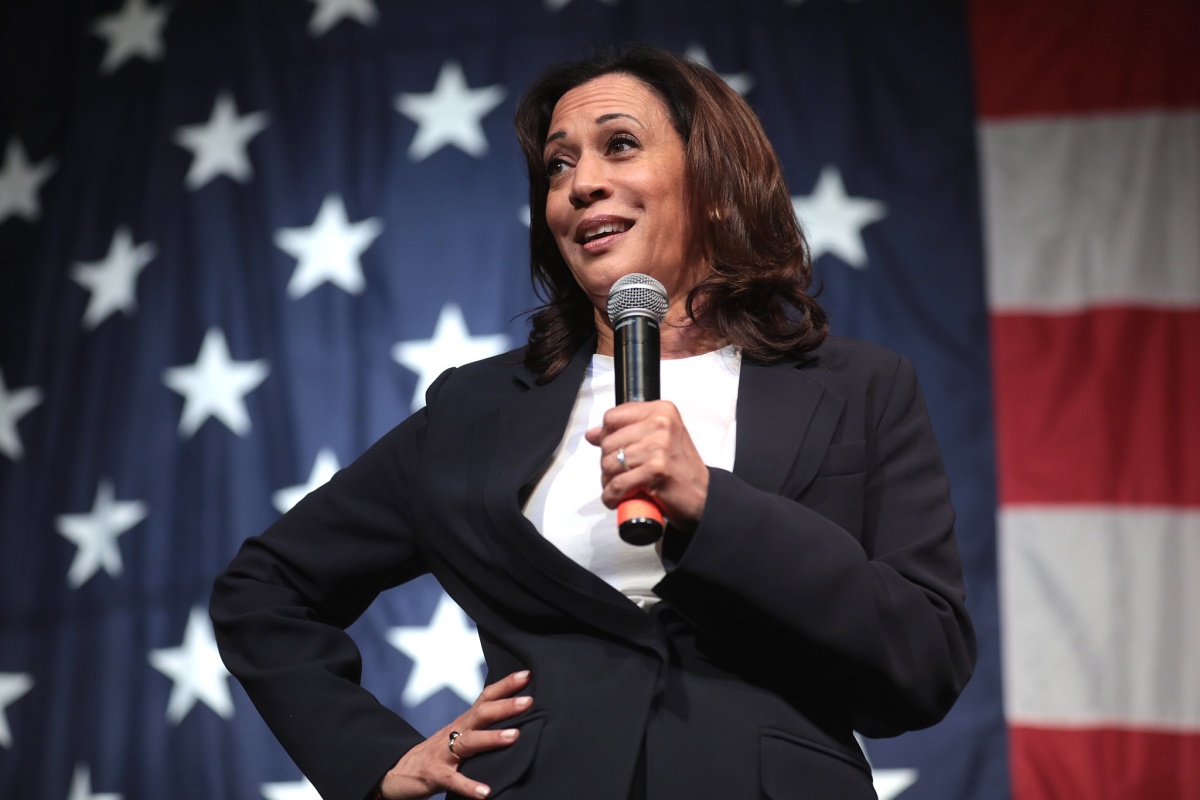
Gage Skidmore • Attribution-ShareAlike (CC BY-SA 2.0) • Flickr


Oct 7, 2024 11:46 PM
Updated Oct 10, 2024 9:52 PM
In sharp contrast to the lawless dictatorship Trump promises in his second term, I urge Undecided voters to examine how Harris would preserve democracy and continue to strengthen the United States.
In sharp contrast to the lawless dictatorship Trump promises in his second term, I urge Undecided voters to examine how Harris would preserve democracy and continue to strengthen the United States. More Videos
I learned an important lesson in 1968.
The presidential election that year was very close. It was the first time I was eligible to vote. By election day, former vice president Richard Nixon, the Republican, was in a close race with incumbent vice president Hubert Humphrey, the Democrat. I was a student at Columbia Law School and was very active protesting against the Vietnam War. My conscience could not allow me to vote for Humphrey because of his unflinching support of President Lyndon Johnson’s dangerous escalation of that illegal war. So I voted for Dick Gregory, the Freedom and Peace Party candidate.
And Nixon was elected.
I’ll never forgive myself for that mistake. Humphrey only lost the popular vote by .7 percent. In thirteen states, the Electoral College was decided by a margin of 5% or less. I wonder how many other young idealistic anti-war voters helped elect Nixon by casting a protest vote or by simply staying home. He went on to perpetuate the war. He was a disaster as President, escaping impeachment only by resigning.
Related stories
Today we face an election even more consequential than the one in 1968; it is existential. While the choice is crystal clear to many of us, and while most of the electorate has made up its collective mind, the election could well depend on two different groups of voters: The Uncommitted National Movement (the “Uncommitted”), for whom the issue of the lives and future of the Palestinian people outweighs all other issues, and the Undecided, who cannot make up their minds.
Since Uncommitted Voters Care About the Humanity and Self-Determination of the Palestinian People, Harris is Their Best Choice
On September 19, the Uncommitted National Movement—the national group that mobilized hundreds of thousands of primary voters to cast protest ballots against President Biden over US support for Israel in the war in Gaza—announced that it would not endorse Kamala Harris for president. “Vice President Harris’s unwillingness to shift on unconditional weapons policy or to even make a clear campaign statement in support of upholding existing U.S. and international human rights law has made it impossible for us to endorse her,” stated Abbas Alawieh, one of the co-founders of the organization. Nevertheless, the New York Times reported that Alawieh said he himself would nonetheless vote for Harris rather than Trump.
And despite its decision not to endorse Harris, the Uncommitted National Movement urged its members not to vote for Donald Trump, who, it said, had “bragged about accelerating the genocide against Palestinians and promised to intensify the suppression of pro-Palestinian activism in the U.S.” The group also urged members not to vote for any third-party candidate, saying that such a vote could help Trump win.
In response, the Harris campaign released a statement that said the “vice president is committed to work to earn every vote, unite our country, and to be a president for all Americans. She will continue working to bring the war in Gaza to an end in a way where Israel is secure, the hostages are released, the suffering in Gaza ends, and the Palestinian people can realize their right to dignity, security, freedom, and self-determination.”
But the New York Times reported recent polls showing that significant numbers of Arab American voters are moving to back third-party candidate Jill Stein in critical swing states, including Michigan, that could cut into Harris’s support in close races.
It would be a grave mistake if Uncommitted voters refuse to vote for Harris. They know full well that the plight of the Palestinian people will get worse and the prospects for peace in the Middle East will be dashed if Trump returns to power.
Trump is a staunch supporter of Benjamin Netanyahu and his policies in Israel. On March 5, Trump declared that Israel must “finish the problem” in its war against Hamas. “Frankly, they got soft,” Trump said about the Biden administration, claiming that the aggression by foreign adversaries would not have happened if he, Trump, were still president. His campaign issued a statement declaring, “President Trump did more for Israel than any American President in history... When President Trump is back in the Oval Office, Israel will once again be protected, Iran will go back to being broke, terrorists will be hunted down, and the bloodshed will end.”
Just days after Hamas attacked Israel, Trump, in a video posted from his Mar-a-Lago estate, declared: “I kept Israel safe. Nobody else will. Nobody else can. And I know all of the players—they can’t do it.” On October 11, he promised that a future Trump administration would “fully support Israel defeating, dismantling, and permanently destroying the terrorist group Hamas,” while telling the Republican Jewish Coalition later that month that Hamas fighters “will burn forever in the eternal pit of hell." That month, his campaign also said that, if elected again, he would bar Gaza residents from entering the U.S. as part of an expanded travel ban.
All that should remind us that Trump “has a lengthy and undeniable history of hostility and animosity towards Muslims,” according to Muslim Advocates. Trump claimed he watched Muslims in New Jersey celebrate after the 9/11 attacks. Despite being quickly and widely debunked, Trump continued to repeat the falsehood. He called for suspicionless surveillance of American Muslims and mosques. He supported a Muslim registry and said there is "absolutely no choice" but to shut down U.S. mosques. He called “for a total and complete shutdown of Muslims entering the United States." He retweeted three anti-Muslim propaganda videos originally posted by the deputy leader of an extreme far-right British nationalist group. And on and on.
On September 23, The Nation magazine endorsed Kamala Harris “in her own right, and because we oppose Donald Trump’s reactionary agenda.” Founded by abolitionists in 1865, The Nation describes itself as “a critical, independent, and progressive voice in American journalism.” Uncommitted voters should seriously consider what it has to say about the choice in this momentous election.
The Nation recalled that in her acceptance speech at the Democratic Convention, Harris warned of the danger to democracy posed by a reelected “Donald Trump with no guardrails”—especially after the Supreme Court’s recent 6–3 decision granting him “presumptive immunity” from criminal prosecution for his official acts. Harris urged Americans to “consider what he intends to do if we give him power again. Consider his explicit intent to set free violent extremists who assaulted those law enforcement officers at the Capitol. His explicit intent to jail journalists, political opponents, and anyone he sees as the enemy. His explicit intent to deploy our active-duty military against our own citizens.” Since those threats could very well be real, The Nation declared, “Of course we endorse Harris over Trump.”
But The Nation went further. “We also endorse Harris in her own right, as an experienced and capable leader with a vision for America’s future that—while not as progressive as we might prefer, particularly when it comes to foreign policy—represents a clear advance on the Democratic presidential nominees of the past half-century.”
The Nation called Harris “an eloquent and tireless fighter for reproductive freedom” who “proposes to make the child tax credit permanent, pass the PRO Act (making it easier for labor unions to organize), build 3 million units of affordable housing, expand Social Security, and tackle price-gouging and healthcare costs—all significant extensions of the Biden administration’s notably progressive economic achievements.”
On foreign policy, however, The Nation conceded that “the positive case is harder to make.” It pointed out that Harris’s campaign refused to allow even one Palestinian elected official to address the Democratic convention and has failed so far to win over the Uncommitted voters, who are “desperate for an end to America’s unconditional support for Israel’s brutal war on Gaza.”
Nevertheless—and here’s the whole point—as The Nation sees it, “anyone promoting Trump as a peace candidate needs to check their eyesight. Or their privilege.” He has been “a cancer on our public life since his days posing as a successful casino operator. His pervasive influence not just on our politics but on our manners, conversations, imaginations, and media developed a momentum that, until Biden withdrew, seemed likely to carry this habitual liar and adjudicated rapist back to the pinnacle of power. Preventing such a calamity ought to be reason enough to turn out to vote—particularly since, unlike in 2016, there is little doubt about how Trump would use such power.”
The Nation’s approach reinforces the lesson I learned in 1968. “Leftists contemplating voting for a third party in protest of Harris’s shortcomings—or out of discontent with our two-party system—need to ask themselves why their particular cause, or their personal discomfort, is more important than making sure that Trump, JD Vance, and their claque of congressional collaborators are defeated decisively, not only in the Electoral College but in the popular vote as well. Especially since we can already see Trump preparing another attack on the legitimacy of our elections.”
The Nation reminded us that the insurrectionists who attacked the Capitol on January 6, 2021, may not have been successful, but their aims “were part of a long campaign to drag this country back not to some mythical golden age but to the actual past when Black Americans had ‘no rights which the white man was bound to respect’ (in the words of the Dred Scott decision), women had no control over their own bodies, corporations were free to pollute our air and water, and employers were allowed to terrorize and discard their workers.”
“Unlike the self-proclaimed radicals who argue that there is no real difference between the two parties, or the two candidates,” The Nation explained, Harris is fully awareness of “what time it is in history.” The Nation insisted that “we can seize the time, together, to renew our republic, forging a new majority coalition to demand that our government deliver on the endlessly deferred promise of shared prosperity, justice, and freedom. First, though, we have to elect leaders who will hear us, can see us, and who rely on our votes.”
The endorsement of the country’s oldest progressive magazine is an important response to the Uncommitted’s narrow one-issue approach to this election. So are the endorsements of progressives like Bernie Sanders and Alexandria Ocasio-Cortez.
If voters who support Palestinian rights and want the bloodshed in Gaza to stop do not vote for Harris and instead help usher in a second Trump presidency, they are making the very same mistake I and others made in 1968 by not voting for Humphrey and ushering in the Nixon presidency.
Elections are about choices. Under the system currently in place, the two candidates who have any chance of winning on November 5 are Kamala Harris and Donald Trump. None of the announced third party candidates has any chance of garnering the 270 electoral votes necessary to be elected President. But those third party candidates, individually and collectively, do have the ominous potential in several swing states of helping to elect Trump by draining small amounts of electoral votes away from Harris and handing them to Trump. Some analysts believe that’s how Trump beat Hillary Clinton in 2016.
What I learned from my mistake in 1968 is that in general elections, especially for President, I need to choose the candidate who most closely aligns with my values and has a realistic chance of winning. That candidate may not be perfect. They rarely are. I may not agree with every position that candidate takes. Sometimes the choice feels like picking the “lesser of two evils.” Sometimes we’re fortunate enough to choose the “the better of two goods.”
If Harris is not your perfect candidate, then after voting for her, you can go out and do other things to actively advance your ideals, including lobbying the Harris administration to change its positions. There are many organizations who would welcome your active involvement and participation in the struggle for justice, equality, civil liberties, human rights, workers rights, marriage equality, freedom of expression, dismantling white supremacy, reforming the dreadful carceral system, abolishing the death penalty, welcoming immigrants, protecting the environment, and building world peace.
But when it comes to voting for the President of the United States, I look at the choices I am given and I make a brutally pragmatic decision, motivated by the realpolitik with which I am presented.
The choice in the 2024 presidential election could not be more stark. We need the largest margin of victory in the popular vote in the history of the United States to decisively repudiate Trumpism and all it stands for. I beg my progressive allies in the Uncommitted movement, after deep reflection, to vote for Kamala Harris.
A Second Trump Presidency Would Install a Fascist Dictatorship
Then there are the Undecided voters. Unlike Uncommitted voters, no single issue dominates their decision. They simply find themselves unable to choose between Harris and Trump.
I met one recently—a highly educated, successful, intelligent businessman. He readily acknowledged Trump’s failings but cited “concerns” about “policy” differences with Harris and “concerns” that she might not be “middle-of-the-road enough,” so he simply had not made up his mind. Given everything we know about Trump and Harris, it is baffling that six weeks before the election some voters are undecided.
Humorist David Sedaris captured it perfectly in a 2008 New Yorker column.
“To put it in perspective, I think of being on an airplane. The flight attendant comes down the aisle with her food cart and, eventually, parks it beside my seat. ‘Can I interest you in the chicken?’ she asks. ‘Or would you prefer the platter of sh*t with bits of broken glass in it?’ To be undecided in this election is to pause for a moment and then ask how the chicken is cooked.”
How Trump conducted himself in the past, especially as President, reveals how he would conduct his second term. As president, he was impeached twice and bipartisan majorities in the Senate twice voted to convict him (falling short of the necessary 2/3). He has been criminally charged with 91 felonies in four different prosecutions and has already been convicted on 34 of those charges. Following a three-year investigation and an 11-week trial in a civil proceeding, a New York State judge found that Trump had committed fraud by falsely inflating the value of his assets and engaging in other illegal conduct. Looking ahead, the court found that relief was necessary to prevent further fraudulent and illegal conduct. Trump was ordered to pay $450 million.
Against this background and the other egregious acts while he was in office, we don’t have to speculate about what a second Trump presidency would look like. He’s told us.
He has predicted (and thus incited) a “blood bath for the country” if he is not elected. He has vowed to be “dictator for one day.” He has threatened “termination” of certain provisions in the Constitution. He claims that immigrants are “poisoning the blood of our country” and he has promised “to have the largest deportation in history.” He has promised to pardon rioters who attacked the Capitol on January 6, and he has threatened to inflict mass persecution on the “vermin” who oppose him.
Last March, Trump hosted authoritarian Hungarian prime minister Viktor Orbán at Mar-a-Lago. Orbán has spoken at the Conservative Political Action Conference (CPAC) and hosted former Fox News Channel personality Tucker Carlson.
Trump showered Orban with praise. “There’s nobody that’s better, smarter or a better leader than Viktor Orbán. He’s fantastic.” Trump applauded Orbán’s approach to governing his country. “‘This is the way it’s going to be,’ and that’s the end of it, right? He’s the boss and…he’s a great leader, fantastic leader. In Europe and around the world, they respect him.”
According to Miles Taylor, former chief of staff of the Department of Homeland Security under Trump and author of Blowback: A Warning to Save Democracy from the Next Trump, “‘Trump 2.0' won’t be as bad as many think. It will be worse.” For Time magazine, he interviewed dozens of former Trump officials about the ex-president’s plans if reelected. “The picture was bleaker than I expected.”
Ex-Trump officials told Taylor that the executive branch will be weaponized in another MAGA presidency. “The damage Trump did in the first term is reparable,” said former national security advisor John Bolton, but he said the next Trump “would do damage that is not reparable, especially in a White House surrounded by fifth-raters.” Fiona Hill, a former advisor on Trump’s National Security Council, believes that the “MAGA movement has paved the way for a politicized intelligence community,” with ideologues in charge of agencies that “will lead the United States into "wars"—wars that America might not be prepared to win.
Insiders report that Trump came close to deploying armed U.S. troops on American soil in February 2019. After watching footage of migrants at the border, he told aides to invoke the Insurrection Act to put down what he called “an invasion.” Trump was preparing to include the announcement in his State of the Union Address, but a number of officials (included Taylor) rushed to the White House and talked the president out of it. Taylor believes that “next time, no agency will be spared from such abuses of power.”
Former Tea Party congressman Reid Ribble told Taylor that Congress’s checks and balances against the presidency “will be undone entirely.” Current and former Republican representatives like Ribble projected that if he wins, Trump would actively obstruct Congress by bypassing the Senate and installing unqualified “acting” officials in government agencies and by simply ignoring subpoenas. The White House would pressure Congress to water down gun laws, overturn protections for same-sex marriage, and seek to outlaw abortion, putting the culture wars center stage.
There is widespread fear that the justice system will be used to punish the MAGA movement’s enemies. “I assume we are going to see the invention of domestic terrorist enemies,” according to Tom Warrick, a Trump-era counterterrorism czar. He predicted that political opponents would be harassed under the guise of counterterrorism.
A Harris Presidency Would Continue to Build a Fair and Equitable American Society
In sharp contrast to the lawless dictatorship Trump promises in his second term, I urge Undecided voters to examine how Harris would preserve democracy and continue to strengthen the United States.
She has issued an 81-page Plan to Lower Costs and Create an Opportunity Economy as part of her comprehensive website detailing her positions on every major issue in this election.
As just one section of the Plan explains, nearly 100 business leaders agree that electing Harris “is the best way to support the continued strength, security, and reliability of our democracy and economy.” Goldman Sachs estimates the biggest boost to the U.S. economy if Harris wins, with higher job growth and lower inflation than if Trump is elected. A Harris victory would lead to between 10,000 and 30,000 more new jobs per month than if Trump is elected. A separate analysis by Moody’s Analytics shows that under a Harris presidency, more than a million new jobs would be added to the economy and household disposable income would rise more than under a Trump presidency. Moody’s finds that Trump’s plan would cause a recession by mid-2025, cost 3.2 million jobs, add over 1 percent to inflation, and reduce middle-class families’ incomes by $2,000.
Moreover, a survey of nearly 40 top economists by the Financial Times and the University of Chicago found overwhelmingly that Harris would be better than Trump on inflation. Economists at Nomura, a financial services group spanning 30 countries and regions, agree that Trump’s across-the-board tariffs would reduce global growth and increase inflation in the United States by almost 1 percentage point. Even the conservative-leaning American Action Forum found that Trump’s tariffs would increase annual costs for ordinary Americans by $4,000 per year, and an economist at the conservative Tax Foundation noted that tariffs as high as some that Trump has threatened “will almost certainly increase the risk of a recession.”
And it can never be repeated enough that the next President may have one, two or three appointments to the Supreme Court. Some, if chosen by Harris, could reduce or eliminate the ultra-conservative super-majority, thereby restoring fundamental constitutional rights, including reproductive freedom, which have been eliminated. Those chosen by Trump would solidify the ultra-conservative super-majority for generations to come. I want Harris to choose those new justices, not Trump. And I think most voters, outside of Trump’s MAGA base, agree with me.
Despite any reservations Uncommitted and Undecided voters may have about Kamala Harris and her policies, given the disastrous alternative, they should vote for her on November 5 if they care about our democracy. The future of our country and the welfare of people around the world depend on it.
Comments

Powered by RoundtableAn AI/DeFi-powered Enterprise Media Operating System. Learn more at Roundtable.io.© Roundtable 2026. By using this site you agree to the Terms of Use and Privacy Policy