


Aug 13, 2024 5:21 PM
Updated Aug 28, 2024 5:58 PM
Trump’s apparent belief that many more Nordic people would love to migrate to the USA should not surprise us.
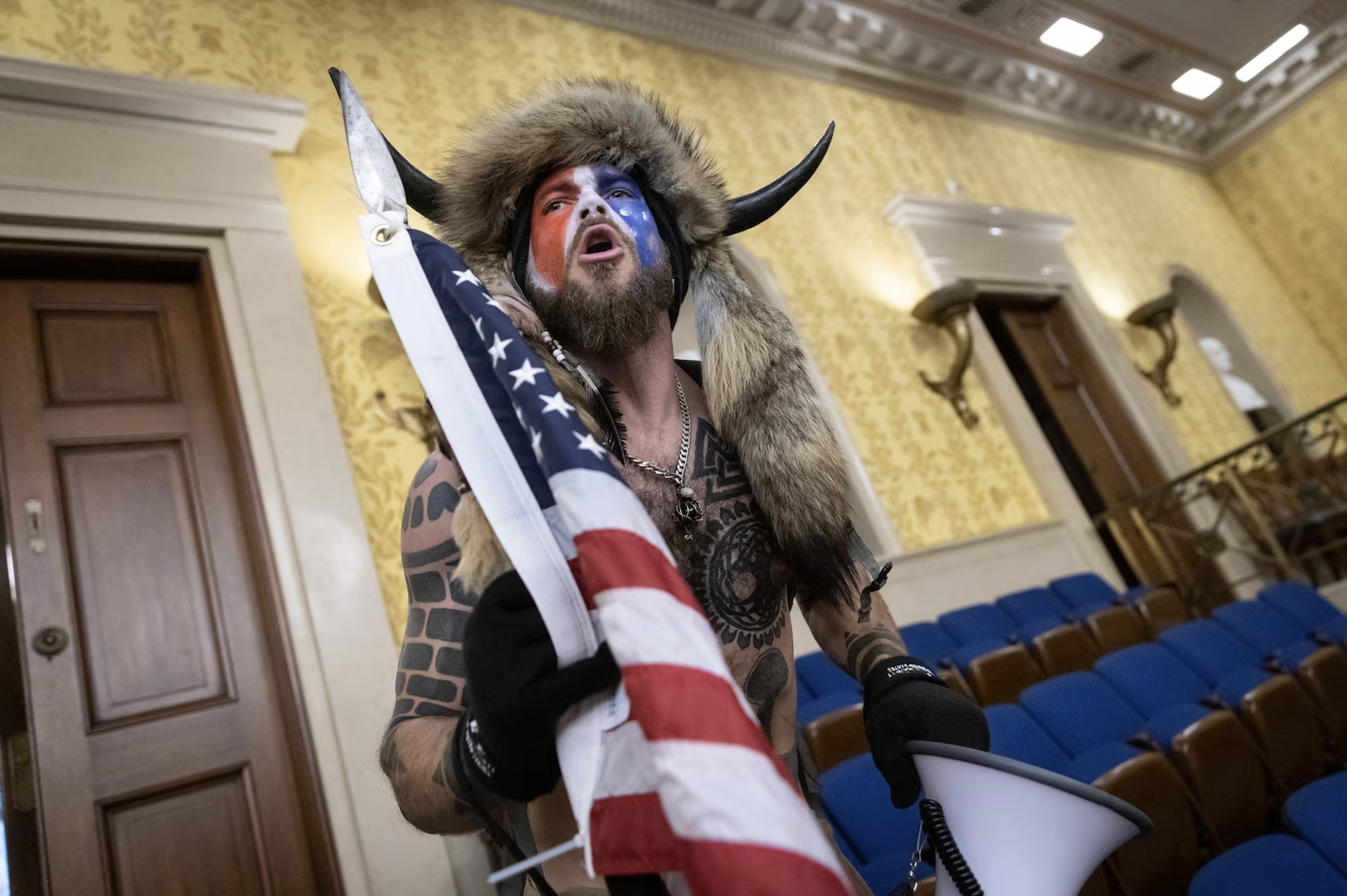
In early August, 2024 a federal judge ruled that authorities should return a "Viking" helmet and spear to a rioter who appeared with them at the Jan. 6th Capitol insurrection. (Earlier he had received a three-year-plus prison sentence for his role in the riots.) Above is a picture of the rioter, and I remember thinking at the time, “What’s the deal with such a helmet?” Here is what I discovered.
First of all, although horned helmets like that of the rioter are often described as “Viking helmets,” such a claim is inaccurate. Nevertheless, the day after the Capitol riot occurred an article appeared entitled “Here's the Story Behind Those Viking Helmets at the Capitol.”
The piece noted that the often viewed picture of the helmet wearer was of “Jake Angeli, an Arizonian who calls himself a ‘Q Shaman’ and is a prominent voice in the QAnon conspiracy movement.” But the article also stated that another man was decked out in a similar outfit. Moreover, it claimed that “horned helmets and fur pelts have become something of a uniform for white supremacists.” And that already decades earlier, in 1998, “the Southern Poverty Law Center identified a neo-Nazi interpretation of Odinism, the pre-Christian, Northern European and Germanic religion, that was spreading in the United States. Furthermore, “a neo-Pagan religion drawing on images of fiercely proud, boar-hunting Norsemen and their white-skinned Aryan womenfolk is increasingly taking root among Skinheads, neo-Nazis and other white supremacists across the nation."
The article continued that during the 21st century such perverted Odinism was accompanied by a “growing interest in Old Norse folklore, and its various (often historically inaccurate) interpretations throughout the centuries. Soon, folklore surrounding the Vikings and other Nordic medieval groups...including representations in modern popular culture [films, TV, etc.]...became visual references for these racist groups...Actual Viking history be-damned.”
Related stories
That same piece points out that the falsification of Viking history was aided by German nationalist composer Richard Wagner (1813-1883)—more about him later—especially in his four-part opera cycle “Der Ring des Nibelungen” (hereafter, the Ring) based on stories from Norse mythology. The essay also quotes a source indicating that the misuse of history by Wagner and other 19th century German nationalists was done to benefit “racial white supremacy" and that it “later influenced the Nazi movement.”
Finally, the essay indicated above quoted a “social justice think tank” in 2018: "Today, [racist sects of neopaganism] are even more prevalent, as White supremacists exploit political instability driven by anti-immigrant and anti-refugee sentiment in Europe, and the racist backlash surging under Donald Trump in the United States."
Besides the above-mentioned essay, others such as “Far-right extremists keep co-opting Norse symbolism–here’s why”(2022) have appeared, but now on to the Nazis-Viking connection. In writing of it I’m indebted to a 2020 article entitled “No Nazis in Valhalla: Understanding the Use (and Misuse) of Nordic Cultural Markers in Third Reich Era Germany” [hereafter Valhalla] and to other information on the Nazis (e.g., Volker Ullrich’s two volumes on Hitler [trans. version, 2016, 2020]). From these sources I learned the following:
- Hitler was a great admirer of Wagner, especially his Ring operas, which are based on Norse mythology.
- Wagner was antisemitic, as reflected in his Ring quartet.
- Nazi propaganda depicted Germans as “rightful ancestors of the strong, victorious Vikings” [Valhalla].
- Nazis made use of some Viking images and symbols like the swastika (a Viking sun representation).
- “The Nazi Party was able to utilize the...elevation of Nordic culture to mythical levels of admiration...in order to legitimize its own dangerous ideas of racial purity and culture” [Valhalla].
About the Vikings and their culture I had learned some information earlier because they had been important in the founding of a Rus state (forerunner of modern-day Ukraine, Russia, and Belarus), and Russia was the country upon which most of my historical research was based. As I wrote in my A History of Russia, Vol. 1, “Scandinavian Vikings called Varangians also played a key role in the new state and founded its political dynasty—the House of Riurik. These Varangians were part of the great Viking raiding and trading outburst of the ninth century, which propelled their excellent ships all over the seas and rivers of Europe and even far into the Atlantic.”
Finally, however, it is time to tie in former President Donald Trump and his admiration for Nordic countries like Denmark, Norway, and Sweden. And in addition, his habit—like that of the Nazis and many of his own followers—to engage in falsehoods about them.
First of all, for a long time Trump maintained that his paternal grandfather, who came to the USA in 1885, was Swedish—see, e. g., the ex-president’s co-written The Art of the Deal (1987)—not German, as he actually was. Secondly, in 2018 he was reported to have said, "Haiti? Why do we want people from Haiti here?...Why do we want these people from all these shithole countries here? We should have more people from places like Norway." Finally, just a few months ago at a fundraiser at a mansion of a billionaire financier in Palm Beach, Fla., he defended his 2018 remarks indicating that when he said, “Why can’t we allow people to come in from nice countries,” he was trying to be nice. “Nice countries, you know like Denmark, Switzerland? Do we have any people coming in from Denmark? How about Switzerland? How about Norway?” (At that same fundraiser Trump also blasted the type of immigrants he said President Biden was allowing in. “People coming from Yemen, ‘where they’re blowing each other up all over the place’...the surge of migrants, particularly from Latin America, [including] gang members [that] ‘make the Hells Angels look like extremely nice people.’ They’ve been shipped in, brought in, deposited in our country.”)
The irony of Trump’s remarks is that many people from Sweden, Denmark, and Norway may not want to migrate to the USA. In 2015 only 561 Norweigans immigrated to the USA, in 2016 only 502. As I indicated earlier this year, people from those Nordic countries are probably happier than most U. S. citizens. Citing World Happiness Reports, I noted that in the 2013 report, “three of the five happiest countries in the world were the Scandinavian ones—Denmark, Norway, and Sweden....The USA seventeenth.” From the 2020 report I cited a chapter entitled “The Nordic Exceptionalism: What Explains Why the Nordic Countries Are Constantly Among the Happiest in the World.” And the 2021 report indicated that “five of the top eight happiest countries were Nordic ones—Finland, Iceland, Denmark, Norway, and Sweden.” The USA was ranked 19th.
Shortly after Trump made his 2018 remarks, a professor of journalism at Sweden’s Stockholm University ironically tweeted: "Of course people from #Norway would love to move to a country where people are far more likely to be shot, live in poverty, get no healthcare because they're poor, get no paid parental leave or subsidized daycare and see fewer women in political power.”
But Trump’s apparent belief that many more Nordic people would love to migrate to the USA should not surprise us. Like the Nazis and many of his own followers, he is less concerned with truth and a true understanding of history than he is with propagandizing for his own political purposes.
As with Hitler, one sometimes wonders whether Trump even realizes he is telling an untruth. In his Hitler: Ascent: 1889-1939, Volker Ullrich quoted former [German] Finance Minister Lutz Schwerin von Krosigk, who said that “bottomless mendacity” was Hitler’s primary personal characteristic. “He wasn’t even honest towards his most intimate confidants...he was so thoroughly untruthful that he could no longer recognise the difference between lies and truth.”
Similarly with Trump, one wonders at times whether he can any longer “recognise the difference between lies and truth.” When he said, for example, as he did at a news conference on 8 August, 2024, that at his Jan. 6, 2021 speech on the White House Ellipse he had the “same number of people, if not, we had more” than Martin Luther King Jr. had at his 1963 “I Have a Dream” speech, we have to ask ourselves, “Does he really believe that?” While admitting estimates can be difficult, Politifact suggests that MLK’s crowd was more than four times as large as Trump’s.
Already by mid 2016, Trump had spewed out almost laughable falsehoods like I’m “sorry losers and haters, but my I.Q. is one of the highest—and you all know it!” And that he also had “the world's greatest memory.” Throughout his presidency the lies just multiplied—one source estimated “30,573 false or misleading claims during his presidential term, an average of about 21 per day.”
In 2018, Michiko Kakutani’s The Death of Truth: Notes on Falsehood in the Age of Trump wrote of the “monumentally serious consequences of his [Trump’s] assault on truth.” At the beginning of June 2020, Donald Trump and His Assault on Truth: The President's Falsehoods, Misleading Claims and Flat-Out Lies, by several members of The Washington Post Fact Checker team, declared, “Donald Trump, the most mendacious president in U.S. history...[is] not known for one big lie—just a constant stream of exaggerated, invented, boastful, purposely outrageous, spiteful, inconsistent, dubious and false claims.”
In an article entitled “False or misleading statements by Donald Trump,” Wikipedia has carried out the documenting of Trump’s falsehoods into the summer of 2024. And just weeks ago, on 31 July The Washington Post ran a piece entitled “Trump issues many falsehoods at Black journalists’ convention.” Such lying was true in 2016 and it’s still true today. About all that Trump and truth have in common is that they both have five letters and the first three are the same.
Comments

Powered by RoundtableAn AI/DeFi-powered Enterprise Media Operating System. Learn more at Roundtable.io.© Roundtable 2026. By using this site you agree to the Terms of Use and Privacy Policy